Dead Movement Walking: How Omega CT-Scanned a Museum Piece to Resurrect Caliber 321
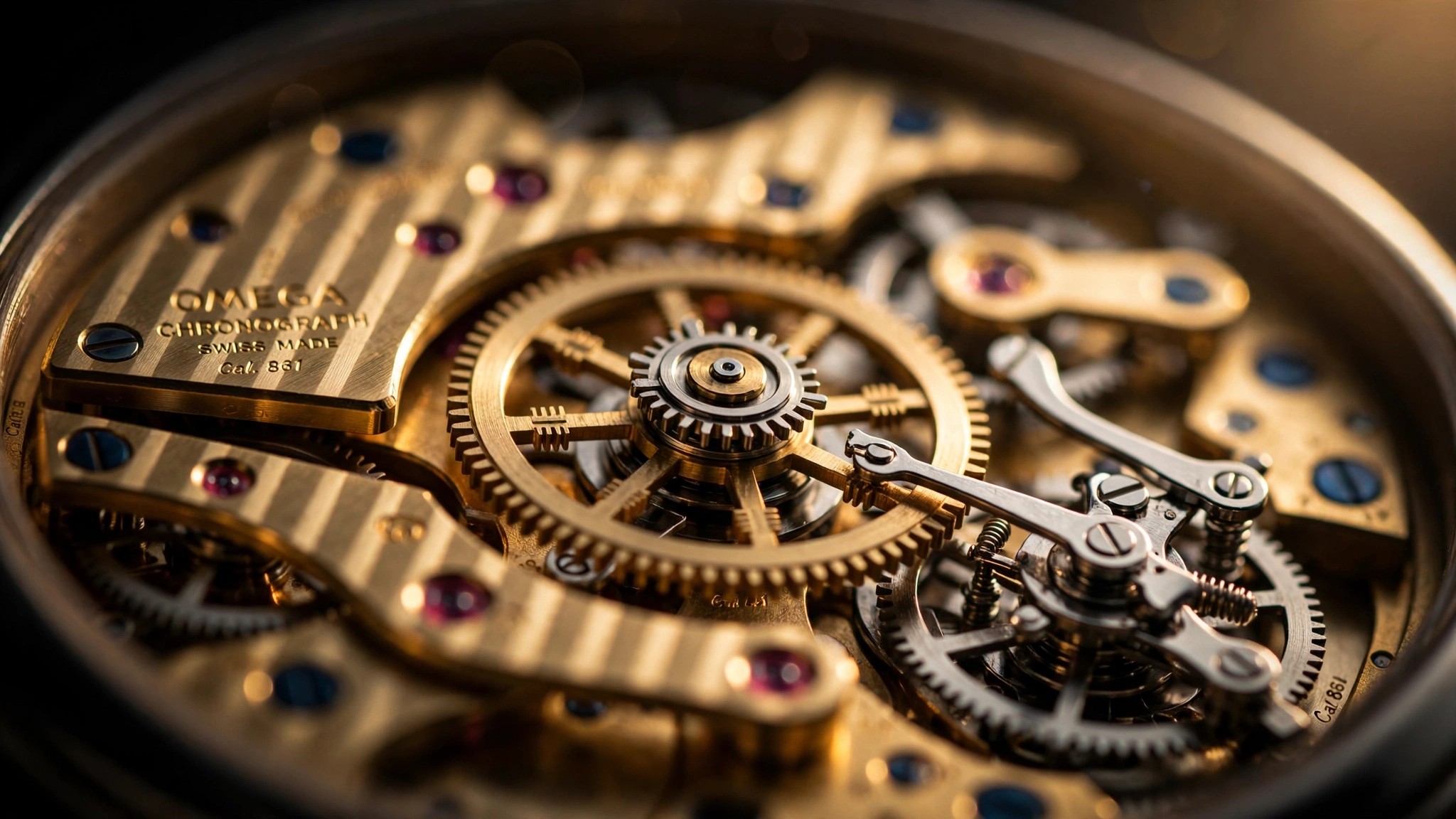
Somewhere in Bienne, Switzerland, inside Omega's corporate museum, a Speedmaster sits under glass. It is not particularly rare by collector standards. Thousands of ST 105.012 references were produced between 1966 and 1969. What makes this one valuable to Omega is not its serial number or its provenance but the movement ticking behind its dial: an original Caliber 321, still assembled, still intact, its column wheel and lateral coupling clutch and monometallic balance all in their factory positions. Fifty years of sitting in a display case is, it turns out, excellent preservation.
In 2017, Omega's product development team made a decision that sounds simple and was anything but: bring back Caliber 321, not as a tribute or a reinterpretation using the modern co-axial architecture already powering every current Speedmaster, but as a faithful recreation of the hand-wound column-wheel chronograph that Lemania first developed as Caliber 27 CHRO C12 in 1942, that Omega adopted and refined into the movement worn during Gemini, Apollo, and every crewed NASA mission from 1965 through the Space Shuttle era. Same architecture, same 244 components, same column wheel and lateral clutch and hand-finished movement that a Swatch Group subsidiary had stopped producing when bell-bottoms were still in their first run.
Nobody had the blueprints.
What Disappeared Between 1968 and 2017
Caliber 321 was discontinued in 1968, replaced by Caliber 861, and the economics were straightforward. Caliber 861 used a cam-lever switching mechanism instead of a column wheel, reducing component count, simplifying assembly, and cutting the skill threshold for servicing. A cam-lever system is less elegant mechanically, producing a slightly rougher pusher feel and less instantaneous chronograph start, but it does the same job for substantially less manufacturing cost, and by the late 1960s Omega was producing Speedmasters in volumes that demanded efficiency over refinement. Column wheels require tighter tolerances, more careful adjustment during assembly, and watchmakers experienced enough to diagnose problems by feel rather than procedure. Cam-levers forgive.
When Omega transitioned to the 861, it did what any production operation does: decommissioned the tooling, reassigned floor space, moved on. Lemania, the movement manufacturer within what would eventually become the Swatch Group, retained some technical documentation, but "some" is the operative word, because partial drawings survived while complete specifications for all 244 components, including the dimensional tolerances, surface finishes, and assembly clearances needed to manufacture a movement from scratch, did not. Half a century of corporate restructuring, facility moves, and the analog-to-digital transition in technical documentation had scattered what existed across archives nobody had comprehensively indexed.
Omega could have done what most brands do in this situation: build something close enough, apply the heritage name, let the marketing handle the rest. They did not.
Scanning What You Cannot Disassemble
Industrial computed tomography works the same way a medical CT scanner does, but with higher energy X-ray sources and finer detector resolution. A rotating X-ray beam passes through the object at hundreds of angular positions, and at each angle detectors on the opposite side record how much radiation was absorbed by the material it passed through, with dense materials like steel and brass absorbing more while thin sections absorb less. A computer reconstructs these absorption profiles into a three-dimensional volumetric model, voxel by voxel, revealing internal geometry without removing a single screw.
Medical CT scans a human body at resolutions measured in fractions of a millimeter, while industrial CT scans a watch movement at resolutions measured in single-digit microns, which means every gear tooth profile, every pivot diameter, every clearance between a wheel and its bridge becomes a measurable digital surface. Wear patterns show up as dimensional deviations from symmetry, and original machining marks are captured as surface texture data, so a watchmaker looking at the reconstructed model can see where a wheel was hand-adjusted during initial assembly because the modification breaks the geometric regularity of machine-finished surfaces.
Omega scanned the museum Speedmaster without opening it, and CT does not care about access: X-rays pass through the case back, through the movement, through the dial, through the crystal, and what comes back is a complete volumetric record of every component in its installed position, including the spatial relationships between parts that only exist when the movement is fully assembled and under spring tension.
This matters more than it sounds, because a watch movement is not a static assembly: springs exert force, gears mesh under load, and pivots sit in jewel bearings with clearances designed to balance lubrication retention against friction. Remove a bridge to measure a wheel, and you lose information about how that wheel sits under the bridge's downward pressure. Scan the entire assembly in situ, and you capture the working geometry, not just the free-state geometry of individual parts laid out on a bench.
From Voxels to Tolerances
Raw CT data gives you shapes, but it does not give you manufacturing specifications. A gear tooth profile captured at 5-micron resolution tells you exactly what that tooth looks like after fifty years of occasional use, minor wear, and whatever thermal cycling a museum display case in Switzerland imposes, yet it does not tell you what the tooth looked like when it left the factory in 1966, or what the design intent was when Lemania's engineers specified the module, pressure angle, and root fillet of that gear in 1942.
Omega's restoration workshop, led by a dedicated team of heritage specialists and movement constructors, cross-referenced the CT data against every surviving document. Partial technical drawings provided nominal dimensions for some components. Horological reference texts from the 1940s established standard practices for chronograph gear train design of that era. Surviving examples of Caliber 27 CHRO C12 movements in various states of service provided comparison points. Where multiple data sources converged on the same dimension, confidence was high. Where they diverged, the team made engineering judgments about which source best represented original design intent versus accumulated drift.
Consider a single dimension: the pivot diameter of the chronograph seconds wheel. CT gives a measured value with an uncertainty band determined by scan resolution and material contrast. Archival drawings, if they exist for that component, give a nominal value with a tolerance. A comparable component from a different surviving movement gives another measured value, also subject to wear. Reconciling these into a manufacturing specification requires understanding which sources reflect design intent and which reflect accumulated history. A pivot that has worn 3 microns in fifty years needs to be specified at the pre-wear dimension, not the current one. But how much did it wear? That depends on lubrication, usage, and whether the watch was serviced during its life, information that museum records may or may not capture.
Multiply this problem across 244 components, some with dozens of critical dimensions each, and the scale of the reconstruction effort becomes clear. CT scanning was the starting point, not the solution. It provided a complete geometric baseline that no other non-destructive method could have delivered. But transforming that baseline into a reproducible manufacturing package required years of interpretive engineering work that no scanner can automate.
Column Wheel vs. Cam-Lever: Why It Mattered Enough to Resurrect
A chronograph switching mechanism controls start, stop, and reset: press the top pusher and the chronograph seconds hand begins sweeping, press again and it stops, press the bottom pusher and it resets to twelve. Behind this simple user interaction, an intricate sequence of mechanical events must occur in precise order, with exact timing, every time.
A column wheel is a rotating pillar with vertical columns machined into its circumference. Each pusher press advances the wheel by one position, and the columns either block or release levers that control the coupling clutch, the brake, and the hammer. Because the columns are integral to a single rotating body, all switching events are geometrically synchronized. Start engages the clutch and releases the brake simultaneously because both levers reference the same column positions. Stop disengages the clutch and applies the brake at the same angular position of the wheel. Reset releases the brake and activates the hammer together. Timing is inherent in the geometry, not dependent on spring tensions or lever adjustments.
A cam-lever system uses flat cams and spring-loaded levers to achieve the same sequence, and it works, having worked reliably for decades in calibers from Valjoux, ETA, and virtually every volume chronograph manufacturer, but the switching action is inherently less crisp because the levers are controlled by spring return forces rather than positive column engagement. Press a cam-lever chronograph pusher and you feel a slight mushiness, a tiny delay between input and action while springs complete their travel. Press a column-wheel chronograph pusher and the action is immediate, metallic, decisive, the difference watchmakers describe as the gap between a light switch and a dimmer knob.
For Omega, the column wheel was not optional, because Caliber 321 is a column-wheel chronograph and building it with a cam-lever would be building a different movement with the same name, a heritage betrayal dressed up as pragmatism. That choice meant accepting every manufacturing complexity that drove Omega away from column wheels in 1968: tighter machining tolerances on the column profiles, higher assembly skill requirements, longer quality control cycles, and a per-unit cost that makes no sense for volume production. But Omega had already made peace with that economics problem, since a resurrected Caliber 321 was never going to be a volume movement and was instead going to live in a limited range of Speedmaster references priced above $14,000, produced in quantities small enough that manufacturing cost per unit was irrelevant against retail margin.
Lateral Coupling Clutch: Friction by Design
Caliber 321 uses a lateral coupling clutch to connect and disconnect the chronograph gear train from the going train. When the chronograph starts, a spring-loaded lever pushes the chronograph driving wheel laterally into mesh with a wheel on the going train. Friction between the two wheels transfers rotational energy. When the chronograph stops, the lever retracts, and the wheels separate.
Modern chronograph movements, including Omega's own co-axial calibers, overwhelmingly use vertical coupling clutches. A vertical clutch presses two friction surfaces together along the axial direction, like a miniature automotive clutch plate. Vertical coupling has a significant advantage: because the friction surfaces are always in contact (even when disengaged, they ride together with minimal clearance), there is no hand-jump when the chronograph starts. A lateral clutch meshes gear teeth, and the brief instant of engagement can cause the seconds hand to skip forward slightly as tooth flanks find each other. Vertical clutches transfer torque through surface friction, not gear meshing, producing a seamless start.
Omega could have retrofitted a vertical clutch into the 321 architecture. Doing so would have improved chronograph start behavior and aligned the movement with contemporary standards. They chose not to. A lateral coupling clutch is how the 321 works. It is how every 321 ever made works, including the ones that timed EVA durations on the lunar surface. Swapping it out would solve a minor functional irritation at the cost of architectural authenticity, a trade Omega refused to make.
Instead, the restoration team focused on optimizing the lateral clutch within its original design constraints. Tooth profiles were refined using the CT scan data to ensure the cleanest possible engagement. Surface finishes on the mating wheels were specified to minimize the instantaneous friction spike at the moment of contact. Spring tensions were calibrated to produce the minimum engagement force necessary for reliable coupling. None of these refinements changed the fundamental mechanism. They polished it.
Materials: 1942 Metallurgy Meets 2019 Manufacturing
Original Caliber 321 movements used materials standard to mid-century Swiss watchmaking: nickel-silver (German silver) for the main plate and bridges, carbon steel for springs and levers, brass for wheels, synthetic ruby for bearing jewels. These materials have worked for centuries, but they carry properties that modern metallurgy and materials science have meaningfully improved upon, creating a tension between historical fidelity and modern performance that Omega had to navigate component by component.
Carbon steel hairsprings are magnetically susceptible. A wristwatch worn near a phone speaker, a magnetic clasp, or a medical imaging suite can become magnetized, altering the spring's effective stiffness and shifting the rate by seconds per day. Omega's modern movements use silicon hairsprings, which are entirely amagnetic, lighter, and more geometrically precise thanks to photolithographic manufacturing. Putting a silicon hairspring in the 321 would have eliminated one of the movement's primary vulnerabilities. Omega kept the metallic hairspring. Same reasoning as the lateral clutch: change the spring, change the movement.
Where Omega did allow modern intervention was in finishing. Surfaces that were originally machine-finished and left unpolished now receive hand-applied decoration: Geneva stripes on the bridges, beveled edges, polished screw heads, and a PVD-treated main plate in the Sedna gold edition. These cosmetic improvements do not alter mechanical function. They acknowledge that a movement retailing north of $14,000 will be scrutinized through a display caseback by buyers who expect finishing commensurate with price.
Damaskeening on the main plate follows a historical pattern documented in archival photographs of early 321 movements. But the execution quality exceeds what 1960s-era automated engraving could produce, because Omega's current finishing atelier has better tooling, more experienced artisans, and no production-volume pressure forcing speed over precision. Paradoxically, the resurrected 321 is better finished than any 321 that ever existed. Not because Omega improved the design, but because manufacturing constraints that originally limited finishing quality no longer apply when you are building dozens of movements instead of thousands.
What the Scan Revealed That Nobody Expected
CT scanning a vintage movement does not just confirm what you think you know. It contradicts it. Several dimensions in the scanned 321 deviated from what the partial surviving drawings specified, by amounts too large to attribute to wear or measurement uncertainty. These deviations fell into two categories: intentional production modifications documented nowhere in the surviving paperwork, and hand-fitting adjustments made during original assembly that effectively made every 321 a slightly unique mechanism.
Pre-CNC watchmaking involved significant hand work. Pivots were turned on lathes but finished by hand. Wheel blanks were stamped but cleaned up individually. Bridges were positioned and pinned by a watchmaker who checked freedom of rotation by feel, shimming or adjusting as needed. Two 321 movements produced consecutively on the same line, by the same hands, could have measurably different clearances at the fourth-wheel pivot because the watchmaker felt one needed a fraction more play. These micro-decisions are invisible in technical drawings, which specify the nominal dimension and tolerance band but cannot capture the judgment of the person holding the burnisher.
For the restoration team, this created a philosophical question with direct engineering implications. Which 321 are you recreating? An idealized version that matches the nominal drawings? Or the specific physical movement in the museum, with its hand-fitted peculiarities and accumulated character? Omega's answer was pragmatic: use the nominal drawings where they exist and are consistent with the CT data, use the CT data where drawings are missing or contradictory, and apply modern tolerance analysis to ensure every component falls within a range that produces reliable function. No individual resurrected 321 matches the scanned original exactly. All of them fall within the functional envelope that the original design intended.
Production: Sixty-Eight Steps Nobody Wanted to Automate
Assembly of the resurrected Caliber 321 happens at Omega's atelier in Bienne, in a dedicated space separate from the main movement assembly lines. Each movement is assembled by a single watchmaker from start to finish, a practice largely abandoned in modern Swiss watchmaking, where movements are typically assembled station-by-station with different specialists handling different subassemblies. Assigning a single watchmaker to a complete 321 is partly romantic and partly practical: with 244 components and a column-wheel chronograph that requires careful adjustment of switching timing, engagement depth, and coupling tension, continuity of hands and judgment through the assembly process reduces the risk of accumulated tolerance stack-up that can occur when different people make independent adjustment decisions on sequential subassemblies.
Omega has not published the full assembly step count, but column-wheel chronograph assembly in the traditional method involves approximately sixty-eight discrete operations from bare main plate to cased movement. Each operation includes positioning, securing, and verifying before proceeding. A single movement takes days, not hours. Rate regulation alone, adjusting the balance wheel's effective radius and the hairspring's active length to achieve COSC-grade accuracy, can consume an entire working day when the hairspring is metallic rather than silicon, because metallic springs respond to temperature, position, and magnetic environment in ways that silicon does not, requiring the regulator to check the watch in multiple positions and at multiple temperatures before signing off.
Output is correspondingly low. Omega does not disclose exact production numbers for the 321, but based on the Speedmaster references that house it (the 311.30.40.30.01.001 in stainless steel, the platinum and Sedna gold editions), annual production likely sits in the low hundreds. Compare that to the Caliber 3861 Moonwatch, which Omega produces in quantities sufficient to supply a globally available, continuously stocked retail model. Different movements, different manufacturing realities, different economies.
What It Preserved and What It Conceded
Preserved: column-wheel switching, lateral coupling clutch, monometallic balance, metallic hairspring, 244-component architecture, hand-wound operation, and the dimensional envelope of the original movement, meaning a resurrected 321 fits the same case as a vintage 321 without modification. Dial-side and caseback-side visual presentation matches archival references within the limits of improved finishing.
Conceded: modern surface treatments, tighter machining tolerances than 1960s equipment could hold, and finishing quality that exceeds the historical standard. Omega also specified Nivachron for the hairspring in some editions, a niobium-zirconium alloy developed by the Swatch Group that is less magnetically susceptible than traditional carbon steel but still metallic, splitting the difference between historical materials and modern performance without crossing into silicon territory.
Not addressed: antimagnetic protection, because Caliber 321 is not a Master Chronometer, carries no 15,000-gauss resistance rating, and is fundamentally a 1942 movement architecture built with modestly updated materials whose magnetic susceptibility reflects that vintage heritage. Omega does not position the 321 as a daily-wear competitor to the 3861 Moonwatch but rather as a functional piece of horological history manufactured to standards its original creators would recognize and could not achieve with the tools available to them.
Why CT Scanning Changes Watchmaking
Before Omega applied industrial CT to the 321 project, reverse-engineering a vintage movement meant disassembling it: every component removed, measured with micrometers and optical comparators, photographed, catalogued, and stored in a partitioned tray. Disassembly is destructive in subtle ways, because screws that have been seated for decades can strip, jewel settings can crack during press-out, springs lose their set, and the spatial relationships between components, the three-dimensional jigsaw of a fully assembled movement, are lost the moment the first bridge comes off.
CT scanning eliminates that trade-off entirely. You get complete dimensional data without touching the movement, and more importantly you get relational data showing how components interact in their installed, loaded, functioning state, which for a chronograph with a column wheel where switching timing depends on exact angular relationships between the column positions and the lever rest points is not optional information. Disassemble the column wheel from its post and you can measure its diameter and column spacing precisely, but you cannot measure where it sits relative to the coupling lever at the exact moment of chronograph start. CT can.
Omega is not the only company that has recognized this, as Patek Philippe, A. Lange & Söhne, and Breguet have all used various forms of non-destructive analysis on historical movements. But the 321 project represents the most publicly documented application of industrial CT to a complete movement resurrection, from scan to production, in the Swiss watch industry, and it establishes a methodology: when heritage matters enough to rebuild rather than reinterpret, start with the scanner, not the screwdriver.
Future applications are straightforward, because every significant historical movement still in existence is a candidate for CT preservation, creating a permanent digital archive of horological geometry that survives even if the physical movement does not. A fire, a flood, an earthquake, and the movement is gone, but its CT scan is a file on a server in three locations. For an industry that prides itself on continuity across centuries, that kind of insurance is not sentimental. It is structural.