Three Percent: How a Spool Valve Replaced Sixty Years of Shim Stacks
Since the mid-1950s, virtually every automotive damper has functioned the same way. A piston moves through a tube of hydraulic fluid. Stacks of thin, flexible metal shims deflect under pressure to regulate flow, generating the force that controls how a wheel responds to a bump. Engineers call this a shim-stack damper. It works, mostly. Its characteristics depend on shim thickness, material properties, dimensional tolerances, assembly friction, preload variation, orifice alignment, operating temperature, and cleanliness of the assemblies. Tuning one requires pulling it apart, rearranging the shims, reassembling it, testing it on a dynamometer, and repeating the process until the force-velocity curve looks acceptable. Shim fatigue and the buildup of wear particulate trapped between shim faces ensure the curve drifts over time.
In a small workshop in Thetford, England, a team of engineers decided to stop rearranging shims.
Dynamic Suspensions and the Acquisition
Dynamic Suspensions was founded in 1990 as a specialist outfit serving European motorsport. Its engineers designed dampers, built advanced hydraulic systems, and provided vehicle dynamics consulting to racing teams. In 1996, Multimatic, a Canadian engineering firm with deep ties to Ford and a growing interest in chassis dynamics, acquired the company. A year later, the operation relocated to a new facility in Thetford that would eventually be designated Multimatic Technical Centre Europe.
Under Multimatic's ownership, the Dynamic Suspensions team refined its existing shim-damper line. Launched in 2000, the modular B1640 shim damper earned championship results in professional road racing across Europe, North America, and Asia. Ford used them on the first-generation GT. Chrysler fitted them to the third-generation Viper. By conventional damper standards, the B1640 was excellent.
Conventional damper standards were the problem. No matter how carefully the B1640 was built, its performance still depended on the cumulative interaction of dozens of flexible shims whose behavior was difficult to predict and impossible to hold constant across thousands of production units. Multimatic wanted something better: a damper whose characteristics could be calculated from engineering drawings before a single part was machined.
Inspiration from Industrial Hydraulics
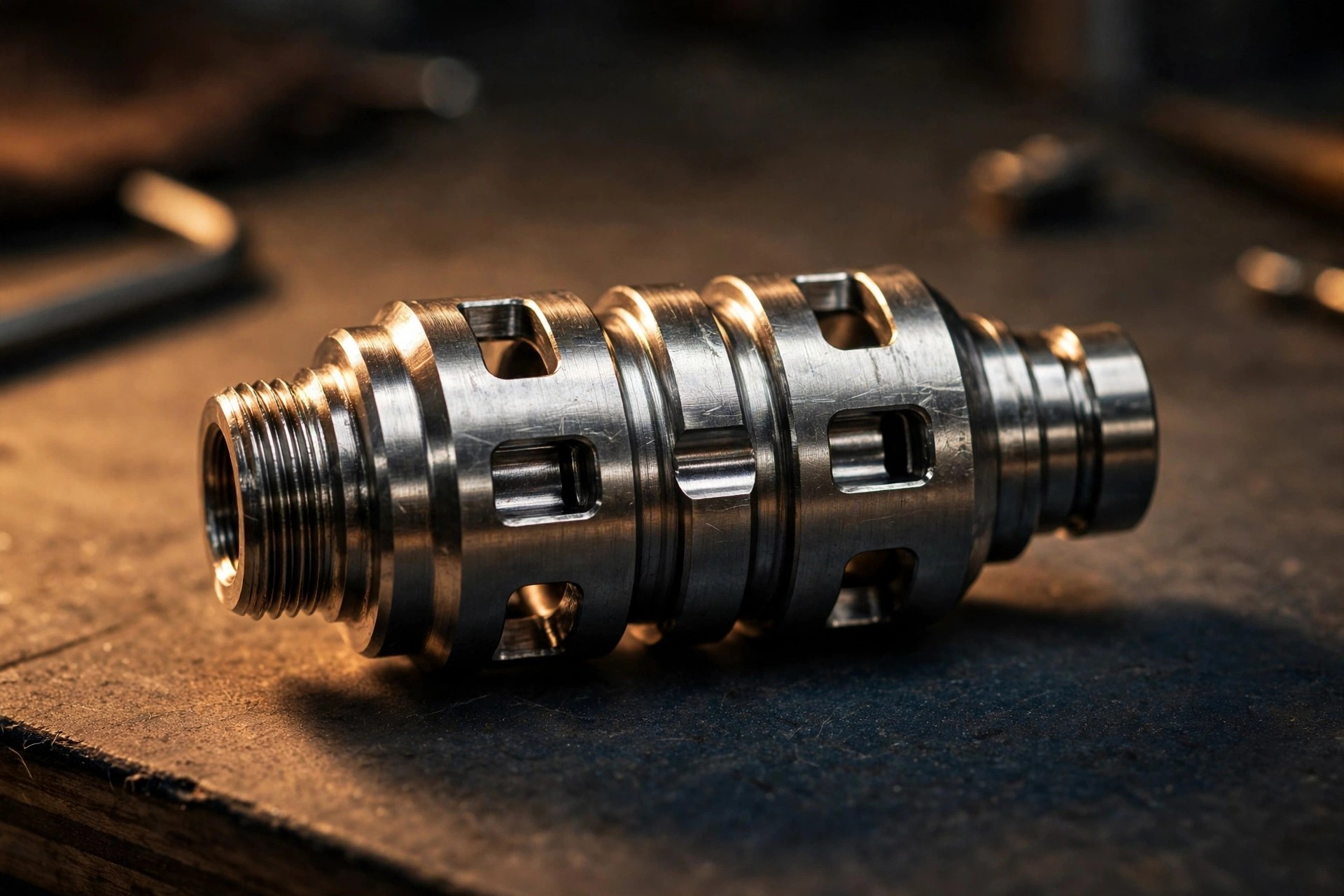
Directional control valves have been used in heavy industrial hydraulic systems for decades. A spool slides inside a precision-bored cylinder, and the position of the spool relative to fixed ports in the cylinder wall determines how much fluid passes through. Flow is governed by port geometry, not by the deflection of flexible elements. The physics is well-understood, the math is clean, and the results are repeatable.
Multimatic's DSSV concept applied this principle to damper valving. Instead of shim stacks, each damper would use spool valves with precisely machined circumferential ports. Hydraulic fluid flowing through the damper would push against a spring-loaded spool. As the spool moved under pressure, port openings would change in a manner defined entirely by the geometry of the machined features. Two spool valves per damper would fully decouple compression and rebound force-velocity curves, allowing each to be specified independently.
Putting this concept into practice faced an immediate obstacle: scale. Larry Holt, Multimatic's Chief Technical Officer, described the challenge. "Think of a tiny little cylinder with a carefully shaped hole in its side which is opened by damper pressure against a tiny little spring with unbelievably challenging tolerances. A lot of companies would have given up after the first tolerance calculation, but we persevered."
Medical-Grade Precision
Conventional machine tools could not cut the port geometries that DSSV required. The circumferential ports in each spool valve are shaped features, not simple drilled holes. Their profiles determine the relationship between fluid pressure and flow rate, which directly sets the damper's force-velocity curve. Any deviation from the specified port shape changes the curve. At the scale involved, deviations measured in microns matter.
Multimatic solved this by installing Electrical Discharge Machining capability at the Thetford facility, the same EDM techniques used to manufacture coronary stents and surgical instruments. EDM uses controlled electrical sparks to erode material from a workpiece with sub-micron precision, without mechanical contact that could introduce tool wear or deflection. Applied to spool valve ports, EDM achieved the dimensional accuracy needed to make the governing hydraulic equations hold true in practice.
Once the machining process was validated, testing confirmed what the math predicted. Removing flexible shims from the damping circuit eliminated the variables that made shim-stack behavior difficult to predict. Force-velocity characteristics were consistent across the full range of suspension frequencies, including highly digressive damping curves that shim-stack designs struggle to reproduce reliably. Spool-to-spool force variance was held within a maximum of plus or minus three percent of total damping force.
Numbers That Changed the Argument
Two performance metrics separated DSSV from its predecessors in terms that no race engineer could ignore.
Heat fade: As hydraulic fluid warms during sustained use, its viscosity drops, and conventional dampers lose force. Multimatic measured typical force degradation from 30 degrees Celsius to 120 degrees across a representative range of velocities. DSSV dampers lost four percent. Poppet-valve dampers lost up to 14 percent. Conventional shim-stack dampers lost up to 16 percent. On an endurance race car sustaining high cornering loads for hours at Spa or Le Mans, four percent versus 16 percent is the difference between consistent lap times and a chassis that goes soft in the final stint.
Cavitation resistance: Shim-stack dampers require relatively high gas pressure in the reservoir chamber to prevent the hydraulic fluid from cavitating at low piston velocities. Cavitation produces momentary voids in the fluid column, causing spikes and dips in damping force that feel like unpredictable harshness to the driver and degrade tire contact with the road. DSSV dampers are essentially cavitation-proof by design, a consequence of the flow characteristics within the spool valve mechanism. Lower reservoir pressures become possible. Lower gas pressure also minimizes ride-height change caused by temperature variation, keeping the car's aerodynamic platform stable as the dampers warm up during a session.
Tunability improved too. External cartridge-mounted spool valves allowed re-valving without disassembling the damper body. What had been a paddock operation requiring damper removal, disassembly, shim rearrangement, and reassembly became a pitlane task. Swap a cartridge, bolt it back in, send the car out. Multimatic developed proprietary software called SpecFinder that let customers select spool valve configurations matched to their target force-velocity curves. SpecFinder functions as a fully predictive damper model, effectively a software dynamometer. If the math says a particular port geometry will produce a particular curve, the hardware delivers that curve. No trial and error.
The Camaro Z/28 and Production Debut
DSSV entered series production on the 2014 Chevrolet Camaro Z/28, a car that Chevrolet positioned as a track weapon disguised as a muscle car. Air conditioning was optional. Sound deadening was removed. Rear seats were deleted. In that context, the Z/28's dampers were less an amenity upgrade and more a statement about what the car was for.
Fitting DSSV to a volume-production vehicle required proving that the technology could survive real-world durability cycles beyond what racing demanded. Race dampers are rebuilt at regular intervals. A production car's dampers must last the warranty period under conditions that include potholes, speed bumps, gravel roads, and owners who never inspect their suspension. Multimatic validated the Z/28's DSSV units through GM's standard durability protocols, including extended hot-weather and cold-weather testing cycles.
For the Z/28's buyers, the tangible benefit was a car that felt the same on lap 30 as it did on lap one. As brake rotors heated and tires wore, the suspension remained consistent. Reviewers at the time called it one of the best-handling cars available at any price, a judgment supported by its ability to lap several circuits faster than the simultaneously available Corvette Z51 despite giving up more than 100 horsepower.
Le Mans, the Ford GT, and the Off-Road Detour
In 2016, Ford returned to Le Mans with a mid-engine GT built by Multimatic. It won its class in its first attempt at the Circuit de la Sarthe, 50 years after the GT40's original victory. DSSV dampers were integral to the car's performance, paired with a pushrod suspension layout and the dual-spring-rate torsion bar system that would later migrate to the production Ford GT. On that car, electronically adjustable eDSSV dampers allowed the chassis controller to vary damping force continuously, combining DSSV's mechanical precision with active control.
A year later, Chevrolet launched the Colorado ZR2, an off-road pickup truck. Fitting race-derived dampers to a truck sounds absurd until you consider what position-sensitive damping means off-road. Multimatic created a DSSV configuration with three spool valves per damper instead of the usual two. Two valves controlled the on-road ride. A third, larger valve activated when the damper exceeded its normal travel range during severe compression events, like landing from a jump or plowing through a deep rut at speed.
Multimatic ran 15,000 suspension simulations before cutting the first part for the ZR2 program. Because DSSV curves are mathematically predictable, simulation results translated directly to hardware specifications. Real-world development and tuning took roughly a quarter of the time that conventional damper tuning would have required. Chevrolet's testing showed a 35 percent reduction in chassis loads and a 50 percent reduction in occupant movement compared to the baseline Colorado suspension. A midsize pickup absorbed trail obstacles with the composure of a purpose-built desert racer while riding smoothly enough on pavement that owners could daily-drive it without complaint.
From Passive to Active: TASV
Every DSSV application through the Mustang GTD was either passive or semi-active. Passive DSSV dampers have fixed spool valves whose characteristics are set at manufacture. Semi-active eDSSV and ASV variants add electronically adjustable spool valves, allowing the chassis controller to shift the damping curve within a predefined range. In either case, the damper reacts to wheel motion. It does not generate force independently.
In 2022, Ferrari debuted the Purosangue with Multimatic's TrueActive Spool Valve system. TASV adds an electric motor to each damper, capable of exerting enough force to move the vehicle body independently of wheel inputs. It is fully active suspension built around spool-valve precision. The motor can push down on a wheel to maintain tire contact over a crest, lift the body to reduce roll in a corner, or pre-adjust ride height based on navigation data about upcoming road surfaces.
TASV eliminates the need for conventional anti-roll bars. In a passive or semi-active system, anti-roll bars connect left and right wheels through a torsion element that resists body roll by transferring load between sides. They are a compromise: stiffening roll resistance also stiffens the suspension's response to single-wheel bumps, degrading ride quality. An active system with enough force authority can control roll independently of single-wheel compliance. Remove the anti-roll bars, and single-wheel bump absorption improves without sacrificing roll control.
Michael Guttilla, Multimatic's vice president of engineering, described the capability. "This technology makes it possible to continuously control the vehicle body to achieve targeted vertical, roll, and pitch dynamics at any speed. For example, the system can actively lower the vehicle's center of gravity and control pitch and roll stiffness under acceleration, braking, and cornering to maximize traction and dynamically optimize understeer and oversteer handling balance."
More Than Half the Grid
Multimatic's own marketing makes a claim that few competitors contest: at Le Mans, more than half the grid runs DSSV dampers. In the 2025 IMSA GTP championship, DSSV units supported the Porsche 963 through multiple race victories to a season title. DSSV is the specified damper for the Porsche 911 GT3 Cup (992.2 generation), the Ford Mustang Dark Horse R, Super GT's GT500 class, Indy NXT, USF Pro 2000, and USF2000. In Formula 1, where damper technology is closely guarded, Multimatic supplies multiple teams.
This is not market dominance through cost advantage. DSSV dampers are more expensive than shim-stack alternatives. They require specialized manufacturing equipment and engineering support. Teams choose them because the three percent variance and the four percent fade number mean that the suspension behaves the same way on the dynamometer, on the first lap, and on the last lap. In a sport where tenths of a second separate podium from retirement, consistency is worth the premium.
A Carefully Shaped Hole
Larry Holt's description remains the most concise summary of what Multimatic built. A tiny cylinder with a carefully shaped hole, opened by fluid pressure against a tiny spring, with tolerances that made the project seem impossible before medical-grade EDM made it feasible.
Sixty years of shim-stack orthodoxy said that damper tuning was an art: part engineering, part intuition, part luck. DSSV made it arithmetic. Calculate the port geometry, machine it to specification, and the damper produces the curve you designed. No trial and error. No shim shuffler. No mystery about why the left-rear damper feels different from the right-rear despite being built from the same parts to the same specification.
From a workshop in Thetford to Le Mans, Formula 1, the Mustang GTD, and the Ferrari Purosangue, the spool valve has not changed in principle since the first one was spark-eroded into shape. What changed was everything around it. Active motors, predictive software, position-sensitive architectures, electronic control. The valve itself remains a tiny cylinder with a carefully shaped hole. Three percent. Four percent. Those are the numbers that killed the shim stack.
Sources
- Multimatic, "DSSV: In the Beginning," corporate case study, multimatic.com, documenting the 1996 acquisition of Dynamic Suspensions, B1640 shim damper history, Larry Holt's description of the DSSV engineering challenge, medical-grade EDM machining, force degradation data (4% DSSV vs 14% poppet-valve vs 16% shim at 30–120°C), and SpecFinder software development.
- Multimatic, "Racing Dampers," product page, multimatic.com, listing DSSV as specified damper for Porsche 911 GT3 Cup 992.2, Ford Mustang Dark Horse R, Super GT GT500, Indy NXT, USF Pro 2000, USF2000, and 2025 IMSA GTP championship with Porsche 963.
- Motor Trend, "Chevy Colorado ZR2 Shocks Explained: Inside the Multimatic DSSV," 2017, describing three-spool-valve position-sensitive architecture, on-road/off-road damping decoupling, velocity-sensitive keyhole orifice tuning, and oil viscosity insensitivity.
- Motor Authority, "Ferrari Purosangue First with Multimatic's New True Active Spool Valve Dampers," 2022, covering TASV electric motor integration, anti-roll bar elimination, body force authority, and Michael Guttilla quote on continuous body control.
- Professional Motorsport World, "Multimatic Makes DSSV Damper Tech Available to Formula SAE and Student Teams," documenting ±3% maximum force variance specification, mode-decoupled heave/roll systems, and damper architecture details.
- Autoblog, "The Chevy Colorado ZR2 Has a Supercar Suspension. Here's How It Works," 2017, detailing 35% chassis load reduction, 50% occupant movement reduction, 15,000 pre-build simulations, and the third bypass spool valve for extreme compression events.
- Motor Authority, "How the Ford GT's Trick Suspension Has Two Unique Spring Rates," 2018, covering Ford GT's pushrod double-wishbone suspension, eDSSV electronic dampers, torsion bar and coil spring dual-rate system, and hydraulic coil-spring lockout in Track mode.