The Screwless Puzzle: Casio's $80,000 Blue Sapphire G-Shock
On October 1, 2026, Casio announced the MRG-D5000 Blue Sapphire: a shock-resistant watch with a case and bezel made entirely of sapphire, assembled without a single screw. Sapphire is the worst material a G-Shock could choose for the thing G-Shocks do. That contradiction is the whole story.
Nine years ago, Kikuo Ibe walked onto a stage in New York with a watch that could not legally exist under his own rules. It was a square G-Shock with the case, the bracelet, everything, cut from sapphire crystal, shown at the brand's 35th anniversary in 2017. Beautiful. Also a failure, because it could not survive Casio's shock testing, which meant it could not be sold as a G-Shock. Back into the drawer it went, sitting there for nearly a decade while engineers worked on the one problem nobody could buy their way out of: how do you build a shock-resistant watch out of a material that shatters.
On October 1, 2026, the drawer opened. The MRG-D5000 Blue Sapphire, development codename Blue Rose Project, wears a bezel and case rendered entirely in synthetic blue sapphire. Twenty pieces worldwide. $80,000 each, which dethrones the solid-gold 2019 Dream Project G-D5000-9JR ($70,000, 35 pieces) as the most expensive production G-Shock ever made. Every one will be hand-assembled by a single master technician at Casio's Yamagata factory and shipped in a glass presentation box, because of course it will.
Hard Is Not Tough
Materials science has exactly one lesson for this watch, and it is the kind of lesson that ruins dinner parties. Sapphire sits at 9 on the Mohs hardness scale, one notch below diamond, which makes it nearly impossible to scratch. Scratch resistance is what makes sapphire crystals desirable on ordinary luxury watches, and it has nothing to do with surviving a fall onto concrete.
Hardness measures resistance to surface deformation, and toughness measures resistance to fracture. In ceramics, these two properties point in opposite directions: the same rigid atomic lattice that refuses to scratch also refuses to yield, so an impact that a steel case would absorb as a dent becomes, in sapphire, a crack that runs. Single-crystal sapphire's fracture toughness sits around 2 to 3 megapascals times root-meter in reference data, against roughly 0.7 for ordinary glass and tens to hundreds for ductile metals. Those are textbook numbers, not Casio's, and the takeaway needs no footnote: sapphire is a glass that happens to be hard.
Which means Casio's choice is genuinely perverse. Ibe's founding pitch for the brand was a single sentence, "a durable watch that would not break even if dropped," and surviving exactly that loading is what sapphire handles worst. Every other manufacturer that cases a watch in sapphire, Hublot among them, accepts the tradeoff quietly and sells scratchproof beauty to people who will never drop-test it. Casio could not do that, because a G-Shock that cannot pass the shock test is a contradiction with a strap. So the engineers did the only honest thing available: they did not try to make tougher sapphire. They rebuilt the force transmission around the sapphire.
The Screwless Puzzle
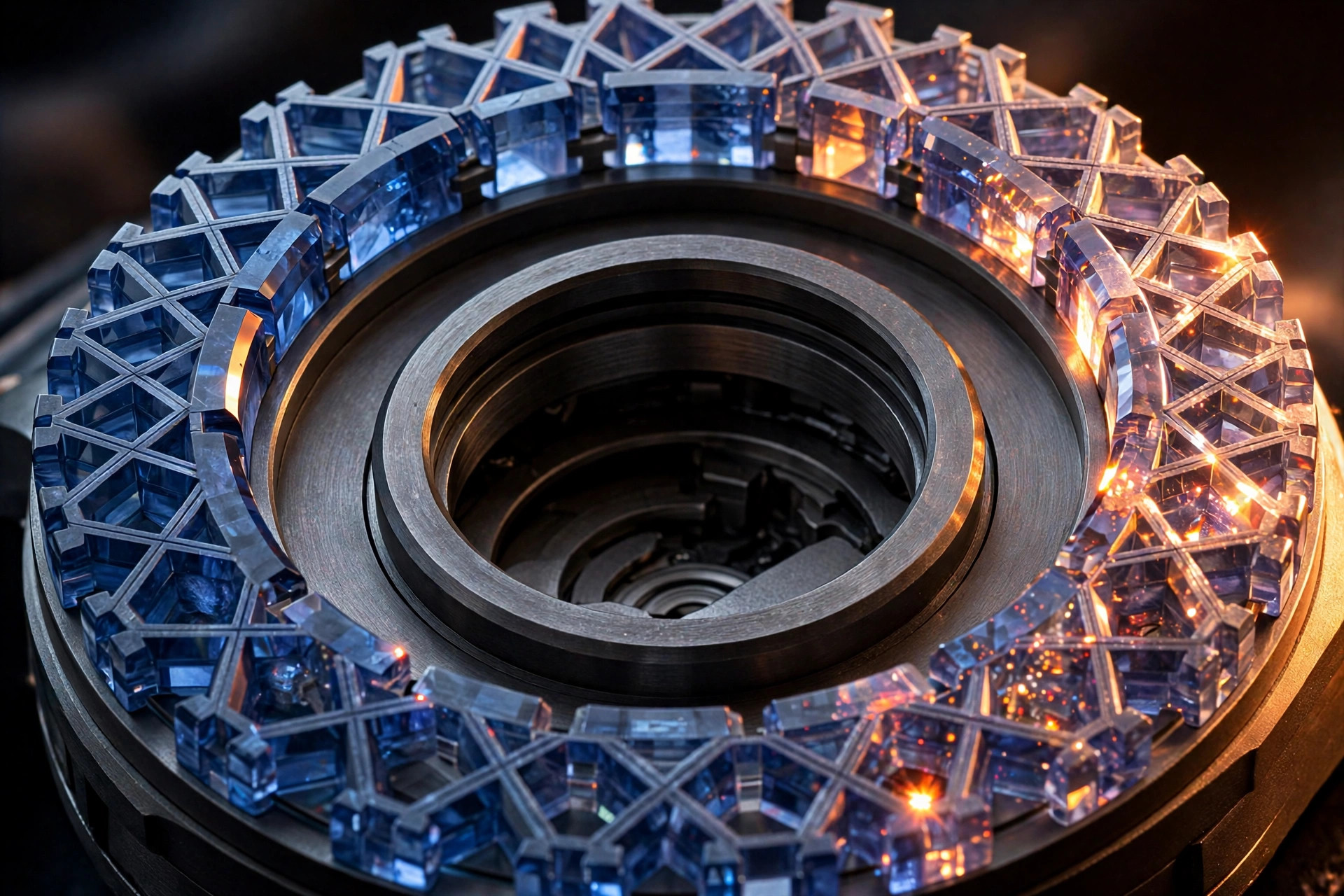
A drilled hole in sapphire is a crack nucleation site with a marketing budget. Screws concentrate force at a point; point loads in a brittle material initiate fracture; the case fails at the fastener long before the material's strength matters. Casio's answer was to delete every screw from the sapphire assembly. The bezel and case split into multiple hand-finished sapphire components that interlock like a three-dimensional puzzle, a construction Casio says draws on kigumi, the Japanese timber-joinery tradition of joining beams with no nails, screws, or glue.
Heritage branding aside, the mechanism is real and specific. An interlocked joint converts a concentrated impact load into distributed bearing contact spread across a large area of the component. No single point in the sapphire sees the stress peak that a screw hole would hand it. Casio's own phrasing is unusually candid for a press release: the company analyzed the force transmitted to the sapphire crystal when the watch takes a knock, and built a shock-resistant structure optimized for protecting that material. Designed around a vulnerability, not a strength.
Geometry follows from that concession. Fratello's reporting notes that Casio grew the blue sapphire as ingots over several months, then selected sections with the desired color concentration and transparency, because doped sapphire boules do not come out uniform. Parts were shaped to resist chipping, and every feature that could start a crack, screw holes included, was removed from the design. Thickness tells the same story: 16.45 millimeters, which one hands-on report fairly called almost a cuboid. That height is the material's tax. Brute-force section thickness plus distributed loading is what lets a brittle shell absorb the energies a G-Shock has to survive, and the cost is paid in wearability.
The Titanium Truth
None of the above should be read as claiming the sapphire is the structure. It is not: inside the blue armor sits a black DLC-coated Grade 5 titanium inner case, and that titanium is the actual load path. The sapphire components are carried; the titanium carries them.
This inversion is the quietest radical thing about the watch. In a normal watch, the case is the structure and the pretty parts decorate it. Here the pretty parts are the most fragile components in the assembly, and the structure exists to keep them alive. Titanium absorbs, the interlocks distribute, and the sapphire merely survives. When Casio says the structure protects the material rather than housing it, that is not poetry. It is a load-path diagram.
It also explains the pricing logic, or at least the engineering side of it. Growing uniform blue sapphire ingots takes months; only zones with the right color concentration and transparency qualify for cutting; every component then has to be machined, a material that eats diamond tooling, and hand-fitted into interlocks with no fasteners to forgive slop. Twenty pieces is not only marketing scarcity. It reads like a yield statement from the boule furnace. My inference, not Casio's, but the economics of doped-sapphire growth point exactly there.
The Gold Was the Inverse Problem
There is a satisfying symmetry here for anyone who followed Dream Project #1. Gold's turn came in 2019: the G-D5000-9JR rendered the square in solid 18k yellow gold: case, bezel, bracelet, even the screws. Gold's problem is the mirror image of sapphire's. Ibe said it took five years to develop an impact-resistant structure for gold precisely because the metal is soft and 1.5 times heavier than stainless steel, and heavier mass means larger impact forces in a drop test. Structure solved it, and 35 pieces sold out at roughly $70,000.
Now the material is light, stiff, and brittle instead of dense, soft, and heavy, and the answer is structure again. Same team, opposite corner of the materials map, same discipline. Dream Project #2, the AI-assisted G-D001 piece unique that hammered at $400,050 for charity at Phillips in 2023, sits between them as the outlier, a design experiment rather than a materials one. The throughline across all three is that Casio treats its anniversary flagships as research programs with price tags, not products. Whether that is admirable or absurd depends on your tolerance for $80,000 quartz, and I will not pretend both readings are not available.
Honest Ledger
Some things need saying plainly. Eighty thousand dollars buys module 3584: a quartz timekeeping module whose accuracy matches any $300 G-Shock with the same electronics, wrapped in Gallium Tough Solar charging and Multi-Band 6 radio control. Timekeeping is not the product. Nobody is buying twenty pieces of doped corundum for the alarms.
The display is a genuine regression. Stuff.tv's hands-on, from someone who wore the actual watch, notes the negative STN LCD looks appropriately moody but is not the most legible way to read the time at a glance. A watch you cannot easily read is a piece of jewelry with ambitions, and that criticism lands harder when the brand's founding sentence is about not breaking. The strap gets a titanium clasp with a refined release button; there is no sapphire bracelet, which the same reviewer wished for and which would have been the honest completion of Ibe's 2017 concept.
Then there is the question nobody at Casio has answered: what happens when a sapphire component chips. Not if. These are interlocked brittle parts in a watch meant to be worn, and sapphire does not dent gracefully. Replacement parts, repair cost, turnaround, whether Yamagata keeps spare components for twenty watches, all unaddressed. A scratchproof case that cannot be serviced is a museum piece, and museum pieces should be honest about it.
And the novelty deserves one deflation. Sapphire-cased luxury watches are not new; several brands have been machining clear sapphire cases for years, and this site covered Hublot's machining work at length. The MRG-D5000's actual first is narrower and more interesting than the headlines: it is the first sapphire-cased watch whose manufacturer claims it passes that manufacturer's own shock testing. The material is old news; the force transmission is the article. If the claim holds, and I have seen no drop-test data to check it against, then nine years in a drawer was the correct development schedule for the wrong material, solved by refusing to fight it.
| Specification | Casio G-Shock MRG-D5000 Blue Sapphire |
|---|---|
| Official model | MRG-D5000-BDR "Blue Sapphire," development codename Blue Rose Project; announced Oct 1, 2026 |
| Case and bezel | Multi-component synthetic blue sapphire crystal, assembled with no screws; interlocks inspired by kigumi timber joinery |
| Inner structure | MR-G Multi-Guard Structure: black DLC-coated Grade 5 titanium inner case carries the load; sapphire is carried |
| Sapphire sourcing | Ingots grown over several months; sections selected for color concentration and transparency; parts shaped to resist chipping |
| Dimensions | 51.3 x 43.2 x 16.45mm; thickness driven by the material's structural requirements |
| Module | 3584; Gallium Tough Solar charging; Multi-Band 6 radio-controlled timekeeping; negative STN LCD |
| Functions | World time (5 zones, 38 cities), stopwatch, countdown timer, 5 daily alarms, full-auto LED backlight |
| Water resistance | 20 bar (200m) |
| Dial | Stainless steel brick pattern (references 1983 DW-5000), blue PVD coating; MR-G and "Shock Resist" lettering in 24K gold |
| Caseback | Screw-lock Grade 5 titanium, DLC coated, blue sapphire insert; engraved DREAM PROJECT plus individual serial number 1/20 to 20/20 |
| Strap and clasp | Dura Soft rubber with brick pattern; new titanium clasp with release button |
| Production | 20 pieces worldwide; each hand-assembled by a single master technician at Casio's Yamagata factory; glass presentation box |
| Price and availability | $80,000 USD / €80,000; six US units staggered December 2026 to June 2027 |
| Predecessors | Dream Project #1: G-D5000-9JR solid 18k gold, 35 pcs, ~$70,000 (2019). Dream Project #2: G-D001 AI-designed piece unique, $400,050 at Phillips charity auction (2023). 2017 sapphire DW5600 prototypes failed shock testing. |
| Siblings | MRG-B5000SA-2 "Super Blue" (500 pcs, $6,600, blue AIP COBARION bezel, facet-cut sapphire accents). GMW-B5000SB-1A2 "Gem Accents" ($860, stainless, four sapphire gems at bezel screw positions). Both land November 2026. |
- Casio Computer Co., Ltd., "Casio to Release MR-G Crafted in Blue Sapphire Crystal," press release, October 1, 2026 (via PRNewswire / HinduBusinessLine): screwless multi-component structure, Multi-Guard Structure, Gallium Tough Solar, 20 pieces.
- Hodinkee, "Hands-On: G-SHOCK Reveals The MRG-D5000 'Blue Rose Project' In Sapphire," October 2026: 2017 Ibe sapphire prototypes, Blue Rose naming, Ibe retirement, caseback homage, Dream Project #1/#2 history.
- Fratello Watches, "New: The G-Shock MRG-D5000 In Blue Sapphire," October 2026: ingot growth over months, section selection, chipping-resistant shaping, titanium caseback, 24K gold lettering, clasp detail, €80,000.
- Stuff.tv, "I wore the insane $80,000 G-Shock Blue Rose Project made from sapphire," October 2026: hands-on wear, 16.45mm "almost a cuboid," negative display legibility, interlocking assembly explanation.
- Hypebeast, "G-Shock $80,000 USD MRG-D5000 Crafted Entirely in Blue Sapphire," October 2026: specs, 20 pieces, single-technician assembly, glass box.
- HiConsumption, "G-Shock's $80,000 Blue Sapphire Flagship Watch Uses Japanese Joinery Instead of a Single Screw," October 2026: spec sheet, US allocation (6 units, Dec 2026-Jun 2027), sibling models, pricing.
- Revolution Watch, "The MR-G at 30: From the First Metal G-Shock to the Blue Rose Project," October 2026: MR-G 30th anniversary context, module and spec breakdowns for all three models.
- WatchDavid, "G-SHOCK MRG-D5000, MRG-B5000SA-2DR and GMW-B5000SB-1A2ER," October 2026: hardness vs toughness framing, Multi-Guard structure detail, €80,000.
- AseanNews, "G-SHOCK Pushes Deeper Into Luxury Materials as Casio Engineers Sapphire to Survive Impact," October 2026: three-tier sapphire integration across the range.
- Watches by SJX, "Up Close: G-Shock Dream Project 'Pure Gold' in 18k Yellow Gold," August 2020, and "Unboxing," March 2020: G-D5000-9JR specs (35 pieces, ¥7.7M), fit and finish notes.
- The Value, "This unique AI-designed G-SHOCK sells for US$400,050," December 2023: G-D001 generative-design piece unique, Phillips charity auction result.
Disclaimer: this article was written without handling the watch or disassembling it. All technical claims rest on Casio's published materials and press reporting; the shock-resistance claim is Casio's and is published here as a claim, not a verified result. Fracture-toughness figures are textbook reference values for single-crystal sapphire, not Casio disclosures. Pricing appears for engineering-economic context (materials cost structure, yield) and is not pricing coverage.