Screws Are the Enemy: How Casio Built an $80,000 G-Shock Out of Solid Sapphire
Sapphire is the hardest material in watchmaking and the worst one for a G-Shock. Casio has spent eight years proving otherwise, and the MRG-D5000 answers a fracture-mechanics problem with a bezel and case assembly that contains no screws.
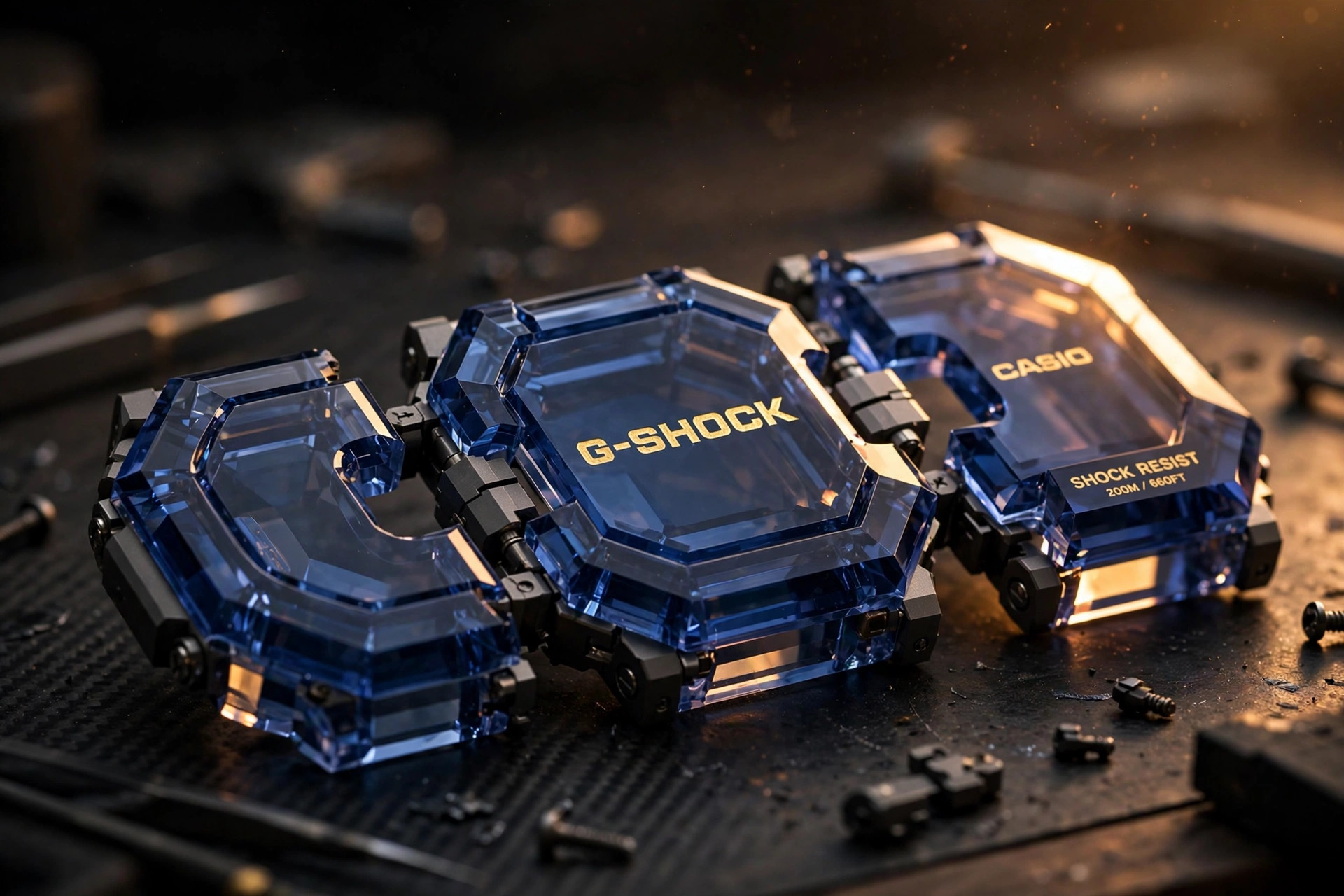
Hardness is not toughness
Watch people conflate the two constantly, so let us separate them before anything else. Hardness is resistance to scratching; toughness is resistance to cracking. Sapphire wins the first contest by a mile and loses the second one badly, and that asymmetry is the entire reason the MRG-D5000 is interesting.
Synthetic sapphire, aluminum oxide grown in a lab, sits at 9 on the Mohs scale, which means almost nothing a wristwatch will ever meet can scratch it. Diamonds can, and tungsten carbide is the only other common material that stands a chance. Everything else slides off.
The measure of how a material handles a crack once one starts is fracture toughness, and here the numbers invert: sapphire runs around 2 MPa·m1/2, while Grade 5 titanium, the alloy under the sapphire in this watch, runs roughly twenty times higher. A titanium case dents; a sapphire case never does. Sapphire chips, then runs a crack, then fails all at once.
Casio announced the MRG-D5000 on October 1, with the bezel and outer case machined from blue synthetic sapphire crystal. Twenty pieces will be made, worldwide, at $80,000 in the US and ¥11,000,000 in Japan, each assembled by a single master technician at the Yamagata factory.
Every conversation about this watch will lead with the price. It should not. Underneath the sapphire sits the actual story: a conventional G-Shock case made of sapphire would not survive being a G-Shock.
The concept that cracked
This watch is eight years old. G-Shock creator Kikuo Ibe conceived a full-sapphire G-Shock around 2017, and Casio showed a sapphire-crystal concept at its 2018 Basel presentations alongside the 35th anniversary pieces.
That same year, the Dream Project produced its famous one-off, an 18-karat solid gold square, the G-D5000, never meant to survive anything. Gold was the statement; sapphire was the promise, and the promise did not ship.
Engineers could not get the shock resistance, the figure that defines the brand, out of sapphire. A concept watch that cannot be dropped is not a G-Shock but a paperweight with marketing.
Ibe has since retired, and development continued without him, the trail visible if you know where to look. In 2022, Casio launched the MRG-B5000 in titanium with the Multi-Guard Structure, a multi-component case architecture where separate parts interlock and share impact loads instead of bolting a bezel onto a case. That was the load-path idea proved in a forgiving material; the MRG-D5000 rebuilds it for a material that forgives nothing.
Why screws had to go
Here is the mechanical problem in one paragraph: in a ductile metal, a screw hole is a detail, while in a brittle ceramic it is a loaded gun.
Any discontinuity in a brittle material concentrates stress, and sapphire, for all its hardness, is a ceramic with a ceramic's manners: low fracture toughness, no plastic deformation to blunt a crack tip, and a catastrophic failure mode once a crack runs.
Against that physics, the classic G-Shock architecture, a resin or metal case held together with screws, reads as a catalog of crack initiation sites. Drill the sapphire, torque a screw into it, and you have pre-stressed the failure point.
Casio's answer, per the October 1 release, is the MR-G Multi-Guard Structure in screwless form: bezel and case composed of multiple separate components, assembled without the screws that can crack sapphire crystal. Casio's engineers modeled how impact force transmits through sapphire and rebuilt the joints around the results.
One question the release does not answer: how a multi-component bezel seals to 200 meters. Presumably gaskets seated against the titanium inner case, but the shock path got the press release and the water path got nothing.
Hypebeast's coverage adds the detail that completes the picture: an interlocking assembly framework inspired by traditional Japanese timber joinery, a three-dimensional puzzle of sapphire elements that absorb and disperse impact forces across joints rather than concentrating them at fastener holes.
There is a second, independent reason the multi-piece design helps, and it is the one the press release never names. Grinding sapphire introduces subsurface microcracks, and in a brittle material those become exactly the crack-initiation sites the whole design is trying to avoid; only careful polishing removes the damaged layer. Dividing the bezel into smaller components also subdivides the stressed volume in each part, and brittle strength scales with stressed volume, the Weibull size effect. Smaller pieces are, statistically, stronger pieces; the joinery is not just a load path but a damage budget.
What the release also does not say is whether the sapphire joint faces meet as lapped hard contact or carry some compliant layer between them. Hard-on-hard faces with grit between them is the failure mode this design has to survive, and it is the detail I would have asked about first.
There is a trade inside the solution the press release will never quantify. Interlocking joinery eliminates screw-hole stress risers and replaces them with corner stress risers: every interlock has re-entrant geometry, and re-entrant corners concentrate stress in sapphire just as holes do. Casio says the structure was optimized around analyzed force transmission, but optimized to what value, and against which failure mode? Read honestly, the design relocates the weak point from a fastener the brand could not trust to a joint it could measure. Whether that joint survives grit and real-world impacts is the experiment the twenty buyers are funding.
Consider how unusual this is. The watch industry solved "how do we use sapphire" a century ago: cut a flat disc for the crystal, drop it in, done. Sapphire has appeared in bezels before, notably in high-end divers, but always as an insert captured by metal, never as the primary structure that takes the hit.
By Casio's claim, the MRG-D5000 is the first G-Shock to achieve a shock-resistant structure using components made of sapphire crystal. Where the Swiss answer to this problem was to make the sapphire thicker and accept the weight, and Hublot did exactly that, with the MP-11 Magic Sapphire and Big Bang Unico Sapphire, thick full-sapphire cases that are famously fragile, the Japanese answer was to redesign the joints.
The blue is grown, not found
No blue sapphire crystal comes out of the ground in bezel shapes. That is also why the multi-piece architecture of the previous section was not optional: in sapphire, a monolithic square bezel would concentrate stress exactly at its corners. Every blue component on this watch is synthetic, grown as an ingot over months, then selected: workers pick pieces with matching color and transparency, which tells you the color is not perfectly uniform ingot to ingot and that twenty matching watches is a constrained run before machining even starts.
Synthetic blue gets its color from dopants, typically iron and titanium in the aluminum oxide lattice, and the result here is a deep, saturated blue that photographs almost black at the edges.
Machining it is its own discipline. Steel tools cannot cut sapphire; diamond abrasives shape it slowly, the material fighting every pass. Nor is a square G-Shock bezel a friendly geometry: round discs are easy, while the brick-pattern square, with its corners and re-entrant angles, is a stress-concentration study in itself, which is presumably part of why the bezel had to become multiple interlocking pieces.
Grade 5 titanium with a DLC treatment sits under the sapphire, a pairing with a long MR-G history. The screw-lock caseback is titanium too, set with a sapphire crystal window engraved with an individual serial number, 1 of 20 through 20 of 20, and the words DREAM PROJECT, tying the watch explicitly to the 2018 one-off program. For the record, the screwless claim covers the bezel and case architecture; the caseback is a threaded titanium ring seated against the inner case, not a fastener driven through crystal. The D, Casio says, references the earlier Dream Project, and the company has filed the watch under its Blue Rose Project, the umbrella for the blue-sapphire releases, alongside two sibling models.
The cost of the structure
Specifications:
| Specification | MRG-D5000 |
|---|---|
| Case / bezel | Lab-grown blue synthetic sapphire crystal, multi-component screwless Multi-Guard Structure |
| Inner case | Grade 5 titanium, DLC treatment |
| Caseback | Titanium screw-lock, sapphire crystal set, DREAM PROJECT engraving, serial 1/20 to 20/20 |
| Dimensions | 51.1 (L) x 43.2 (W) x 16.45 (thickness) mm |
| Weight | 121 g |
| Water resistance | 200 m |
| Shock resistance | Brand-tested; Casio publishes no public impact protocol |
| Movement | Tough Solar (Gallium Tough Solar); no Bluetooth |
| Power reserve | ~11 months in the dark; ~22 months in power-saving |
| Sync | Multi Band 6 (Japan, North America, Europe, China) |
| Functions | World time (38 cities), 1/100-s stopwatch, 24-h countdown, 5 alarms, full-auto LED |
| Dial | Blue vapor-deposition brick pattern, 24-karat gold lettering; sapphire crystal, inner AR coating |
| Strap | Black Dura Soft rubber, titanium clasp |
| Price | ¥11,000,000 (Japan, incl. tax) / $80,000 (US) / €80,000 |
| Limitation | 20 pieces worldwide; single master technician assembly, Yamagata |
| Availability | Japan lottery Dec 1, 2026; US eligibility registration, 6 pieces Dec 2026-Jun 2027 |
Dimensions deserve one more look. At 16.45 mm thick, this is a tall watch, and the thickness is the tax the sapphire structure levies: sapphire needs section thickness to survive impact even with clever joints, and no marketing cheats physics.
Weight is the surprise. At 121 grams this is light for a watch this substantial, because sapphire, at roughly 4 g/cm³, is actually a touch lighter than the Grade 5 titanium it replaces. The mass budget that would have gone to metal went to crystal, and crystal is the lighter half of the trade.
A watch at this price that wears like a big G-Shock is, quietly, the most G-Shock thing about it.
The siblings and the honest module
Siblings matter because they are the same idea at human prices. Limited to 500 pieces at $6,600 and arriving in November, the MRG-B5000SA sets two-carat facet-cut blue sapphire crystals into the top and bottom of a Cobarion case with blue arc ion plating. Its stablemate, the GMW-B5000SB at $779 with no limitation, places blue sapphire at four points on a full-metal bezel.
Trickle-down is real here: the flagship proves the structure, and the volume models carry the material language. Note the honest boundary, though: the siblings carry sapphire as inset stones, not as structure. Nothing structural has trickled down at all. Only the D5000 loads its crystal.
Now the module, where I get to be critical. Casio's press release calls it Gallium Tough Solar, with Multi Band 6 radio sync across Japan, North America, Europe, and China. World time across 38 cities, a 1/100-second stopwatch, a 24-hour countdown, five alarms, a full-auto LED: a perfectly respectable G-Shock module.
It is also, notably, missing Bluetooth and Smartphone Link, both of which the far cheaper MRG-B5000R carries, and multiple launch reports flag the omission. At this price point in 2026, the absence reads less like a technical limitation and more like a decision: the D5000 keeps the square's traditional analog module lineage, radio sync and solar, while the flagship titanium square gets the connected features.
I would have preferred Casio to explain that choice, because silence invites theories. The obvious one is budget: the Multi-Guard redesign consumed the engineering and the module was frozen. A more charitable explanation is physics: a Bluetooth antenna inside a titanium chassis fights conductive shielding, and sapphire, for all its RF transparency, cannot fix the metal inner case. A sharper version of the theory: the module is the one component that absorbed none of the eight-year engineering effort. This is a manufacturing thesis wearing an off-the-shelf timekeeper. All three are open questions; Casio has answered none.
Visually the watch stays close to the square formula: the traditional brick pattern in a blue vapor-deposition treatment, the MR-G logo, SHOCK RESIST lettering, and details in 24-karat gold, under a sapphire dial crystal with anti-reflective coating on its inner face. Against the sapphire case, the strap is black Dura Soft rubber with a titanium clasp, a deliberate restraint given the sapphire bracelet the early prototypes showed. Rubber does not compete with the case, and that is the correct call.
What twenty pieces actually means
Allocation mechanics are precise. In Japan, the MRG-D5000 sells by lottery on December 1. In the US, six pieces are allocated, arriving in stages between December 2026 and June 2027, and Casio's US product page requires buyers to register for the opportunity and confirm eligibility, which is corporate language for "we will be choosing you." The eligibility criteria are not published. Europe lists it at €80,000.
An honest question hides inside the scarcity: who tests a sapphire G-Shock that twenty people on Earth will own? By Casio's account the watch is engineered to survive the impacts the brand's reputation requires, with 200-meter water resistance to match, but nobody buying one of twenty will drop it down a staircase to verify. In practice the shock resistance is a design claim rather than an experienced fact, which puts the MRG-D5000 in the same philosophical category as a 300-meter dive watch owned by someone who swims in pools.
Capability is real; verification is theoretical. What you are buying is the engineering having been done, not the engineering being used, and I find that defensible, because the engineering is the point in a way it was not for the gold one-off.
The 18-karat G-D5000 was a joke the brand told about itself: what if a G-Shock were as heavy as possible? This watch asks the opposite: what if a G-Shock were made of the material least suited to being a G-Shock, and survived anyway? One is a stunt. The other is a manufacturing thesis.
I have not handled the MRG-D5000. Nobody outside Casio and a handful of journalists has. Everything above is drawn from the October 1 announcement, Casio's published specifications, and contemporaneous launch reporting. The fracture-mechanics reading is mine.
What to watch for
Two open questions will decide whether the MRG-D5000 is a museum piece or a milestone. First, does the Multi-Guard sapphire structure actually survive the brand's own impact testing in a way that maps to the real world, or is the shock resistance engineered to pass a protocol that a brittle bezel was always going to pass on a good day? Casio's claim is specific, a structure redesigned around analyzed force transmission, which is more than the industry usually says.
Second, does the joinery idea leave the 20-piece halo and reach production watches? The MRG-B5000SA uses sapphire as inset stones, not as structure. The day a production G-Shock carries load through interlocking sapphire joints at a four-figure price, the Dream Project will have done its real job.
Until then, Casio has built the most expensive G-Shock it has ever offered for sale around the hardest problem in its materials science, and solved it by deleting the screw. Somebody in Yamagata is about to assemble twenty of them, by hand, one at a time. That is not a product strategy. That is a flex. And it is, on the engineering merits, earned.