Seventy Joints Below the Surface: How Casio Seals a Multi-Component Titanium Dive Watch to ISO 200 Meters
Most serious dive watches minimize joins in the case. Fewer sealing surfaces mean fewer potential leak paths. Casio's MR-G Frogman takes the opposite approach, assembling more than 70 individual titanium components into an ISO 200-meter professional dive case while maintaining G-Shock-level shock resistance.
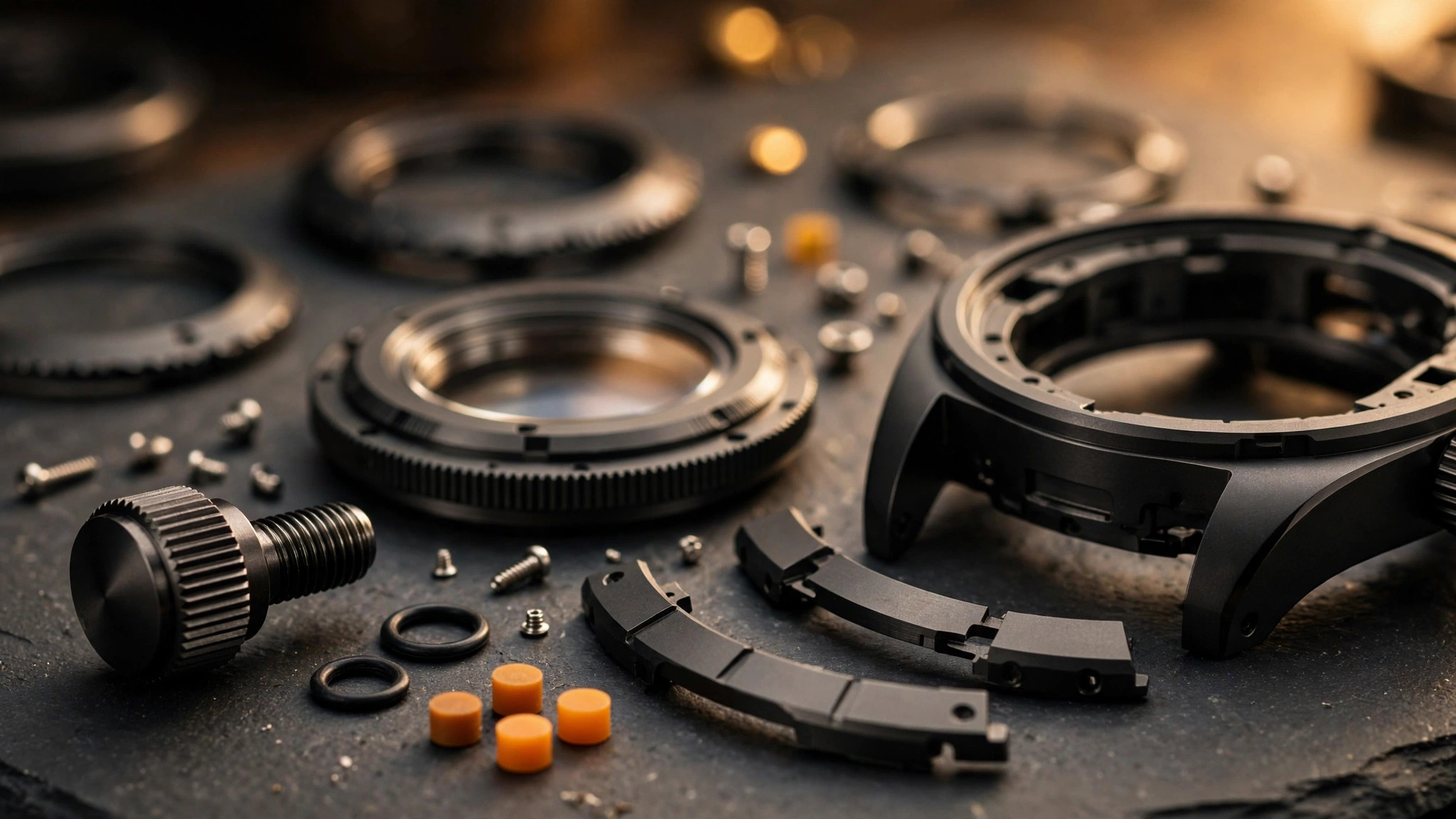
Every Join Is a Gamble
A watch case that must survive 200 meters of water pressure is really a pressure vessel worn on the wrist. At 200 meters, hydrostatic pressure reaches approximately 20 atmospheres, or about 294 pounds per square inch applied uniformly to every surface. Water at that pressure does not merely press inward. It hunts for paths, migrating along any gap between components where sealing compression is insufficient or where thermal cycling has degraded a gasket. Each join between two rigid parts, whether threaded, press-fit, or screwed, represents a potential failure point that must be sealed and then verified to ISO 6425 standards.
ISO 6425 is the international standard that separates actual dive watches from water-resistant fashion pieces. Certification requires overpressure testing at 125 percent of rated depth (250 meters of equivalent pressure for a 200-meter rating), condensation testing after thermal shock between 40°C and 5°C water baths, and resistance to external forces applied to the crown and pushers under pressure. Every component boundary in the case is a surface that must pass these tests. More components means more boundaries, which means more ways to fail.
This is why most dive watches are engineered to minimize their component count. Rolex's Oyster case is essentially three pieces: caseback, mid-case, and bezel, with the crystal pressed into the bezel ring. Seiko's "tuna can" divers use a monoblock mid-case wrapped in a protective shroud, sealing the module in a cylinder with only two critical gasket surfaces. Citizen's Promaster line follows similar logic. Fewer parts, fewer seals, fewer problems.
Casio's MR-G Frogman MRG-BF1000 ignores this logic entirely. Its case comprises more than 70 individually machined, individually hardened, individually coated exterior components, assembled by hand at the Yamagata Premium Production Line in northern Japan. It is certified to ISO 200 meters. Understanding how requires understanding why Casio chose complexity over simplicity, and what engineering makes it survivable.
Why Seventy Parts
Frogman has been a resin-cased diver since 1993. Its asymmetric case, with the crown at two o'clock and a distinctive screw-lock caseback featuring an engraved diving frog, became one of G-Shock's most recognizable silhouettes. When Casio decided to translate Frogman into their MR-G flagship line, they faced a fundamental design constraint: resin is molded into a single shell. Metal is not. Reproducing the organic curves, undercuts, and asymmetric geometry of the resin Frogman in titanium required breaking the design into dozens of discrete components, each machined separately and assembled to recreate a shape that resin achieved in one pour.
But complexity was also a deliberate choice, not merely a consequence of the geometry. G-Shock's defining engineering achievement is shock resistance, and shock resistance in a metal case demands a fundamentally different architecture than a simple dive shell. A monoblock titanium case transmits impact energy directly to the module inside. Casio's solution is what they call a protective structure: a multi-layered assembly where fluoro rubber buffers sit between bezel components and the case body, absorbing and distributing impact forces before they reach the crystal or the movement. Between the bezel and the mid-case, these buffers provide face-guarding functionality, absorbing shocks from the front and sides. More components in this context is not a liability. It is the mechanism by which the watch survives a one-meter drop onto concrete and then a dive to 200 meters in the same afternoon.
Three Alloys for Three Jobs
Not all 70 components are made from the same material. Casio uses three distinct alloys, each selected for the specific mechanical demands of its location in the case.
Ti64, a titanium-aluminum-vanadium alloy (Ti-6Al-4V), forms the case body, buttons, crown, and caseback. This is the same alloy used in aerospace fasteners, surgical implants, and connecting rods for racing engines. Its appeal is the ratio of tensile strength to weight: approximately 900 MPa yield strength at a density of 4.43 g/cm³, roughly 40 percent lighter than stainless steel at comparable strength. For a dive watch that must resist 20 atmospheres of pressure without becoming a lead weight on the wrist, Ti64 is the obvious structural choice.
COBARION, a cobalt-chromium alloy developed by Eiwa Corporation and registered as a trademark of the Iwate Industry Promotion Centre, forms the bezel. Its hardness exceeds 1,000 HV, approximately four times that of pure titanium (around 200 HV) and significantly harder than hardened 316L stainless steel. On the Frogman, COBARION serves a specific purpose: the bezel is the part of the watch most exposed to contact, abrasion, and accidental impacts against walls, doorframes, and dive equipment. Placing the hardest available alloy on the most exposed surface is straightforward materials engineering, but the challenge lies in integrating a cobalt-chromium bezel with a titanium case body. Different alloys have different coefficients of thermal expansion, meaning the bezel and case expand at different rates as temperature changes. At depth, where water temperature can drop sharply, this differential expansion alters the compression on the sealing surfaces between the bezel and case. Casio accounts for this with the fluoro rubber buffers, which are elastomeric and can accommodate dimensional changes that a rigid gasket could not.
DAT55G, a proprietary titanium alloy from Daido Steel, forms the bracelet links. Its hardness is roughly three times that of pure titanium, giving it better wear resistance at the articulating joints where bracelet links rub against each other thousands of times per day. A bracelet made from standard titanium would develop visible wear marks at the link pivots within months. DAT55G delays this considerably, though Casio adds a further layer of protection with a deep-layer hardening treatment and DLC coating applied to every single link before assembly.
| Casio MR-G Frogman MRG-BF1000B-1A | |
|---|---|
| Case Material | Ti64 titanium alloy (Ti-6Al-4V) |
| Bezel Material | COBARION cobalt-chromium alloy (~1,000+ HV) |
| Band Material | DAT55G titanium alloy (~3× pure Ti hardness) |
| Surface Treatment | Deep-layer hardening + DLC coating (per component) |
| Case Dimensions | 56 × 49.7 × 18.6 mm |
| Water Resistance | ISO 200 meters (ISO 6425) |
| Crystal | Anti-reflective sapphire |
| Caseback | Pure titanium, screw-lock, with press-fit sapphire window |
| Movement | Tough Solar + Multi-Band 6 radio + Bluetooth |
| Lume | Neo-Brite (hand-painted) |
| Exterior Components | 70+ |
| Production | Yamagata Premium Production Line |
| Price | $6,500 (standard); $7,700 (30th Anniversary LE, 800 pcs) |
Hardening Before Assembly
Surface hardening a completed watch case is standard practice across the industry. Citizen's Duratect process, Sinn's Tegiment technology, and various PVD and DLC treatments all harden the exterior of an assembled case. Casio does something different with the MR-G Frogman: each of the 70-plus components is individually treated with deep-layer hardening and then coated in diamond-like carbon before any assembly begins.
Deep-layer hardening is a thermal and chemical process that modifies the titanium alloy from the surface inward, creating a hardness gradient rather than a discrete coating layer. Oxygen or nitrogen atoms diffuse into the titanium lattice at elevated temperatures, forming a solid solution that is significantly harder than the base alloy but metallurgically continuous with it. Because the hardened zone is part of the metal itself, it cannot delaminate or chip the way a surface coating can. On top of this hardened surface, Casio applies a DLC coating, a thin film of amorphous carbon with hardness values in the range of 1,000 to 2,000 HV. DLC is only micrometers thick, but its sp3 carbon bonding structure gives it diamond-like mechanical properties: extremely low friction, high scratch resistance, and chemical inertness.
Treating each component individually before assembly is more expensive and time-consuming than treating the completed case, but it solves a specific problem. In an assembled multi-component watch case, crevices between parts, internal surfaces of screw threads, and the inner faces of bezel segments are physically inaccessible to line-of-sight deposition processes like PVD or DLC. These hidden surfaces remain untreated and vulnerable to corrosion, wear, and galvanic interaction between dissimilar metals. By hardening and coating every part before it goes into the case, Casio ensures that even surfaces buried inside the assembly receive full treatment. When the watch is disassembled for service years later, every component surface is protected, not just the ones visible from the outside.
Sealing the Puzzle
A 70-component case with ISO 200-meter certification requires a sealing strategy that goes beyond O-rings in grooves. Casio uses several overlapping approaches, each addressing a different class of potential leak path.
Crown and caseback seals use screw-lock construction, where threading the crown or caseback down compresses an O-ring or gasket against a machined seating surface. Screw-lock seals are mechanically self-reinforcing: the threading provides consistent compression independent of manual tightening force, and the mechanical interference of the thread acts as a secondary barrier even if the O-ring degrades. On the Frogman, the crown sits at two o'clock in the original asymmetric position, requiring a custom threaded tube rather than the standard three o'clock crown tube found on most dive watches. Custom geometry means custom tooling, which is feasible at MR-G production volumes (hundreds to low thousands per reference) but would be prohibitively expensive at mass-market scale.
Between bezel components, the fluoro rubber buffers serve double duty. Their primary function is shock absorption, but they also act as compressive gaskets. Fluoro rubber (fluoroelastomer, commonly known by the trade name Viton) has excellent resistance to saltwater, UV degradation, and temperature extremes, making it an appropriate long-term sealing material for a dive watch. Because these buffers are compressed between rigid titanium and COBARION components, they maintain sealing pressure across a range of temperatures and under the dimensional changes caused by differential thermal expansion between the alloys. A rigid gasket in the same position would lose compression as the metals contracted in cold water. An elastomeric buffer maintains seal integrity by deforming to follow the changing gap.
Crystal-to-case sealing relies on the sapphire crystal being pressed into the bezel assembly with a gasket ring. Sapphire's dimensional stability under pressure is an advantage here: it does not flex or deform measurably at 20 atmospheres, which means the gasket compression remains constant regardless of depth. At the caseback, a pure titanium screw-lock construction holds a press-fit sapphire crystal window. Pure titanium is used for the caseback specifically, rather than Ti64, because pure titanium offers better corrosion resistance against prolonged saltwater contact on the skin side and because its lower yield strength compared to Ti64 allows the screw threads to be formed with tighter tolerances, improving the seal.
A Radio Window at 200 Meters
Most professional dive watches are purely mechanical or, if quartz, use a simple oscillator that needs no external signal. Casio's Frogman is a connected device. It receives Multi-Band 6 radio time signals from atomic clock transmitters in Japan (JJY), the United States (WWVB), Germany (DCF77), the UK (MSF), and China (BPC). It also communicates with smartphones via Bluetooth Low Energy. Both functions require an antenna, and an antenna encased in titanium is useless. Titanium, like all metals, is opaque to the radio frequencies involved.
Casio's solution is the sapphire caseback window. Sapphire (aluminum oxide, Al&sub2;O&sub3;) is transparent to radio waves from roughly 1 MHz through several GHz, covering both the 40-77.5 kHz range of atomic clock transmitters and the 2.4 GHz band used by Bluetooth. By press-fitting a sapphire disc into the titanium caseback and positioning the antenna directly behind it, Casio effectively creates a radio-transparent porthole in an otherwise opaque pressure vessel. Radio waves pass through the sapphire, reach the antenna, and the watch synchronizes, all while maintaining the same 200-meter pressure seal as a fully opaque caseback.
This is an elegant piece of dual-purpose engineering. Exhibition casebacks on mechanical watches are common, but they serve an aesthetic function. On the Frogman, the sapphire caseback is structural and functional. It carries a 3D-engraved Frogman diving character finished in red vapor deposition for visual identity, but its real job is letting electromagnetic signals through while keeping the Pacific Ocean out. On the limited-edition MRG-BF1000EB, the caseback sapphire also features the serial number of each piece engraved in the crystal surface, adding traceability without compromising the radio window.
Hand-Painted Lume at Production Scale
Underwater legibility demands luminous markings, and the Frogman's Neo-Brite luminous compound on the hour indices is applied by hand, not printed. Casio's technical documentation specifically notes that the large index marks have recessed portions on their top surfaces that are hand-painted to achieve a thicker coating than screen printing or pad printing can deliver. A thicker lume deposit glows brighter and longer, which matters at depth where ambient light drops to near zero.
Hand-painting lume is standard at Swiss brands producing watches in the tens or hundreds of units per year. Patek Philippe, Jaeger-LeCoultre, and A. Lange & Söhne all employ lume painters as specialized artisans. What makes Casio's approach notable is the context: this is not a $200,000 minute repeater produced in single digits. It is a $6,500 production dive watch from a company whose core competency is manufacturing millions of digital watches per year. Running hand-painted lume through the Yamagata Premium Production Line, which also handles hand-finishing and individual component inspection, represents a deliberate inversion of Casio's usual manufacturing priorities. Speed and volume yield to precision and per-unit quality, but only for the MR-G line. Every other G-Shock leaves a different factory at a different pace.
Yamagata and the Cost of Complexity
Casio's Yamagata factory in Higashine, Yamagata Prefecture, has produced watches since 1979. In the 2010s, Casio designated a separate production line within the facility as the Premium Production Line, dedicated exclusively to MR-G and other flagship models. Workers on this line are selected for specific skills: hand-polishing, precision assembly of multi-component cases, and visual inspection at tolerances that automated quality control cannot reliably detect.
Assembly of an MRG-BF1000 follows a specific sequence. All 70-plus exterior components arrive individually hardened and DLC-coated. A technician assembles the case body from the mid-case, crown tube, button housings, and associated gaskets. Fluoro rubber buffers are placed in their recesses. Bezel components, already finished in COBARION, are mounted and secured with titanium screws. Crystal, gasket rings, and caseback with its sapphire window are installed and torqued to specification. At each stage, sealing surfaces are inspected under magnification for contamination or defects that could compromise the O-ring or gasket interface. After assembly, the completed watch undergoes pressure testing per ISO 6425 requirements, including condensation and thermal shock tests.
A completed MRG-BF1000 retails for $6,500 in its standard configuration. Limited editions like the 30th Anniversary MRG-BF1000EB, with its COBARION bezel hand-sculpted by master gem cutter Kazuhito Komatsu into brinicle-inspired facets coated in polar blue AIP (arc ion plating), reach $7,700, limited to 800 pieces. For perspective, a Rolex Submariner, the archetypal three-piece-case professional dive watch, retails for approximately $9,100. A Seiko Marinemaster 300 starts around $3,300. Positioned between these benchmarks, the Frogman's price reflects neither Swiss-luxury brand premium nor pure manufacturing cost, but the labor intensity of hand-assembling a 70-component titanium case that no other dive watch attempts.
More Parts, Different Logic
Conventional dive watch engineering optimizes for seal simplicity. Rolex, Seiko, Omega, and Blancpain all pursue minimal component counts in their dive cases because each additional join is a statistical increase in failure probability. Casio's Frogman inverts that priority because it is solving two engineering problems simultaneously: water resistance and shock resistance. A monoblock titanium dive case handles the first problem well. It handles the second problem poorly, because rigid metal transmits impact energy directly and efficiently. By breaking the case into dozens of components separated by elastomeric buffers, Casio creates a structure that absorbs and dissipates kinetic energy at every interface while maintaining sealing integrity through the compression of those same elastomeric elements.
Whether this trade-off is worthwhile depends on what you expect from a dive watch. If you want a watch that survives depth and nothing else, a three-piece Oyster case is more robust by virtue of its simplicity. If you want a watch that survives depth, and also a concrete floor, and also a reef strike, and also a decade of daily wear on a construction site, then a 70-component case with impact-absorbing buffers at every layer starts to make engineering sense. Casio has been refining this shock-resistant multi-component philosophy since Kikuo Ibe dropped the first G-Shock prototype off a third-floor restroom window in 1981. Applying it to a professional dive case was not a departure from their engineering culture. It was the logical extension of it.