Not That Kind of Quartz: H. Moser's Forged Fibre Streamliner and the Button Borrowed from a 1989 Sneaker
Push the orange button on the left side of the case. A gear train engages. Energy flows directly into the barrel spring, and on the dial an orange disc slides upward behind an arc-shaped aperture, marking new power stored in the mainspring. Release. Push again. Each press buys roughly another hour of runtime. Keep pressing after the spring is fully charged if you want; a slip clutch prevents over-winding, and the haptic feedback from the mechanical gear train is reason enough to do it anyway.
Welcome to the Streamliner Pump from H. Moser & Cie., a collaboration with Reebok that debuted at Watches & Wonders 2026 and is exactly as playful as it sounds. It is also a 131-component hand-wound caliber housed inside a material that most watch buyers will hear the name of and immediately misunderstand.
Forged quartz. In an industry that spent four decades defining itself against quartz, Moser built a case from it.
Silicon Dioxide, Not a Crystal Oscillator
Clarification: this is not quartz in the battery-powered sense. No piezoelectric crystal vibrating at 32,768 Hz. Forged quartz fibre is a composite built from strands of silicon dioxide glass, and its relationship to a quartz watch movement is roughly equivalent to the relationship between a carbon atom and a carbon tax. Same word. Entirely different physics.
Quartz glass fibre begins as amorphous SiO2, drawn into thin strands at temperatures exceeding 1,700°C. Where standard glass fibre uses a broader family of silica-based compositions (often containing alumina, boron oxide, or calcium oxide additives for specific mechanical properties), quartz fibre is high-purity silicon dioxide, typically above 99.9% SiO2 content. Purer than glass fibre. Whiter. More thermally stable across the temperature swings a wristwatch encounters between January mornings and August afternoons.
To forge a case from this material, strands are cut into short segments and laid into a precision mould. Compression follows, then resin injection: an epoxy matrix flows through the compressed fibre bed, filling voids and binding the randomly oriented segments into a rigid composite. Two successive curing cycles harden the structure, first at moderate temperature to gel the resin, then at higher temperature to complete the polymer cross-linking that gives the case its final mechanical properties.
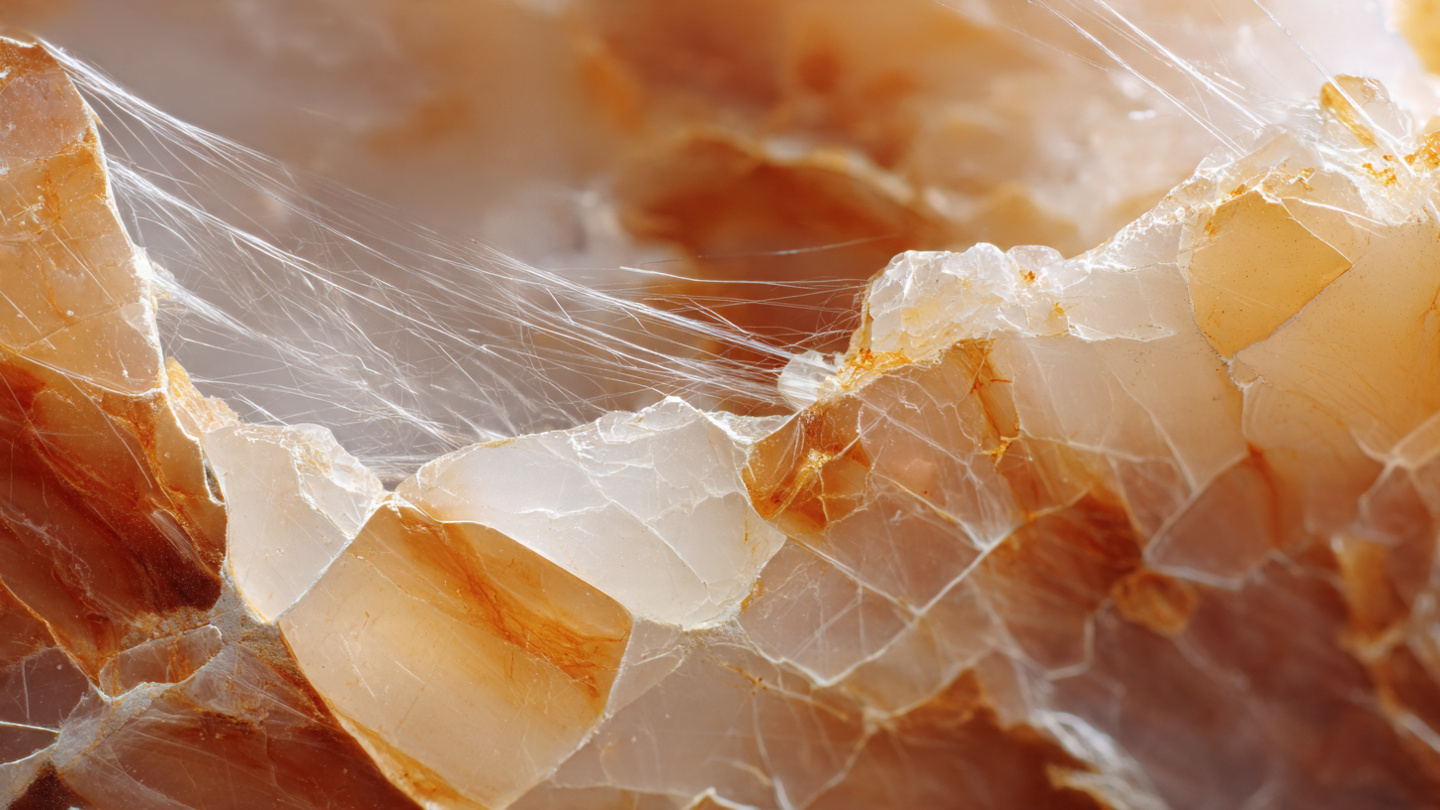
Random fibre orientation matters enormously here. Unlike woven carbon composites, where parallel fibre bundles create the regular crosshatch pattern visible on everything from Formula 1 bodywork to Richard Mille watch cases, forged composites use randomly distributed short fibres that produce an irregular, marbled surface texture. In carbon, this creates the swirling grey-and-black pattern that Panerai's Carbotech and Lamborghini's forged carbon body panels made famous starting in the mid-2000s. In quartz, the visual result is fundamentally different because the base material is translucent white rather than opaque black, producing a moiré pattern that catches and scatters light in ways that carbon fibre cannot replicate regardless of how it is processed.
No two cases look identical. Manufacturing tolerances control the dimensions, but the random fibre distribution during moulding ensures that every surface pattern is unique, driven by stochastic variation in how several thousand short SiO2 strands settle under compression before the resin locks them in place permanently.
Why Carbon Wasn't Enough
Forged carbon has been in watchmaking for nearly two decades, and it works. Strong, light, visually distinctive. Hublot, Panerai, TAG Heuer, and a dozen independents have all built cases from forged carbon composites with legitimate engineering justifications. Nobody needed an alternative.
Quartz fibre offers two advantages that carbon does not, and both matter for a wristwatch expected to last decades on a wrist.
First: UV resistance. Prolonged sunlight exposure degrades the epoxy matrix in most carbon-epoxy composites, causing surface yellowing and eventual micro-cracking as the resin breaks down under ultraviolet radiation. Aerospace carbon structures address this with UV-blocking coatings or opaque paint layers, but watch cases are meant to be seen, not painted over. Quartz fibre resists UV degradation inherently, because silicon dioxide is transparent to visible light and highly resistant to photochemical breakdown across the solar spectrum that reaches a human wrist. A forged quartz case exposed to direct sunlight for thirty years will not yellow the way an uncoated carbon composite case eventually might.
Second: colour. Carbon fibre is black. Always. You can coat it, paint it, layer it with coloured resins, but the underlying composite is dark grey to black regardless of processing parameters, because carbon itself absorbs visible light across the entire spectrum. Quartz fibre is naturally colourless to white, which means pigment added to the resin matrix before injection produces genuine through-colour in the finished composite. Moser currently offers the Streamliner Pump in black (achieved with a DLC coating on the cured surface) and white (the natural quartz-and-resin colour), but the technology supports any colour the brand decides to produce. Carbon composites cannot do this without surface treatments that are, functionally, paint.
Titanium on the Inside
A composite case creates a structural problem that solid metal avoids entirely. Metal watch cases are self-supporting: the case back threads directly into the mid-case, gaskets compress between mating metal surfaces, and the crown tube is machined integral to the case wall. Forged composites lack the thread-holding strength, the gasket-sealing precision, and the long-term dimensional stability required for serious water resistance certification.
Moser's answer is a component the brand calls a sarcophagus: an internal titanium frame that sits entirely inside the forged quartz shell. Movement, gaskets, crown tube, case back threading, and strap attachment points all connect to titanium. Forged quartz provides the exterior geometry, the visual texture, and roughly two-thirds of the weight savings. Titanium provides everything structural.
At 4.51 g/cm³, titanium is 43% less dense than 316L stainless steel. Combined with the forged quartz exterior (epoxy-fibre composites typically measure between 1.5 and 2.0 g/cm³), the resulting case assembly weighs substantially less than an equivalent all-steel Streamliner while maintaining 10 ATM water resistance. That hundred-metre rating depends entirely on the titanium frame's gasket interfaces, not on any sealing property of the composite material itself.
Hublot has run a similar dual-structure approach since the original Big Bang launched in 2005: carbon or ceramic exterior, metal chassis inside for structural integrity. Richard Mille's NTPT carbon cases incorporate titanium case backs and crown components for identical reasons. Moser's contribution to this conversation is not the engineering pattern, which is well established, but the material itself. No other Swiss manufacturer is forging quartz fibre watch cases. Whether that remains true in five years depends on how many collectors respond to a material that looks unlike anything else in the cabinet.
Charlotte Coliseum, February 1991
Before the movement, the story. Reebok released the Pump sneaker on November 24, 1989. It was the first shoe with an internal inflation mechanism for a custom fit: an inflatable bladder wrapped the ankle, a basketball-shaped orange button on the tongue pumped air in, and a release valve on the heel let it out. Simple pneumatics in a high-top silhouette. Retail price was $170, roughly $420 in 2026 dollars, expensive enough that owning a pair signalled something beyond athletic intent.
Dee Brown changed the shoe's trajectory permanently. At the 1991 NBA Slam Dunk Contest at Charlotte Coliseum, the Boston Celtics rookie walked to the free-throw line before each dunk and bent down to pump up both shoes with exaggerated deliberation. His final slam was a no-look dunk performed while covering his eyes with his forearm, still wearing the freshly inflated Pump Omni Zone IIs. Brown won the contest. Reebok sold $500 million in Pump sneakers that year. Paul Litchfield and Steve Smith, the shoe's co-designers, had built a technical product. Dee Brown turned it into a ritual.
Thirty-five years later, Edouard Meylan, CEO of H. Moser & Cie., was interested in the gesture, not the pneumatics. Pressing a button to prepare equipment for performance. What if pressing a button could wind a watch?
HMC 103: Converting a Push into a Tick
Moser's automatic HMC 500 movement was the starting platform. Compact at 30mm diameter and 4.5mm height, the HMC 500 uses a platinum micro-rotor for self-winding and powers the Streamliner Small Seconds. For the Pump project, the engineering team stripped the automatic winding system entirely and designed something that has no equivalent in Moser's existing caliber family: a gear train terminating at an anodized aluminium pusher mounted through the left side of the case.
Press the button. An internal rack advances through a linear stroke. Gears multiply that stroke into rotational energy delivered to the barrel arbor, tensioning the mainspring. One press stores enough energy for approximately one hour of operation, and the mechanical choreography is visible through the sapphire case back: skeletonised bridges expose the rack sliding, gears rotating, and the barrel absorbing energy in real time. Seventy-four hours of total power reserve means roughly seventy presses from fully depleted to fully wound, though nobody will actually perform this exercise because the mainspring's increasing resistance curve makes the final presses noticeably harder than the first, and most owners will simply press intermittently throughout the day.
When the mainspring reaches full tension, the button still depresses and the rack still moves, but a slip clutch in the gear train disconnects the drive before the barrel can accept excess energy. Moser describes this as pressing purely for the pleasure of the interaction, which sounds like marketing language until you actually try it and discover that haptic feedback from a mechanical gear train engaging and disengaging under your thumb is a qualitatively different sensation from winding a crown. A crown rotates against increasing spring resistance through a winding stem that bends ninety degrees at the keyless works, damping most of the tactile information before it reaches your fingers. A pump button transmits force in a direct line through rigid gears with no angular coupling, and you feel the mechanism work.
Gauthier Got There First
Credit where it belongs: H. Moser did not invent the caseband pusher for winding a mechanical watch. Romain Gauthier's Logical One, introduced in 2013, replaced the winding crown with a pusher embedded in the left side of the case. Gauthier's reasons had nothing to do with sneakers. He wanted to eliminate the winding stem entirely, because stems introduce a ninety-degree force coupling at the keyless works, create a potential moisture ingress point at the crown tube, and represent one of the most frequently damaged components in watch movements during amateur service.
Gauthier's implementation sat at a different altitude of complexity. His Logical One featured a chain-and-fusée constant-force mechanism with links machined from synthetic ruby (replacing traditional steel chain links for reduced friction), a snail-shaped cam instead of the conventional cone, and a sapphire-lined mainspring barrel to reduce wall friction. Prices ranged from CHF 108,000 to CHF 145,000. Haute horlogerie solving a force-transmission thermodynamics problem with maximum possible elegance and minimum possible commercial accessibility.
Moser borrows Gauthier's ergonomic insight, not his constant-force architecture, and deploys it at CHF 31,360 inside a watch that exists because someone looked at a Reebok Pump and saw a winding system. Both prove the same structural point: mechanical watches do not need crowns on the right side of the case. Convention placed them there. Convention is optional.
Straumann Inside
HMC 103 beats at 3 Hz (21,600 vibrations per hour). 131 components, 31 jewels. Standard specifications for a hand-wound manufacture caliber, except for one detail that separates Moser from nearly every other Swiss brand at this price point: the hairspring.
Moser produces its own hairsprings. Precision Engineering AG in Delémont, part of the same corporate family that includes H. Moser & Cie., manufactures the Straumann hairspring from a proprietary nickel-iron alloy developed by the Moser-Schaffhausen founding family. In an industry where the overwhelming majority of brands buy hairsprings from Nivarox (a Swatch Group subsidiary that supplies an estimated 90% of the Swiss industry), vertical integration of hairspring production is a genuinely rare capability. Rolex, Patek Philippe, Swatch Group brands, and Moser. That is approximately the complete list of Swiss manufacturers with in-house hairspring fabrication, and Moser is the smallest operation on it.
Finishing on the HMC 103 follows Moser's house language: anthracite-treated bridges with the characteristic double Moser stripes, a style that deliberately reads less ornate than the hand-engraved anglage and polished sinks on a Lange or Patek movement. Restraint as a design position. On the dial side, polished lacquer (black or white) carries applied hour markers and streamlined hands fitted with Globolight inserts. Globolight is a ceramic composite embedded with Super-LumiNova phosphorescent pigments, developed for higher luminescence consistency than painted lume applications. Glow colour is green.
Case diameter: 40mm. Height: 9.7mm for the case, 11.4mm including the slightly domed sapphire crystal. Screw-down crown with rubber ring on the right side handles time-setting only. Integrated rubber strap, steel pin buckle with Moser logo. Two references: 6103-2200 in black forged quartz with DLC-coated titanium case back, 6103-2201 in white forged quartz with uncoated titanium case back. Each limited to 250 pieces.
Buyers also receive an exclusive Reebok Pump sneaker co-created by Moser and Reebok for Streamliner Pump owners and friends of the brand. I have not worn the sneaker. I suspect it does not wind anything.
Between Joke and Artifact
Moser occupies a peculiar altitude in Swiss watchmaking. Technically serious, ancestrally legitimate (the Moser-Schaffhausen name dates to 1828, the Straumann hairspring heritage is real industrial history), but culturally committed to being the brand that coats a dial in Vantablack to protest industry hype, names a concept watch after Swiss cheese, and now builds a winding mechanism inspired by a basketball shoe. Edouard Meylan calls this posture "playful sophistication," and the Streamliner Pump is its most literal expression yet.
Whether you find the Reebok collaboration charming or tiresome probably determines whether you will consider a CHF 31,360 watch that replaces one of horology's oldest interfaces with an orange button. Fair enough. Personal taste is not an engineering argument.
Strip away the sneaker angle, though, and what remains is a legitimately interesting material-science and mechanical-design object. Forged quartz fibre solves real problems that forged carbon does not: UV resistance across a multi-decade ownership horizon, through-colour without surface coatings, and a visual texture that is genuinely unique per piece because stochastic fibre orientation during moulding is not something manufacturing tolerances can or should eliminate. A titanium sarcophagus inside a composite shell is honest structural engineering, borrowed from Hublot and Richard Mille but applied to a material neither brand has attempted. And a caseband pump that lets you wind the movement through a visible gear train is, whatever its cultural origins, a more mechanically transparent interaction than the crown-and-stem system that everybody already knows how to use without thinking about it.
Sometimes the watches that refuse to take themselves seriously are the ones most worth examining. Press the button. Feel the gears. Decide for yourself whether the joke is also an artifact.
Sources
- Monochrome Watches, "Pumping Up Horology: The Surprising H. Moser & Cie. x Reebok Streamliner Pump," Watches & Wonders 2026 coverage.
- H. Moser & Cie., official Streamliner Pump product page, ref. 6103-2200 and 6103-2201, h-moser.com.
- Cortina Watch, "Watches and Wonders 2026: H. Moser & Cie Streamliner Pump," cortinawatch.com.
- Watchespedia, "H. Moser Streamliner Pump: Limited Mechanical Watch," technical analysis, watchespedia.com.
- IMBOLDN, "H. Moser & Cie × Reebok Streamliner Pump Marries Quartz Fibre and Playful Power," imboldn.com.
- Oracle of Time, "H. Moser & Cie. Present Streamliner Pump in Partnership with Reebok," oracleoftime.com.
- Hodinkee, "Introducing The Romain Gauthier Logical One: Complete With A Totally New Take On The Fusée And Chain," 2013.
- Romain Gauthier, Logical One calibre technical specifications, romaingauthier.com.
- Fratello Watches, "How Watches Work: What Is Carbon Fiber In Watchmaking?" carbon composite manufacturing overview.
- Wikipedia, "Reebok Pump," historical timeline and Dee Brown Slam Dunk Contest documentation.
- Worldtempus, "Streamliner, Popping up Where One Least Expects It," en.worldtempus.com.