Four Hundred Horsepower Per Tonne, the Old Way: Michelotto's Gruppo 4 Tributo
Padua's Palazzo Moroni hosted a strange kind of anniversary on October 10, 2026. Fifty years after the Ferrari 308 GTB received its Group 4 homologation, the firm that built the rally cars returned to the city where its founder opened his first workshop in 1969, and showed a new car shaped like the old one. Only it is not a restored 308, not a restomod, and not a Ferrari at all in any official sense. AC Motorsport and Michelotto call it the Gruppo 4 Tributo, and its specification sheet reads like a dare to the entire modern supercar industry: a naturally aspirated 3.4-litre V8, a five-speed dogleg manual with an exposed gated shifter, and a quoted weight of 950 kilograms.
That weight is the whole argument. Everything else on the car exists to defend it, explain it, or apologize for nothing at all. Modern performance cars add power to overcome mass, then add cooling and structure to survive the power, then add mass again, in a spiral that ends with family sedans weighing more than the racing trucks of a generation ago. Michelotto went the other direction, and the result is a car whose headline number is not its horsepower but its division.
The arithmetic of subtraction
Run the numbers yourself, because they are simple enough to check on a phone. Carscoops reports 380 horsepower from the 3.4-litre V8, while Autoblog, citing CarBuzz, reports 375 horsepower and 268 lb-ft against Carscoops' 269 lb-ft. One outlier outlet claims 400 horsepower. Take the conservative pair and the math still lands in striking territory: 380 horsepower divided by 0.95 tonnes equals exactly 400 horsepower per tonne, and even the lower 375 figure gives 395. Specific output sits around 112 horsepower per litre without a turbocharger in sight, which is serious naturally aspirated engineering by any standard, and one outlet reports peak power arriving at 8,250 rpm, high enough that the engine's character matters as much as its output.
Context turns those ratios into a story. At 950 kilograms, the Tributo is 140 kilograms lighter than the original 308 GTB it honors, according to Carscoops, which means a half-century of materials progress actually shows up on the scale instead of being spent on equipment. Autoblog notes it is roughly 270 pounds lighter than a modern Mazda MX-5 Miata, a car famous precisely for being light, and the comparison stings because the Miata carries a four-cylinder and a folding roof, not a V8 and a tubular chassis. One comparison puts Ferrari's own 296 GTB at 1,470 kilograms, which would make the Tributo 520 kilograms lighter than Maranello's current mid-engine V6 hybrid, a gap roughly equal to a full-size motorcycle with a rider aboard. Every kilogram removed from a 950-kilogram car is worth about 0.4 horsepower at this power level, so lightness here is not a handling footnote. Lightness is the powertrain strategy.
Weight also explains why the modest torque figure deserves no apology. A car this light does not need 600 lb-ft to feel urgent, because torque only has to accelerate 950 kilograms, and a naturally aspirated V8 that revs past 8,000 rpm fills the gap with revs rather than boost. Turbocharged rivals will win a drag race on paper. On a road with corners, where mass punishes braking, turn-in, and tire wear on every single corner, the lighter car collects its advantage hundreds of times per drive, silently, without ever appearing on a spec sheet. That is the bet Michelotto is making, and it is the same bet Colin Chapman made, the same bet the original 308 rally cars made, and the same bet almost nobody in the modern industry is willing to make anymore.
A rally car layout, not a styling cue
Look past the wedge silhouette and the pop-up headlights, because the Tributo's hardware reads like a competition car that happens to be road-legal. A custom tubular chassis carries composite body panels, a construction method that trades the crash-structure sophistication of a modern monocoque for repairability, low tooling cost, and honest lightness at low volume. One report places the V8 transversely behind the cabin, the classic 308 arrangement, which keeps the car compact and its polar moment of inertia tight, at the cost of service access that will test any owner's patience. Adjustable suspension, four-piston brake calipers, 18-inch wheels, and Pirelli P Zero Trofeo RS tires complete a package that assumes the buyer will actually drive the car hard, rather than merely photograph it.
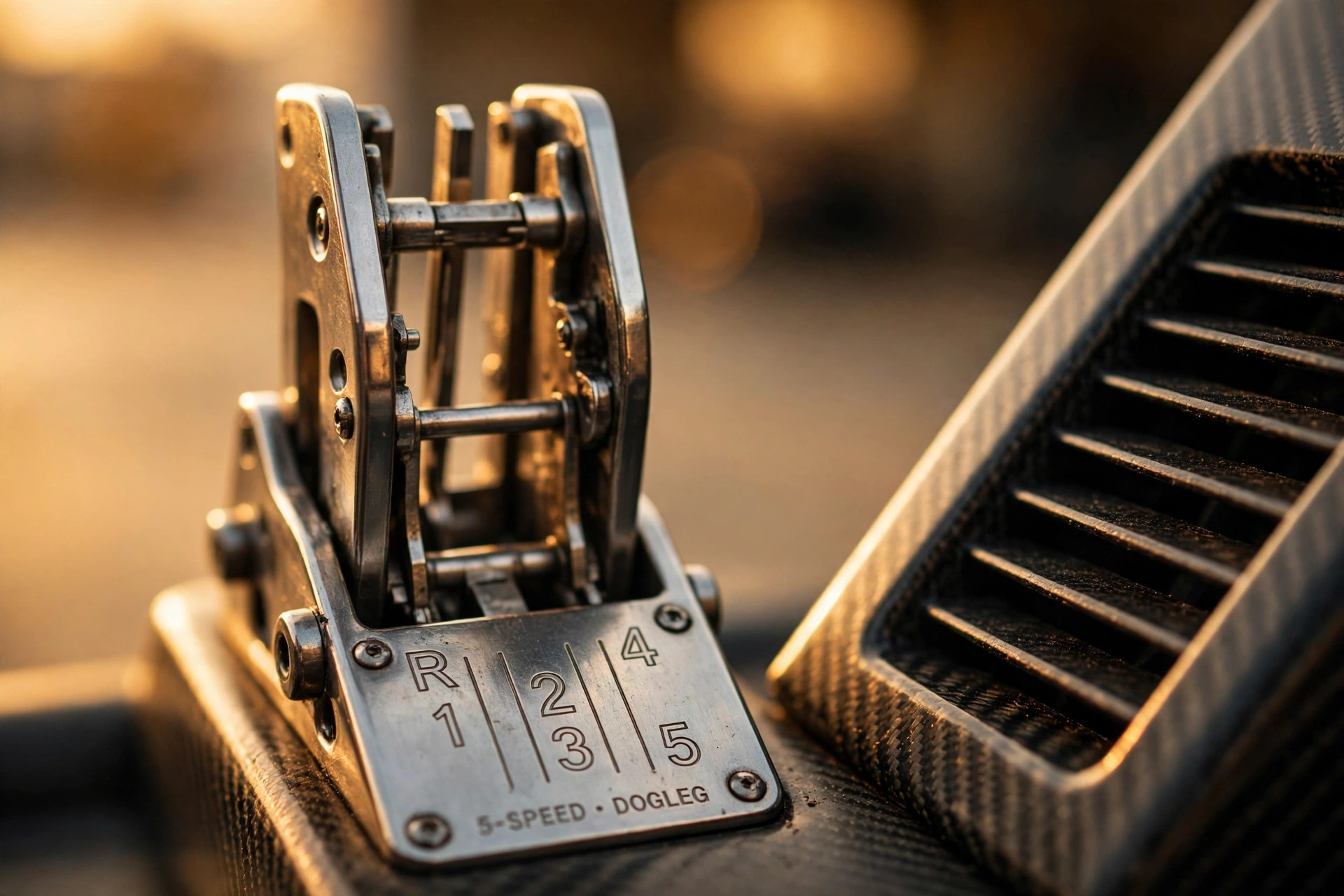
Then there is the gearbox, and it deserves its own paragraph because gearboxes like this are going extinct in real time. A five-speed dogleg manual puts first gear down and to the left, out of the way of the second-to-third shift that matters on a road, and the exposed metal gate turns every shift into a small mechanical ceremony. Porsche's own patent work on a simulated manual for electric cars, covered elsewhere on this site, shows how far the industry has drifted from the real thing: manufacturers now engineer fake shift feel for cars with no gears at all, while Michelotto simply fits actual gears and an actual gate. Dogleg boxes demand attention at parking speeds and reward it everywhere else, which is exactly the kind of trade modern product planning refuses to make. Five speeds, not six or seven, because a light car with a rev-happy V8 does not need a highway overdrive gear pretending to be a performance feature.
Flared fenders, hood gills, quarter-panel vents, a huge rear clamshell, black grilles, dual exhausts, an exposed carbon-fibre diffuser, and four circular taillights all quote the original 308 directly, so far, so tribute, but every one of those details also does work: vents feed and extract air, the clamshell opens the whole rear for service, the diffuser manages the underbody. Form following function is easy to claim and hard to prove, and a tubular-chassis car with composite panels at least makes the claim testable, since every panel can be weighed, removed, and justified. If a vent weighs nothing and cools something, it stays. If it only looks fast, a 950-kilogram budget has no room for it.
The firm that built the originals
Here is where the Tributo separates itself from every other retro wedge on the market. Most tributes are built by admirers. This one is built by the firm that built the originals, and that distinction is not marketing. Giuliano Michelotto opened his Padua workshop in 1969, and his company went on to prepare Ferrari's rally machinery through the 1970s and 1980s, building more than 700 competition cars, collecting a reported 1,495 victories and 44 world championships along the way. When a firm with that record builds a tribute to its own work, the usual question, whether the tribute understands the original, answers itself. Michelotto was there. It has the jigs, the memories, and the scar tissue.
Its record with the 308 specifically is the stuff of rally trivia that happens to be true. Michelotto-prepared 308 GTBs contested the World Rally Championship in an era when rear-wheel-drive, naturally aspirated cars faced the rising four-wheel-drive turbo tide, and they still delivered results that stand alone in Ferrari history. Jean-Claude Andruet won the 1981 Tour de France Automobile in a 308, and a 308 finished second at the 1982 Tour de Corse, which remains Ferrari's only podium finish in top-level WRC competition. Those are not the achievements of a styling house. They are the achievements of a race shop that knew how to make a road car survive stages it was never designed for, and the Tributo's tubular chassis, adjustable suspension, and competition tires are a direct inheritance from that work, not a costume.
Later chapters of the same story explain why the Tributo exists now and why it looks the way it does. After Group B was banned in 1986, Michelotto cancelled its more extreme 308 GT/M rally project, and engineering from that rally program later fed into two of Ferrari's most celebrated road cars, the 288 GTO and the F40. Michelotto subsequently worked on the 333 SP prototype program and decades of Ferrari GT endurance machinery. Read that lineage backwards and the Tributo stops looking like nostalgia: it is the rally branch of the family tree, the one that got pruned by regulation in 1986, finally growing a new shoot forty years later, built by the same hands, without asking Maranello's permission.
A tribute that is not a restomod
Calling the Tributo a restomod would be wrong in a way that matters mechanically, not just semantically. A restomod starts with an old car and upgrades it. AC Motorsport founder Francesco Calzavara, who started his company two years ago after working at Michelotto, started with nothing: a new tubular chassis, new composite panels, a new drivetrain, and a silhouette that quotes the 308 without containing a single original 308 part. That distinction carries real consequences. A restomod inherits an old car's crash structure, rust, and compromises. A new car inherits only its maker's judgment, which is a heavier burden, because there is no original chassis to blame when something flexes or rattles.
Independence cuts both ways, and honesty requires saying so. Autoblog notes the car is being built independently of Ferrari, which means no Maranello engineering sign-off, no factory parts pipeline, and no prancing horse on the nose to reassure a future buyer. What it has instead is Michelotto's name, which in rally circles carries more weight than most manufacturers' badges, and a design that multiple outlets describe as more resolved than Ferrari's current styling direction. Carscoops goes further, calling the tribute just about perfect against recent Ferrari designs it finds odd-looking. Taste is subjective, but the engineering point underneath the praise is not: a small team with a clear brief and no committee can still draw a coherent wedge, while a large manufacturer balancing pedestrian safety, cooling, and platform sharing often cannot.
One tension in the prototype deserves attention rather than applause. For all its analog promise, the Tributo's cabin pairs a flat carbon-fibre dashboard, physical switches and dials, a three-spoke steering wheel, and a metal gated shifter with a large digital display ahead of the driver, plus Alcantara bucket seats and four-point harnesses. Purists will call the screen a betrayal. Engineers will call it a concession to the reality that a new car in 2026 needs instrumentation, diagnostics, and a way to display information that analog dials cannot carry. Watch whether the screen survives to production unchanged. Prototypes often carry placeholder electronics, and the ratio of physical switches to screen real estate in the production car will tell you more about Michelotto's priorities than any press statement.
What is not settled yet
Three open questions belong in any honest account of this car, and the first is the engine itself. Michelotto has not disclosed the V8's origin, and one outlet notes only that it is a more modern Ferrari unit rather than the original 308's Tipo F106 bored out, which is plausible and unverifiable at the same time. A modern Ferrari V8 in a 950-kilogram tubular chassis raises immediate questions about electronics integration, emissions compliance, service support, and parts supply, none of which have answers yet. Until Michelotto names the donor or the architecture, treat the engine as a claimed 3.4 litres and a claimed output range, not as a known quantity.
Second is the output discrepancy itself, which is small but instructive. Carscoops says 380 horsepower and 269 lb-ft. Autoblog says 375 horsepower and 268 lb-ft. A third outlet says 400. Differences of five horsepower are rounding noise, but a 25-horsepower spread between outlets covering the same reveal suggests at least one source converted units loosely or repeated a preliminary figure, and buyers should wait for Michelotto's own specification sheet before quoting any single number as fact. This article uses 380 horsepower as its headline figure because Carscoops published the most complete specification set, and flags the alternatives wherever the difference changes the conclusion. At these weights it does not: 395 versus 400 horsepower per tonne is the same car.
Third is everything commercial, and it is all unannounced. No price, no production count beyond one outlet's vague handful, no on-sale date, no delivery timeline. That silence is normal for a prototype reveal from a tiny manufacturer, and it is also a warning: the Tributo exists today as a running prototype and a specification sheet, not as a tested product. Nobody outside Michelotto has driven it, weighed it independently, or timed it. Its 950-kilogram figure is a manufacturer claim, its handling is a promise, and its durability is a hypothesis. All three may prove true. None has been proven yet.
| Specification | Michelotto Gruppo 4 Tributo |
|---|---|
| Reveal | October 10, 2026, Palazzo Moroni, Padua, Italy; 50th anniversary of 308 GTB Group 4 homologation (1976) |
| Builders | AC Motorsport (Francesco Calzavara) with Michelotto Group; built independently of Ferrari |
| Construction | Custom tubular chassis, composite/carbon-fibre body panels; not a restomod, no original 308 parts |
| Engine | Naturally aspirated 3.4-litre V8, transverse behind cabin (per one report); origin undisclosed |
| Output | 380 hp (Carscoops) or 375 hp (Autoblog via CarBuzz); 268-269 lb-ft; one outlet reports peak power at 8,250 rpm; one outlier claims 400 hp |
| Specific output | Approximately 112 hp per litre at 380 hp |
| Gearbox | Five-speed dogleg manual, exposed metal gated shifter; no automatic offered |
| Weight | 950 kg (2,094 lb) claimed; 140 kg lighter than original 308 GTB; about 270 lb lighter than a Mazda MX-5 Miata |
| Power-to-weight | 400 hp per tonne at 380 hp; 395 hp per tonne at 375 hp |
| Suspension / brakes / tires | Adjustable suspension; four-piston calipers; 18-inch wheels; Pirelli P Zero Trofeo RS tires |
| Interior | Flat carbon-fibre dashboard, physical switches and dials, large display, three-spoke wheel, metal gated shifter, carbon racing seats, Alcantara buckets, four-point harnesses (prototype) |
| Original 308 rally record | 1981 Tour de France Automobile win (Andruet); 1982 Tour de Corse second place, Ferrari's only top-level WRC podium; 308 GT/M project cancelled after Group B ban (1986) |
| Michelotto record | Workshop founded Padua 1969; 700+ competition cars; reported 1,495 victories, 44 world championships; later 288 GTO Evoluzione, competition F40, 333 SP programs |
| Price / production / availability | Not announced |
Honesty block: This article is based on coverage from Carscoops (October 23, 2026), Autoblog (October 19, 2026), ItalPassion, and TechEBlog, plus the Michelotto history those outlets report. I have not driven this car, and no independent test exists. Peak output is reported as 380 horsepower by Carscoops and 375 by Autoblog, with one outlier at 400; the 950-kilogram weight is a manufacturer claim, not an independent measurement. Price, production count, and on-sale date are unannounced, and the engine's origin is undisclosed.
Michelotto spent fifty years learning how to make a Ferrari survive a rally stage. Now it has built a car that weighs less than the one it started with, carries a bigger idea in a smaller package, and asks nothing of batteries, turbos, or committees. Subtraction, it turns out, is still a performance technology.