No Crystal Lattice, No Problem: 3D-Printed Metallic Glass for EV Motor Cores
Iron Loss, Explained Without Handwaving
Inside an electric motor, the rotor spins within the stator, generating a magnetic field that reverses direction hundreds of times per second. Each reversal forces the tiny magnetic regions inside the core material to flip their orientation. Billions of microscopic compass needles, snapping to point the other way, over and over, at frequencies that can exceed 1,000 Hz in high-speed EV motors. That flipping costs energy.
In silicon steel, the dominant core material used in virtually every production electric motor today, those compass needles sit inside a crystal lattice. Ordered rows of atoms. Repeating structures. Grain boundaries everywhere. When the field reverses, the magnetic domains, properly called Weiss domains, have to push past all of that crystalline scaffolding to reorient, and the push takes energy that goes somewhere unhelpful: it becomes heat.
Two loss mechanisms are at work simultaneously. Hysteresis loss comes from the domains fighting the crystal structure as they reorient against grain boundaries and lattice defects. Eddy current loss comes from circulating electrical currents induced in the core material by the changing magnetic field, currents that flow in closed loops through the conductive steel and dissipate energy as resistive heating. Both scale with frequency, which means running the motor faster, switching the field more often, and losing more energy with every revolution. In a modern EV motor optimized for highway efficiency, iron losses can account for 25 percent of total motor losses, according to research published by UNIST in the Journal of Materials Science & Technology, and at that fraction they are far too large to ignore.
Engineers have been chipping away at iron losses for decades through incremental improvements that are reaching diminishing returns. Thinner laminations reduce eddy currents by limiting the cross-sectional area available for induced current loops. Better silicon steel grades with higher silicon content lower hysteresis by reducing the magnetocrystalline anisotropy that opposes domain rotation. Grain-oriented steels align crystal structures to improve permeability in one direction, which helps in transformers but offers limited benefit in the rotating fields of a motor. All of these refinements optimize a material that has a fundamental structural problem: it has a crystal lattice, and crystal lattices resist magnetic reorientation by their very nature.
You can optimize the lattice indefinitely without eliminating its resistance. Or you can eliminate the lattice itself.
What Metallic Glass Actually Is
Metallic glass is not glass in any sense a person holding a wine stem would recognize, and the name has probably done more to confuse engineers than any other term in materials science. It is a metal whose atoms share one structural property with window glass: the complete absence of long-range periodic order, meaning no crystal lattice, no grain boundaries, and no repeating unit cells anywhere in the bulk material. The atoms are frozen in a disordered arrangement, locked into position before they had time to organize into the crystalline structures that metals overwhelmingly prefer.
Achieving this requires extraordinary cooling rates, because molten metal wants to crystallize the way water wants to flow downhill. Left to its own thermodynamic preferences, the atoms will find their lowest-energy arrangement, which is almost always an ordered crystal, and they will do it in milliseconds if you let them. To prevent crystallization, the melt must cool fast enough that the atoms freeze before they can sort themselves out, and for iron-rich compositions relevant to motor applications, the critical cooling rates are on the order of 105 to 106 degrees Celsius per second.
That constraint has defined the material's entire commercial history since the 1960s, when the only reliable way to produce amorphous iron alloys was melt spinning: pouring molten alloy onto a rapidly rotating copper wheel that quenches it into ribbons roughly 25 micrometers thick. Allied Chemical commercialized this process as Metglas in the late 1970s, and it works beautifully for transformer cores, where the geometry is simple enough that flat, stacked ribbons in rectangular configurations are all you need. Metglas-core distribution transformers cut no-load core losses by roughly 65 to 70 percent compared to conventional silicon steel transformers, and millions are deployed on electrical grids worldwide.
Motors demand something else entirely, because a stator core is not a rectangle but a cylinder with precisely shaped teeth and slots, internal channels, bolt holes, and dimensional tolerances measured in hundredths of a millimeter. Cutting 25-micrometer-thick amorphous ribbon into those geometries is a manufacturing nightmare: the material is extremely hard, far stronger than steel despite the misleading softness that "glass" implies, and cutting tools dull so rapidly that tool replacement costs alone make the process uneconomical. Worse still, the mechanical energy of cutting can locally heat the material above its crystallization temperature, destroying the amorphous structure at exactly the cut surfaces where magnetic performance matters most, while stacking thousands of ribbon layers into a three-dimensional motor geometry produces poor slot definition and prohibitive assembly costs.
The magnetic properties have been known and measured for forty years, and every study tells the same story. Core losses in amorphous iron alloys run about one-tenth those of non-oriented electrical steel, per Metglas's own published data. Simizu et al. measured just 3 watts of core loss in an amorphous-core high-speed motor operating above 1 kHz where a silicon steel equivalent generated 90 watts, a ratio that becomes extreme at the high frequencies where eddy current losses dominate. A 2024 ANSYS Motor-CAD simulation replacing M19 silicon steel with Metglas 2605SA1 in an induction motor found a 62 percent reduction in core losses, peak stator temperature down 17 degrees Celsius, and system efficiency up from 80.71 to 85.46 percent. The material advantage is not in dispute and never has been.
The problem was never the material but the geometry, and for four decades nobody could solve one without sacrificing the other.
The Saarland Breakthrough: Printing Without Crystallizing
Professor Ralf Busch has been working with metallic glasses for decades, including collaborations with NASA, the German Aerospace Center, and experiments conducted aboard the International Space Station. His research group at Saarland University holds multiple patents on novel amorphous alloy compositions. For the past four years, working under the EU-funded AM2SoftMag project with partners in Spain, Italy, Poland, and the German industrial firm Heraeus AMLOY Technologies, Busch's team tackled the motor geometry problem head-on.
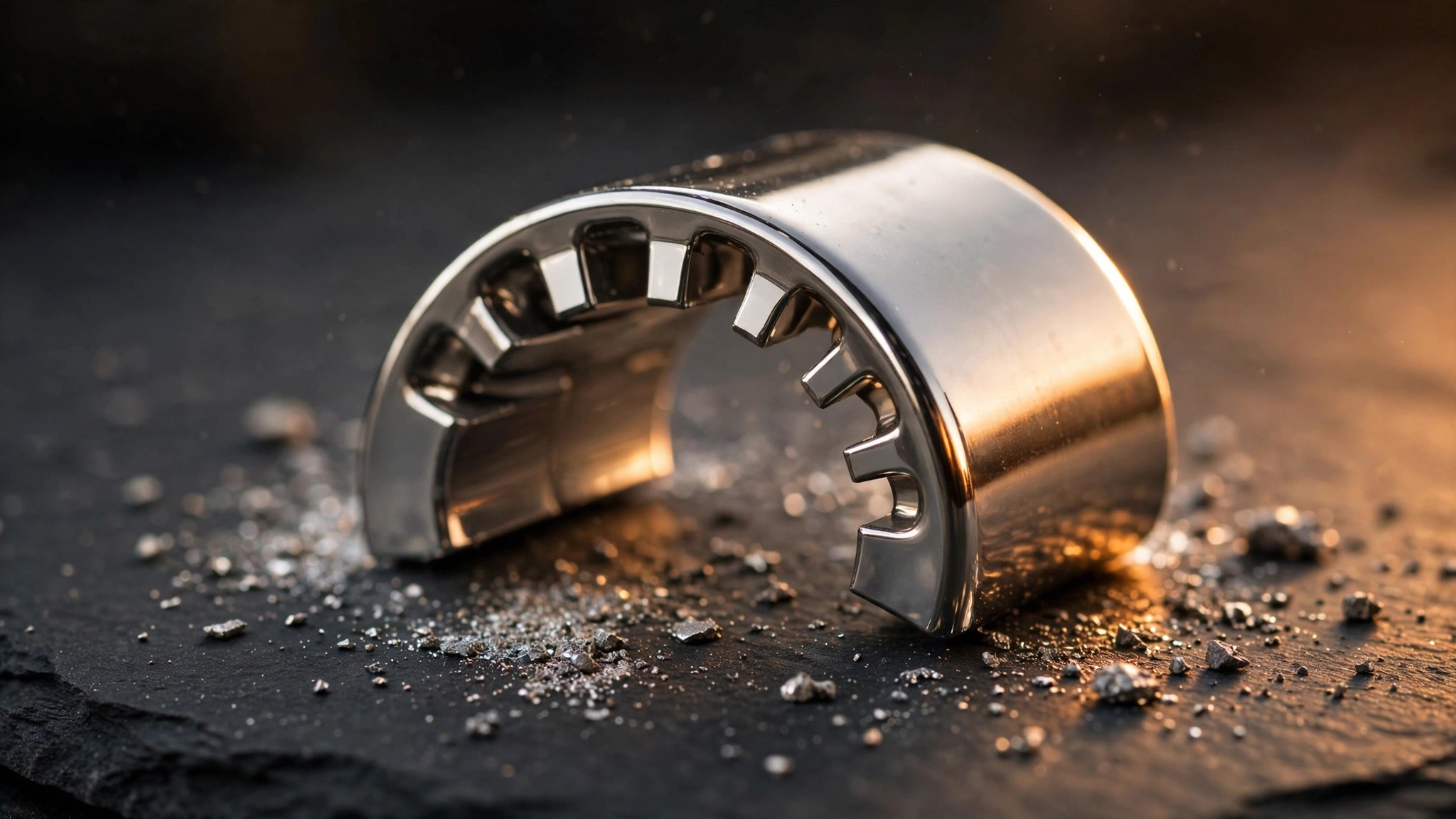
Their approach was Laser Powder Bed Fusion, a form of metal 3D printing in which a laser melts fine metal powder layer by layer, building a solid object from the bottom up with each layer approximately 50 micrometers thick, comparable to the thickness of a melt-spun ribbon. The laser melts a thin stripe of powder, the surrounding unmelted powder and the previously solidified layers act as a heat sink, and the newly melted material solidifies in microseconds.
That cooling rate is fast enough, and the reason is almost elegant in its simplicity. Because each layer is only 50 micrometers deep, the thermal mass is tiny and the heat dissipation path is short, so the alloy quenches into its amorphous state before the atoms have time to nucleate crystals. No post-processing. No annealing. Just geometry doing thermodynamics' work. Layer after layer, the process builds fully amorphous motor components with the complex shapes that eluded ribbon-based manufacturing for decades, including teeth, slots, channels, and compound curvatures that no stamping die or ribbon-stacking process could ever produce. Whatever the CAD model specifies, the printer builds, without cutting a single piece of amorphous material.
Finding the right alloy was the harder part, because the composition must satisfy three constraints simultaneously: it must vitrify, meaning it must form an amorphous glass rather than crystallize during printing; it must have soft magnetic properties suitable for motor cores, which means high permeability and low coercivity in the relevant frequency range; and it must be compatible with the LPBF process itself, meaning the powder must melt cleanly, wet the substrate, and solidify without cracking or delamination between layers. Busch's team screened hundreds of compositions across a five-dimensional compositional space, each alloy containing five elements with iron content between 70 and 80 percent, and only three alloys passed all three gates.
"We selected hundreds of alloys and tested their resistance to crystallization," Busch told Saarland University's press office. "In an alloy containing five elements, that meant searching through a five-dimensional compositional space. If an alloy fails, it's back to the drawing board for a complete redesign."
The breakthrough, he said, came just over a year before the project's February 2026 conclusion. Three alloys out of hundreds. Four years of searching.
What This Changes for EV Motors
Modern EV motors have gotten very good at reducing losses everywhere except the iron core. Copper losses have fallen through better winding techniques, hairpin stators with flat rectangular conductors that pack more copper into each slot, and shorter end turns that reduce resistive path length. Rotor losses have dropped through optimized magnet arrays and improved squirrel-cage or reluctance designs. Power electronics losses keep shrinking as silicon carbide inverters replace silicon IGBTs with their faster switching speeds and lower conduction resistance. In a well-designed modern drive unit, the stator core loss has become the dominant remaining inefficiency, which makes it the biggest remaining opportunity for anyone willing to change the core material.
Replace the silicon steel lamination stack with an amorphous alloy core, and the arithmetic is straightforward even after accounting for trade-offs. An order-of-magnitude reduction in core loss, adjusted for the amorphous material's lower saturation flux density of roughly 1.56 tesla versus 2.0 to 2.2 tesla for common silicon steels, yields a net system efficiency improvement of 2 to 5 percentage points depending on the operating envelope. At highway cruise, where the motor runs at moderate load and high frequency for sustained periods, the gain concentrates precisely where range-conscious drivers need it most.
Two to five percentage points of motor efficiency at cruise translates to roughly 3 to 8 percent more range on a highway drive cycle, assuming constant pack capacity. On a 300-mile-rated EV, that is 9 to 24 additional miles before the driver needs a charger. Real miles. The kind that change a purchase decision for a buyer hovering near the range-anxiety threshold.
There is a secondary benefit that the specification sheets will not capture directly, and it may matter more than the efficiency number in real-world driving. Less core loss means less heat generated inside the stator, which means the motor can sustain peak power longer before thermal derating kicks in. For a performance EV making repeated hard pulls, whether at a track day or merging onto a highway on-ramp three times in ten minutes, thermal headroom is the difference between consistent power delivery and the silent, dispiriting fade of a control unit quietly pulling back output to save the motor from itself.
The Saturation Trade-Off
Nothing in materials science is free, and amorphous iron alloys pay for their magnetic obedience with a lower ceiling. They saturate magnetically at about 1.5 to 1.6 tesla, well below the 2.0 to 2.2 tesla typical of grain-oriented or non-oriented silicon steels. Saturation flux density determines how much magnetic flux a given cross-section of core material can carry: below saturation, permeability is high and the motor operates efficiently, but above it the core effectively becomes transparent to additional flux, the motor loses torque capability, and the drive must compensate with more current, which means more copper loss eating into the efficiency gain you thought you had.
Lower saturation means you either accept a smaller peak torque envelope or use more core material to carry the same flux, and more material means a larger, heavier motor that partially offsets the efficiency benefit. The permeability advantage of amorphous alloys, one to two orders of magnitude higher than silicon steel below saturation, partially compensates by allowing the motor to operate at lower flux densities for a given performance level, but the trade-off is real and motor designers will have to resize their magnetic circuits accordingly.
For high-speed motors running at 15,000 rpm and above, where iron losses in silicon steel are enormous and the motor already operates below peak flux density most of the time, the trade favors amorphous alloys overwhelmingly because the loss reduction dwarfs the saturation penalty. For low-speed, high-torque applications like direct-drive wheel motors, where peak flux density matters and operating frequency is low enough that iron losses in silicon steel are manageable, the case is weaker and probably does not justify the manufacturing premium. Motor design is always a conversation between constraints, and the optimal core material depends on which constraint is loudest.
What Still Has to Happen
The AM2SoftMag project ran from 2022 to February 2026, funded by €3.5 million from the European Innovation Council under Horizon Europe's Pathfinder Open program, and it demonstrated feasibility without pretending to demonstrate production readiness, which is an honest distinction that too many research announcements blur.
LPBF is slow, and that is the bluntest constraint standing between a laboratory proof of concept and an automotive production line. Building a full stator core layer by layer at 50-micrometer resolution takes hours, not the seconds required for a stamped lamination stack. For prototype motors, aerospace applications, and high-value niche drives, that build time is acceptable. For a mass-market EV motor line producing thousands of units per day, it is not even close, and scaling LPBF to automotive production volumes will require either dramatically faster laser systems, multi-laser configurations that parallelize the build, or entirely different additive manufacturing approaches that maintain the required cooling rates at higher throughput.
Powder cost is another constraint that scales unfavorably in the near term. Iron-rich amorphous alloy powder suitable for LPBF is not a commodity material, and current pricing reflects small-batch production by specialty suppliers like Heraeus AMLOY Technologies in Karlstein am Main. At automotive scale, powder production would need to industrialize, with atomization plants dedicated to the specific alloy compositions that Busch's team identified, and whether the powder can be produced at a cost competitive with electrical steel laminations, which rank among the cheapest precision components in any motor, remains genuinely uncertain.
Then there is qualification, which is the step where promising materials science goes to wait in line for years. Every motor core in a production vehicle must survive thermal cycling, vibration, humidity, and mechanical load over a 15-year, 150,000-mile warranty period. Stamped silicon steel laminations have decades of field data behind them, while 3D-printed amorphous alloy cores have laboratory characterization and not a single mile of road validation. The gap between "works in the lab" and "survives the warranty" is measured in years of testing, and no automaker will skip it regardless of how compelling the physics may be.
But the physics is settled, and it has been settled since the Reagan administration. Amorphous alloys are better soft magnetic materials for AC motor applications, period, full stop, no caveats required. What changed in 2026 is that someone finally demonstrated a manufacturing process that can produce them in motor-relevant geometries without destroying the amorphous structure that makes them worth using. The rest is engineering, scale, and money, and those are solvable problems because the physics, which was the genuinely hard part, was solved forty years ago. Now the manufacturing has caught up, and the question is no longer whether amorphous motor cores are better but how fast the industry can learn to build them.