Cars / Electric Powertrain Engineering
The 530-Kilowatt Number: Mercedes-AMG's GT SUV Makes Sustained Power the Spec That Matters
On October 17, 2026, AMG unveiled its first fully in-house SUV. Peak output reads 1,169 PS. Beside it sits the honest figure: 530 kW of continuous output, and the entire engineering of the car exists to defend that number.
Peak horsepower used to be an engine's biography. One number told you about displacement, aspiration, redline, and the courage of the engineers who signed off on it. Electric motors broke that contract, because in the EV era peak output is largely a question of how many motors you are willing to parallel and how long you are willing to tolerate the heat, which means the headline number now describes a party trick measured in seconds. What it cannot tell you is what happens on the fourth lap.
Mercedes-AMG appears to have noticed: unveiled October 17, 2026, the GT SUV is the first full-size SUV AMG has developed entirely in-house in its 59-year history, and only the second vehicle on the dedicated AMG.EA high-performance architecture after the GT 4-Door Coupé. Three axial-flux motors from British outfit YASA carry the flagship GT 63: a peak of 860 kW, which is 1,169 PS or about 1,153 horsepower, plus up to 2,000 Nm of torque. It is more than the AMG One hypercar's 1,048 hp, and it arrives on a more-than-2.6-tonne five-seater. None of that is the interesting number; the interesting one sits printed beside it: 530 kW of continuous output, somewhere around 62 percent of peak, sustained.
Continuous output is the spec the electric performance segment has been declining to discuss for years. Most headline EV figures are burst ratings, so nobody publishes the number that survives ten minutes of abuse: nobody has wanted to defend it. AMG just volunteered the figure, and Dr. Jörg Burzer, Mercedes-Benz's CTO, paired it with the claim that electric performance "no longer requires any compromises" in sustained power, range, or charging. That is either a dare or a thesis. Either way, the hardware behind the claim is the story.
The cooling is the car
Sustained electric power is, at bottom, a heat problem. Motors generate waste heat in their windings; gearboxes generate it in their meshes; inverters generate it in their switches; batteries generate it in their cells. Every one of those components has a temperature ceiling, and the continuous-power rating of the system is set by whichever of them hits its ceiling first. Raising the rating means lowering temperatures, and lowering temperatures means cooling that is more aggressive, more direct, and harder to package.
AMG's answer starts with the battery: the GT SUV runs an 800-volt pack in 106 and 128 kWh versions, built from 18 and 22 modules of cylindrical cells, each cell 4.1 inches tall and an inch in diameter. Dielectric oil that does not conduct electricity flows directly around every cell, pulling heat from the metal with no cold plate and no thermal interface material in between. It is the most direct possible way to cool a cell, and AMG traces the concept to Formula 1 battery thinking, which is where high-power cell arrays with aggressive direct cooling have lived until now. A pack this size, cooled this directly, holds the continuous-power argument together. Energy density is quoted above 298 Wh/kg from an NCMA cathode with a silicon-containing anode, and the big pack is rated for 700 km on the WLTP cycle at 21.2 kWh per 100 km.
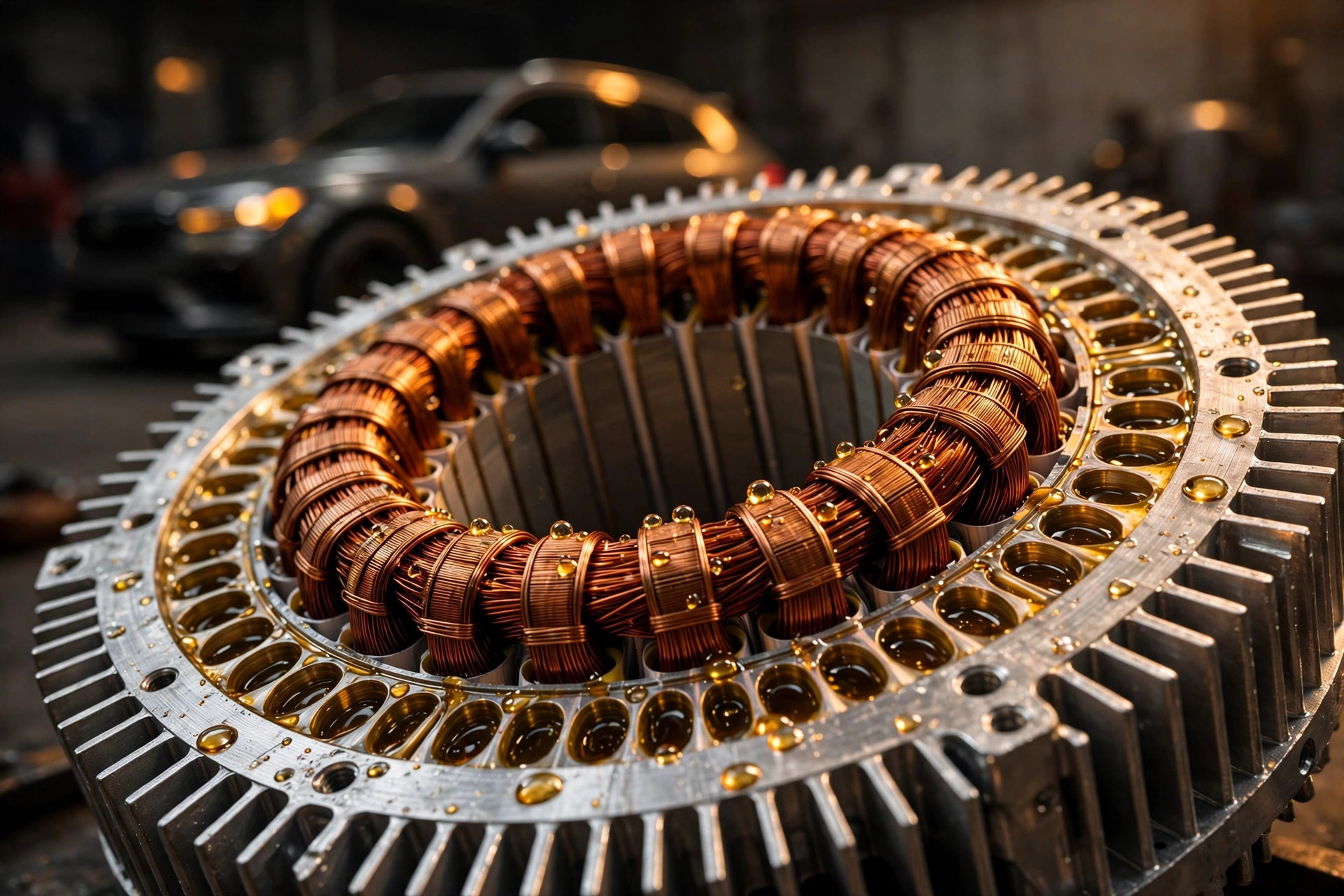
Then the motors: two of the three YASA axial-flux units live at the rear axle in a single compact drive unit, each with its own planetary gearbox inside a shared housing. Both the motors and their gearboxes are oil-cooled, which matters because the planetary reduction is where continuous torque turns into continuous heat. Axial-flux machines are already the packaging answer to the power-density question; we covered YASA's motor architecture in detail earlier this year. But a pancake motor's short thermal path works in both directions: it concentrates power and it concentrates heat. Oil on the gears and windings is what lets the burst number and the sustained number coexist in the same housing.
Two water-cooled silicon carbide inverters finish the chain, and the SiC detail deserves a pause. Silicon carbide switches lose less energy as heat than conventional silicon IGBTs at high currents, which means they stay cooler under the same load and can switch at higher frequencies for finer control. Less waste heat at the inverter is directly load taken off the cooling system, and the cooling system is what determines the continuous rating. This is the whole thesis in miniature: 530 kW is not a motor spec; it is a cooling spec.
Disconnects, two-speeds, and the honesty of the GT 53
Power is only half the design problem; not wasting it is the other half. In the GT 63 and GT 55, the third motor sits at the front axle and works as a booster that a disconnect unit decouples under light load, removing its mechanical drag from the efficiency equation when the rear motors suffice. Fully variable AMG Performance 4MATIC+ then distributes torque continuously across axles according to conditions. It is the EV version of a habit AMG knows from the mechanical all-wheel-drive era: build for the violent case, then disconnect your way to efficiency for the boring one.
More revealing, in some ways, is the entry GT 53. It skips the axial-flux hardware entirely and runs two conventional synchronous motors, one per axle, for a combined 400 kW (544 PS), with a two-speed transmission on the rear axle balancing acceleration against high-speed efficiency. A two-speed EV gearbox is an admission that direct drive is a compromise: one ratio optimized for launch is wasted at Autobahn speeds, and one ratio optimized for cruising wastes the motor at launch. Porsche's Taycan made this argument years ago; AMG's willingness to put a two-speed on the base model while the flagship runs single-ratio planetary units suggests the gearbox decision was made car by car, not by brand ideology.
There is also something to be said for the charging figures being presented as capability rather than guarantee. That 710 kW peak for the GT 55 and GT 63, the 10-to-80 percent run in 11 to 12 minutes on the 128 kWh pack, the 450 km of range added in 10 minutes: these numbers depend on a charger that can actually deliver 710 kW, and virtually none can today. AMG has published vehicle-side potential, and the coverage so far has treated it that way. Publishing the continuous output figure while being honest that the charging figure is infrastructure-limited is, on balance, a grown-up way to do a launch.
Mass, managed
None of this is free: at 5.08 meters long and more than 2.6 tonnes, the GT SUV's chassis engineering reads like a list of compensations for mass: AMG ACTIVE RIDE CONTROL+ with active pitch and roll stabilization, standard on the GT 63, rear-wheel steering with up to 6 degrees of steering angle, and active aerodynamics including a roof spoiler and front air panel. Carbon-ceramic brakes are standard equipment on the flagship. These are the right answers to the weight question, and they are also the most expensive possible answers.
AMG measured the GT 63's 0 to 100 km/h time of 2.5 seconds on a one-foot rollout basis, the drag-strip convention that subtracts the first 30 centimeters of launch from the clock. The 0 to 200 km/h figure is 6.8 seconds, and top speed is 270 km/h with the Driver's Package. One-foot rollout is standard practice in the American press, but it flatters the standing-start number by roughly two tenths. Know the convention and the number reads correctly.
Inside the cabin, the AMGFORCE Sport+ program recreates the sound of an AMG V8 or six-cylinder engine, complete with simulated gear changes and seat shakers. This is the one place where the launch feels insecure. A car that can honestly publish 530 kW continuous does not need to pretend to be a V8, and simulating gear changes in a vehicle whose actual drivetrain philosophy is seamless torque is an odd tribute to a past the car is busy replacing. Leave the shakers in the menu, by all means. But the engineering here is the sound of the future, and it should not be embarrassed to make it.
What the number changes
The GT SUV reaches US dealerships in summer 2027, with the GT 53 taking German orders from October 20, 2026 and the GT 55 and GT 63 following in spring 2027. By then the question will be whether the continuous figure becomes a convention. If AMG's 530 kW stands alone, it is a marketing flourish. If rivals are forced to publish their own sustained numbers, the entire performance-EV segment gets more honest overnight, because a continuous rating is much harder to fudge than a peak: it is the whole cooling system, audited.
Peak figures will keep their headlines; they are too much fun to retire. But the useful number was always the second one, the one that survives the fourth lap, and it took AMG's first in-house SUV to say it out loud. "SUV by shape. GT by nature," as AMG chairman Dr. Stefan Weckbach put it at the reveal. For fifty-nine years the badge meant a big engine in an improbable place. The new translation is a thermal budget in an improbable place. It is not the AMG anyone grew up with. It may be the first AMG that tells you the whole truth about power.
GT SUV range: key figures
| Debut | October 17, 2026; first full-size SUV developed entirely in-house by AMG in its 59-year history; second model on the AMG.EA architecture |
|---|---|
| GT 63 powertrain | Three YASA axial-flux motors: rear drive unit with two motors, each with its own planetary gearbox in a shared housing; front motor with disconnect unit |
| GT 63 output | 860 kW peak (1,169 PS / ~1,153 hp), 530 kW continuous (721 PS / ~711 hp); up to 2,000 Nm (1,480 lb-ft) |
| GT 55 output | Same tri-motor layout at 600 kW (816 PS); 0 to 200 km/h in 9.4 seconds |
| GT 53 output | Two synchronous motors, 400 kW (544 PS); two-speed transmission on rear axle; up to 668 km WLTP |
| Performance (GT 63) | 0 to 100 km/h in 2.5 s (one-foot rollout basis); 0 to 200 km/h in 6.8 s; 270 km/h top speed with Driver's Package |
| Battery | 800 V; 106 / 128 kWh usable (18 / 22 modules); cylindrical cells 4.1 × 1.0 in with direct dielectric oil immersion cooling; NCMA cathode, silicon-containing anode; >298 Wh/kg energy density |
| Charging | Up to 710 kW DC (GT 55 / GT 63); 600 kW (GT 53); 10 to 80% in 11 to 12 min on the 128 kWh pack; figures are vehicle-side capability, infrastructure-dependent |
| Range | Up to 700 km WLTP (128 kWh); 21.2 kWh/100 km consumption |
| Chassis | AMG ACTIVE RIDE CONTROL+ (active pitch and roll stabilization); rear-wheel steering up to 6 degrees; active aerodynamics (roof spoiler, front air panel); carbon-ceramic brakes standard on GT 63 |
| Inverters | Two water-cooled silicon carbide inverters |
| Dimensions / mass | 5.08 m long; over 2.6 tonnes; built at Sindelfingen |
| Availability | GT 53 order books open October 20, 2026 (Germany); GT 55 and GT 63 follow spring 2027; US dealerships summer 2027 |
Sources: Mercedes-AMG GT SUV reveal coverage, Oct 17-19, 2026: GTspirit, “Mercedes-AMG GT SUV Revealed with Up to 1,169 PS & 700km Range,” Oct 19, 2026; Review Central Middle East, “Mercedes-AMG unveils all-new GT SUV,” Oct 19, 2026; ArenaEV, “Affalterbach reveals the 1,169 hp Mercedes-AMG GT SUV,” Oct 19, 2026; FreshMotors, “2027 Mercedes-AMG GT SUV: Up to 1,153 hp and 700 km,” Oct 19, 2026; GSMDome, “Mercedes-AMG GT SUV Debuts With Up to 1,169 hp and 710 kW Charging,” Oct 19, 2026; The EV Report, “Mercedes-AMG GT SUV Debuts With 1,153 HP and 710-kW Charging,” Oct 19, 2026; eMobility Online, “Mercedes-AMG GT SUV: Electric Performance Meets Luxury,” Oct 19, 2026; NamasteCar, “Mercedes-AMG GT SUV Debuts With 1,169 HP,” Oct 18, 2026. YASA axial-flux motor background: this site, Mercedes-AMG YASA axial-flux motor, June 2026. Cell chemistry, oil-immersion cooling, and charging figures are per Mercedes-AMG materials as reported by these outlets; charging figures are vehicle-side capability and infrastructure-dependent. This author has not driven the vehicle; all measurements are per published sources.