A conventional rear wing needs airspeed to function. At 200 kilometers per hour, a Formula 1 car's multi-element rear wing generates perhaps 800 kilograms of downforce through pressure differential across its surfaces. At zero kilometers per hour, the same wing produces nothing at all, as inert and useless as a spoiler bolted to a car on a showroom floor.
The McMurtry Spéirling PURE breaks this rule. Completely.
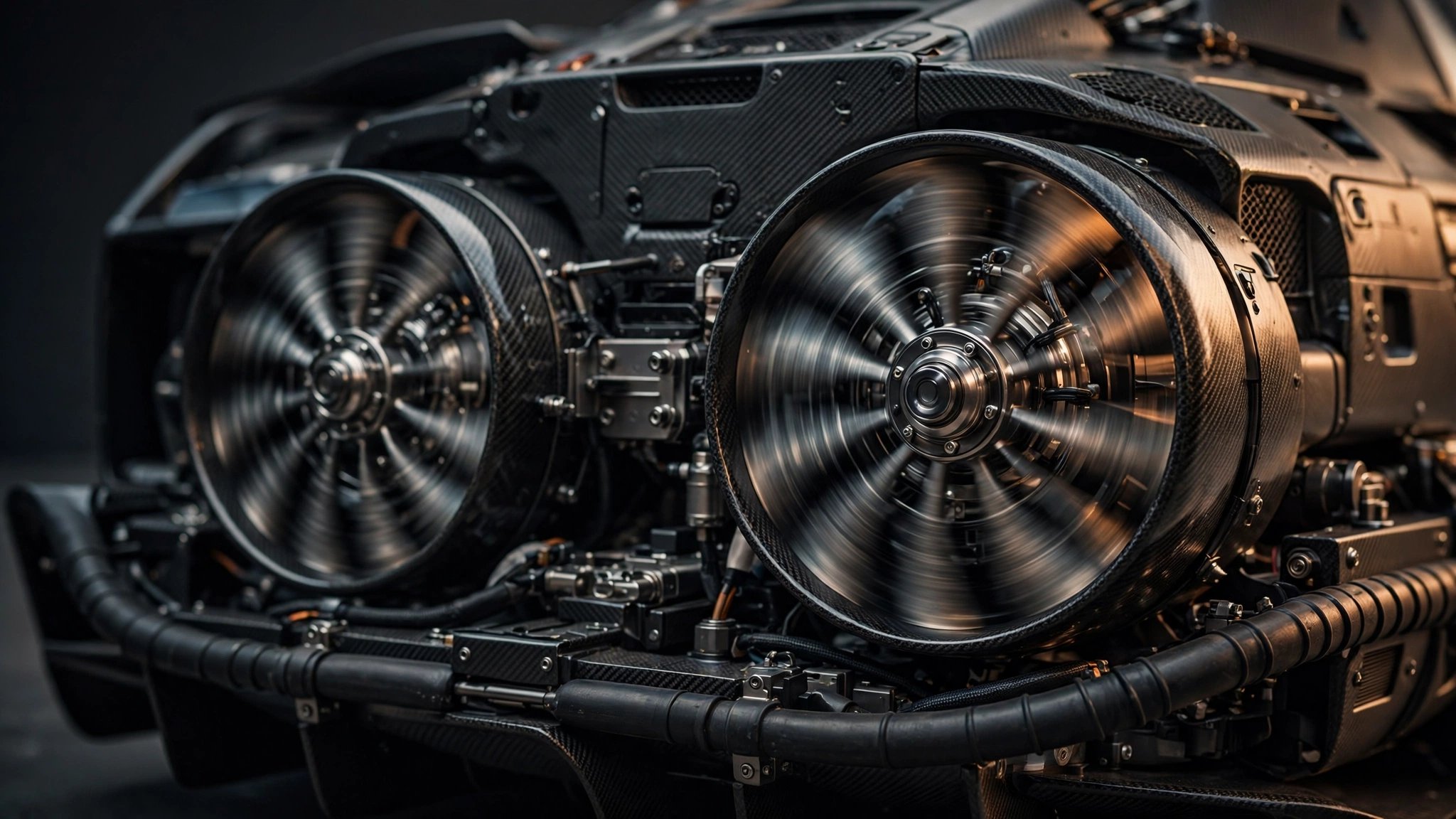
Standing still in a pit lane, engine off, two fans spinning behind the cockpit, the car pushes 2,000 kilograms of force into the ground beneath it. That figure exceeds the car's own mass of 1,350 kilograms by nearly fifty percent. In April 2025, co-founder Thomas Yates drove a validation prototype upside down on a rotating platform at the company's Gloucestershire headquarters to prove the point: the downforce holds at any orientation, at any speed, including none.
The Spéirling PURE, which entered production in 2026 with customer deliveries beginning before year's end, is the first fan car a civilian can buy. Just 100. They will be built at roughly two per month, starting from £995,000 before taxes. Its engineering has been attempted, protested, banned, revived, and banned again across five decades of motorsport controversy, beginning with a drawing of a beanie cap that arrived in Jim Hall's mailbox in the late 1960s.
The Physics of Mechanical Downforce
Aerodynamic downforce relies on Bernoulli's principle applied to shaped surfaces moving through air. Wings work because curved upper surfaces accelerate airflow, reducing static pressure above relative to below, and ground effect extends this principle by using the shaped undertray of a car to accelerate airflow in a constricting channel, reducing pressure beneath the floor. Both mechanisms scale with the square of velocity: double the speed and you quadruple the downforce, halve it and you lose three-quarters of your grip, which means a wing that pins a car to the track at 250 kilometers per hour contributes essentially nothing in a 60-kilometer-per-hour hairpin.
Fan-assisted downforce operates on a different principle altogether. Seal the underside of the car against the road surface, evacuate air from that sealed cavity, and the atmospheric pressure above the car presses down against the low-pressure region beneath it, producing a net downward force that depends on seal quality and the fan's pumping capacity rather than on how fast the car is traveling.
Think of it as an inverted hovercraft: a hovercraft pumps air into a skirted cavity to float above the surface, while a fan car pumps air out of a skirted cavity to press against it, and the math is the same with the sign flipped. Simple in theory. Brutally difficult in practice. The engineering problem shifts from maintaining a positive pressure cushion to maintaining a negative pressure seal against an uneven, abrasive road surface while a car weighing over a tonne slides across it at 300 kilometers per hour.
The Chaparral 2J: Proof and Prohibition
Jim Hall built the first fan car for competition in 1970, entering the Chaparral 2J into the Canadian-American Challenge Cup series. Hall was relentless. Hall had been the first constructor to mount a wing directly to a race car's suspension, on the 1966 Chaparral 2E, and when adjustable wings were subsequently banned following structural failures on poorly copied F1 imitations, he needed another approach to generating downforce independent of body shape.
Inspiration arrived as a sketch from a fan: a crude drawing of a car that looked like a child's beanie cap, with a propeller mounted on top. Hall's team adapted the concept, and instead of a propeller on the roof they installed two 17-inch fans at the rear, driven by a separate 45-horsepower two-cylinder Rockwell JLO snowmobile engine. Sliding polycarbonate skirts hung from the car's perimeter, maintaining roughly a one-inch gap to the track surface to complete the seal.
Nobody had seen anything like it. The 2J generated approximately 1,000 kilograms of downforce at standstill, allowing cornering forces that nothing else in Can-Am could approach. Vic Elford posted a sub-one-minute qualifying lap at Laguna Seca that remained a remarkable benchmark decades after the car was outlawed and dismantled. Pole position fell to the 2J at nearly every event it entered, and it never won a single one of them because the auxiliary snowmobile engine proved chronically unreliable, failing repeatedly before the checkered flag. Competitors filed protests alleging the sliding skirts constituted an illegal movable aerodynamic device, and that debris thrown rearward by the fans endangered other drivers. After a single season, the SCCA banned the car outright. Hall's assessment was philosophical: "If I can come up with a better mousetrap that is within the regulations, I ought to be allowed to use it."
The Brabham BT46B: One Race, One Win, Voluntary Withdrawal
Gordon Murray watched what ground effect aerodynamics did to Formula 1 in 1977 and 1978 with considerable interest and limited options. Colin Chapman and Peter Wright's Lotus 79 used shaped undertrays and sliding skirts to create Venturi-effect ground effect, and it destroyed the field. Murray understood the physics but faced a packaging problem: the flat-12 Alfa Romeo engine bolted into the back of his Brabham BT46 was too wide and too bulky to permit the underfloor channels that made Venturi ground effect work.
Murray's answer was brutal. He bolted a large horizontally mounted fan to the rear of the BT46, creating the BT46B, and claimed at the time that the fan's primary function was engine cooling with the aerodynamic effect being merely incidental. His claim was transparently disingenuous, a fig leaf of justification that nobody in the paddock or the press or the FIA took seriously for a moment. Everyone knew it. Niki Lauda drove the BT46B to victory at the 1978 Swedish Grand Prix at Anderstorp, its only race entry. Brabham then withdrew the car voluntarily before it was formally banned, partly under pressure from other teams, partly because Bernie Ecclestone recognized the political damage of running a car that made the rest of the grid look incompetent.
Two attempts at competitive fan cars, two bans, and fifty-six years of silence between the Chaparral 2J's debut and the McMurtry Spéirling PURE rolling off a production line in a Gloucestershire village called Wotton-under-Edge.
Why This Isn't the T.50
Gordon Murray revisited fans in the T.50 supercar, but his application is fundamentally different. Murray's T.50 employs a single 400-millimeter carbon fiber fan that operates as a boundary layer management device. It energizes the airflow passing through the rear diffuser by drawing in the slow-moving boundary layer air that would otherwise stall the diffuser. Depending on driving conditions, the fan switches between aerodynamic modes, adjusting the car's downforce balance, but it does not create a sealed low-pressure cavity beneath the car. It cannot generate downforce at zero speed because it relies on incoming airflow that it then redirects and accelerates.
McMurtry's approach is closer in principle to the Chaparral 2J because it does not manage airflow passing through a diffuser but instead creates a partial vacuum by sealing the floor and pumping the air out, letting atmospheric pressure do the rest. Where the T.50's fan serves as a sophisticated aerodynamic aid that enhances existing airflow, the Spéirling's fans are mechanical downforce generators operating on thermodynamic principles rather than aerodynamic ones, and that distinction is why one works at 200 kilometers per hour while the other works at zero.
Engineering the Seal
The sealed-skirt system is where the Chaparral 2J's greatest weakness becomes the Spéirling PURE's central engineering challenge. Hall used rigid polycarbonate skirts that maintained a fixed one-inch gap to the road. Air leaked constantly through that gap, limiting the achievable vacuum, and the skirts wore against rough pavement, degrading seal quality over the course of a race.
McMurtry's answer was material science. The company replaced rigid skirts with rubber compound skirts designed to contact the road surface directly, creating a far more effective seal than a fixed-gap arrangement. For the production PURE, McMurtry developed redesigned skirt material rated for thousands of miles of track use before replacement is required. An onboard air compressor allows the skirts to retract, so the car can be loaded onto a trailer or maneuvered at pit-lane speeds without dragging its seals across concrete. Previous prototypes required an external compressed air bottle to lift the skirts, a clumsy arrangement that the production car eliminates.
This is where theory meets tarmac. Seal integrity under dynamic conditions presents the real engineering puzzle. A car cornering at 3g loads its outside suspension heavily and unloads the inside, which changes ride height asymmetrically. Road surface irregularities, curbing, and track camber all threaten to break the seal momentarily. McMurtry's solution appears to involve compliance in the skirt mounting, allowing the seals to follow surface changes passively while the fans maintain pumping capacity sufficient to sustain useful vacuum even with intermittent leakage.
23,000 RPM and the Redundancy Question
The two fans sit behind the cockpit, relocated lower in the production car than in the prototype to reduce the center of gravity. Each fan spins at up to 23,000 RPM, drawing air from the sealed underbody cavity through filtered inlets and expelling it rearward through a central tunnel. Expelled rearward through a central tunnel, the air produces what observers describe as a jet-engine scream, incongruous from an electric vehicle but entirely consistent with the physics of high-speed rotating machinery moving large volumes of air.
McMurtry chose a dual-fan configuration explicitly for redundancy. If one fan fails mid-corner, the remaining fan continues generating downforce, and the car remains controllable. This addresses one of the Chaparral 2J's fatal competitive flaws: its single auxiliary engine was a single point of failure. One failure, total loss of grip. When it quit, which happened often, the car lost all mechanical downforce simultaneously. A driver carrying 1,000 kilograms of additional grip into a corner at 200 kilometers per hour does not want that grip to vanish between the apex and the exit.
Beyond straight-line redundancy, the dual configuration maintains downforce during a spin. Wings stall in a spin. Airflow separates from wing surfaces the moment the car rotates past its designed angle of attack, and all that carefully engineered downforce evaporates at precisely the moment the driver needs it most. Fan-generated vacuum does not depend on airflow direction. Fan-generated vacuum operates independently of yaw angle, which means a driver who loses control still has more grip available during recovery than a conventional car would, accelerating the deceleration from a spin into a controlled stop.
Powertrain: 1,000 Horsepower, Rear-Wheel Drive, 1.55 Seconds
The electric powertrain pairs two Helix drive motors on the rear axle, producing a combined 986 horsepower. Battery capacity nearly doubled. A 100-kilowatt-hour pack replaces the prototype's 60-kilowatt-hour unit. Packaging that larger cell required extending the wheelbase from 2.0 to 2.2 meters, which incidentally improved weight distribution and high-speed stability.
Even by hypercar standards, the performance numbers are absurd. Zero to 60 miles per hour takes 1.55 seconds with a one-foot rollout, making the Spéirling PURE the fastest-accelerating car ever tested. Top speed reaches 190 miles per hour, cornering forces hit 3g, and braking forces match that figure, aided by regenerative braking that recovers up to 200 kilowatts regardless of state of charge, paired with Brembo carbon ceramic discs for the remaining deceleration.
Range at race pace reflects the priorities of a track-only weapon. At LMP2 speeds, the battery sustains approximately 50 kilometers of running before requiring a charge. Charging from 20 to 95 percent takes as little as 20 minutes under ideal conditions, though ambient temperature and charger output create real-world variation. McMurtry offers an optional portable 100-kilowatt-hour power bank for tracks without high-speed charging infrastructure, delivering up to 120 kilowatts of DC fast charge from a towable unit.
From Prototype to Production: 95 Percent New
McMurtry describes the production PURE as incorporating approximately 95 percent new components compared to the prototype that set the 39.08-second Goodwood hillclimb record in 2022. That record still stands, and the car that set it was a hand-built technology demonstrator with a smaller battery, narrower track width, and prototype-grade skirts. That is an extraordinary attrition rate. Turning it into something a customer can operate at track days without a full engineering support crew required rethinking nearly everything except the core principle.
Compared to the prototype, the production car grew 14 percent wider and 11 percent longer. It weighs 1,350 kilograms, roughly 300 kilograms more than the record-setting machine, with most of that mass attributable to the larger battery and the additional structure required to house it. A new swan-neck rear spoiler with reinforced central struts supplements the fan-generated downforce at higher speeds. Headlights, brake lights, indicators, and hazard flashers make the car legal for the track day events and time attack competitions that require road-car signaling equipment, a concession to regulation that the hand-built prototype never needed because it only ever ran at private test sessions and the Goodwood hillclimb.
Steering changed entirely, from the prototype's electric power assist to a hydraulic system with what McMurtry describes as Formula 1-style valving, providing lighter effort and more granular feedback. Electronically adjustable dampers are available as an option, replacing the fixed-rate units on the prototype and allowing owners to tune suspension response between sessions without swapping physical hardware.
Inside, the cockpit accommodates drivers up to 6 feet 7 inches tall and 150 kilograms, with adjustable pedals and steering wheel and a custom-molded seat. A boot compartment behind the driver stores a helmet and HANS device. Pragmatic details, all of them. They matter when a car costs over a million pounds and the owner intends to drive it rather than display it.
The Competition Landscape
The Spéirling PURE is designed for time attack competition: Global Time Attack in the United States, European Time Attack Masters, and GT1 Sports Club events. In these formats, where outright pace over a single lap or short stint determines the result, fan-assisted downforce provides advantages that conventional aerodynamics cannot match. Low-speed corners, where wings produce minimal downforce, become as grippy as high-speed sweepers. Braking zones shorten dramatically because the car maintains full mechanical grip at any deceleration rate regardless of whether it enters the braking zone at 250 kilometers per hour or 80. Launch traction is effectively unlimited because the car has more vertical force pressing its tires into the pavement than its own weight can provide.
Whether fan cars remain legal in these series is an open question. Jim Hall's Chaparral 2J lasted one season before the SCCA banned it. Murray's BT46B lasted one race before voluntary withdrawal made a formal ban unnecessary. History is not encouraging. But motorsport sanctioning bodies in 2026 face a different argument than their predecessors did in 1970 or 1978. Fan-assisted downforce is no longer a secret weapon sprung on an unsuspecting paddock. McMurtry has demonstrated the technology publicly for four years, set records that still stand, and developed a production car that any sufficiently funded enthusiast can purchase. Banning a technology after it becomes commercially available and widely understood creates a different political dynamic than banning a prototype fielded by a single factory team.
What Changed in 56 Years
The Chaparral 2J's core problem was never the physics, which worked beautifully from the very first test session, but rather the engineering surrounding it: an unreliable auxiliary engine, rigid skirts that wore out, a single-fan system with no redundancy, and the political environment of a racing series where competitors had the standing to protest a car that made them look slow.
McMurtry solved each engineering problem methodically. Electric fan motors replace the auxiliary combustion engine, eliminating the 2J's most frequent failure mode. Compliant rubber skirts rated for thousands of miles replace rigid polycarbonate panels that degraded within a single race. Dual fans provide redundancy against single-fan failure. An onboard air compressor manages skirt retraction without external equipment. And the political problem disappears entirely when you sell the car to private owners running time attack events rather than entering a factory-backed prototype into a championship with other constructors' cars.
Yes, the production Spéirling PURE weighs more than the prototype. It is wider and longer and heavier, and it is also, by any reasonable measure, considerably more capable: better thermal management from the larger battery, more durable skirts, more refined fan positioning, hydraulic steering with greater feel, and the option of electronically adjustable dampers. McMurtry has taken a record-breaking technology demonstrator and turned it into a vehicle that someone can trailer to a track, unload using the retractable skirt system, charge from a portable power bank, and lap faster than anything short of a current-generation Formula 1 car.
The fans spin, the skirts seal, and the atmosphere pushes down, and the physics that Jim Hall proved in 1970 and that Gordon Murray exploited in 1978 and that the rest of motorsport spent half a century trying to outlaw finally has a product number, a price tag, and a waiting list of buyers who have read the fine print and signed the check anyway.