Fixed Seats, Raised Floors, and a Wing That Grows Backwards: The Structural Logic of McLaren's W1
Pre-Preg and Pressure: How the Aerocell Gets Built
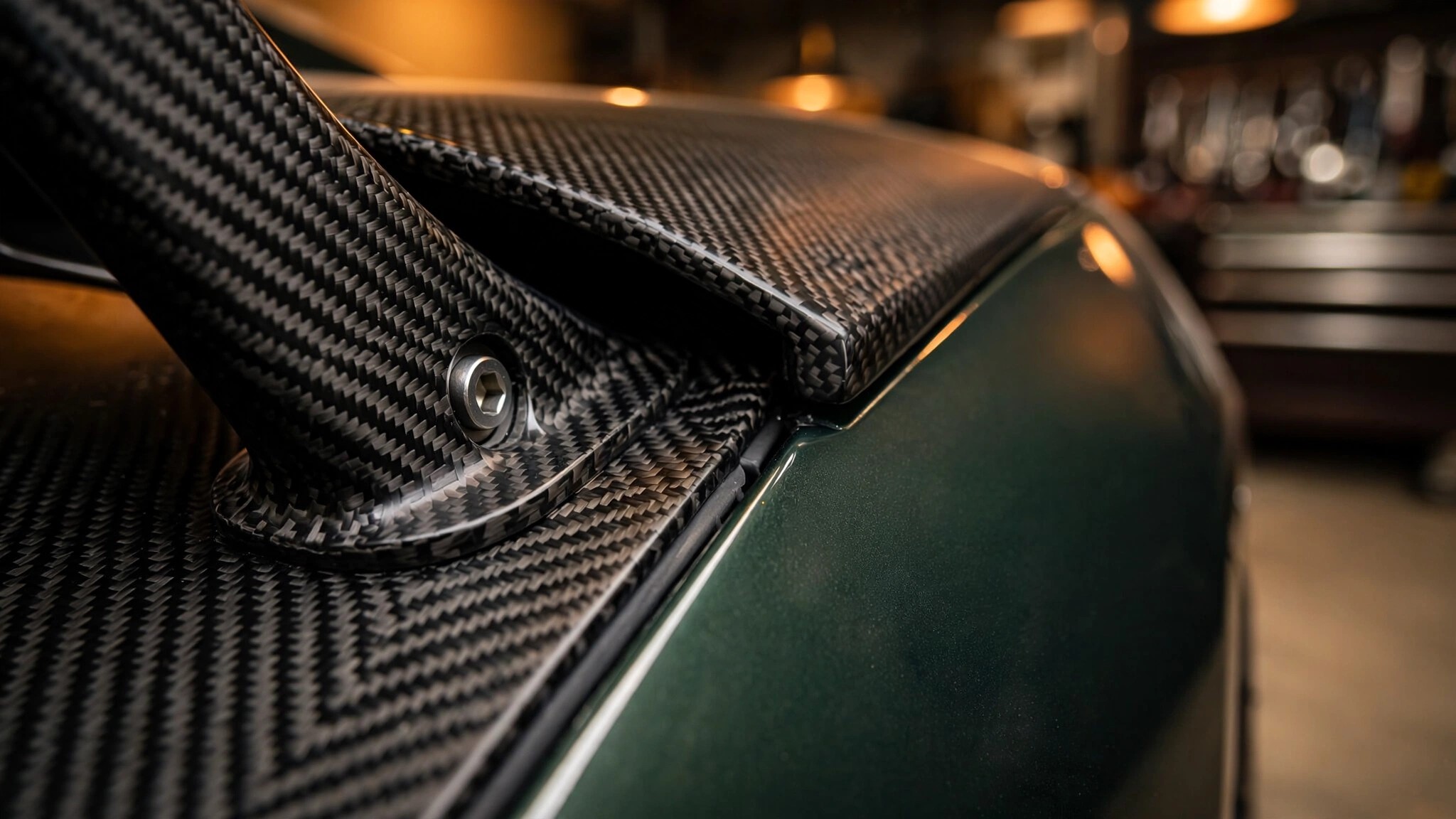
Carbon fiber monocoques are not new territory for McLaren. They invented the concept for Formula 1 in 1981 with the MP4/1, and every road car they have sold since the 12C in 2011 has been built around a carbon tub. What changes with the W1's Aerocell is the manufacturing method. McLaren abandoned the resin transfer molding used for the 750S's Monocage II and the Artura's MCLA in favor of pre-preg layup, a slower, more labor-intensive process that the company previously reserved for the track-only Solus GT.
Pre-preg means the carbon fiber sheets arrive at the factory already impregnated with a precisely measured amount of resin. Workers hand-lay these sheets into the mold one layer at a time, controlling fiber orientation and thickness at every point across the structure. Pressure treatment is then applied inside the mold during curing. Higher structural strength follows because the resin distribution is more uniform and void content (trapped air bubbles within the laminate) drops dramatically. Pound for pound, it is stiffer and lighter.
Andy Sylvester-Thorne, McLaren's Head of Body Structures, has been with the company for over twenty years. He worked on the original MonoCell for the 12C, the MonoCage for the P1, and the MCLA for the Artura. When his team was given the W1's performance targets, they concluded that the production-friendly processes used on those earlier cars would not suffice. "One of the reasons I've been with McLaren for so long is the challenge," Sylvester-Thorne said. "The almost impossible nature of what the business sets for us."
The pre-preg approach is time-consuming and demands highly skilled technicians. Each layer must be positioned by hand with precision that automated processes cannot yet replicate at the tub level. This is why McLaren limits it to low-volume applications: the Solus GT, which exists in single digits, and now the W1, capped at 399 units. For the 750S, which sells in the thousands, the faster processes at the McLaren Composites Technology Centre in Sheffield remain essential. But for 399 cars where every gram is a variable in a downforce equation, the math favors hands and autoclaves over speed.
Seats That Don't Move
Most supercars let the driver slide the seat fore and aft to find a comfortable position. The W1 does not. Its seats are molded directly into the Aerocell structure, fixed and immovable. Instead, the pedal box adjusts, along with the steering column and primary controls, to bring the car's interface to the driver rather than moving the driver within the car.
This sounds like a constraint, but it is actually a liberation.
When seat position is variable, engineers must account for the full range of driver positions when defining headroom, A-pillar angles, mirror sightlines, and crash structure geometry. Each of these envelope calculations forces the monocoque to be larger, heavier, and less aerodynamically integrated than it needs to be for any single occupant position. By fixing the seat, Sylvester-Thorne's team collapsed these envelopes. Interior dimensions shrank and A-pillars got thinner, improving outward visibility. Wheelbase shortened by nearly 70 mm compared to what a conventional seat-adjustable layout would have required, because the entire monocoque could be compressed around a known, fixed driver position.
Less structure means less weight. Less weight means less power needed to achieve the same acceleration. Less wheelbase means less aerodynamic surface to manage, and a more responsive chassis at turn-in. Every downstream dimension benefits from the upstream decision to freeze the seat location. It is a ruthless piece of packaging logic, borrowed from race cars where adjustable seats have never existed because the mass penalty is unacceptable.
Raising the Floor to Find the Ground
Ground-effect aerodynamics work by accelerating air through shaped tunnels beneath the car. Bernoulli's principle does the rest: faster-moving air under the car creates lower pressure than the slower air above it, generating downforce without the drag penalty of a conventional wing. Formula 1 reintroduced ground effect in 2022 after banning it for decades, and it transformed the sport. But only one road car before the W1 had genuine ground-effect underbody aerodynamics: the Aston Martin Valkyrie, designed by Adrian Newey.
To make ground effect work, the underside of the car needs depth. Air tunnels need volume to accelerate flow and shape venturi profiles. McLaren created that volume by raising the Aerocell's floor 65 mm higher than a conventional monocoque, which lifted the footwell position approximately 80 mm at the front of the tub. Drivers sit higher relative to the road surface than they would in a 750S, but the car itself is lower to the ground, because the raised floor creates cavernous space beneath the monocoque for aerodynamic tunnels and a massive rear diffuser.
In Road mode, the active front wing lifts to reduce downforce and the Active Long Tail rear wing retracts flush with the body. In Road mode, the car rides at a normal, speed-bump-friendly height. Switch to Race mode and the front suspension drops 37 mm, the rear drops 17 mm, and the ground-effect package seals to the road surface. At speed, the W1 generates 350 kg of front downforce and 650 kg at the rear, totaling 1,000 kg. More than the car's own dry weight pressing it into the tarmac.
Robin Algoo, McLaren's chief aerodynamics engineer, emphasized that raw downforce numbers miss the real story. What separates the W1 from cars that also claim high downforce figures is the stability of its aero balance through corners and across a range of speeds and attitudes. At Nardò, McLaren's reference circuit, the W1 lapped three seconds quicker than the Senna, a car many considered the most extreme track-focused McLaren ever built. Stable, predictable aero balance at corner entry is what delivers those seconds, not just peak downforce on a straight.
A Wing That Extends Rearward
Conventional rear wings pivot upward to increase angle of attack and generate more downforce. McLaren's Active Long Tail does something different. It extends 300 mm rearward from the trailing edge of the car, sliding out horizontally to lengthen the car's aerodynamic profile rather than raising a surface into the airstream.
Why backwards instead of up? Because the W1's downforce strategy is built around the underbody, not the wing. A traditional upward-deploying wing would add drag and shift the aero balance rearward, potentially destabilizing the car by unloading the front axle at high speed. By extending the rear surface horizontally, the Active Long Tail works with the underbody and rear diffuser as an integrated system. By extending, the tail controls the pressure recovery zone behind the car, allowing the diffuser to extract more air from underneath without flow separation. Downforce increases, but drag does not rise proportionally, because the system is managing underbody flow rather than fighting freestream air with a flat plate.
In Road mode, the tail retracts entirely into the body, and the W1 looks like a normal (by hypercar standards) mid-engine coupe. In Race mode, the car effectively grows 300 mm longer. This morphing capability is why McLaren calls it the Active Long Tail, a reference to the company's iconic "Longtail" race cars of the 1990s. Those cars achieved their low-drag, high-downforce aero by literally being longer. The W1 recreates that principle on demand.
ART Carbon Fiber: An Aerospace Process Scaled Down
While the Aerocell itself uses hand-laid pre-preg, McLaren debuted an entirely separate carbon fiber technology on the W1's active front wing. Called ART (Automated Rapid Tape), it is an adaptation of a manufacturing method used in aerospace for building aircraft fuselage and wing structures. Boeing and Airbus build 787 and A350 fuselages by having robotic arms deposit composite tapes in precise patterns over large molds. McLaren took that concept and redesigned it for automotive scale.
Rather than using robotic arms (slow, expensive, optimized for aircraft-scale parts), McLaren developed a machine with a fixed deposition head and a rapidly moving bed capable of rotation. Dry composite tape is laid down in measured lengths, with the bed rotating to position the tape at whatever fiber angle the structural analysis specifies. Because the machine can place fibers in any orientation, engineers gain anisotropic control: a part can be made stiff in the direction it bears load and flexible where compliance is needed, all within a single component. Conventional hand-laid pre-preg uses woven sheets where the fiber orientation is constrained by the weave pattern, forcing engineers to add extra layers to compensate for off-axis weakness.
McLaren claims up to 95% of raw tape material ends up in the final part. Hand-cutting pre-preg sheets from a roll generates irregular off-cuts that cannot be reused. ART's measured-tape approach virtually eliminates this waste. Automated deposition also removes human positioning errors and enables real-time monitoring of process parameters, reducing rejected parts. McLaren's first ART component, the W1's front wing fixed plane, is 10% stiffer than a comparable pre-preg component, a meaningful gain for a surface that must resist deformation under hundreds of kilograms of aerodynamic load without adding weight.
A prototype ART machine has been running at the McLaren Composites Technology Centre in Sheffield since early 2025, with an industrial-specification machine scheduled to replace it for higher-capacity production. McLaren has stated that integrating ART into the structure of future carbon fiber tubs, not just aerodynamic components, is already under consideration. If the W1's front wing proves the concept in production, the next McLaren monocoque could be built this way.
Suspension Bolted to Carbon
Previous McLaren road cars mounted their front suspension to aluminum subframes bolted beneath the carbon tub. McLaren eliminated the subframe entirely. Its front double-wishbone suspension mounts directly to the Aerocell structure through hardpoints integrated into the carbon layup. This is a first for McLaren Automotive, though the approach is standard in Formula 1, where the survival cell carries all suspension loads without intermediary metalwork.
Removing the subframe serves two purposes: it saves weight, and it opens up the underbody for aerodynamics. A conventional aluminum subframe blocks airflow in exactly the region where ground-effect tunnels need to accelerate it. By integrating suspension pickup points into the carbon structure, McLaren's aerodynamicists gained unobstructed access to the entire front underbody for shaping venturi profiles.
The front suspension uses pushrods and inboard dampers, another Formula 1 technique that McLaren Automotive had never previously adopted for a road car. Pushrods convert the vertical motion of the wheel into the compression of a damper mounted inboard, near the car's centerline. Externally visible through the W1's bodywork, the pushrods are a visual statement of the car's racing intent. Functionally, inboard dampers reduce unsprung mass at the wheel and lower the car's center of gravity. At the rear, conventional outboard springs and dampers are used, though several suspension components throughout the car are 3D-printed from titanium to further reduce mass. The wheels are forged magnesium.
Integration as Engineering Philosophy
What makes the W1 interesting from an engineering perspective is not any single technology. Pre-preg carbon tubs, active aerodynamics, ground effect, and pushrod suspension all exist independently. It is the degree to which McLaren has subordinated every structural decision to aerodynamic performance that distinguishes this car.
The seats are fixed because it makes the tub smaller, which makes the underbody tunnels more effective. The floor is raised because ground effect needs depth. The suspension is bolted to carbon because subframes block airflow. The rear wing extends rearward because the diffuser needs pressure recovery, not a bigger plate in the wind. The front wing uses ART carbon fiber because it needs to be stiff enough to hold its shape under aerodynamic load without becoming heavier. Each decision reinforces the others. Remove one and the system degrades.
McLaren built 399 of these. The MHP-8 V8 and its hybrid system produce 1,275 hp combined. It accelerates to 186 mph faster than any McLaren ever made. All of these facts are incidental to the engineering story. What matters is a monocoque that was designed as an aerodynamic device first and a passenger compartment second, and a manufacturing strategy that treats each structural element as a variable in an airflow equation. Whether it succeeds as a driving experience is a question for a track day. As an exercise in structural aerodynamic integration, it has no current peer among production road cars.
| McLaren W1 Key Specifications | |
|---|---|
| Monocoque | Aerocell, hand-laid pre-preg carbon fiber with in-mold pressure curing |
| Monocoque floor raise | 65 mm (80 mm footwell lift at front) |
| Wheelbase reduction (fixed seats) | ~70 mm vs. adjustable-seat equivalent |
| ART carbon fiber debut | Active front wing fixed plane (10% stiffer than pre-preg equivalent) |
| Front suspension | Pushrod, inboard dampers, bolted directly to Aerocell (no subframe) |
| Rear suspension | Double wishbone, outboard springs/dampers, 3D-printed titanium components |
| Active Long Tail extension | 300 mm rearward |
| Downforce (Race mode) | 1,000 kg total (350 kg front, 650 kg rear) |
| Engine | MHP-8: 4.0 L twin-turbo flat-plane V8, 928 hp, 9,200 rpm redline |
| Hybrid system | F1-derived radial flux e-motor, 347 hp, 1.4 kWh battery |
| Combined output | 1,275 hp / 988 lb-ft |
| Dry weight | 1,399 kg (3,084 lb) |
| Brakes | Carbon Ceramic Racing+ with enhanced ceramic layer |
| Wheels | Forged magnesium |
| Production | 399 units |
Sources
- McLaren Automotive, “McLaren W1: Design and Engineering,” press materials, October 2024.
- McLaren Automotive, “The Aerocell: McLaren W1 Technical Deep Dive,” mclaren.com, 2024.
- Top Gear, “McLaren W1: Everything You Need to Know About the P1 Successor,” October 2024.
- Car and Driver, “McLaren W1 Specs, Features, and Aerodynamics Explained,” 2024.
- Autocar, “McLaren W1: Active Long Tail Explained,” November 2024.
- Road & Track, “McLaren W1 Is the Most Aerodynamically Advanced Road Car Ever Built,” October 2024.
- McLaren Applied, ART Carbon Fiber Technology white paper, Sheffield MCTC, 2025.
- Racecar Engineering, “Ground Effect in Road Cars: From Valkyrie to W1,” January 2025.