Two Chronographs, One Switch: MB&F’s Sequential Flyback EVO Puts a Logic Gate on Your Wrist
Most chronographs answer one question: how long did that take? A split-seconds chronograph answers a harder one: how long did that take, and how long did the thing inside it take? Stephen McDonnell’s Sequential answers a question almost nobody asks, because until 2022 no wristwatch could answer it at all: how long did two different things take, measured independently, with the ability to swap between them, add them together, or restart either one without stopping it first?
Chronographs are normally singular. One column wheel, one clutch, one set of counters, one pusher to start and stop, one to reset. Doubling that machinery inside a single movement means doubling the column wheels, the clutches, the gear trains, and the energy demand, while somehow keeping everything synchronized to a single time base. McDonnell solved the synchronization problem by giving both chronographs one shared oscillator, then solved the control problem with a mechanism that has no precedent in watchmaking: the Twinverter, a binary switch that inverts the running state of both chronographs with one press.
From 585 Parts to 621: What Flyback Costs
When MB&F launched the original LM Sequential EVO in 2022, it won the Aiguille d’Or at the Grand Prix d’Horlogerie de Genève, the industry’s top prize. That movement contained 585 components and four timing modes. Adding flyback functionality to both chronographs took two more years of development and 36 additional components, bringing the total to 621. Flyback first reached production in the classic LM Sequential Flyback in 2024; the EVO version, announced on January 20, 2026, pairs the upgraded calibre with the sport-oriented EVO case.
Flyback matters because of what a normal chronograph reset cannot do. Stopping a chronograph, resetting it to zero, and restarting it takes three pusher presses and a visible pause in measurement. A flyback chronograph collapses all three actions into one press: the running chronograph snaps back to zero and immediately starts timing again, with no stop in between. Pilots invented the requirement in the 1930s, when navigating by dead reckoning meant timing successive legs of a flight without losing seconds to pusher presses. McDonnell’s version extends that capability to both chronographs simultaneously, so either timer can be flyback-reset while the other keeps running untouched.
Each chronograph gets its own column wheel, the toothed, castle-shaped component that sequences start, stop, and reset operations in a mechanical chronograph. Column wheels are the expensive, traditional way to build a chronograph; cam-actuated systems are cheaper and more common. Two column wheels in one movement is rare in pocket watches and, before the Sequential, unheard of in a wristwatch. Each chronograph also gets its own vertical clutch on the fourth wheel of its train, a jewelled coupling that engages and disengages the chronograph from the going train without the stutter that horizontal clutches introduce when the seconds hand jumps on engagement.
The Twinverter Is a Logic Gate Made of Steel
Five pushers crowd the case. Four operate the two chronographs in the conventional way, two per timer. A fifth pusher sits at 9 o’clock, and it does something no conventional chronograph pusher does: it advances both column wheels at once.
Press the Twinverter when both chronographs are stopped and both start. Press it when both are running and both stop. Press it when one is running and the other is stopped, and they swap states, the running one stops and the stopped one starts, in a single action. McDonnell calls it a magic button. Engineers would recognize it as a mechanical XOR gate: one input, two outputs, each output inverted relative to its previous state.
That single inversion unlocks the five timing modes. Independent mode runs each chronograph on its own pushers, two stopwatches sharing a wrist. Simultaneous mode starts both together for split-seconds style comparison, except the comparison happens across two separate dials rather than two hands on one dial. Cumulative mode adds successive intervals together, useful for timing a race with pit stops. Sequential mode turns the pair into a lap timer, swapping between chronographs at each lap so one always runs while the other holds its reading. Flyback mode lets either chronograph reset and restart instantly while the other continues.
Both chronographs share one oscillator, a flying balance wheel with regulating screws beating at 3 Hz, or 21,600 vibrations per hour. Sharing the oscillator is what makes the two timers comparable at all: two independent balances would drift apart by seconds per day, making any comparison between the two chronographs meaningless within hours. One balance means both timers measure against the same time base, and the 72-hour power reserve comes from twin barrels wound together.
EVO Means the Case Has to Survive the Movement
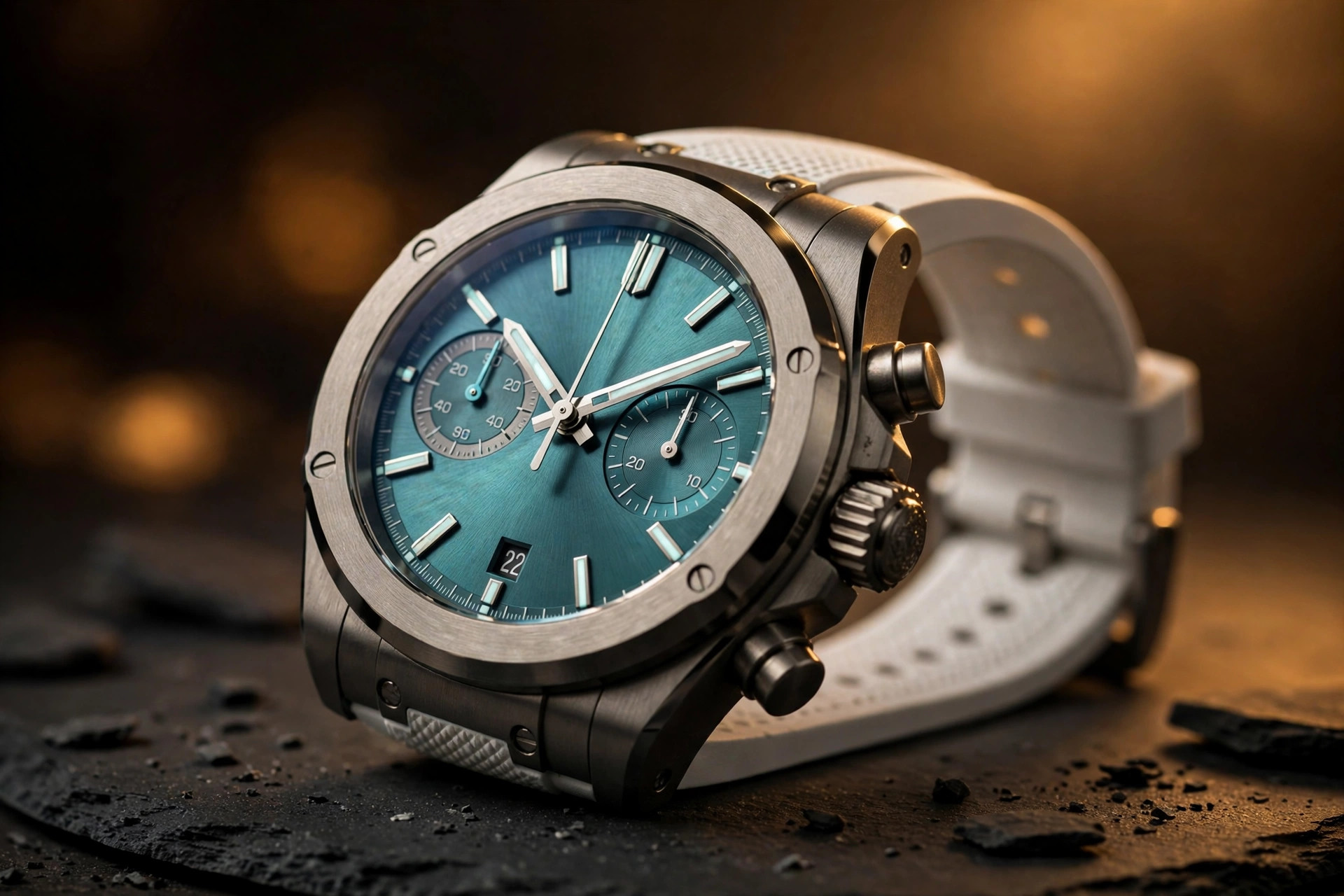
MB&F’s EVO designation is a promise that the watch can be worn actively, and the case engineering has to earn it. Grade 5 titanium, the Ti-6Al-4V alloy used in aerospace fasteners and orthopedic implants, forms the 44mm case. It weighs roughly 40 percent less than steel at the same volume while matching its tensile strength, and it resists corrosion from sweat and salt water far better than steel does. At 18.2mm thick, the case is tall, and no honest account can pretend otherwise, but the titanium keeps the mass manageable where a gold or steel case of the same dimensions would feel like a paperweight.
Inside the case sits the FlexRing, an annular elastomer dampener between the movement and the case. It works like a suspension bushing in a car: the ring absorbs shock and vibration before it reaches the movement, deforming elastically and returning to shape. A conventional chronograph movement bolted rigidly into its case transmits every impact directly to the balance staff and the chronograph pivots. FlexRing decouples the movement from the case just enough to blunt those impacts, which is how MB&F justifies an 80-meter water resistance rating and a screw-down crown on a watch containing 621 hand-finished components.
Eighty meters is not a dive rating, and nobody should confuse it with one. It means the watch survives swimming, showering, and the kind of accidental immersion that kills most high complications, which are typically rated to 30 meters or left unrated entirely. For a double chronograph with five pushers, each one a potential water entry point, 80 meters represents serious gasket engineering: every pusher stem needs its own seal, and every seal adds friction that the pusher mechanism must overcome.
Legibility gets its own engineering decision. Time is shown on an inclined dial, tilted toward the wearer, a Legacy Machine signature that improves the viewing angle when the wrist rests naturally. Chronograph seconds sit at 9 and 3 o’clock, with minute counters at 11 and 1, and the aquamarine dial plate gives the whole assembly a technical, almost instrument-panel character. A power reserve indicator on the caseback reports the state of the twin barrels without cluttering the dial.
The Counterargument: Two Stopwatches Nobody Asked For
Honest criticism starts with the obvious question. Who needs two chronographs? A split-seconds chronograph already times two events from a common start. A flyback chronograph already restarts instantly. Combining both capabilities into two independent mechanisms solves a problem that exists mostly in theory, and the solution costs CHF 168,000 before taxes, roughly USD 230,000, for a watch that is 18.2mm thick and tells time on a tilted dial that some wrists will find awkward to read at a glance.
Shared-oscillator architecture carries a real engineering risk too. Both chronographs draw from the same balance wheel, so a fault in either chronograph train, a bent pivot, a jammed clutch, a broken tooth on a column wheel, can drag on the shared time base and degrade timekeeping for the entire watch. Two independent movements in one case would isolate failures; one shared oscillator couples them. McDonnell accepted that coupling because it is the only way to make the two timers genuinely comparable, but the trade is real and should be stated plainly.
Then there is the EVO premise itself. A sport watch that costs as much as a house deposit and measures 18.2mm thick will never be worn the way a steel sports chronograph is worn, no matter how effective the FlexRing or how deep the water resistance. MB&F knows this. The EVO treatment is best read as a durability statement rather than a usage instruction: the watch is built to survive activity, even if its owner mostly wears it to dinner.
None of that diminishes the achievement. McDonnell built a double chronograph with a binary switch that no one else had attempted, then added flyback to both halves, then packaged it in a titanium case that survives 80 meters. The Sequential Flyback EVO is not the most practical chronograph, the thinnest chronograph, or the most legible chronograph. It is the most conceptually complete one: every timing mode a mechanical chronograph can offer, in one movement, controlled by one switch.
Four years after the original Sequential won the Aiguille d’Or, its flyback EVO descendant answers the question the first version raised. What happens when you give a watchmaker who thinks in systems a second chance at the same problem? He adds 36 components, one more timing mode, and a titanium case that dares you to actually wear it.
Specifications: MB&F LM Sequential Flyback EVO
| Reference | LM Sequential Flyback EVO, titanium |
| Movement | Stephen McDonnell in-house calibre, hand-wound, fully integrated dual chronograph |
| Components | 621 (63 jewels) |
| Frequency | 3 Hz (21,600 vph) |
| Power Reserve | 72 hours, twin barrels |
| Chronographs | 2 independent column-wheel chronographs with flyback, shared oscillator |
| Twinverter | Binary switch at 9 o’clock, inverts both chronographs simultaneously |
| Timing Modes | Independent, simultaneous, cumulative, sequential (lap timer), flyback |
| Clutches | Vertical clutch on the fourth wheel of each train |
| Balance | Flying balance wheel with regulating screws |
| Case | 44mm × 18.2mm, grade 5 titanium, brushed, sandblasted and polished |
| Dial | Aquamarine dial plate, inclined time display, chronograph seconds at 9 and 3, minutes at 11 and 1 |
| Crystal | Sapphire front and back, anti-reflective treatment |
| Water Resistance | 80 meters, screw-down crown |
| Shock Protection | FlexRing annular dampener between case and movement |
| Strap | Integrated white rubber strap, titanium folding buckle |
| Power Reserve Indicator | Caseback |
| Limited Edition | No |
| Price | CHF 168,000 + taxes (EUR 181,000 / USD 230,000) |
Sources & Methodology
Technical specifications from MB&F press materials via Monochrome, Watches by SJX, WatchAdvice, and Waqt coverage of the January 20, 2026 launch, and The Executive Magazine’s November 2, 2026 report on MB&F’s autumn releases. Component counts, timing modes, and Twinverter operation corroborated across at least three independent outlets. Grade 5 titanium properties from standard Ti-6Al-4V materials data. Author has not handled the LM Sequential Flyback EVO. All engineering claims attributed to the manufacturer or verified against independent coverage from at least two sources.