Flame Through a Keyhole: Pre-Chamber Combustion From Honda's Garage to Maserati's Nettuno
Fifty years separate a Civic that passed smog checks without a catalytic converter and a twin-turbo V6 making 210 horsepower per liter. Both engines rely on the same trick: ignite a tiny charge, then use its explosion to light everything else.
A Slow Flame Is a Wasted One
Every internal combustion engine faces the same thermodynamic negotiation. Run a rich air-fuel mixture and the flame propagates quickly, delivering strong power output but wasting unburned hydrocarbons out the exhaust. Run a lean mixture and combustion is cleaner, more thermally efficient, but the flame crawls. It may not even reach the far walls of the cylinder before the exhaust valve opens, leaving pockets of unburned charge behind. Worse, lean mixtures resist ignition entirely. A single spark plug sitting at the edge of a lean charge is asking a match to light wet wood.
For most of automotive history, engineers managed this tension by keeping mixtures close to stoichiometric (14.7 parts air to 1 part fuel) and letting catalytic converters handle the emissions. Lean-burn designs appeared occasionally, but they were compromises that traded power for efficiency because more air meant less power per stroke. No production engine had a real answer to the flame speed problem.
Then Honda found one, in a garage in Wako, Saitama.
Three Valves and a Tiny Room
In January 1970, a Honda research team led by engine-performance chief Shizuo Yagi installed a modified single-cylinder engine into a Honda N600 hatchback and drove it to a testing facility. Its cylinder head was unusual, carrying three valves per cylinder instead of two: the standard intake and exhaust valves plus a smaller auxiliary intake valve feeding a miniature pre-combustion chamber positioned directly around the spark plug. R&D Director Tasuku Date had suggested the idea after studying how diesel engines used pre-chambers to manage ignition. Diesel pre-chambers were nothing new, but adapting the concept to a gasoline engine running on a carburetor was.
Here is how it worked: a standard carburetor fed a lean mixture (approximately 20:1 air-to-fuel by mass, sometimes leaner) through the main intake valve into the cylinder. Simultaneously, a second barrel of the carburetor fed a rich mixture (roughly 4:1 or 5:1 air-to-fuel) through the small auxiliary valve into the pre-chamber. When the spark plug fired, it easily ignited the rich charge in the tiny room. That burning gas then blasted through a connecting passage into the main cylinder, where its energy and heat ignited the lean main charge. In effect, the pre-chamber acted as an amplifier. One spark became a distributed ignition event.
Honda named it CVCC, for Compound Vortex Controlled Combustion. The C was for compound, meaning two chambers; the V was for the vortex that the jet of flame created as it entered the main chamber, swirling the lean charge into rapid, complete combustion; and the CC stood for controlled combustion. The acronym was chosen specifically to reveal nothing about the mechanism during Honda's premature 1971 public announcement, made at Soichiro Honda's insistence before the engineering was even finished. "Mr. Honda told us, 'If I asked you guys when it would be completed, you'd never tell me that you had it completed to a tee,'" Yagi later recalled. "'The company would go bankrupt before you'd say that.'"
By 1975, the CVCC engine sat in the Honda Civic. It passed the US Clean Air Act emissions standards without a catalytic converter, without fuel injection, without an air pump, and without an EGR valve. No other production engine could claim that. The Civic could run on leaded gas, unleaded gas, or anything in between, because it had no converter to poison with lead. The EPA rated it the most fuel-efficient car in America four years running, peaking at 54 highway miles per gallon in 1977. Honda licensed the technology to Toyota, Ford, Chrysler, and Isuzu.
Why It Disappeared
The CVCC had a shelf life. As emissions standards tightened through the late 1970s and 1980s, the three-way catalytic converter proved simpler and more effective at cleaning up exhaust than stratified-charge combustion alone. Fuel injection replaced carburetors, giving engineers precise control over mixture ratios that CVCC's dual-barrel carburetor managed only approximately. Honda abandoned CVCC by the mid-1980s in favor of its own PGM-FI electronic fuel injection system. Pre-chamber ignition went quiet for nearly three decades. It seemed like a solution whose problem had been solved by other means.
But the problem hadn't been solved; it had been deferred. Catalytic converters clean up after inefficient combustion, but they don't make combustion itself more efficient. And as Formula One teams began chasing thermal efficiency under the 2014 hybrid regulations, they rediscovered what Honda had known in 1970: a pre-chamber can make a flame do things that no single spark plug can achieve alone.
Formula One Finds 50 Percent
When the FIA introduced the 1.6-liter turbo-hybrid V6 regulations for the 2014 season, fuel flow was capped at 100 kilograms per hour. Teams that could extract more work from each gram of fuel would go faster. Mercedes-AMG Petronas was the first to deploy what the paddock eventually learned was turbulent jet ignition, or TJI, supplied by German engineering firm Mahle. Ferrari followed in 2015, and by 2017, every competitive F1 power unit used some form of pre-chamber ignition. By the 2020s, thermal efficiencies had crossed 50 percent, meaning more than half of the fuel's chemical energy was converted to mechanical work. For context, a good road car engine manages around 35 to 40 percent. A coal power plant runs about 33 percent, which means Formula One engines had become the most thermally efficient gasoline piston engines ever built, and pre-chamber ignition was a primary reason.
Every team's implementation was active, not passive. Each pre-chamber received its own tiny fuel injector, separate from the main cylinder's injectors, delivering a precisely metered squirt of fuel into the small chamber before ignition. This active approach guaranteed a reliably rich mixture in the pre-chamber regardless of the extremely lean conditions in the main cylinder (lambda values well above 1.0, sometimes approaching 1.4 or beyond). When the spark plug fired inside the pre-chamber, jets of burning gas shot through an array of small orifices at velocities exceeding the local speed of sound. These supersonic jets created intense turbulence throughout the main cylinder, breaking the flame front into a network of distributed ignition sites. Instead of a single flame kernel propagating outward from one point at maybe 30 meters per second, the pre-chamber jets created dozens of simultaneous ignition events. Within a millisecond, the entire charge burned. Complete. Uniform. Fast enough that combustion finished well before the exhaust valve opened, extracting maximum work from every molecule of fuel.
Maserati Brings It to the Street
In 2020, Maserati unveiled the MC20, the brand's first mid-engine sports car since the MC12 had retired in 2004. Its engine, the Nettuno, was a 3.0-liter twin-turbocharged 90-degree V6 making 621 horsepower at 7,500 rpm and 538 pound-feet of torque from 3,000 to 5,500 rpm, with an 8,000-rpm redline. Designed entirely in-house at Maserati's Modena engine lab by chief powertrain engineer Matteo Valentini and his team, the Nettuno shared its basic block architecture with Alfa Romeo's 690T V6, but with different internal casting content, different bore geometry, different oil passages, and one feature the Alfa never received: pre-chamber ignition.
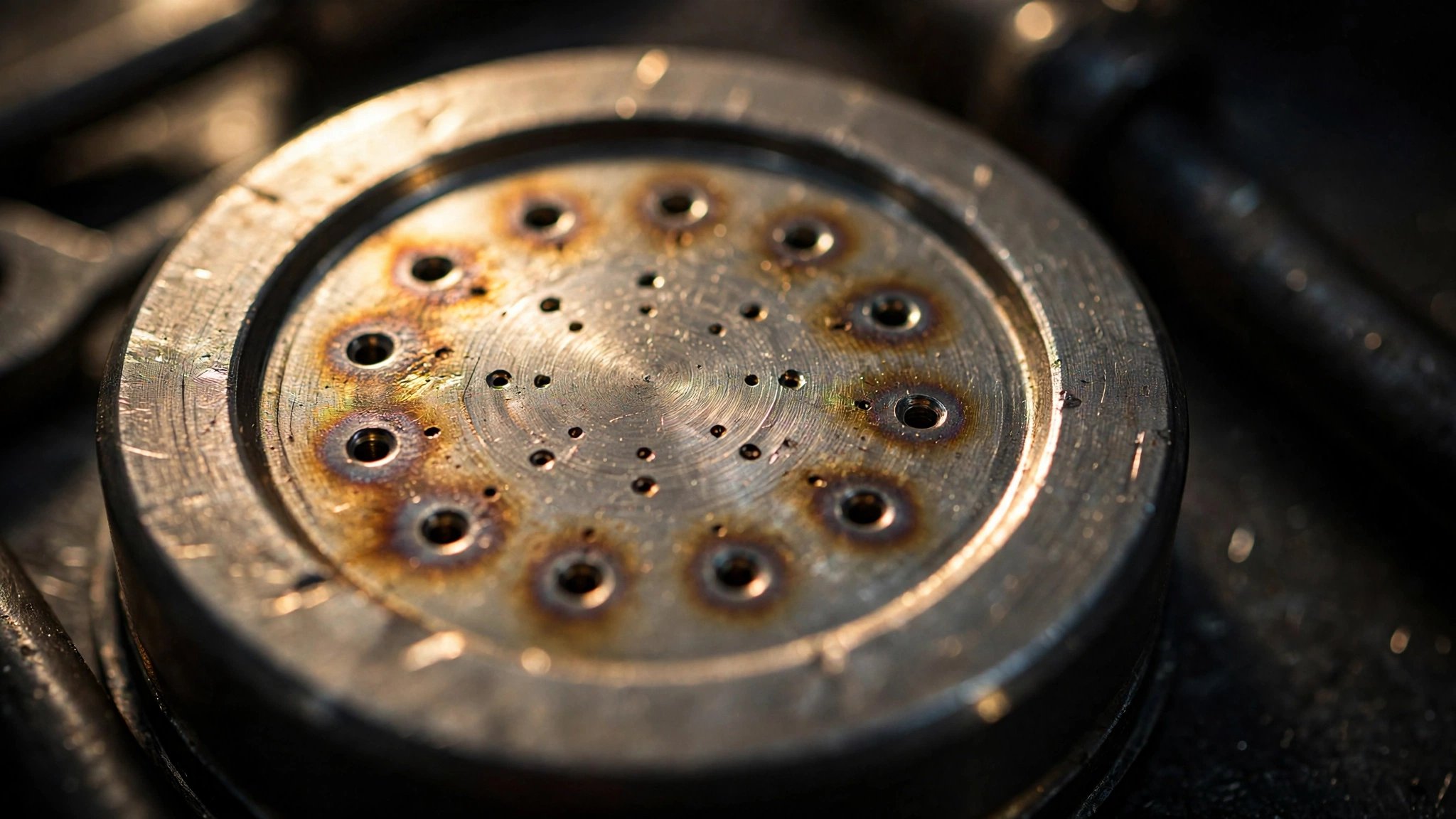
Valentini's approach was passive, with no dedicated fuel injectors in the pre-chambers. Instead, each of the Nettuno's six cylinders carries a 1.5 cc pre-chamber positioned centrally above the piston crown, connected to the main combustion volume through six precisely drilled orifices. During the compression stroke, the rising piston forces a portion of the air-fuel mixture from the main cylinder up through those orifices and into the pre-chamber. A spark plug inside the pre-chamber ignites this compressed charge, and the resulting combustion blasts back through the same orifices as high-velocity jets of flame, igniting the main charge from multiple points simultaneously.
Passive pre-chambers are simpler than active ones, requiring no extra fuel rail, no extra injectors, and no extra electronic controls per cylinder. But they have a drawback that Maserati had to solve: at low loads and engine speeds, the mixture entering the pre-chamber through compression alone can be too lean, too cold, or too poorly mixed to ignite reliably. An active approach (dedicated fuel injection) is expensive and complex. Maserati's solution was twin-spark ignition: each cylinder carries two spark plugs, one inside the pre-chamber and a second, conventional plug extending its electrode into the side of the main combustion chamber. At low loads, the engine management system fires only the lateral plug, running conventional combustion with the pre-chamber sitting dormant. As load and rpm rise, the ECU transitions to firing the pre-chamber plug, bringing jet ignition online. Seamless. Valentini told MotorTrend that a driver will never notice the switch. There is no VTEC-like engagement point, no perceptible change in character. Sophisticated engine maps phase between the two ignition modes and simultaneously modulate the dual fuel injection system: port injection operates at 6 bar on one rail, direct injection at 350 bar on a separate rail. At any given moment, the engine management is adjusting four independent variables per cylinder: which spark plug fires, when it fires, how much fuel the port injector delivers, and how much fuel the direct injector delivers.
One Hundred Horsepower From a Centimeter and a Half
When asked directly what the pre-chamber system contributed, Valentini gave a number: without it, the Nettuno would produce just over 500 horsepower. With it, 621. That is roughly 100 horsepower from a cavity smaller than the tip of a pinky finger.
The physics explains why. In conventional combustion, the flame front propagates outward from the spark plug at 20 to 40 meters per second, depending on mixture conditions and in-cylinder turbulence. For an 88 mm bore cylinder (the Nettuno's bore), the flame needs approximately 2 to 3 milliseconds to traverse the full chamber diameter. At 7,500 rpm, one complete combustion cycle takes about 8 milliseconds for the power stroke alone. Losing 2 to 3 of those milliseconds to flame propagation means combustion pressure is still rising when the piston is already well past top dead center and descending, reducing the mechanical leverage available to push the crank. Energy lost to late-burning charge near the cylinder walls exits as heat through the coolant and exhaust rather than as work through the crankshaft.
Pre-chamber jets cut that propagation time to a fraction of a millisecond by creating multiple simultaneous ignition fronts distributed across the cylinder volume. Peak pressure arrives earlier in the power stroke, at a crank angle where the connecting rod geometry provides maximum mechanical advantage. More of the fuel's energy becomes torque, and less becomes waste heat. Maserati's patent application claims the system enables a 15 percent increase in achievable compression ratio and a fuel consumption reduction of up to 30 percent, though neither figure has been independently verified.
| Maserati Nettuno V6 (F154CD) | |
|---|---|
| Configuration | 90° V6, twin-turbo, dry sump |
| Displacement | 2,992 cc (3.0L) |
| Bore × Stroke | 88 mm × 82 mm |
| Compression Ratio | 11.0:1 |
| Valvetrain | DOHC, 4 valves per cyl, continuous cam phasing |
| Fuel System | Port injection (6 bar) + Direct injection (350 bar) |
| Ignition | Twin-spark: pre-chamber plug + lateral plug per cylinder |
| Pre-chamber Volume | ~1.5 cc per cylinder |
| Power | 621 hp @ 7,500 rpm (MC20), up to 740 PS in later variants |
| Torque | 538 lb-ft (730 Nm) @ 3,000–5,500 rpm |
| Redline | 8,000 rpm |
| Specific Output | 207.6 hp/L (MC20 base) |
| Engine Weight | 220 kg (485 lb) dry |
| Dimensions (L×W×H) | 600 × 1,000 × 650 mm |
Why Maserati Chose a Single Turbo Layout
Nearly every high-performance turbocharged V6 and V8 of the past decade uses a hot-vee configuration, mounting the turbochargers inside the valley between the cylinder banks where they nestle close to the exhaust ports. AMG does it, BMW M does it, Porsche does it, and Cadillac does it with the CT5-V Blackwing. The advantages are well documented: shorter exhaust runners reduce turbo lag, the compact packaging lowers center of gravity, and the intake charge exits the compressor on the outside of the vee where cooler airflow is more accessible.
Maserati went the other way. The Nettuno routes its exhaust outboard, placing the two single-scroll turbochargers outside the cylinder banks. Valentini explained the decision with engineering honesty: at 210 horsepower per liter, the team could not find a hot-vee configuration that simultaneously met their reliability targets and emissions requirements. Thermal management of a 3.0-liter engine producing over 600 horsepower is brutal. Stuffing both turbochargers into the vee concentrates heat in the worst possible location, between two banks of cylinders that are already running pre-chamber combustion with peak pressures and temperatures higher than conventional ignition. Moving the turbos outboard sacrificed packaging elegance for thermal survivability. Valentini also acknowledged that outboard exhaust runners raise the center of gravity slightly, but he was pragmatic about it: the engine lives, the power stays, and the carbon-fiber intake covers look better than hot-vee plumbing anyway.
The Orifice Problem
Designing a pre-chamber for a road car is not the same as designing one for Formula One. An F1 engine is rebuilt every few hundred kilometers. A road car engine needs to survive 150,000 miles with minimal maintenance. The pre-chamber orifices are the critical wear point.
Each orifice is roughly one millimeter in diameter. Combustion gases pass through them at velocities exceeding 300 meters per second, carrying temperatures above 2,500 degrees Celsius. The thermal cycling is extreme: cold during intake, hot during combustion, cold again during exhaust, thousands of times per minute. Carbon deposits from incomplete combustion can gradually clog the orifices, changing their effective diameter and flow characteristics. If one orifice partially blocks, the jet pattern becomes asymmetric, and the multi-point ignition advantage degrades toward a single-point flame front.
Maserati addressed this with materials selection (the pre-chamber inserts are made from nickel-based superalloy, the same family of materials used for jet engine turbine blades) and with the dual ignition strategy. If pre-chamber combustion quality degrades at any point, the ECU can fall back to the lateral spark plug for conventional ignition, treating the pre-chamber as a passive cavity. The engine still runs in that fallback mode. It just runs at 500 horsepower instead of 621, which is the trade-off for long-term durability on a consumer product designed to survive 150,000 miles.
From Civic to Supercar
The conceptual thread connecting the 1975 Honda Civic CVCC to the 2020 Maserati Nettuno is startlingly direct: use a small, separate combustion event to ignite a larger, harder-to-burn charge. Honda used a third valve and a carburetor. Maserati uses six laser-drilled holes and 350-bar direct injection. Both solve the same physics problem: a lean charge won't ignite from a single spark alone, but it will ignite from a jet of flame.
Honda did it to pass emissions tests. Maserati does it to extract 210 horsepower per liter from a naturally aspirated bore diameter running at 11:1 compression with twin turbochargers force-feeding the charge. Formula One did it to cross the 50 percent thermal efficiency barrier. The mechanism scales, but the principle doesn't change.
What has changed is precision, not the underlying idea. The CVCC pre-chamber was cast aluminum with roughly machined passages. Modern pre-chambers are superalloy inserts with orifices machined to tolerances measured in microns, positioned to create specific jet angles and turbulence patterns modeled in computational fluid dynamics software before any metal is cut. The Honda CVCC carburetor approximated the rich charge flowing into the pre-chamber, while modern systems meter fuel at 350 bar with piezo-actuated injectors opening for durations measured in microseconds. The execution is separated by fifty years of manufacturing capability.
Mahle, the company that supplied F1 teams with active pre-chamber systems, is now developing production-ready versions for passenger cars. Several manufacturers, none of whom will go on record, are known to be evaluating pre-chamber ignition for their next generation of turbocharged engines. The physics are too compelling to ignore: faster burn rates mean earlier peak pressure, which means more efficient work extraction, which means either more power from the same fuel or the same power from less fuel. In an era when every engine needs to simultaneously deliver performance and meet increasingly stringent emissions regulations, pre-chamber ignition is not a niche curiosity. It is becoming a fundamental combustion architecture.
Honda figured this out in a garage in 1970. Soichiro Honda bet the company on it before the engineering was even done. He wasn't wrong. He was just fifty years early.