Thirty Years In, Manthey Bores the Engine Out Again
At the DTM finale at Hockenheim on October 9, Manthey Racing marked three decades with two limited-edition race cars: a 560-PS 911 GT3 Cup built around a bored-out 4.2-liter flat-six, and a 500-PS Cayman GT4 RS Clubsport closing a ten-year mid-engine chapter. Fifteen of each will be built. The displacement-first move from an aero-first shop is the whole story.
Start with what this article is not. Nobody outside Manthey's customer program has driven either of these cars, myself included, and every figure below is a launch claim, not a measurement. Fifteen units of each exist, most of them spoken for in principle already, and neither is a road car. What interests me is the engineering argument the pair makes, because it runs exactly opposite to the direction the industry has been walking for twenty years.
Manthey unveiled the 911 GT3 Cup MR 30 and the 718 Cayman GT4 RS Clubsport MR 30 on October 9 at the DTM season finale at Hockenheim, where the team was simultaneously fighting for its third DTM title in four years. Porsche owns 67 percent of the shop as of this month, up from 51, and just folded it into a new Home of Sports Cars division alongside Sonderwunsch, Exclusive Manufaktur, and Heritage, thirty years after Olaf Manthey's operation first opened its doors. That corporate context matters, and I will come back to it, but first the metal.
The shop that stopped boring engines
To understand why a bored-out flat-six is the story, you have to know what Manthey usually does. In the 1990s and 2000s, Olaf Manthey's 996- and 997-generation projects found their speed the way everyone found speed back then: in the engine. Bigger bores, more displacement, the main lever pulled first. Then the shop evolved, and the lever moved.
By the time of the 991-generation Cup MR cars, Manthey's formula had become holistic and chassis-first: aerodynamics, suspension, cooling, and balance, with the engine left largely as Porsche built it. Nine joint Manthey Kits since 2020 follow the same philosophy, from 911 and 718 kits to the Taycan Turbo GT with Weissach package that reclaimed the Nürburgring EV record. Manthey became the company you call when everything around the powertrain needs to work harder. Engine internals were somebody else's department.
Which is what makes the Cup MR 30 such a deliberate reversal. For its 30th anniversary, the shop went back to the first trick it ever learned. That is either nostalgia or confidence, and the lap time answers it.
4.2 liters, on purpose
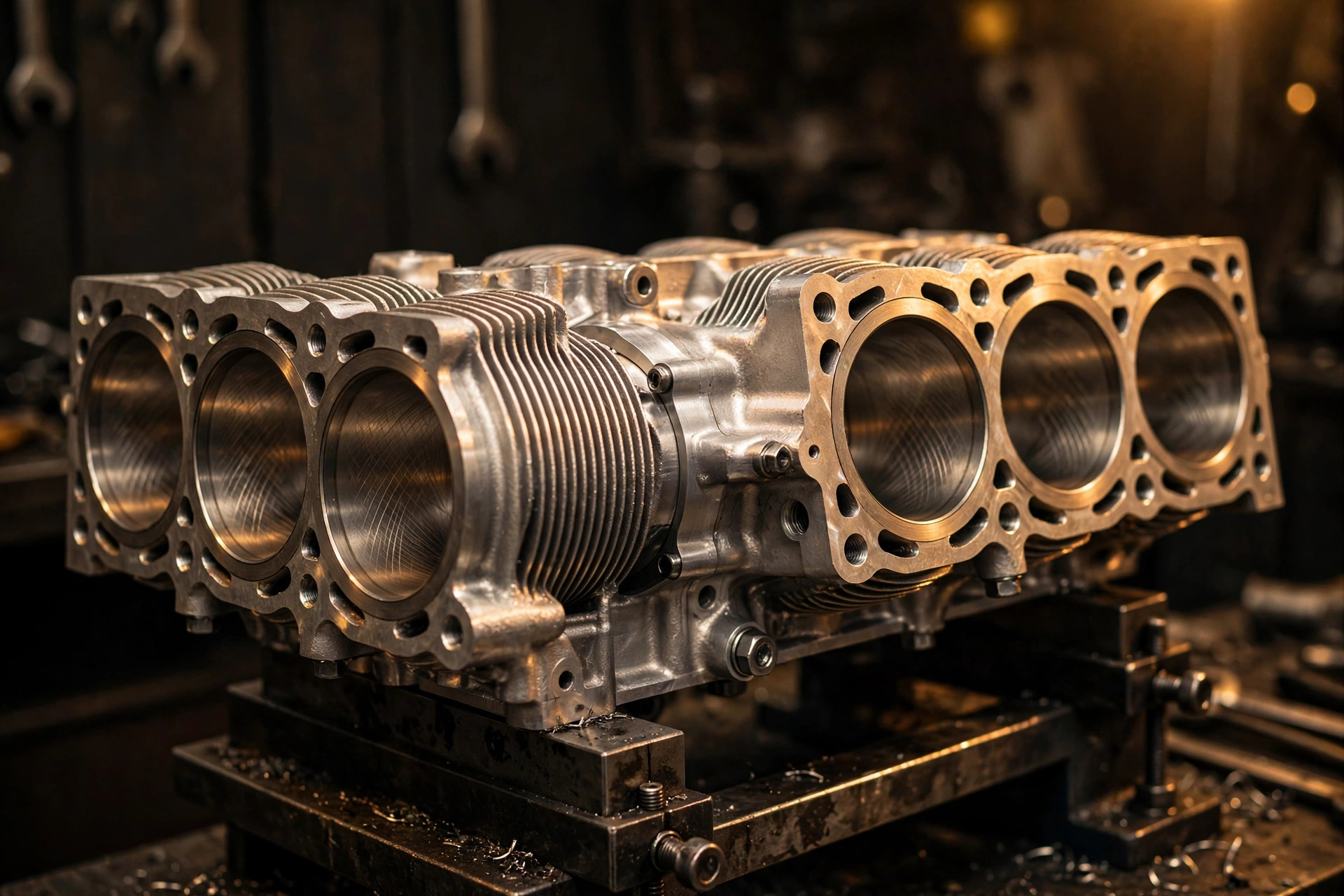
Here are the bones. The Cup MR 30 starts from the revised 992.1-generation 911 GT3 Cup and grows the water-cooled flat-six to 4.2 liters, good for 560 PS (412 kW) through the stock sequential six-speed to the rear axle. Track width grows 20 millimeters up front and 50 at the rear, on six-way-adjustable coilovers. A bespoke forged wheel set saves 3.8 kilograms.
Now the number that actually matters: 7:58.605. The underlying development car ran that lap at the 24.358-kilometer Nordschleife configuration used in NLS competition, and it did it with less power than the production version makes. Read that twice: Manthey validated the chassis, aero, and cooling package at a deficit, then shipped the final engine with more. Anniversary cars are supposed to be jewelry, and this one arrived with a lap time instead.
What boring an engine out actually buys you is worth saying plainly, because the modern habit is to reach for boost. Displacement adds torque everywhere in the rev range without adding lag, heat, or a turbocharger that has to survive a race. On a naturally aspirated flat-six that already revs toward the top of the chart, roughly 5 percent more swept volume is 5 percent more air per cycle, which means the torque curve lifts across the board instead of shifting right. The costs are well understood too: larger bores mean longer flame travel, heavier pistons, and cylinder walls with less material between them, which is why nobody bores out a stressed racing engine casually. Manthey did it anyway, and then told everyone the lap time.
Everything else on the car follows the mature Cup MR formula. Carbon-fiber front and rear bodywork, a front splitter with integrated underbody, new flics, a reworked rear wing with larger end plates, all pushing downforce up. Some of the carbon components use recycled fiber, which deserves a pause: reclaimed carbon typically arrives as chopped or discontinuous fiber with property scatter that virgin continuous layups do not have, so engineering aero bodywork around it means designing for statistical variance rather than datasheet certainty. A race shop doing that on an anniversary car is a quiet statement about where materials work is going.
Then there is the central radiator, a Manthey signature going back to the 991-generation Cup MR cars. Moving the radiator out of the vulnerable flanks and into the center protects it in contact and, per Manthey's own design logic, lets the exhaust airflow do cleaner work. It is the kind of solution that looks obvious only after someone has raced it for a decade.
Placed in the catalog, the car slots between a stock 911 GT3 Cup and the far more serious 911 GT3 R. That gap is real estate Manthey has been renting for years. Now it owns a house there.
The Cayman closes the book
If the Cup MR 30 is a throwback, the Cayman GT4 RS Clubsport MR 30 is a eulogy. Manthey's mid-engine racing program runs back a full decade, starting with the homologation kit it built for the original 981-generation Cayman GT4 Clubsport, the car that opened GT4 competition to the platform worldwide. That kit led to Manthey's own Cayman GT4 Trophy on the Nordschleife, which today runs as the Porsche Endurance Trophy Nürburgring. Everything since, the Trackday MR, the GT4 RS Clubsport Leichtbau, fed into this final version. Five hundred PS. Five point seven kilograms lighter than the standard car, thanks to carbon fenders, a bonnet with a central radiator vent, a redesigned rear section, and a new splitter and diffuser. Brake cooling ducts borrowed from the 911 GT2 RS Clubsport EVO program. The development car backed the engineering with a top-20 overall finish at the 24 Hours of the Nürburgring.
Consider the timing. Porsche's current strategy has the electric 718 Boxster and Cayman reaching full production in 2028. This car is therefore, in practical terms, the last combustion-era statement of Manthey's mid-engine program. Ten years of development, distilled into fifteen cars, and then the platform goes electric. Anniversaries are supposed to look backward. This one does, because forward is a different powertrain.
Both cars wear a white-and-red anniversary livery drawn from historic Porsche race schemes, echoing the car Manthey ran at this year's Nürburgring 24 Hours, with 30th-anniversary badging and embroidered interior details. Order requests close October 30, with Manthey selecting among applicants for the limited run. Cayman deliveries start in November; the Cup cars follow in the first quarter of 2027.
The business underneath the livery
None of this happens in a vacuum. Porsche's stake increase, from 51 to 67 percent, was announced October 8 alongside the new Home of Sports Cars division, and it landed one day after CEO Michael Leiters presented the Sportwagenschmiede 35 strategy at Weissach: fewer variants, higher exclusivity, value over volume, combustion and hybrid investment continuing. Manthey now sits in the Performance vertical of that structure, next to Sonderwunsch and Exclusive Manufaktur, which tells you exactly what Porsche thinks Manthey is for. It is the track-to-road credibility arm of an exclusivity strategy. The MR 30 pair is the first product of that arrangement, and it is not subtle about the brief: real development, real lap times, fifteen cars each.
Managing director Nicolas Raeder was blunt about intent, saying in effect that these were not built to celebrate a birthday. They were built for the racetrack, and the anniversary is simply where the development work happened to land. Race car director Helmut Brakhage framed the pair as three decades of motorsport experience aimed at drivability and emotion. I believe both of them, mostly because a 7:58 Nordschleife lap at reduced power is an expensive way to lie.
The oldest trick, validated by a lap time
So what is the argument here? That in an era when racing development is aero-first and engine work is the last lever anyone pulls, the most interesting anniversary car of the year pulled the engine lever first. Manthey spent two decades teaching the industry that speed lives in downforce, dampers, and cooling. Then, for its 30th, it bored out a flat-six and let the lap time do the talking.
There is something honest about that. These days the reflex is to add: boost, hybrid assist, active aero. The Cup MR 30 adds displacement, subtracts nothing, and trusts that five percent more swept volume still means something in a world of software-defined performance. It does. Physics has not been updated.
And the Cayman, quietly, is the more important car of the two. It closes a chapter. Ten years of mid-engine Cayman racing development ends with fifteen cars and a top-20 at the Ring, and the next 718 will be electric. If you care about combustion-era engineering, this is the kind of car you pay attention to on the way out, because nobody builds a second one.
| Specification | 911 GT3 Cup MR 30 | 718 Cayman GT4 RS Clubsport MR 30 |
|---|---|---|
| Base car | Revised 992.1 Porsche 911 GT3 Cup | 718 Cayman GT4 RS Clubsport |
| Engine | 4.2 L water-cooled flat-six (bored out) | 4.0 L flat-six |
| Power | 560 PS (412 kW) | 500 PS |
| Gearbox | Sequential six-speed, rear-wheel drive | |
| Track width | +20 mm front / +50 mm rear | Standard |
| Suspension | Six-way-adjustable coilovers | Revised track setup |
| Weight saving | 3.8 kg (forged wheel set) | 5.7 kg (carbon bodywork) |
| Cooling | Central radiator (Manthey signature since 991 Cup MR) | Central radiator layout, bonnet vent; GT2 RS Clubsport EVO brake ducts |
| Aero | Carbon front/rear bodywork (incl. recycled fiber), splitter w/ integrated underbody, flics, reworked wing, larger end plates | Carbon fenders, redesigned rear section, new splitter and diffuser |
| Validation | 7:58.605, 24.358 km NLS Nordschleife config (at lower power than production) | Top-20 overall, 24 Hours of the Nürburgring (development car) |
| Production | 15 units each; order requests close October 30, 2026 | |
| Deliveries | Q1 2027 | November 2026 |
Sources: TopSpeed, Manthey MR 30 debut and technical detail (October 9, 2026); American Motorspot, MR 30 specifications and availability; duPont Registry, 30th anniversary reveal report; Carscoops, Porsche increases Manthey stake to 67 percent; Porsche AG via EQS, Home of Sports Cars announcement (October 8, 2026); Zero2Turbo, MR 30 anniversary livery and ordering detail.