One Inch of Hood: Magnuson's Heartbeat TVS2650
In September 2026, Magnuson revealed the Heartbeat 2650 LS3: a supercharger that moves 2.65 liters of air per revolution and still fits under a factory C6 Corvette hood. It is not the blower; it is which way the air turns.
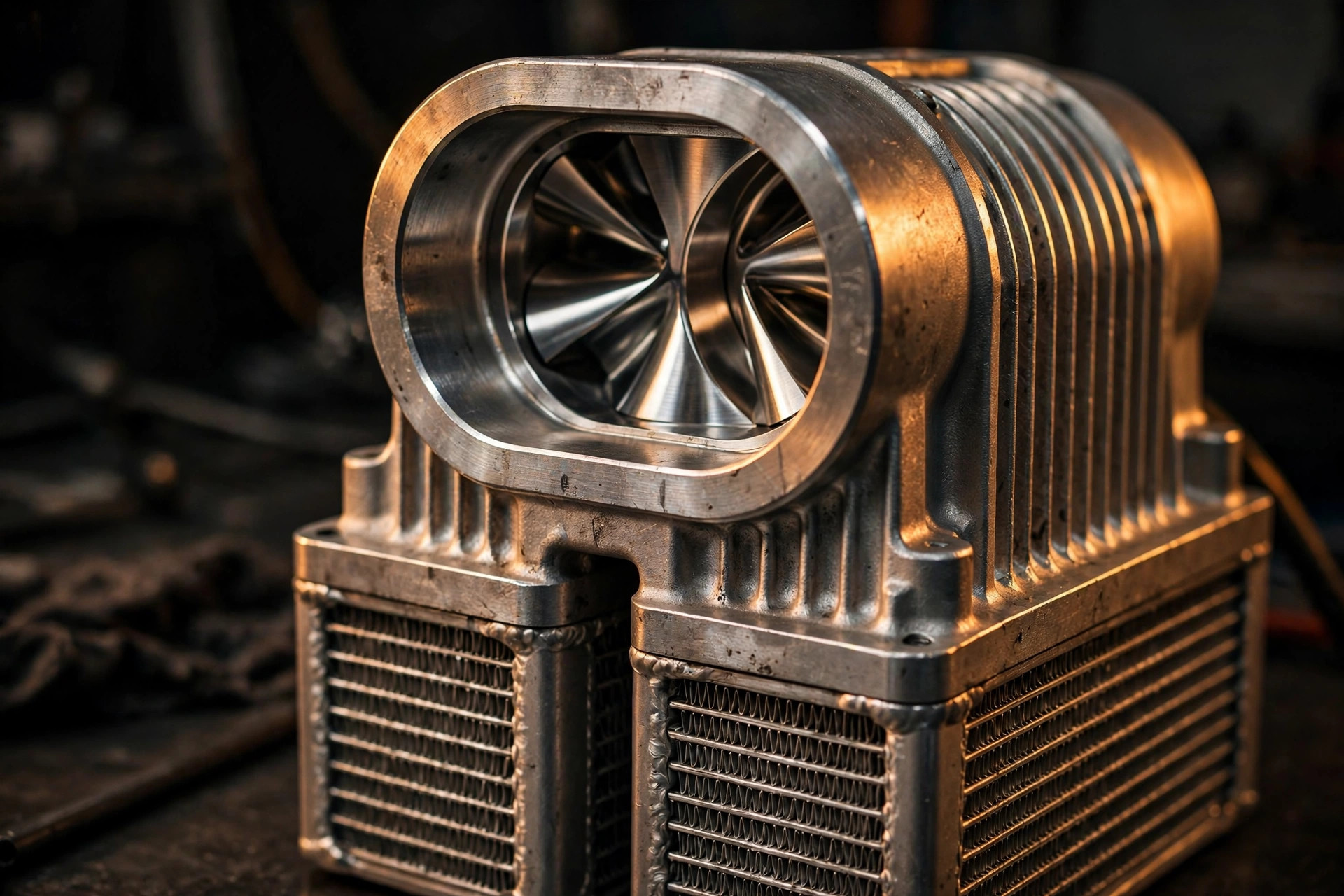
Blame the C6 Corvette's hood. Not the engine. Not the fuel system. Not the tune. It sits low over the LS3, sculpted tight to the intake, and replacing it means an aftermarket cowl piece that never quite matches the factory paint and announces the modification to everyone in the parking lot. Years ago, Magnuson's engineers said the quiet part out loud: the replacement hood was the biggest reason Corvette owners talked themselves out of a supercharger. So the company designed around the hood instead of through it.
Last month that idea went one generation further. Magnuson's Heartbeat 2650 LS3 pairs Eaton's TVS2650 rotor pack, 2.65 liters of displacement per revolution, with the same low-profile Heartbeat housing that made the original 2300 famous. Claimed support: more than 1,200 horsepower with the right engine, fuel system, and tuning. First kits arrive late October for LS3 hot rods running the Corvette accessory drive. A complete C6 Corvette kit follows later this year.
Air Turns Sideways
A traditional top-mount supercharger is simple in the way a hammer is simple. Air enters the top, the rotors compress it, and it discharges downward into the intake manifold, which means the intercooler has to live somewhere in that vertical stack, which means the whole assembly grows upward until it meets the hood. Magnuson's Heartbeat, introduced at PRI in 2014, broke that stack. Instead of discharging downward, it forces the air forward, through a pair of split intercooler bricks angled mid-way between the blower outlet and the cylinder heads, with the charge air flowing horizontally instead of vertically, and that single rotation changes everything downstream.
Intercoolers sit where the air is going anyway, which means bigger rotors fit above them and the plenum gains volume for free. Tiny dimples inside the coolant cores tumble the coolant and sharpen heat transfer. A demand-operated vacuum bypass valve unloads the blower at idle and light throttle, so the engine cruises like it is naturally aspirated and only pays the supercharger's parasitic tax when the driver asks for boost. Heartbeat's original 2300 design ended up just 1-7/8 inches taller than a stock LS3 manifold, 25 horsepower stronger and 17 pounds lighter than Magnuson's previous modular kit, and it fit under the C6's hood. That was the whole point.
What GM Did Instead
For contrast, look at what General Motors did when it faced the same ceiling on the C7 Z06. GM's LT4 engineers minimized height at all costs, and the cost was the rotors themselves: a TVS R1740 pack displacing 1.7 liters per revolution instead of the LS9's 2.3, with rotors both shorter (7.9 inches against 8.3) and smaller in diameter (3.9 against 4.4) to make room for the intercoolers crammed between the valve covers. To recover the lost displacement, GM spun the smaller blower 3.10 times crank speed, against 2.32:1 for the LS9, which is to say smaller rotors spun harder. That works, right up until it does not: higher drive ratios mean more parasitic loss, more heat of compression, and a narrower efficiency island. GM's answer was a packaging victory and a thermodynamic compromise. Magnuson's is the mirror image: spend the height budget on the intercoolers, keep the rotors big, and let displacement do the work that drive ratio used to do.
Fifteen Percent More Air, Same Ceiling
The 2650's arithmetic is straightforward. Its rotor pack displaces 2.65 liters per revolution against the 2300's 2.3, a 15 percent gain in air moved per crankshaft turn, inside a housing that keeps the Heartbeat's low profile. Magnuson notes the Heartbeat is more compact than the company's own Magnum LS3 TVS2650, which uses the same rotor pack in a taller case. Same air, lower ceiling. The return matters because the old TVS2300 Heartbeat had been discontinued, to the audible disappointment of the CorvetteForum crowd; the 2650 is a revival, not just an upsell.
Rotor-pack ratings, published on Magnuson's universal hot-rod kit spec sheet, put the hardware's ceiling at 24,000 rpm and a 2.4 pressure ratio. Those numbers belong to the Eaton hardware, not to any particular Corvette installation, and Magnuson is careful to rate the Heartbeat 2650 LS3 at more than 1,200 horsepower with appropriate supporting modifications. One Magnuson dealer advertises a 30% airflow increase over the TVS2300 Heartbeat, well above the 15% displacement gain alone, which suggests the 2650 is also meant to be spun harder; that is the dealer's claim, not a measured number. Read that sentence the way it is written: the blower is no longer the bottleneck, the LS3's rotating assembly is.
Supporting hardware tells the same story, from the jackshaft drive's high-torque, low-inertia carbon fiber driveshaft to quick-change cartridge pulleys that tune boost with cog swaps instead of press fits, and an inlet accepting GM's LT5 throttle pattern up to 109 mm. Every one of those choices assumes the buyer will eventually outgrow the stock bottom end. Magnuson is selling headroom.
Quiet Technology
The bypass valve deserves its own section because it is the reason any of this is streetable. A Roots blower is a positive-displacement pump: it moves a fixed volume of air per revolution whether the engine wants it or not, which is why supercharged cars historically drank fuel at cruise. At light throttle, the demand-operated bypass opens and recirculates intercooled air through the blower, unloading it. Around town, the engine breathes like it is naturally aspirated. Stab the throttle and the valve snaps shut, boost is instant, and the recirculated charge is already cool, which shortens the thermal recovery between pulls. Four hundred horsepower that behaves like three hundred until you ask, which is not a small thing.
What We Don't Know
Everything above the hardware line is Magnuson's claim, and the claims have the usual shape, starting with the fact that no independent dyno sheet exists yet. That 1,200-horsepower figure assumes a built engine, a fuel system with real capacity, and competent tuning; bolt it to a stock LS3 and the pistons will file their own complaint. Still undetailed is the full C6 Corvette kit, the one that matters to the owners who started this whole packaging exercise: heat-exchanger routing, exact installed height, and emissions paperwork are all still open.
But the engineering judgment is already visible, and it favors Magnuson's tradeoff over GM's. GM shrank its blower to fit the ceiling while the aftermarket turned the airflow sideways and kept the big rotors. Twelve years after the first Heartbeat, the idea has grown 15 percent larger and still fits under the same hood. Some constraints you engineer around; the good ones, you engineer through.
| Spec | Heartbeat 2650 LS3 |
|---|---|
| Rotor pack | Eaton TVS2650, high-helix four-lobe Roots |
| Displacement | 2.65 L per revolution |
| Rotor rating (pack) | 24,000 rpm, 2.4 pressure ratio |
| Charge cooling | Two split/angled charge-air coolers, horizontal airflow |
| Bypass | Vacuum demand-operated, unloads at idle/light throttle |
| Drive | Jackshaft, carbon-fiber driveshaft, quick-change cog pulleys |
| Throttle compatibility | GM LT5 pattern, up to 109 mm |
| Rated support | 1,200+ hp with supporting modifications |
| Fitment | Stock C6 Corvette hood (full kit late 2026) |
| First availability | Late October 2026, LS3 hot rods w/ Corvette accessory drive |
Sources
- GM Authority, "Magnuson Launches Heartbeat TVS2650 Supercharger, Fits C6 Corvette," late September 2026 (URL dated September 2026): announcement, stock-hood fitment, 1,200+ hp claim with supporting mods, dual charge-air coolers, late-October hot-rod availability, complete C6 kit later in 2026, compactness advantage over the Magnum LS3 TVS2650.
- LSX Magazine, "Magnuson Heartbeat Superchargers: A New Generation of LS Boost": angled intercoolers mid-way between blower outlet and cylinder heads, the plenum-volume and rotor-room tradeoff, Heartbeat 2300 at 1-7/8 inches over the stock LS3 manifold, Matt Hatley's hood-replacement deterrent quote.
- LSX Magazine, "PRI 2014: Magnuson's Heartbeat Superchargers Pump Up LS Engines": split twin intercooler bricks, horizontal charge-airflow, dimpled coolant cores, demand-operated bypass valve, +25 hp and -17 lb versus Magnuson's previous modular kit.
- LSX Magazine blower analysis: LT4's TVS R1740 (1.7 L/rev, 7.9 x 3.9 in rotors, 3.10:1 drive) versus LS9's TVS R2300 (2.3 L/rev, 8.3 x 4.4 in rotors, 2.32:1 drive).
- Texas Speed, Magnuson universal LS3 TVS2650R hot-rod supercharger system specifications: 24,000 rpm rotor capability, 2.4 pressure ratio, jackshaft carbon-fiber driveshaft, quick-change cog pulleys, LT5-pattern inlet, 109 mm throttle compatibility, port-injection rails.
- CorvetteForum C6 General Discussion, "Magnuson Heartbeat 2650" thread, started September 10, 2026: early reveal via Magnuson's Instagram and LS Fest photos; confirms LS3-only fitment with C6 Corvette spacing, stock-hood intent, and owner disappointment at the TVS2300 Heartbeat's discontinuation.
- Cross-reference: "Four Lobes, 160 Degrees," Efficient Design, on Eaton TVS rotor geometry in the CT5-V Blackwing; lobe-geometry background is covered there and not repeated here.