One Train, Three Handbrakes: Lange's Triple Split Goes Platinum
In September 2026, A. Lange & Söhne closed out an eight-year trilogy. The Triple Split, the only mechanical chronograph that extends split-seconds timing to minutes and hours, gets a 950 platinum case and a rhodié-coloured dial. Nothing inside changed. That restraint is the story, because what sits inside is 567 parts, two column wheels, and a patented answer to the friction problem that has kept everyone else to a single split hand.
What the Trilogy Closed
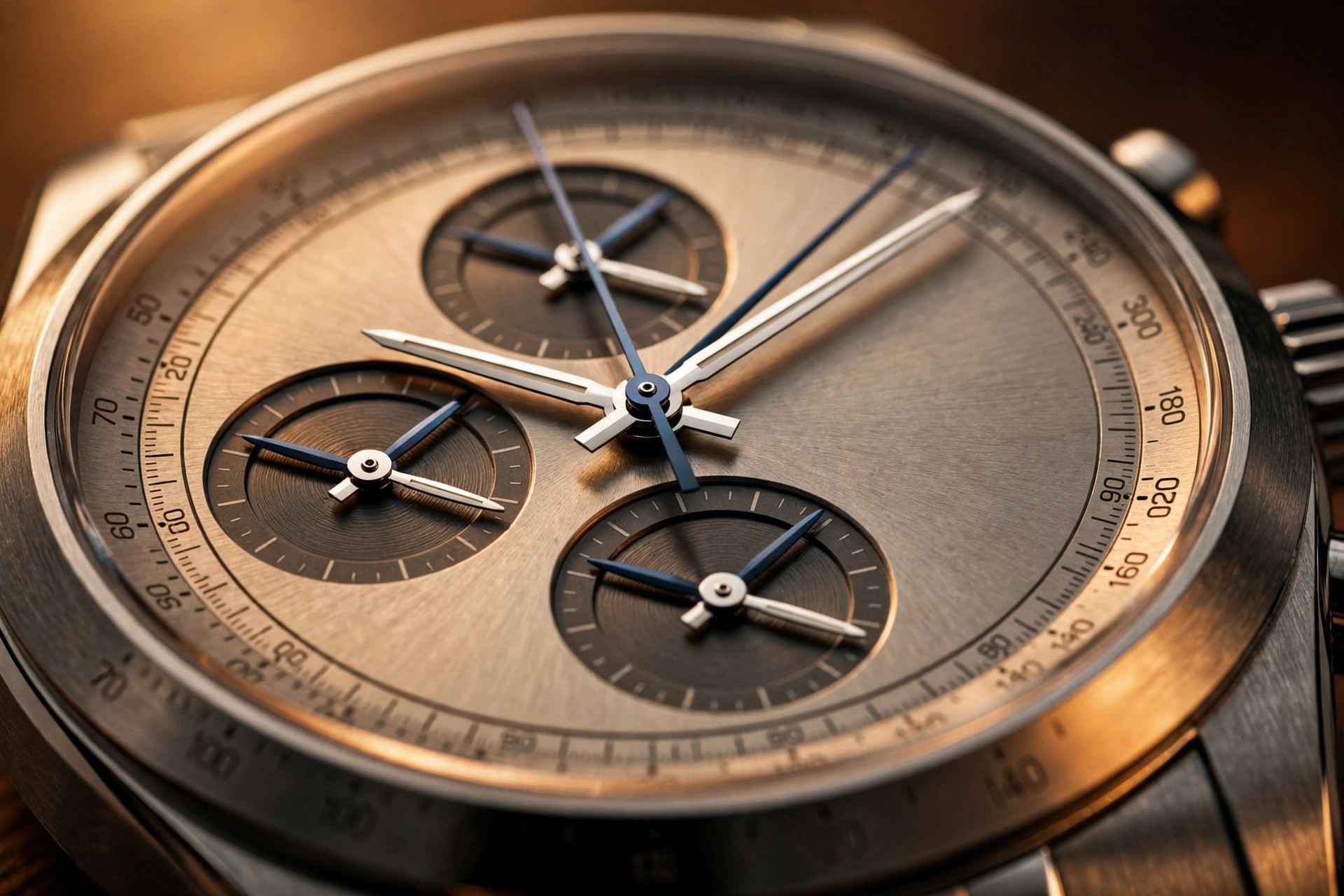
Lange keeps the lineage short and deliberate. The Double Split of 2004 took the conventional rattrapante beyond its usual 60-second range by adding a second pair of hands for the minutes, extending comparative timing to 30 minutes. In 2018, the Triple Split added a third pair for the hours, multiplying the range by 24 to a full 12 hours. White gold came first, pink gold followed in 2021, and now the platinum edition lands in September 2026: a 43.2mm by 15.6mm case, rhodié-coloured sterling silver dial with dark grey auxiliary dials, blued rattrapante hands against rhodiumed chronograph hands, red accents in the counters and the UP/DOWN power-reserve display, and a dark brown alligator strap on a platinum deployant buckle.
One hundred pieces, price on request. Mechanically, the specification carries over untouched, which is worth saying plainly rather than letting the marketing imply otherwise: calibre L132.1, hand-wound, 567 components, 46 jewels, five screwed gold chatons, 21,600 semi-oscillations per hour, 55-hour power reserve. Turn the watch over and the sapphire caseback shows untreated German silver bridges with Glashütte ribbing, straight-grained and bevelled levers and springs, and the familiar hand-engraved balance cock. Lange changed the wrapper; the engine was already finished.
Why Three Splits Breaks Brains
A conventional rattrapante stops one hand. Press the pusher at 10 o'clock, a brake clamps the split-seconds wheel, the underlying chronograph seconds keep running beneath it, and you read the intermediate time off the frozen hand; press again and the split hand snaps forward to rejoin its twin. That is already hard, and Lange did it three times, on three different wheels, running at three different speeds.
Central seconds turn once per minute. Each counter behaves differently: the minute counter advances in precisely jumping snaps, once every 60 seconds, instantaneous, while the hour counter drags continuously around its own subdial. Every one of the three carries a paired rattrapante hand, blued steel riding directly over its rhodiumed counterpart. Three brakes, three clamp-and-release events, three parked wheels that must hold position and then be flung back into perfect sync with their partners.
A parked hand is the enemy of rate stability, and this is the core engineering problem the watch exists to solve. A stopped wheel pressed against a running train creates friction. Friction steals amplitude from the balance. Amplitude loss is rate loss, which means the entire exercise is self-defeating if splitting a time throws the watch off its beat. One parked seconds wheel is manageable. Parking three wheels, at three different speeds, while the chronograph keeps running beneath them, is a friction tax no one else has been willing to pay. A rattrapante for seconds is an established craft. For minutes, rare. For hours, Lange's alone to this day.
The Disengagement Mechanism
Lange's answer is a patented disengagement mechanism, and it works by refusing to fight the problem. When a rattrapante hand is parked, the mechanism physically disengages the split train from the seconds and minute-counter arbors, cutting the friction path instead of overpowering it. Parked hands hold their positions mechanically, off the load of the going train, while the chronograph hands beneath them continue uninterrupted. Press the pusher again and everything re-engages and catches up in unison.
This matters because there is only one balance in the building. One balance, one in-house hairspring, feeding a 55-hour reserve through 567 parts, with no auxiliary escapement for the chronograph and no second barrel to hide behind. Every split hand, every jump of the minute counter, every catch-up snap draws from the same oscillating system that is keeping the time of day. That disengagement is what lets a single balance carry the heaviest chronograph architecture in serial production without sagging, and it is the detail that separates this movement from every other rattrapante ever made.
Slow on Purpose
Running at 3 Hz is a design decision, not a limitation. Faster beats resolve finer fractions, but finer fractions are worthless if the train cannot deliver the energy cleanly and consistently. At 21,600 vibrations per hour, the smallest measurable interval is exactly one-sixth of a second, which follows directly from the beat rate and is printed nowhere as marketing because it needs no marketing. Lower frequency keeps energy per impulse modest, wear rates down, and the amplitude of a single balance steadier under the load of 567 parts.
Then there is the jumping minute counter, the sleeper complication inside the complication. Once every 60 seconds, the minute system must snap forward instantaneously, which means storing energy and releasing it all at once, the same class of problem as a jumping-hour display. Lange solved the jumping minute in the Double Split and carried the solution forward: the minute wheels accumulate and release, the hour counter drags smoothly without jumping at all, and the central seconds never pause. Three different motion behaviors, one calibre, no visible compromise at 3 Hz.
Two Column Wheels
Column wheels are the mechanical logic gates of a chronograph, sequencing start, stop, and reset. L132.1 carries two, because the flyback function is a separate state machine from start-stop logic. Pressing the pusher at 4 o'clock mid-measurement stops the current timing, resets all six chronograph and rattrapante hands to zero, and restarts immediately on release. No stop-press-reset dance, no lifting your thumb: that is the flyback, and it is the feature that turns the watch from a lab instrument into a timing tool.
Additive timing is the use case Lange keeps naming. Any number of intermediate times can be recorded during one continuous measurement, out to 12 hours: laps, competitors, outbound and return legs of a long flight. When the 2018 watch launched, Lange's own example was Jan Frodeno's 2016 Ironman world record, seven hours, 35 minutes, 39 seconds, with the runner-up 20 minutes and 44 seconds back, a pair of times only a triple-split chronograph could record to the second on one dial. Nobody will time an Ironman with a 15.6mm-thick platinum watch, which changes nothing about the engineering point.
Platinum Changes Nothing (and Everything)
Mechanically, the 2026 edition is identical to its siblings. Materially, it is the heaviest possible expression of the trilogy. Platinum at 950 fineness is the densest precious metal used in watchmaking, 21.45 grams per cubic centimeter, roughly a fifth heavier than gold at the same volume, and it work-hardens under the cutter, which makes machining slower and tooling hungrier. Watchmakers accept that penalty because platinum takes a finish gold cannot match: a cool, white, almost lunar luster that never plates, never fades, and never shows the brass beneath.
At 43.2mm across and 15.6mm thick, in platinum, this watch will be heavy. Lange publishes no weight figure. Gear Patrol's Johnny Brayson, covering the release, put it plainly: he had not handled the watch, but he imagined it weighs a ton. A rhodié dial keeps the cool register, grey subdials, luminous main hands, red accents on the counters and the power-reserve display. Substantial is the polite word, and the mechanics inside earned the metal.
The Honest Ledger
Price is available on request. Lange listed the 2018 white gold original at 139,000 euros including German tax, and platinum, a 100-piece edition, and eight more years of Lange pricing point in exactly one direction. The trilogy structure is also the luxury playbook at work: same engine, new metal, smaller edition, higher price, with scarcity doing the selling. Water resistance is 30 meters, which is to say: do not swim in it. It is large and thick, with a dial dense with information: six chronograph hands, four subdials, a tachymeter ring, an UP/DOWN indicator. This is not a watch that disappears on the wrist.
I have not handled the Triple Split. Everything here is built from Lange's technical documentation and published specifications, and that is worth stating, because the feel of the pushers, the legibility at a glance, the way 567 parts settle on the wrist, those are handling questions no press release can answer. As chronograph architecture goes, the triple rattrapante remains the most technically complete in serial production, and the platinum case is the loudest possible way of saying so.
| Specification | Triple Split, platinum edition (2026) |
|---|---|
| Case | 950 platinum, 43.2 mm diameter, 15.6 mm height |
| Dial | Rhodié-coloured sterling silver, dark grey auxiliary dials, blued rattrapante hands |
| Movement | Manufacture calibre L132.1, hand-wound |
| Components / jewels | 567 parts, 46 jewels, 5 screwed gold chatons |
| Frequency | 21,600 semi-oscillations per hour (3 Hz), smallest unit 1/6 second |
| Power reserve | 55 hours, UP/DOWN (AUF/AB) indicator |
| Complications | Flyback chronograph with triple rattrapante (seconds, minutes, hours) to 12 hours, precisely jumping minute counter, tachymeter |
| Water resistance | 30 m |
| Strap | Dark brown alligator, platinum deployant buckle |
| Edition | 100 pieces, price on request |
- A. Lange & Söhne, Triple Split technical specifications: manufacture calibre L132.1, 567 components, 46 jewels, 21,600 vph, 55-hour power reserve, patented disengagement mechanism (via dsf.my, January 2018).
- Tatler Asia, "A. Lange & Söhne's Triple Split chronograph gets a platinum makeover," September 2026.
- Gear Patrol, "The Ultimate Chronograph Watch Reaches Its Final Form," September 8, 2026.
- Hypebeast, "A. Lange & Sohne 1815 UP/DOWN & TRIPLE SPLIT Release Info," September 2026.
- Prestige Online, "A. Lange & Söhne Unveils Its Latest Novelties at the Concours of Elegance," September 2026.
- WatchBase, "A. Lange & Söhne caliber L132.1": 30.6 mm diameter, 9.4 mm height, column wheel, flyback, rattrapante.
- Horbiter, "A. Lange & Söhne Triple Split": single balance with single hairspring architecture, jumping minute wheels, continuous hour counter.
Disclaimer: this article was written without handling the watch. All technical claims rest on A. Lange & Söhne's published documentation and secondary reporting. Where data has not been published, the article says so.