Two Clocks in One Case: Lange's Datograph Perpetual Gets a Platinum Bracelet
On October 24, 2026, at noon Central European Summer Time, an embargo lifted on a watch A. Lange & Söhne had already shown, quietly, a month earlier. CEO Wilhelm Schmid and product chief Anthony de Haas carried it to the Concours of Elegance at Hampton Court Palace in September, let a few writers handle it, and said nothing. Now it has a reference number, 410.136E, and a distinction no Datograph Perpetual has held before: it arrives on a metal bracelet.
A Datograph Perpetual is two instruments that want opposite things from a watch. One measures the fifth of a second you just spent. Another tracks a moon that will not be wrong by a day for 122.6 years. Putting both in one case, driven by one mainspring, is the whole point of the watch, and the whole problem with it.
A fifth of a second, and 122 years
Start with the movement, because everything else here is a frame for it. Calibre L952.1 is a first-generation Datograph base with a perpetual calendar module built on top: 333 parts in the chronograph and outsize date, 223 in the calendar, 556 in total, beating at 18,000 vibrations per hour. That slow 2.5 Hz beat is what limits chronograph resolution to one fifth of a second, and it is a deliberate trade. Lange values the long, lazy arc of the balance over the frantic tick of a high-beat chronograph, and the Datograph has always been a watch that measures time the way its maker thinks about it.
Inside, a classic column wheel coordinates the chronograph through rockers and switching levers, with a lateral clutch engaging the seconds hand. Two details deserve attention. First, the minute counter jumps precisely, the instant the central seconds hand passes zero, so an elapsed reading is never ambiguous mid-minute. Second, the levers are unusually long, because they have to route around the outsize date gearing at 12 o'clock and reach subdials that sit lower on the dial than a standard chronograph layout allows. Length in a lever is lost motion waiting to happen, and getting a flyback reset to snap cleanly through long levers is the kind of problem that separates a manufacture caliber from a catalog one.
Dial geometry does quiet work here too. Lange describes an equilateral triangle: the outsize date in its framed twin aperture at 12 marks the tip, the two subdials below the horizontal axis form the base, and the moonphase at 6 rounds it out. At 8 o'clock, one subdial stacks day, running seconds, and a day/night indicator. At 4 o'clock, the other stacks month, leap-year cycle, and the jumping minute counter. Reading all of that at a glance is optimistic. Reading it after a week of ownership is realistic, which is the right standard for a watch like this.
None of this is new, and that is the point. Launched in 2006, the Datograph Perpetual was the first Lange wristwatch to unite a chronograph and a perpetual calendar with an outsize date. Twenty years on, the 410.136E changes nothing inside. Its argument is that the movement never needed changing, and that the right way to mark two decades is to dress it in the one thing it never had.
The bracelet is the news
To understand why a bracelet counts as news, rewind to Lange's post-revival years. In the 1990s and 2000s, Wellendorff supplied elaborate five-row bracelets for Lange models including the Lange 1 and the Datograph, in yellow, pink, and white gold and in 950 platinum. They added tens of thousands of euros to the price. Relatively few sold. Unsold examples were later melted down and recycled into watch cases, which is how a bracelet becomes a collector's item by subtraction. Surviving originals now command premiums that occasionally rival the watches they accompanied.
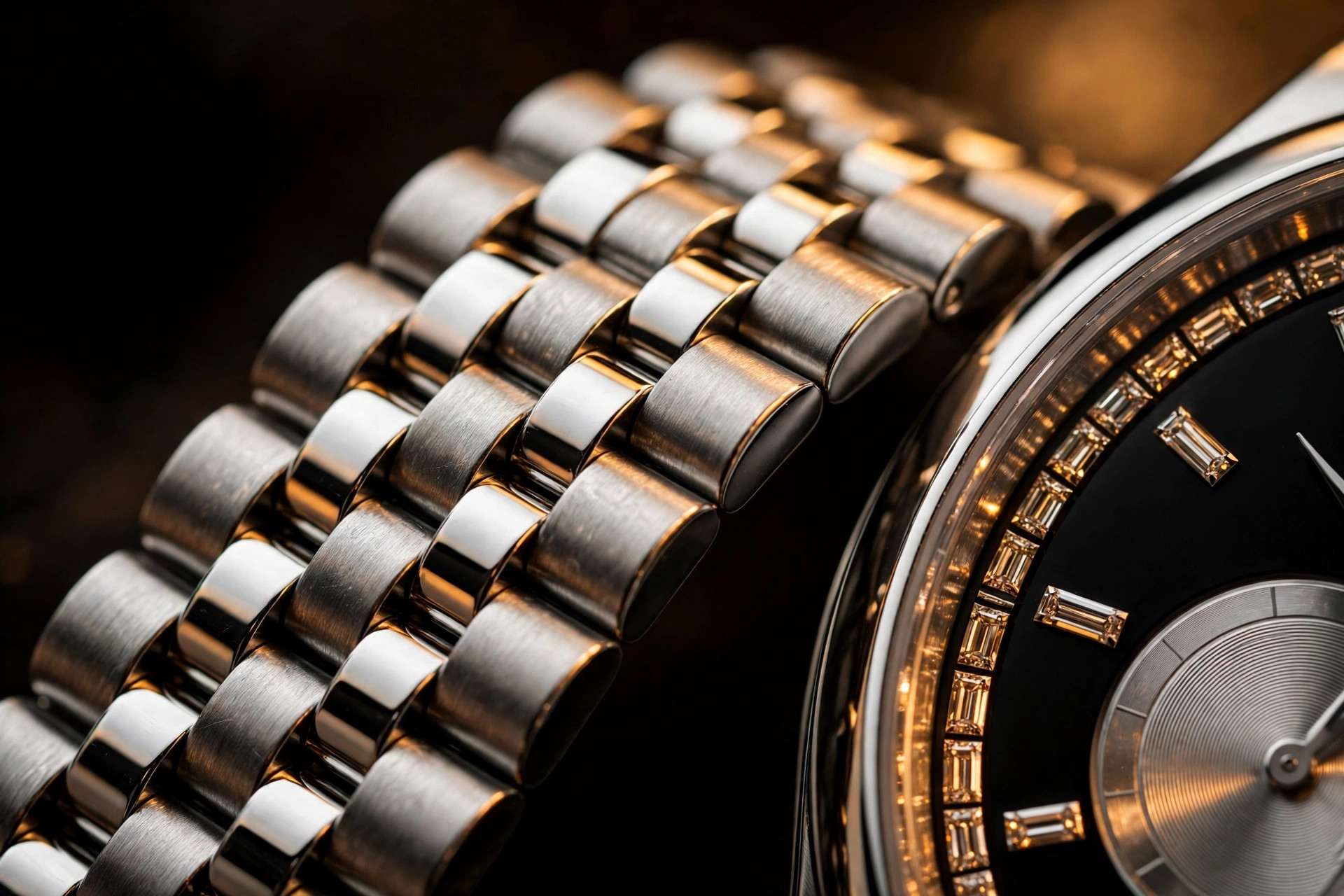
Wellendorff today makes jewelry, not watch bracelets, so Lange designed this one in-house. Coverage disagrees, interestingly, about what it borrowed. One hands-on account stresses the differences from the Odysseus bracelet: no fine-adjustment system, a push-button deployant clasp, jewelry intent rather than sports-watch intent. Another describes it as an Odysseus bracelet in disguise, citing the push-button link removal system on the back of each five-row link, the alternating brushed and polished tops, and the chamfered link edges.
Both readings fit if you separate the link from the clasp. Link construction borrows the modern Odysseus system, which matters for longevity: a bracelet whose links come apart with buttons, rather than with a jeweler's bench, is a bracelet that survives decades of sizing. Clasp philosophy stays jewelry: no micro-adjust, no sports-watch pretensions, just an engraved push-button deployant. That split is the correct engineering call for this watch. A Datograph Perpetual does not need a dive clasp. It needs a bracelet that will still be intact when the moonphase finally drifts, sometime in the 2140s.
Then there is the weight. Platinum runs about 21.45 grams per cubic centimeter, against roughly 8 for steel and 19.3 for gold, and a five-row bracelet is a lot of metal before you add a 41 by 13.5 millimeter case. One hands-on writer, who wore the watch at Hampton Court, estimated it approaches 300 grams, and reported that it wears better than the number suggests while never letting the wearer forget what it is made of. Treat 300 grams as an estimate, not a measurement: nobody has published a scale reading. Still, the direction is unambiguous. This is the heaviest Datograph Perpetual ever made, and the weight is not an accident. Density is the material's signature, the same way lightness is titanium's, and Lange is leaning into it rather than apologizing for it.
Eleven stones, 0.13 carats
Diamonds on a Lange dial are rare enough to count as news on their own. Eleven baguette-cut stones, applied by hand, total approximately 0.13 carats, in F-G color and VVS clarity per the manufacture's specification. A pair marks 12 o'clock. Markers are omitted at 4 and 8, where the subdials sit, pushed slightly lower than on earlier Datograph Perpetuals so the stones have room to breathe against the black 925 silver dial.
Color-coding keeps the dial honest. Gold hands carry the calendar: hours, minutes, day, month, leap year. Blued steel carries the short-time work: the 30-minute counter and running seconds. Rhodiumed steel carries the central chronograph seconds. In a dial carrying this much information, that discipline is load-bearing, not decorative.
Here is the opinion part: 0.13 carats, total, is restraint as a flex. Most jewelry watches put more diamond weight in a single stone than Lange put in this entire dial. One critic noted the baguettes read short against the dial's scale, and guessed, plausibly, that uniform sizing forced the compromise. Fair, but the alternative, larger stones shouting over a flyback chronograph, would have been worse. Gem-setting on a men's dress watch works when it behaves like punctuation, and eleven small rectangles at the hours are punctuation.
The 36-hour problem
Every perpetual calendar has an operating envelope, and this one's is tight. Thirty-six hours of power reserve is short for a watch whose entire purpose is never needing to be set. Let it run down and the reset runs through recessed pushers, one each for day, month, and moonphase, plus the date, with a stylus and patience. Owners of every brand's perpetual learn this lesson the same way, and the lesson is always annoying.
Lange's mitigation is genuinely clever. A rapid-correction pusher at 10 o'clock advances all calendar indications and the moonphase simultaneously, so a watch that stopped on Tuesday can be walked forward to Saturday in seconds rather than in stylus taps. An internal interlock means the pusher only works with the crown pulled out, so a sleeve cannot advance your calendar by accident. That interlock is the difference between a convenience and a liability, and it is the kind of detail that justifies the manufacture's reputation more than any finishing shot.
Two limits survive even that fix. First, the Gregorian exception: on March 1, 2100, when the century rule skips a leap year, every perpetual calendar ever made needs a one-day correction, this one included. Second, the calendar only stays correct if the watch stays wound, which makes a winder part of this watch's operating envelope whether or not the box includes one. A 36-hour reserve on a perpetual is a design decision with a daily cost, and the cost is discipline.
What to watch for
Three open questions belong in any honest account of this release. One is the weight: 300 grams is a hands-on estimate, and a production measurement would settle it. Another is luminescence, where sources disagree: one hands-on account reports none, while the manufacture's specification lists luminous hour and minute hands. Check the production piece before repeating either claim.
Third is the usual question with a 50-piece platinum Lange, and it is the least interesting one. Pricing is on application, one hands-on account guessed around 250,000 euros, and allocation runs through Lange boutiques. Figures like that dominate coverage of watches like this, and they obscure the engineering, which is the only part that will still matter when the 50 pieces are delivered. What matters is that the first Datograph Perpetual on a bracelet is also the heaviest, the most jeweled, and the most honest about its own operating limits, and that Lange chose to mark twenty years of a movement by changing everything around it and nothing inside it.
That restraint is rarer than the platinum: most brands mark an anniversary by redesigning the thing people loved, while Lange redesigned the strap.
| Specification | Datograph Perpetual Ref. 410.136E |
|---|---|
| Reference | 410.136E, limited edition of 50 pieces, individually numbered |
| Case | 950 platinum, 41.0mm diameter, 13.5mm height, brushed flanks, polished stepped bezel |
| Crystal | Sapphire front and exhibition caseback, six-screw caseback |
| Water resistance | 30m (3 bar) |
| Movement | Lange manufacture calibre L952.1, manual winding, 32.0mm x 8.0mm |
| Components / jewels | 556 parts (333 base chronograph and outsize date, 223 calendar module), 45 jewels, 4 screwed gold chatons |
| Frequency | 18,000 vph (2.5 Hz), lever escapement, in-house balance spring |
| Power reserve | 36 hours |
| Functions | Flyback chronograph with jumping 30-minute counter, perpetual calendar with outsize date, day, month, leap-year cycle, day/night indicator, moonphase (122.6-year accuracy), tachymeter |
| Dial | Solid 925 silver, black finish, rhodié auxiliary counters, 11 hand-applied baguette-cut diamond hour markers, approx. 0.13 carats total, twin stones at 12, omitted at 4 and 8 |
| Hands | 750 gold calendar and time hands, blued steel chronograph counter and subsidiary seconds, rhodiumed steel central chronograph seconds |
| Bracelet | Five-row 950 platinum bracelet, alternating satin-brushed surfaces and polished bevels, push-button deployant clasp engraved Lange |
| Correctors | Rapid-correction pusher at 10 o'clock (crown-out interlock) plus three recessed pushers for day, month/leap year, moonphase |
| Price | Price on application (one hands-on account estimates around 250,000 euros, unconfirmed) |
| Availability | Lange boutiques; embargo lifted October 24, 2026, 12:00 CEST |
Honesty block: This article is based on A. Lange & Söhne's published specifications and press release (via Deployant's full-text reproduction), plus hands-on coverage from Fratellowatches and watchesbysjx. I have not handled this watch. The 300-gram figure is a hands-on estimate, not a measurement; the luminescence discrepancy between sources is flagged above as unresolved. Price is on application; the euro estimate is one writer's guess, not a list price.
Lange redesigned the strap, and the strap weighs as much as the argument.