Down, Not Back: Lamborghini’s Temerario Spyder and the Roof That Stows Vertically
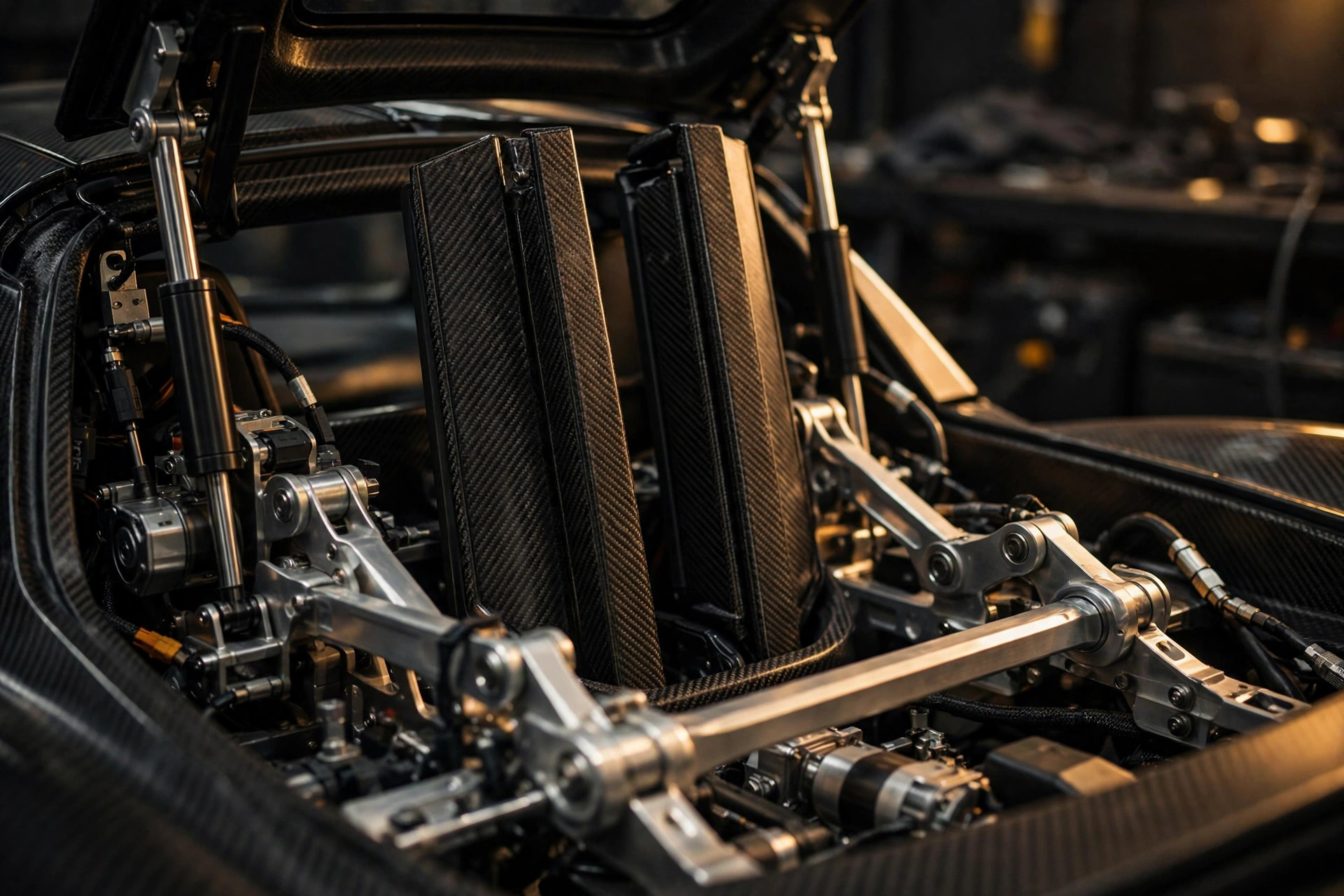
Lamborghini's new convertible does not fold its roof back. It drops it.
Under the lights of the Academy Museum of Motion Pictures in Los Angeles, Lamborghini revealed the Temerario Spyder a day ahead of the Los Angeles Auto Show. It is the convertible version of the 907-horsepower hybrid coupe, and its launch specification wears gloss Blu Cepheus with Shiny Black detailing and exposed carbon fiber, according to DailyRevs. Powertrain unchanged. Speed nearly unchanged. Only the roof is new, and it changes the car.
Nearly every retractable hardtop in production folds its roof backward and stacks it horizontally, over the engine or behind the seats, because that is where the space is; Lamborghini's does the opposite. Its roof splits into two panels, the panels fold together, rotate upright, and lower vertically into a compartment immediately behind the seats, ahead of the engine. Ten electric actuators coordinate the move, in a sequence Lamborghini patented as a dual-blade mechanism. 17 seconds to open, 18 to close, operable at speeds up to 31 mph.
Ten Motors Where Hydraulics Used to Live
Retractable hardtops have run on electro-hydraulic systems for two decades: a pump, a reservoir, high-pressure lines snaking through the rear bodywork, and a set of hydraulic rams doing the heavy work. Lamborghini deleted all of it, and the Spyder's roof runs on ten electric actuators alone: no pump, no fluid, no hydraulic circuit at all. Jalopnik, which examined the car at the reveal, describes the result as smoother, quieter, and more compact than a hydraulic setup, and the compactness is the point: an electric actuator lives where it works, while a hydraulic system needs a pump somewhere and lines everywhere.
Split, fold, rotate, descend. That is the whole published choreography, and it is notably short on detail. Lamborghini has said the roof splits into two panels, the panels fold together, rotate upright, and drop into the vertical slot, but nothing about whether the side windows drop first, how the engine cover moves out of the way, or how the panels latch once stowed. Ten actuators sequenced in software can handle all of that. Nobody outside Sant'Agata has seen the sequence itemized, and a mechanism is only as good as its least reliable step.
Complexity buys one thing hydraulics cannot: precision. Electric actuators can be position-controlled to fractions of a degree and sequenced against each other in software, which is how two roof panels rotate upright, fold together, and drop into a vertical slot without colliding with each other, the seats, or the engine cover. Try that with hydraulic rams and you are tuning valves by hand. Lamborghini's choice reads less like a gimmick than like a company that looked at the mechanism as a robotics problem instead of a plumbing problem.
After decades of soft tops, the hardware finally fits. That is why now. Electric actuators have shrunk and cheapened to the point where ten of them cost less space than one hydraulic circuit, and the Temerario already carries the electrical architecture to run them: a 3.8 kWh battery and three electric motors mean the car is wired for high-current accessories in a way a purely combustion Lamborghini never was. A folding hardtop was always possible, but it took a hybrid to make it practical, which is the irony: the car that finally gives Lamborghini a folding roof is the one that had to be electrified first.
A Convertible Whose Center of Gravity Drops With the Roof Down
Three millimeters. That is the whole argument. Stow a roof horizontally and you park a heavy panel high up and toward the rear, which raises the center of gravity and shifts the balance backward, exactly the two things a supercar cannot afford. MotorTrend reports Lamborghini's own figures for the alternative: a conventional horizontal stow would have raised the Spyder's center of gravity by 0.28 inch and moved its longitudinal balance point 0.43 inch toward the rear axle with the roof down, while vertical stow does the reverse: with the roof open, the Spyder's center of gravity drops by 0.12 inch, about 3 millimeters, and weight distribution stays put.
Three millimeters sounds like nothing, and on a stopwatch it is nothing. A supercar's center of gravity sits roughly 450 millimeters off the ground, by the author's estimate, so 3 millimeters is well under one percent. Nobody will feel it through the steering wheel. Direction is what matters: every other convertible on sale gets dynamically worse, in this one specific metric, the moment its roof comes down. This one gets marginally better, because Lamborghini treated the stowed roof as a mass-placement problem rather than a packaging afterthought. Mass low and central beats mass high and rearward, and the vertical slot behind the seats happens to be low and central.
Hiding the roof vertically strips the visual mass of the roofline away, and MotorTrend notes the Spyder looks lower to the ground with the top down than a conventionally stowed convertible does. A new engine cover shows off the V8 where a horizontal roof stack would have buried it. Lamborghini even fitted an adjustable rear window, DailyRevs notes, so the driver can tune how much of that 10,000-rpm soundtrack reaches the cabin with the roof up. Small decisions, all pointing the same way: nobody bolted this roof onto a coupe, engineers designed the car around it.
Two Hundred and Twenty Pounds
Open air is never free, and it costs about 220 pounds over the coupe, according to both MotorTrend and Jalopnik, putting curb weight around 4,400 pounds, a MotorTrend estimate. Lamborghini has not published a split between the mechanism, the actuators, the reinforcement, and the panels, so the 220 pounds arrives as a single number. Performance pays for it in small change, starting with 0 to 62 mph in 2.8 seconds against the coupe's 2.7, 0 to 124 in 7.3, two tenths slower, and top speed unchanged at 213 mph.
Do the arithmetic and the penalty is almost exactly what mass alone predicts. 220 pounds on a 4,400-pound car is 5 percent more mass; against unchanged power, the 0 to 62 time should worsen by roughly 5 percent, from 2.7 seconds to about 2.84. Lamborghini claims 2.8, a touch better than mass alone predicts, which is what instant electric torque at launch buys. Electric torque does not erase the penalty. It absorbs it, and the absorption is measurable to a tenth of a second.
For calibration, Ferrari's 296 GTS, the obvious rival, pays 70 kilograms, 154 pounds, for its folding hardtop over the GTB coupe, with about 65 kilograms of that in the roof mechanism itself and the rest in sill, A-pillar, and B-pillar reinforcement. Lamborghini's penalty runs about 43 percent heavier, and unlike the Ferrari, which matches its coupe's 2.9-second sprint, the Spyder gives back a tenth. Part of the gap is size: the Temerario is a bigger, heavier car with a V8 and three motors to begin with. Part of it is the mechanism: ten actuators and a patented vertical stow cost more than two roof panels and a tonneau cover.
Lamborghini offers a way to buy some of it back. Alleggerita, Italian for lightened, swaps in carbon-fiber-reinforced polymer for the front splitter, rear decklid, and underbody panels, adds carbon door cards, and, with the optional carbon-fiber wheels, saves 49 pounds, about 22 kilograms, according to DailyRevs and Jalopnik. That recovers roughly a fifth of the Spyder penalty. Pay extra to remove weight the roof added, and the customer funds both sides of the argument.
Living With It
Open air does not mean leaving the bags behind. MotorTrend puts the frunk at just under 4.0 cubic feet, a bit smaller than the 992-generation 911's 4.8, and says it holds two small carry-ons. Roof down, the car still carries luggage, and Lamborghini also fitted its first-ever neck warmers, per Jalopnik, warm air blown at the occupants' necks for top-down driving in cold weather, a feature Mercedes has offered for years and Sant'Agata had never bothered with. Spyder owners will drive with the roof down in weather that is not perfect, and Lamborghini finally admits it. That is the only honest reason to build a convertible.
A Stiffer Frame, Built Around the Roof's Parking Spot
Removing a roof removes structure, and every convertible since the first one has paid for open air with flex. Lamborghini's answer starts with the coupe's all-aluminum spaceframe, already more than 20 percent more torsionally rigid than the Huracán's, according to Lamborghini's own spaceframe release, and adds stiffening elements and reinforced mounting points to the Spyder, concentrated behind the seats, exactly where the folded roof sits when deployed. TopCarNews reports the result as 6 percent stiffer than the Huracán Spyder in both static and dynamic torsional rigidity, with a 9 percent increase in dynamic bending stiffness also reported. Lamborghini has published no absolute figure, only the relative one. Reinforcement location is the useful part.
That compartment is now doing chassis work, not just holding a roof. In a conventional convertible, the roof's parking spot is dead space, a void the chassis engineers work around. Here the compartment sits low, central, and reinforced, carrying the mechanism's loads and bracing the frame behind the seats at the same time. Lamborghini says the spaceframe was designed from the outset to support open-top loads, which suggests the Spyder was not an afterthought grafted onto the coupe but a variant the platform anticipated. That last point is inference, not a published fact: no source says the compartment braces the frame, only that reinforcement concentrates where the roof stows. Rigidity claims point the same way, and the location is the tell.
One layout question the vertical stow answers better than a horizontal stack would: cooling. A roof folded over the engine blankets the engine cover and the intakes beneath it. A roof stowed vertically behind the seats leaves the engine bay uncovered, which matters for a twin-turbo V8 that already runs hot. Roof down, the open questions move to the cabin: buffeting, and whether the adjustable rear window works as a wind deflector the way Ferrari's adjustable glass screen does in the 296 GTS. Rain is the third unknown: a vertical slot behind the seats needs drainage and sealing that a tonneau-covered horizontal stack handles by gravity. Lamborghini has published nothing on any of the three, and answers will come from the first owners, not the reveal stage.
Same Engine, New Audience
Same engine. Good, it did not need changing. This one just lets you hear it properly. Temerario's L411 is a clean-sheet 4.0-liter twin-turbo V8 with a flat-plane crankshaft, making 800 PS, 789 horsepower, between 9,000 and 9,750 rpm, with a redline at 10,000 rpm and about 10,250 rpm available on launch control. PS and CV are the same metric horsepower under different badges: 800 PS for the engine alone, 920 CV for the combined system.
Three axial-flux electric motors lift combined output to 920 CV, 907 horsepower. Two drive the front axle independently, for torque vectoring. One sits between the engine and the eight-speed dual-clutch transmission. Torque is 730 newton-metres, 538 pound-feet, from the V8 alone at 4,000 to 7,000 rpm, and 800 newton-metres, 590 pound-feet, for the combined system. Thirteen configurations span the drive modes and hybrid system, per Jalopnik, though Lamborghini has not itemized what the thirteen are. Full L411 detail, bore and stroke, titanium rods, diamond-like-carbon followers, lives in this site's engine article.
Its powertrain carries over untouched, so the numbers are the coupe's, digit for digit. What changes is the audience, because with the roof down, a 10,000-rpm flat-plane V8 is no longer something you hear through glass and insulation. Lamborghini also offers a factory Akrapovič titanium exhaust for the Temerario, an 11.4-kilogram system, 12 percent lighter than standard, with larger tubing, new manifolds, a reworked silencer, and frequencies tuned by noise, vibration, and harshness engineers for the run toward redline. In the coupe it is an option. In the Spyder it is the point. Forget the roof mechanism and the rigidity figure. The car sells one thing: unmuffled access to the only turbocharged production engine that reaches 10,000 rpm, a claim Lamborghini makes for the L411 and no rival has yet answered.
What Lamborghini Has Not Said
Price first: Autoblog's preview puts the Spyder just below $391,000, TopCarNews reports $390,900, and Jalopnik says Lamborghini has not confirmed a figure at all, so treat any number as preliminary until the company publishes one. CarBuzz, in newer reporting, calls $390,900 the firm starting price before destination fees and tariffs, with American sales starting in the second quarter of 2027. Orders opened on November 18, with first deliveries expected in spring 2027, per TopCarNews. No absolute torsional rigidity figure exists, only the 6 percent relative claim against the Huracán Spyder. No wind-tunnel numbers for roof-down drag. No lap time. No service procedure for a mechanism that lives vertically behind the seats. Curb weight around 4,400 pounds is an estimate derived from the 220-pound delta, not a weighbridge ticket.
Worth asking, too: what happens if one of the ten actuators stalls mid-cycle, whether the roof can be closed manually, and how a dealer reaches a mechanism buried behind the seats when the warranty claim arrives. Ten actuators means ten control points, and Lamborghini has published no failure procedure for any of them. Electric actuation does change the failure math, in the Spyder's favor and against it. A hydraulic roof fails everywhere at once when a seal goes: pressure drops, the whole system stops. An electric roof fails one actuator at a time, and position sensors can halt the sequence before a desynced panel binds, at least in theory. Practice depends on whether Lamborghini built in redundancy, a manual override, or a limp-home close, and none of that is published. Ten actuators are ten stall points. A roof that stops halfway in the rain is a roof that failed, however elegantly it was sequenced. Does the vertical stow stay vertical after 50,000 miles of heat cycles and road vibration, or does a mechanism with ten actuators and a patented folding sequence develop the kind of tolerance drift that turns a 17-second ballet into a grinding complaint? Does the roof seal as quietly at year five as it does on the reveal stage? And does the neck-warmer experiment mean Lamborghini finally accepts that its convertibles get driven in winter, or is it a checkbox for the options list? They are the questions that decide whether a clever mechanism is also a durable one, and durability is the part of convertible engineering that never makes the reveal video.
Counterargument: The Heaviest Way to Go Roofless
Purists will call the folding hardtop the wrong answer, and they have a case. It is the heaviest, most complex way to remove a roof. A soft top weighs less and folds smaller; a manually removable panel weighs less still and needs no actuators at all.
Lamborghini's own history agrees: the Silhouette targa of 1976, the Jalpa, and the Gallardo and Huracán Spyders all went roofless without a folding hardtop, and every one of them was lighter for it. Choosing the hardtop buys a coupe silhouette and coupe quiet with the roof up, at 220 pounds and ten motors, and that is a lot to pay for silence.
Fair. But a soft top cannot match a hardtop's refinement at 213 mph. A removable panel cannot fold itself at 31 mph in traffic. Lamborghini chose the mechanism that preserves the coupe experience most completely, then engineered the stowage so it would not punish the car's balance. Ferrari's 296 GTS, the company says, folds its roof into the space above the engine bay, the conventional answer. Lamborghini looked at the same problem and folded down instead of back. Silence cost 220 pounds, and the stow paid some of it back in balance.
Questions, Answered
What makes the Temerario Spyder's roof different from other folding hardtops? Most retractable hardtops fold backward and stack horizontally over the engine or behind the seats, which raises the center of gravity and shifts weight rearward when the roof is down. Its patented dual-blade roof splits into two panels that rotate upright and stow vertically behind the seats, ahead of the engine, driven by ten electric actuators instead of electro-hydraulics. Lamborghini says the vertical stow lowers the center of gravity by 3 mm with the top down and leaves weight distribution unaltered.
How much heavier is the Spyder than the coupe? About 220 pounds, putting curb weight around 4,400 pounds. That costs a tenth of a second to 62 mph and two tenths to 124 mph, while top speed is unchanged at 213 mph. Alleggerita, with carbon-fiber body components and carbon wheels, saves 49 pounds.
How much does it cost, and when can you buy one? Reports disagree: TopCarNews reports $390,900, Autoblog's preview puts it just below $391,000, and Jalopnik says Lamborghini has not confirmed a figure. CarBuzz, in newer reporting, calls $390,900 the firm starting price. Orders opened on November 18, 2026, with first deliveries expected in spring 2027, per TopCarNews.
How fast is the Temerario Spyder, and how does it compare with the coupe? Lamborghini claims 0 to 62 mph in 2.8 seconds, 0 to 124 mph in 7.3 seconds, and a top speed of 213 mph, from the same 920 CV hybrid powertrain as the coupe. Its coupe sibling is a tenth quicker to 62 mph; top speed is identical.
What happens if one of the ten roof actuators fails mid-cycle? Lamborghini has not published a failure procedure, and whether the roof can be closed manually or the sequence halted safely is an open question.
Bottom Line
Thirty-eight years after the Jalpa, Lamborghini has an open-top V8 again. A roof coming off is the easy part. Where it goes when it is off is the car.
Specifications: Lamborghini Temerario Spyder (November 2026)
| Reveal | November 18, 2026, Academy Museum of Motion Pictures, Los Angeles, ahead of the LA Auto Show |
| Roof | Patented dual-blade retractable hardtop; two panels stow vertically behind the seats, ahead of the engine |
| Actuators | 10 electric actuators; no electro-hydraulic system |
| Operation | 17 s open / 18 s close; operable up to 31 mph |
| CG Effect | Center of gravity drops 0.12 in (3 mm) with top down; a horizontal stow would have raised it 0.28 in and shifted balance 0.43 in rearward |
| Weight Penalty | About 220 lb over the coupe; curb weight around 4,400 lb (MotorTrend estimate) |
| Weight Saving | Alleggerita package with carbon-fiber wheels saves 49 lb (22 kg) |
| Chassis | Reinforced all-aluminum spaceframe; 6% more torsionally rigid than the Huracán Spyder (static and dynamic), plus 9% dynamic bending stiffness |
| Engine | L411 4.0L twin-turbo flat-plane V8; 800 PS (789 hp) at 9,000-9,750 rpm; 10,000 rpm redline (about 10,250 on launch control) |
| Hybrid System | Three axial-flux electric motors; 920 CV (907 hp) combined; V8 torque 730 Nm (538 lb-ft), combined torque 800 Nm (590 lb-ft) |
| Transmission | 8-speed dual-clutch; 13 drive-mode and hybrid configurations |
| Drive | All-wheel drive; front axle driven by two independent electric motors |
| Performance | 0-62 mph 2.8 s; 0-124 mph 7.3 s; top speed 213 mph (343 km/h) |
| Exhaust Option | Akrapovič titanium, 11.4 kg, 12% lighter than standard |
| Frunk | Just under 4.0 cu ft |
| Price / Availability | About $390,900 reported (TopCarNews; CarBuzz calls it the firm starting price); Jalopnik notes Lamborghini has not confirmed a figure; orders opened November 18, 2026, deliveries spring 2027 (per TopCarNews) |
| Firsts | First Lamborghini retractable hardtop; first open-top Lamborghini V8 since the Jalpa (1988); first Lamborghini neck warmers |
| Launch Specification | Gloss Blu Cepheus with Shiny Black detailing and exposed carbon fiber |
Sources & Methodology
Reveal facts, roof mechanism, figures, and quotes from MotorTrend (November 19, 2026), Jalopnik (November 19, 2026), Autoblog (November 19, 2026), DailyRevs (November 19, 2026; launch specification and Alleggerita details), and TopCarNews (November 19, 2026), with the teaser and Akrapovič exhaust details from DriveSpark (November 14, 2026). Ferrari 296 GTS weight penalty (70 kg over the GTB, about 65 kg in the roof mechanism) and roof-stow layout from Ferrari launch coverage (Wikipedia, Team-BHP, DrivingElectric, 2022). Headline figures are corroborated across multiple outlets; figures resting on a single outlet are attributed to that outlet in the body. Price figures disagree across outlets (Autoblog just below $391,000, TopCarNews $390,900, Jalopnik unconfirmed) and are reported here as preliminary, with CarBuzz's newer reporting calling $390,900 the firm starting price. L411 engine figures from this site's own article on the engine. Curb weight around 4,400 pounds is MotorTrend's estimate from the reported 220-pound delta, not a manufacturer weighbridge figure. The 450 mm center-of-gravity height, the 5 percent mass arithmetic, and the torque conversions are the author's calculations from the published figures, not manufacturer claims. Author has not driven the Spyder, which exists publicly only as a reveal car; performance, weight, and rigidity claims are Lamborghini's, corroborated by multiple outlets rather than by independent measurement.