The Roof That Stands Up: Lamborghini's Temerario Spyder and the First Electric Hard Top
Fifty years of open-top Lamborghinis, and not one of them ever had a hard top. The Temerario Spyder changes that with ten electric actuators and a roof that disappears by standing up.
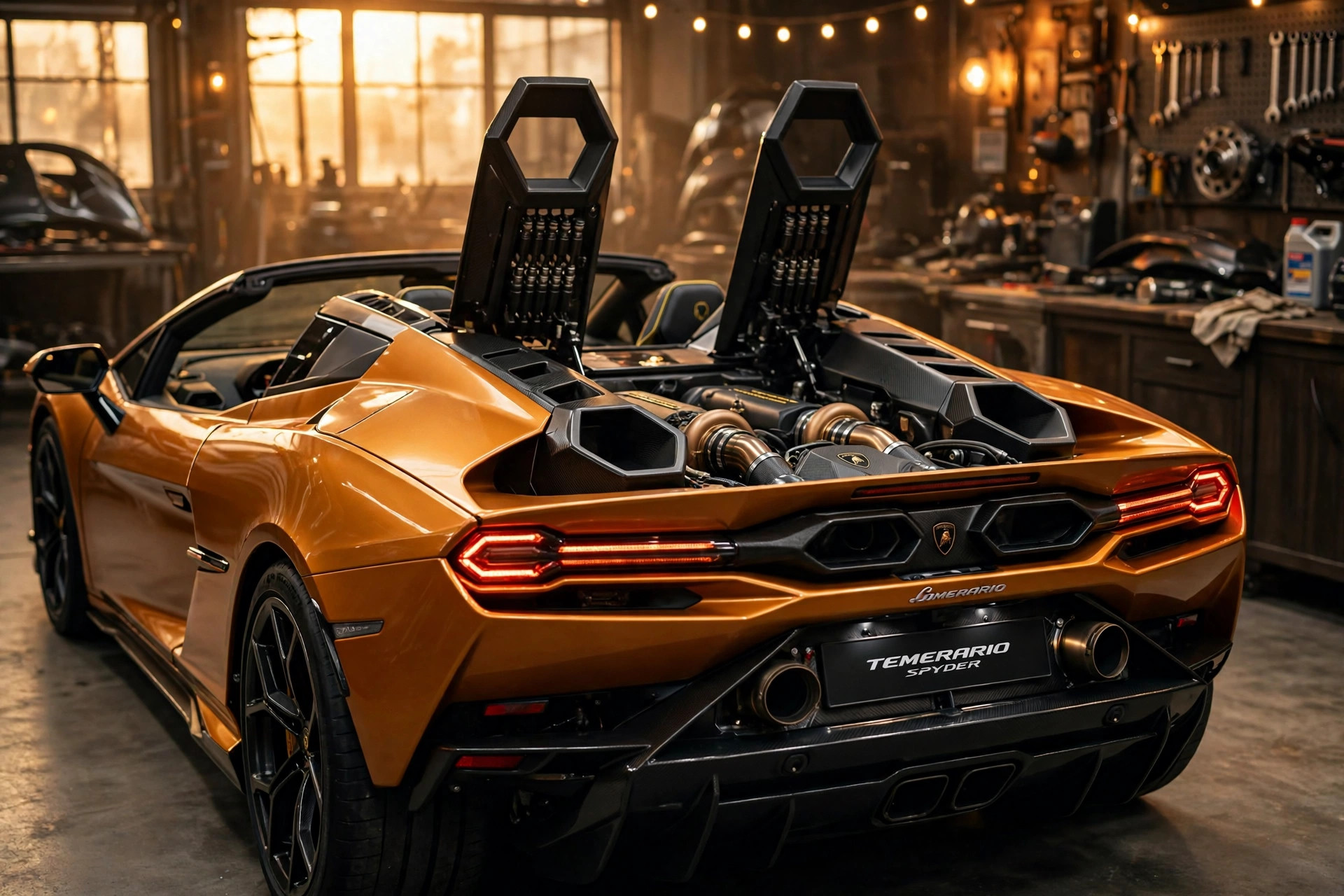
On November 19, Lamborghini unveiled the Temerario Spyder in two places at once, Sant'Agata Bolognese and the Academy Museum of Motion Pictures in Los Angeles, and the car it showed was the first open-top series-production Lamborghini in fifty years to carry a retractable hard top. That run stretches back to the 1976 Silhouette, and every Spyder since has worn fabric. Fabric folds small, weighs little, and asks almost nothing of the structure underneath it. A hard top asks for everything: mechanism, bracing, packaging, and a place to put two rigid panels when they are not overhead. Lamborghini's answer is to stand the roof up.
Most retractable hard tops fold horizontally, stacking their panels over the engine bay or into the trunk, which is exactly where a mid-engine supercar keeps its most sensitive cargo. Stacking mass high and rearward raises the centre of gravity and shifts weight toward the back axle, and the usual cure is more structure to carry the load, which adds more mass in the same place. Temerario Spyder breaks the loop by stowing its two roof panels vertically behind the seats, in a patented position Lamborghini says lowers the centre of gravity by 3 mm when the roof is open, while leaving weight distribution between the axles unaltered. Three millimetres is a small number. Its direction is the point. Every other folding hard top makes the car taller in behaviour when it opens. This one makes it lower.
Ten motors instead of one pump
Conventional retractable hard tops run on electro-hydraulics: a pump, a reservoir, high-pressure lines, valves, and a set of hydraulic rams that push the panels through their choreography. Hydraulics are strong and well understood, and they carry familiar penalties. Fluid has mass, lines leak, pumps whine, and a single pump failure strands the whole mechanism in whatever position it died in. Lamborghini replaced the entire circuit with ten electric actuators, one for each job in the sequence, and no hydraulic fluid anywhere in the car.
Electric actuation buys something hydraulics cannot offer, which is per-actuator position control. Each of the ten motors knows where its panel is, how fast it is moving, and how much force it is meeting, so the controller can sequence two rigid panels through a tight vertical slot without the panels ever negotiating with each other by feel. It also buys a failure mode that is less catastrophic: one stalled actuator can be diagnosed and worked around, while a burst hydraulic line ends the conversation. What it costs is complexity in a different currency. Ten motors mean ten controllers to synchronize, ten gearboxes to protect from heat and dust, and ten new things that can fail, each of them buried behind the seats in a space no mechanic reaches easily. Lamborghini has not published service intervals or actuator life figures, and until cars reach customers, the durability question stays open.
Operation takes about 17 seconds and works at speeds up to 50 km/h, which is fast enough to use at a traffic light and slow enough that nobody will mistake it for a party trick. An electronically adjustable rear window sits between cabin and engine, letting driver and passenger tune how much airflow and how much V8 reaches them with the roof closed. Two streamlined hexagonal cowls behind the seats stretch the cabin visually toward the tail while framing the engine cover, and Centro Stile's design director Mitja Borkert describes the roof as integrated rather than added, which is the kind of claim every convertible makes and very few earn. Here the evidence is in the silhouette: with the roof down, the car still reads as a Temerario, because the roof never had to be hidden under a tonneau shaped like an apology.
A frame with fewer welds in it
Removing a fixed roof from any car costs stiffness, and a mid-engine supercar pays that cost twice, because the structure behind the seats is already doing two jobs, carrying the engine and holding the rear suspension. Lamborghini's all-aluminium spaceframe answers with numbers that read like a before-and-after: static torsional rigidity up 6 percent, dynamic bending stiffness up 9 percent, and dynamic torsional rigidity up 6 percent against the Huracan Spyder, while structural components fall by half and heat-input welds drop by 80 percent against the Huracan EVO Spyder.
That weld figure deserves more attention than the stiffness percentages. Aluminium loses strength in the heat-affected zone around every weld, so a spaceframe's weak points are usually its joints, not its members. Cutting heat-input welds by four fifths means the frame keeps more of its parent metal's properties, and cutting component count by half means fewer joints exist to weaken in the first place. Extrusions and castings carry loads that welded assemblies used to, which is a manufacturing story as much as a performance one: fewer parts to fixture, fewer welds to inspect, fewer places for tolerance to accumulate. Stiffness is the headline. Simplicity is the mechanism.
Inside, the cabin grows in every direction that matters against the Huracan EVO Spyder, with 46 mm more legroom, 22 mm more headroom, and 9 mm more shoulder and elbow room, enough that Lamborghini says the car fits occupants up to two metres tall. A three-level seat neck warmer handles cold mornings, and the 112-litre front luggage compartment survives the roof's vertical stow, which is the other half of the packaging win: nothing about the roof competes with the frunk, because the roof never goes near it.
A V8 that revs like it forgot the turbos
Under the engine cover sits the same HPEV powertrain as the coupe, and it is worth describing precisely because the roof is not the only engineering in the car. A 4.0-litre twin-turbo V8 makes 800 CV on its own and revs to 10,000 rpm, rising to 10,250 rpm when Launch Control is engaged, which Lamborghini says is the highest engine speed of any series-production open-top super sports car with a turbocharged engine. Three axial-flux electric motors, one at the rear and two on the front axle, lift combined output to 920 CV and 800 Nm. Acceleration to 100 km/h takes 2.8 seconds, to 200 km/h 7.3 seconds, and top speed is 343 km/h.
Forced induction and ten thousand revs usually fight each other. Turbos want exhaust energy, which means backpressure, and backpressure costs the breathing a high-revving engine needs. Valve trains get heavy as revs climb, and heavy valve trains float. Lamborghini's three answers arrive in order: a 180-degree flat-plane crankshaft that keeps the firing intervals even and the exhaust pulses clean for the turbos, titanium connecting rods that cut reciprocating mass where it matters most, and DLC-coated finger followers that let the valve train survive the speeds the crankshaft invites. Two turbochargers sit inside the 90-degree V, running up to 2.5 bar of boost, with A357+Cu aluminium cylinder heads to carry the heat. None of this is new technology in isolation. Putting all of it in one production engine, and then removing the roof above it, is the statement.
Thirteen selectable driving experiences combine Citta, Strada, Sport, Corsa, and Corsa ESC Off with Recharge, Hybrid, and Performance strategies, and a three-level Drift Mode manages controlled oversteer. In Citta the car runs purely on electric power up to 190 CV, which is enough to leave a neighbourhood without waking it. That matters for a car whose engine note is part of the purchase, because the loudest thing about it should be a choice, not a default.
The honest weight of it
Every convertible carries a weight penalty, and Lamborghini's own release is silent on what this one weighs, which is the least surprising omission in the document. Secondary reports put the Spyder at about 1,805 kg dry, roughly 100 kg more than the 1,690 kg dry coupe, and that figure should be read with its provenance attached: it comes from the press, not from Sant'Agata. What can be said from Lamborghini's own numbers is that the penalty buys a car with no performance deficit worth naming, since the Spyder matches the coupe's top speed and trails its 0 to 100 km/h claim by a tenth of a second. An optional Alleggerita package claws back up to about 22 kg with carbon-fibre parts and carbon wheels, and an optional Akrapovic titanium exhaust weighs 11.40 kg, 12 percent less than the standard system. Both are the usual Lamborghini answer to mass: spend money on materials, not on apologies.
What remains unanswered is everything that only time and customers can settle. Lamborghini announced no price and no delivery date, and the figures circulating in the press are reports, not facts, so they do not belong in this article. Roof mechanisms live or die on their tenth year, not their first press drive, and ten electric actuators in a hot space behind a 10,000-rpm engine will earn their reputation slowly. Bridgestone supplies the tires as Lamborghini's exclusive partner, the same Potenza Sport fitment developed for the coupe, which at least means the only part of the car touching the road was not redesigned for the occasion.
Fifty years of fabric tops taught Lamborghini what a convertible costs. The Temerario Spyder is the first answer that tries to pay less than the going rate, by standing the roof up instead of laying it down, by replacing hydraulics with motors that know where they are, and by building a frame with fewer welds in it. Whether the arithmetic holds for a decade is a question for the owners. For now, the roof goes up in 17 seconds, the car gets 3 mm lower when it does, and the V8 behind the seats still revs to ten thousand. That is a convertible that kept its roof and its engine in the same conversation.
Specifications
| Item | Temerario Spyder |
|---|---|
| Unveiled | November 19, 2026, Sant'Agata Bolognese and Los Angeles |
| Roof | Retractable hard top, first on a Lamborghini Spyder; fully electric, patented vertical stow, ten electric actuators, no electro-hydraulic circuitry |
| Roof cycle | About 17 seconds, operable up to 50 km/h |
| Centre of gravity, roof open | 3 mm lower than closed; weight distribution unaltered |
| Chassis | All-aluminium spaceframe; +6% static torsional rigidity, +9% dynamic bending stiffness, +6% dynamic torsional rigidity vs Huracan Spyder; 50% fewer components, 80% fewer heat-input welds vs Huracan EVO Spyder |
| Engine | 4.0-litre twin-turbo V8, 800 CV, 10,000 rpm (10,250 rpm Launch Control), 180-degree flat-plane crank, 2.5 bar boost, titanium rods, DLC finger followers |
| Electric motors | Three axial-flux (one rear, two front axle) |
| Combined output | 920 CV (677 kW), 800 Nm |
| Performance | 0-100 km/h 2.8 s; 0-200 km/h 7.3 s; top speed 343 km/h |
| Driving modes | 13 experiences; Citta electric-only up to 190 CV; three-level Drift Mode |
| Cabin | +46 mm legroom, +22 mm headroom vs Huracan EVO Spyder; three-level neck warmer; 112-litre front luggage compartment |
| Dry weight | About 1,805 kg per secondary reports (Lamborghini publishes no figure); about 100 kg over the coupe |
| Options | Akrapovic titanium exhaust 11.40 kg (12% lighter); Alleggerita package up to about 22 kg lighter |
| Price / deliveries | Not announced by Lamborghini |
Limitations
Not driven, not handled, and no independent measurements exist yet. All performance figures are Lamborghini's. Dry weight, roof cycle time, cabin dimension gains, and delivery timing come from secondary reports, and the reported US price figures circulating in the press are not official, so none of them are treated as fact here. Actuator durability, roof sealing over time, and cabin noise with the top up cannot be assessed until customer cars accumulate mileage.
Sources
- Automobili Lamborghini, "Lamborghini Temerario Spyder: Unfiltered Performance," newsroom, November 19, 2026
- Automobili Lamborghini, Los Angeles debut release, "Automobili Lamborghini Unveils Temerario Spyder Against the Iconic Hollywood Skyline," November 19, 2026
- Bridgestone Americas, "Bridgestone continues partnership with Lamborghini as exclusive tire partner for the new Temerario Spyder," November 19, 2026
- Hypebeast, "Lamborghini Temerario Spyder," November 19, 2026
- Gearculture, "Lamborghini Temerario Spyder: The Hard Top That Stands Up to Disappear," November 2026
- Vulkan Magazine, "Lamborghini Drops the Roof on the Temerario, and Lets the V8 Shout," November 2026
- ArabWheels, "Lamborghini Temerario Spyder Gets First Hardtop and 343 km/h Top Speed," November 2026
- Batmangarage, "Lamborghini Temerario Spyder Price, 907 hp and Hardtop Roof," November 2026