Forward and Backward: How IWC Replaced a 40-Year-Old Program Disc With Gears That Think in Both Directions
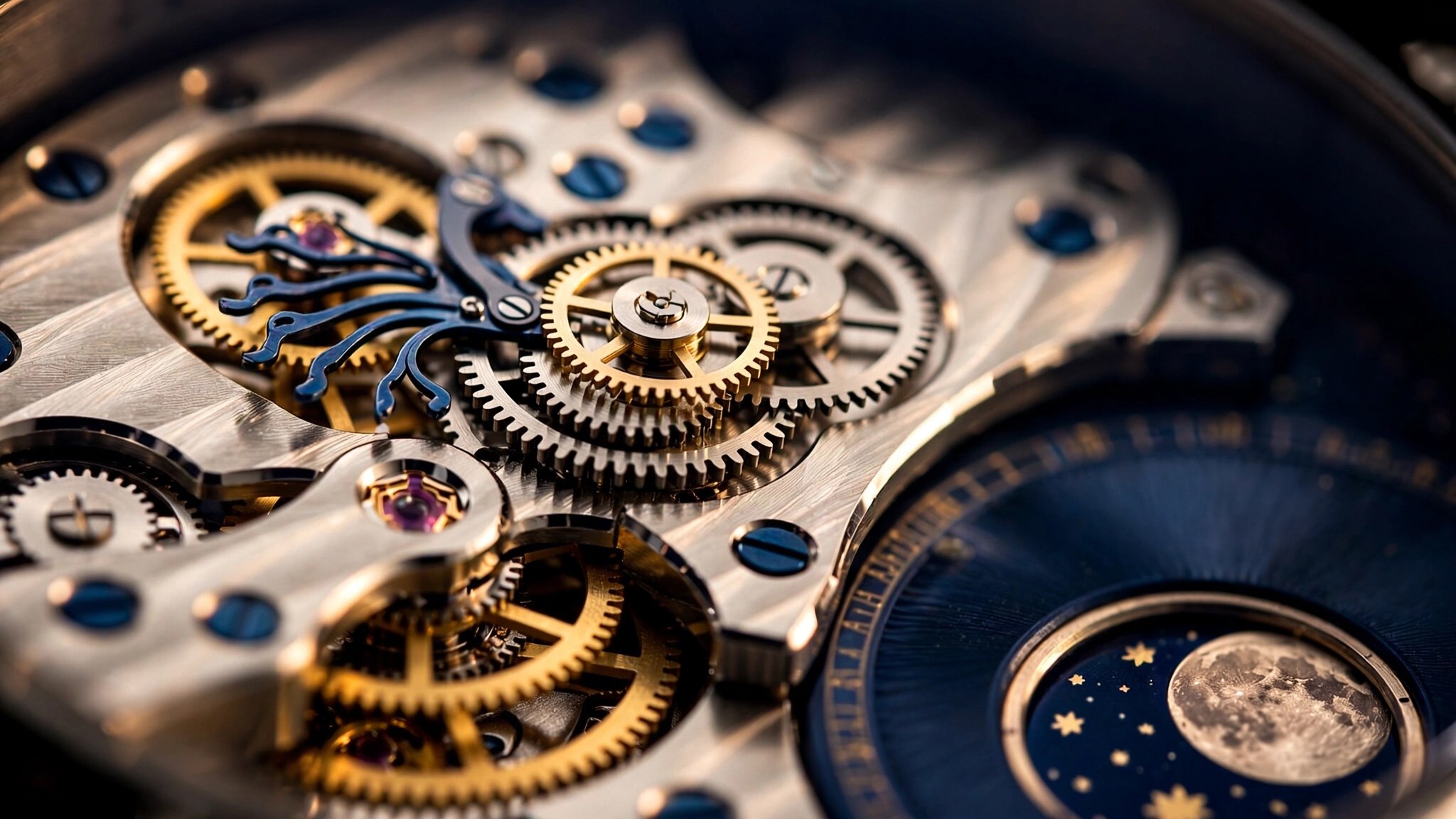
Perpetual calendars are the most mechanically complex common complication in watchmaking. A simple calendar displays the date and advances it once per day, which means it shows 31 at the end of every month and requires manual correction five times per year for months with fewer than 31 days. An annual calendar handles 30-day and 31-day months automatically but still trips on February. A perpetual calendar handles everything: 28, 29, 30, and 31-day months, including the leap year correction for February, without any manual intervention for a full century or more.
Building one is hard enough, but building one you can set through the crown instead of tiny corrector pushers is considerably harder. Building one you can set in both directions through the crown is something IWC spent years engineering from scratch, because the fundamental mechanism that made crown-setting possible in 1985 was also the mechanism that made it unidirectional. To go both ways, they had to throw out the disc and start over.
Kurt Klaus and the Program Disc
Kurt Klaus joined IWC in 1957 and spent nearly three decades working on complications before he unveiled the Da Vinci Perpetual Calendar, Reference 3750, at Baselworld in 1985. What made it revolutionary was not the perpetual calendar itself, which had existed since the eighteenth century, but the interface. Every perpetual calendar before it required corrector pushers: small recessed buttons on the case flanks that the owner pressed with a stylus to individually advance the date, day, month, or year when setting the watch. Forget which pusher controls which function, push the wrong one, and you could desynchronize the entire calendar, requiring a watchmaker to reset it.
Klaus eliminated all of that with a single mechanical innovation: the program disc. A thin metal disc, etched with a profile of varying depths around its circumference, rotating once every four years. As the disc turned, a spring-loaded lever rode along its edge, rising and falling with the contour. Deep notches corresponded to months with fewer than 31 days. The depth told the calendar mechanism how many days to skip at the end of each month: one day for 30-day months, two or three days for February depending on leap year status.
Because the entire four-year cycle was encoded in the physical profile of a single rotating disc, Klaus could connect the adjustment mechanism to the crown through a simple gear train. Turn the crown, the program disc advances, the lever reads the new position, and all calendar indications update accordingly. Elegant. Intuitive. A genuine breakthrough in how humans interact with mechanical complexity.
But program discs are ratchets. They advance in one direction only, by design. The spring-loaded lever riding the disc's edge works because it follows the profile passively as the disc rotates forward. Reverse the disc and the lever catches against the profile's steep transitions, the mechanical equivalent of dragging a needle backward across a vinyl record. Klaus knew this, and every watchmaker who has worked with cam-based calendar mechanisms knows it too. Unidirectional operation was not a limitation of Klaus's execution. It was a fundamental property of the program disc concept itself.
What LIGA Makes Possible
LIGA stands for Lithographie, Galvanoformung, Abformung: lithography, electroplating, and molding. Developed at the Karlsruhe Nuclear Research Center in the early 1980s for fabricating microstructures, the process uses X-ray or UV lithography to pattern a thick photoresist layer, then electroplates metal into the resulting mold. What emerges are components with near-vertical sidewalls, aspect ratios exceeding 20:1, and dimensional tolerances measured in single-digit micrometers.
For watchmaking, LIGA matters because it can produce gear geometries that are impossible to achieve through traditional methods. Stamping, hobbing, wire EDM: these are the standard approaches to manufacturing watch gears, and each imposes constraints on tooth profiles, minimum feature sizes, and the complexity of shapes that can be cut or formed in a single operation. LIGA operates more like printing than cutting. If you can draw the geometry, LIGA can build it, and the resulting components have surface finishes and dimensional accuracy that exceed what even the best CNC mill can achieve at these scales.
IWC turned to LIGA for the ProSet's most critical components: the extendable and retractable fingers that replaced the program disc's passive lever. These fingers are mechanical actuators, tiny structures that extend to engage calendar wheels or retract to disengage them, and their geometry requires multi-level features with precise step heights that encode the perpetual calendar's month-length logic. Traditional manufacturing could not produce them at the required tolerances. LIGA could.
Fingers Instead of Cams
Here is the core of the ProSet mechanism, and where the automotive analogy becomes useful.
A manual transmission uses synchronizer sleeves to engage gear ratios. When you move the shift lever, a sleeve slides along a hub and locks onto a gear through a set of dog teeth or a cone friction interface, coupling the gear to the output shaft. Move the lever the other way, the sleeve retracts, disengages, and slides to lock onto a different gear. Engagement and disengagement in both directions, mechanically controlled by the position of a single input, which is the shift lever connected to the driver's hand.
IWC's extendable fingers work on a parallel principle. Each finger is mounted on a multi-layered program wheel, and the layers of the wheel determine when each finger extends or retracts. One layer encodes month lengths: at the boundary between a 30-day month and the next month, specific fingers extend to advance the date past 30 directly to 1. Another layer encodes leap year status, determining whether February shows 28 or 29 days. The layers interact mechanically, stacking their logic the way a four-year program disc encoded all months in a single surface profile, but through discrete gear positions rather than a continuous cam contour.
The critical difference from a program disc: gears mesh in both directions. A gear tooth engages regardless of whether the wheel turns clockwise or counterclockwise. No ratchet, no cam follower, no directional dependency. When the crown turns forward, the program wheels advance, the fingers extend or retract according to the new position, and the calendar indications update. When the crown turns backward, the same program wheels retreat, the fingers respond to the previous position, and every indication steps back one day in perfect synchronization.
Synchronization across multiple outputs from a single bidirectional input. That is what a transmission does, and that is what the ProSet does, except the ProSet's outputs are date, day, month, year, and moonphase rather than gear ratios and wheel speeds.
Why Bidirectional Matters More Than It Sounds
Owners of traditional perpetual calendars learn to be careful. Very careful. Setting one involves advancing the calendar day by day using the crown or pushers, watching the date, day, month, and moonphase all update as you step through. Miss your target by one day and the consequences depend on which direction you missed. One day forward? Fine, step back. Except you cannot step back, because the mechanism is unidirectional. So you must continue forward through the remaining days of the month, through the next month, and potentially through several more months until you return to the correct date from the other side.
Overshooting February 28 on a non-leap year means cycling forward through all of March, April, May, June, July, August, September, October, November, December, January, and February again. Twelve months of careful, day-by-day crown turning. Each click requires attention because the perpetual calendar's intelligence is encoded in the mechanism's position, and skipping or mis-counting can desynchronize the moonphase, which accumulates its own independent error and is the hardest indication to correct.
Professional watchmakers charge several hundred dollars to set a perpetual calendar after battery replacement or extended storage. Not because the task is technically difficult for someone trained, but because it demands patience, precision, and the risk of expensive damage if done incorrectly. Crown threads can strip. Calendar components can be forced past their designed limits during rapid forward adjustment. Moonphase driving gears are fragile by necessity, since they must transmit minimal torque to achieve their 1-day-per-122.5-years (or better) accuracy.
ProSet eliminates the entire category of risk. Overshoot by a day, turn the crown back one click. Overshoot by a month, turn the crown back thirty clicks. Every indication retreats in lockstep, including the moonphase. No watchmaker required. No anxiety about overshooting. The mechanical complexity increased enormously to deliver an experience that feels, to the owner, like simplicity.
Calibre 82665: What Surrounds the Calendar
A perpetual calendar mechanism means nothing if the movement around it cannot sustain reliable timekeeping, and IWC built Calibre 82665 on their current generation platform with several notable specifications.
Pellaton automatic winding, IWC's proprietary system dating to Albert Pellaton's 1950 design and refined continuously since. Unlike a standard unidirectional or bidirectional rotor winding system where pawls engage a click wheel, the Pellaton system uses eccentric cams and connecting rods that convert rotor motion into mainspring tension. Modern IWC Pellaton systems use zirconium oxide ceramic components in the winding train for wear resistance, because ceramic-on-steel interfaces generate less friction and resist degradation far longer than steel-on-steel, a materials advantage analogous to ceramic ball bearings in automotive turbocharger cartridges.
Silicon hairspring. Anti-magnetic, temperature-stable, and manufacturable to tolerances that metal alloys like Nivarox cannot match. Silicon's elastic modulus is orientation-dependent because the material is crystalline, and IWC exploits this anisotropy to engineer terminal curves that improve isochronism, the balance wheel's ability to maintain consistent amplitude regardless of mainspring tension. A nickel-phosphorus escape wheel complements the silicon hairspring, providing a lubrication-free contact surface that resists the long-term degradation traditional oiled escapements experience between five-year service intervals.
Sixty hours of power reserve. Adequate for a weekend off the wrist but not extraordinary by modern standards, where 70-hour reserves are increasingly common in this price range. IWC likely made a deliberate trade-off: the ProSet mechanism's multi-layered gear trains consume more energy than a traditional program disc because gears meshing in both directions require tighter tolerances and more consistent torque delivery, and the power budget reflects that additional mechanical load. A program disc is a passive cam. A gear train is an active mechanism that demands energy to maintain its engagement pressures.
Running at 28,800 vibrations per hour, or 4 Hz, the balance oscillates eight times per second, a frequency that provides good resolution for the seconds hand and reliable amplitude stability under the varying mainspring torque that a 60-hour power reserve implies. Moon phase accuracy of 1 day per 1,044 years puts it in the upper tier of mechanical moonphases, behind the very best (Lange's 1 day per 1,058 years, A. Lange 1815 Rattrapante Perpetual Calendar) but ahead of the industry standard 1 day per 122.5 years by a factor of roughly eight.
Smaller Than Its Ancestor
Calibre 82665 fits inside a 42mm case. Its predecessor, the Big Pilot's Perpetual Calendar powered by Calibre 52615 with Kurt Klaus's forward-only mechanism, required 46.5mm. A 4.5mm reduction in case diameter might sound modest until you consider what happened inside: IWC removed a program disc, which is a relatively compact component that encodes an enormous amount of information in a small surface area, and replaced it with a multi-layered gear train architecture that must encode the same information through discrete mechanical positions rather than continuous surface profiles.
More mechanism in less space. This is where LIGA's dimensional precision pays its second dividend. Traditional gears manufactured by stamping or hobbing carry dimensional tolerances that require clearance between components, and clearance consumes space. LIGA-manufactured components have tighter tolerances, which means tighter clearances, which means the gear trains can be packed more densely without risking interference. Every micrometer of tolerance improvement across dozens of components compounds into measurable case size reduction.
Water resistance improved from 60 meters on the predecessor to 100 meters on the ProSet models, a specification that reflects improved case and crown gasket engineering rather than anything related to the calendar mechanism itself, but worth noting because perpetual calendar watches historically have poor water resistance. Many do not exceed 30 meters. A perpetual calendar rated to 100 meters suggests IWC is building for daily wear, not special-occasion deployment, and that philosophy aligns with the ProSet's user-friendliness: a watch designed to be set, worn, adjusted, and lived with, not handled with anxiety.
Three Models, One Mechanism
IWC launched the ProSet in three references. IW329601 is the Le Petit Prince edition: 42mm steel case, blue dial, steel bracelet with the EasX-CHANGE quick-release system, priced at $38,800. IW339601 is also Le Petit Prince but in 43mm white zirconium oxide ceramic with a blue dial on a rubber strap at $41,600. IW329602 is the rose gold edition with a green dial at $54,700.
All three share the double moonphase display at 12 o'clock, showing northern and southern hemisphere phases simultaneously, and a four-digit year display positioned between 7 and 8 o'clock. Four-digit year displays are uncommon in perpetual calendars because they require an additional gear train to drive the thousands and hundreds digits, which only change every hundred or thousand years. Most perpetual calendars display a two-digit year or, more commonly, just a leap year indicator showing which year in the four-year cycle the mechanism currently occupies.
IWC's inclusion of a four-digit year display is functionally unnecessary and mechanically extravagant. Nobody will own this watch long enough to see the thousands digit change. But it serves a purpose that transcends function: it declares that this mechanism does not take shortcuts, that even the most inconsequential display is driven by a complete gear train rather than a painted placeholder, and that the engineering behind the ProSet was pursued to completion rather than practical sufficiency.
$38,800 for the steel Le Petit Prince makes it among the most accessible perpetual calendars from a major manufacture. Patek Philippe's 5236P Perpetual Calendar, with its inline display, starts at $85,525 in platinum. A. Lange's Langematik Perpetual begins around $73,300. Vacheron Constantin's Patrimony Perpetual Calendar sits near $60,000. Even AP's recently introduced crown-adjustable perpetual, the Royal Oak Perpetual Calendar, commands $68,500 or more. At under $40,000, the ProSet undercuts them all while offering a feature, bidirectional adjustment, that none of them provide.
Whether this pricing strategy reflects IWC's commitment to accessibility or a calculation about market positioning is a question for business analysts, not engineers. From an engineering standpoint, the ProSet at $38,800 is an extraordinary amount of mechanical problem-solving per dollar.
What Klaus Started, Gears Finished
Kurt Klaus solved the right problem in 1985. Before him, perpetual calendars were intimidating objects that required tools and training to set. After him, they were watches you could adjust with the same crown that set the time. His program disc was a stroke of applied genius, encoding a four-year calendar cycle in the physical contour of a single rotating component.
But the disc imposed a constraint that could not be engineered around, only engineered away. Forward-only operation was not a bug in Klaus's design. It was the defining characteristic of cam-based encoding: a follower rides a surface profile, and surface profiles have direction. The only way to enable bidirectional operation was to abandon surface profiles entirely and move to discrete mechanical positions, which meant gears.
IWC's LIGA-manufactured fingers and multi-layered program wheels are the mechanical equivalent of replacing an analog signal with a digital one. A program disc stores calendar logic in a continuous, physically shaped surface. Program wheels store it in discrete positions of interlocking gears. Continuous encoding is elegant but directional. Discrete encoding is complex but omnidirectional. The trade-off is density for flexibility, and IWC chose flexibility.
That choice required LIGA because discrete gear positions at this scale demand tolerances traditional manufacturing cannot deliver. It required multi-layered wheel architecture because a single gear plane cannot encode the interlocking logic of months, days, and leap years. It required extendable fingers because fixed gear engagement would not allow the selective day-skipping that makes a perpetual calendar perpetual. Every component in the ProSet exists because the decision to enable backward adjustment cascaded through the entire mechanism, demanding solutions at every level.
Klaus started with a question: can the owner set a perpetual calendar without tools? His answer was the program disc. IWC started with a different question: can the owner set a perpetual calendar without fear? Their answer was gears. Both questions arose from the same impulse, reducing the distance between a complex mechanism and the person wearing it, and the forty years between them represent the time it took for manufacturing technology to catch up with mechanical ambition.
One click back. That is the entire value proposition, compressed into its simplest expression. Forty years of engineering to earn the right to turn a crown counterclockwise.
Specifications: IWC Big Pilot's Watch Perpetual Calendar ProSet
| Reference (steel) | IW329601 (Le Petit Prince, blue dial, bracelet) |
| Reference (ceramic) | IW339601 (Le Petit Prince, 43mm white zirconium oxide, blue dial) |
| Reference (gold) | IW329602 (18k rose gold, green dial) |
| Movement | Calibre 82665, automatic, in-house |
| Winding | Pellaton system with zirconium oxide ceramic components |
| Frequency | 28,800 vph (4 Hz) |
| Power Reserve | 60 hours |
| Jewels | 34 |
| Functions | Hours, minutes, small seconds, perpetual calendar (date, day, month, 4-digit year, dual moonphase) |
| Calendar | ProSet bidirectional perpetual, crown-adjustable forward and backward |
| Moonphase | Dual hemisphere, 1 day deviation per 1,044 years |
| Escapement | Nickel-phosphorus escape wheel, silicon hairspring |
| Case | 42mm (steel/gold) / 43mm (ceramic), 100m water resistance |
| Strap System | EasX-CHANGE quick release |
| Price | $38,800 (steel) / $41,600 (ceramic) / $54,700 (rose gold) |
Sources & Methodology
Technical specifications from IWC Schaffhausen press materials and reference sheets for Calibre 82665. ProSet mechanism description synthesized from Hodinkee introduction coverage, EuropeSays/Kien Lee technical analysis, Time and Tide hands-on review, TodayOnTheWrist reference coverage, and MONOCHROME Watches video presentation (all April 2026, Watches and Wonders). Kurt Klaus historical context from IWC Museum archives and multiple secondary sources confirming the 1985 Da Vinci Perpetual Calendar (Ref. 3750) as the first crown-adjustable perpetual calendar. LIGA process description from published Karlsruhe Institute of Technology research and Sigatec manufacturing literature. Competitor pricing from current authorized dealer listings as of June 2026. Moonphase accuracy comparison figures from manufacturer specifications. Author has not handled the ProSet. All engineering claims attributed to manufacturer press materials or verified against independent coverage from at least two sources.