Light Storage Battery: How IWC Fused Phosphorescence into Ceramic
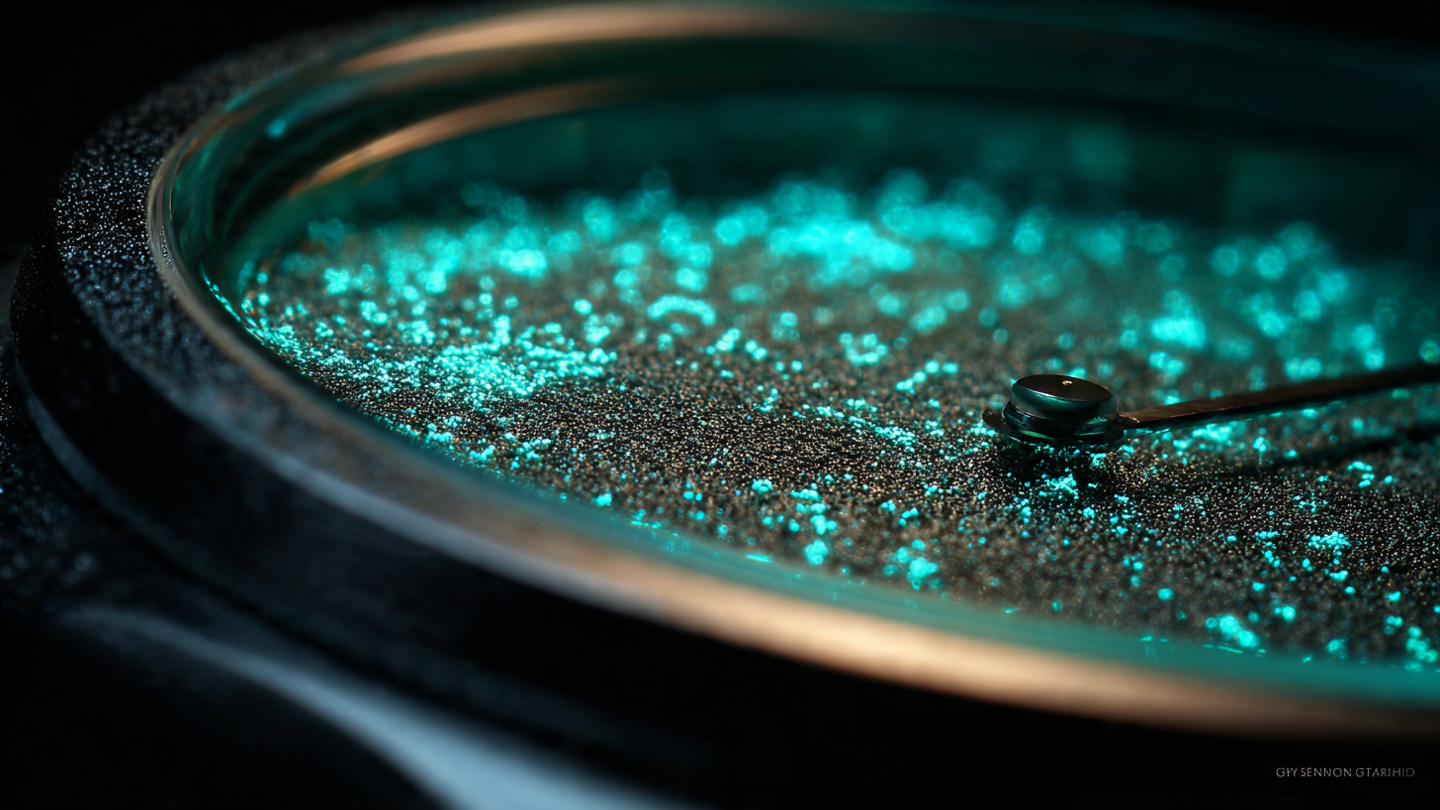
Super-LumiNova on a watch dial is paint. A thin phosphorescent layer, measured in tens of micrometers, applied over brass or ceramic, sealed beneath sapphire crystal. Every serious Swiss manufacturer uses it on indices and hands, from Rolex and Omega to Panerai and IWC, and the compound underneath every brand's application is fundamentally identical: strontium aluminate pigment mixed with a binder, deposited as a surface coating that sits on top of whatever structural material holds the watch together, and if you stripped away that paint you would always find dark metal underneath.
IWC decided to ask a stranger question. Not where phosphorescent material should go, but whether a watch case could become phosphorescent material. Could you sinter glow-in-the-dark pigments directly into the ceramic itself, distributed throughout the entire cross-section, so that luminescence was not a surface treatment but a volumetric property of the structural housing?
Several years of work, one custom manufacturing process, and a patent pending.
They called it Ceralume.
Two Ceramics, One Problem
White ceramic watch cases begin as zirconium oxide powder. ZrO2 gets stabilized with yttrium oxide to prevent destructive phase transformations during thermal cycling, pressed into what ceramicists call a green body, machined close to final geometry, then fired in a kiln at temperatures between 1,400 and 1,500 degrees Celsius until the individual powder particles fuse across grain boundaries into a dense polycrystalline structure that shrinks 20 to 25 percent in every linear dimension during the process. What emerges from the furnace measures roughly 1,300 Vickers in hardness, weighs less than steel, resists chemical attack, and will survive decades of daily wrist wear without a single visible scratch.
Super-LumiNova comes from RC Tritec, a Swiss firm that quietly supplies the luminescent compound used by nearly every luxury watchmaker on the planet. Chemically, it is strontium aluminate (SrAl2O4) doped with europium and dysprosium ions. Europium provides luminescence, and dysprosium creates electron traps that extend afterglow duration. Also a ceramic compound, which on paper makes blending it with zirconia sound trivial.
Here is why. Zirconium oxide powder optimized for watch-case sintering uses particles in the sub-micron range, carefully engineered over decades of industrial refinement for maximum packing density and uniform shrinkage behavior, while Super-LumiNova pigments are deliberately coarser because phosphorescent efficiency scales with crystal size: larger strontium aluminate crystals contain more electron trap sites per grain, absorb more photons, and sustain brighter afterglow for longer durations than finely ground particles where surface defects dominate and quench emission prematurely. Grind the pigment to match the ceramic powder's fineness and the afterglow dies.
So you have fine powder and coarse pigment, and when you mix them, clustering is the inevitable result. Coarse pigment particles clump together in pockets while fine ceramic powder fills the interstitial spaces unevenly, creating a two-phase aggregate rather than a homogeneous blend. Sinter that mixture and the finished case becomes a patchwork: bright zones where pigment concentrated, dead zones where ceramic dominates, visible under any UV lamp and obvious to the naked eye the moment you kill the lights. A topographic map of manufacturing failure, glowing unevenly from a case that costs more than most cars.
Ball Milling as Controlled Violence
Ball milling is ancient. Drop your powders into a rotating cylindrical drum, add hard grinding media, spin it, and let cascading balls break down agglomerates through repeated impact and attrition as they tumble through the powder bed with each revolution. Ceramic engineers have used variants of this process for centuries to prepare uniform mixtures before firing.
Standard ball milling would destroy the luminescent pigments entirely, because strontium aluminate's phosphorescent properties depend on the precise crystallographic positions of europium and dysprosium dopant atoms within the host lattice, and aggressive milling fractures crystals, disrupts those dopant sites, introduces surface defects that act as non-radiative recombination centers, and ultimately produces a powder that mixes beautifully but barely glows.
IWC's XPL division engineered a proprietary ball-milling protocol that threads an extraordinarily narrow needle: enough mechanical energy to disperse pigment particles uniformly throughout the ceramic matrix, and gentle enough to preserve the crystallographic integrity that gives those particles their entire reason for existing. Drum rotation speed, ball diameter, ball material composition, milling duration, the mass ratio of grinding media to powder blend, and the staging sequence of when each component enters the drum are all optimized parameters that IWC holds as trade secrets. Dr. Lorenz Brunner, who leads IWC's Research and Innovation department, described the result publicly only as a "ground-breaking manufacturing process tailored to the unique combination of ceramic powders and Super-LumiNova pigments."
Leonard Fetz, IWC's Innovation Product Manager, offered a more direct framing. Particle sizes differ. You cannot independently adjust them without degrading performance. Super-LumiNova is itself a ceramic, so modifying its particle characteristics means altering its phosphorescent behavior. Adapt the process to the materials, not the materials to the process.
Sintering Against Physics
Homogeneous powder is necessary but not sufficient, because the blended ceramic-phosphor mixture still has to survive sintering.
Zirconium oxide sinters optimally between 1,400 and 1,500 degrees Celsius, where atomic diffusion across grain boundaries reaches rates sufficient to eliminate porosity and produce a mechanically sound, dense body. Below about 1,300 degrees, too much porosity remains, structural integrity suffers, and water resistance ratings become fiction. Above 1,550, grain growth runs away and the ceramic loses fracture toughness.
Strontium aluminate is pickier. Its phosphorescent function depends on europium and dysprosium atoms sitting at precise substitutional sites within the crystal lattice, and excessive thermal energy promotes diffusion of these dopant ions away from their functional positions, progressively quenching luminescence as the firing temperature climbs. Push high enough and the strontium aluminate undergoes phase transformations that obliterate its ability to store and re-emit photons entirely.
IWC needed a sintering profile where zirconia densifies adequately while embedded phosphor particles retain their luminescent architecture intact. Compromise is inevitable: slightly less-than-optimal ceramic density to preserve phosphorescence, or slightly diminished glow to achieve structural integrity. Finding the exact balance took years. What we know is the outcome. A ceramic case hard enough and dense enough for a watch rated to 100 meters of water resistance, carrying phosphor particles that glow blue for more than 24 hours under calibrated dark-chamber measurement conditions.
Post-sintering machining added another layer of difficulty. Diamond-tool grinding generates localized heat at the cutting interface, and for conventional zirconia this thermal load is managed through coolant flow without much concern. For Ceralume, that same heat could damage phosphor particles exposed near the surface, creating a dead skin of non-luminous ceramic that masks the glowing interior. IWC confirmed both sintering parameters and grinding protocols required modification. Specifics remain proprietary.
How Phosphorescence Actually Works
A quick detour into solid-state physics, because understanding what Ceralume does requires understanding what strontium aluminate does at the atomic level.
In SrAl2O4 doped with Eu2+ and Dy3+, luminescence follows a three-stage cycle. Stage one: a europium ion absorbs an incoming photon from sunlight or artificial light and transitions from its ground electronic state to an excited state. Charging complete, the excited electron does not drop back to ground: instead it gets captured by a nearby dysprosium trap site, a metastable energy state created by the dysprosium ion occupying a specific crystallographic position in the host lattice, where the electron cannot decay radiatively because an energy barrier prevents it from returning to the europium ion through normal relaxation pathways. Stage three: thermal fluctuations at room temperature occasionally provide enough energy for the electron to escape its trap, whereupon it returns to the europium center and drops to ground state, emitting a visible photon in the process at a wavelength peaking near 520 nanometers for standard formulations, though IWC describes Ceralume's emission as blue, which suggests either modified host-lattice chemistry or co-dopants that shift the spectrum toward shorter wavelengths.
Trap depth governs timescale. Shallow traps release electrons in minutes, producing a bright initial flash that fades quickly, while deep traps hold electrons for hours but at emission rates below what human scotopic vision can detect (roughly 0.32 millicandelas per square meter). Commercial Super-LumiNova is engineered with a distribution of trap depths spanning that useful range, balancing initial brightness against sustained perceptibility.
Ceralume's advantage is volume. Painted dials carry phosphor in a layer measured in tens of micrometers. A Ceralume case distributes phosphor through millimeters of structural ceramic. More phosphor per unit of visible surface area means more total photon absorption capacity, more electron traps available for energy storage, and more sustained emission over time. IWC measured 24-plus hours of visible glow in dark-chamber testing. Standard Super-LumiNova dial applications typically fall below perceptible thresholds within 8 to 12 hours.
From Apprentice Sketch to Lewis Hamilton
Every year, IWC's apprentices participate in a design challenge. In one of these exercises, an apprentice team proposed a fully luminous watch. Rough rendering, ambitious concept, probably assumed impossible, but XPL took it seriously and spent years turning the idea into a viable manufacturing process.
Years of development produced a concept watch unveiled in May 2024: a Pilot's Watch Chronograph 41 in Ceralume, compact and wearable enough to end up on Lewis Hamilton's wrist at the Monaco Grand Prix, generating exactly the kind of wrist-level visibility that sells watches to people who don't read spec sheets. Then the concept disappeared from IWC's public communications for nearly two years, which in retrospect clearly meant they were solving the production-scale manufacturing challenges that separate a hand-finished prototype from a repeatable commercial product.
At Watches and Wonders Geneva 2026, IWC revealed the production model. Not the Chronograph 41 that collectors expected, but instead the Big Pilot's Watch Perpetual Calendar, which at 46.5 millimeters in diameter and 15.9 millimeters thick maximizes luminous surface area and makes the phosphorescent effect as visually dramatic as possible across a case that could double as a nightlight if you left it on a bedside table.
Reference IW505801: What $76,300 Buys
Monochromatic by design. Everything that can carry phosphor does. Case, dial, rubber strap, even the "Probus Scafusia" medallion embedded in the automatic rotor visible through the sapphire caseback. In daylight, the watch reads as an exercise in white-on-white texture, with matte ceramic surfaces meeting glossy ones, printed numerals appearing in a subtly different shade of white than the luminous substrate beneath them, and grey hands providing the only real tonal contrast on an otherwise achromatic instrument.
Turn off the lights. Everything inverts. Case and dial and strap erupt in blue phosphorescence while the non-luminous printed numerals become dark shadows against glowing background and the hands read as darker silhouettes. Legibility actually improves in total darkness. Under fluorescent office lighting, distinguishing hour from minute from complication subdial requires attention. In a pitch-black room, every element separates by contrast alone.
Inside: IWC caliber 52616. Kurt Klaus developed IWC's perpetual calendar mechanism in the 1980s, and this movement carries his legacy forward through a Pellaton winding system reinforced by ceramic components, 168 hours of power reserve stored across a single mainspring barrel, displays for date and day and month and a four-digit year aperture and a Double Moon phase tracking both hemispheres with a deviation of one day every 577.5 years, all operating at 4 Hz across 54 jewels without chronometer certification.
One notable absence. IWC also introduced the ProSet perpetual calendar at Watches and Wonders 2026, which allows bidirectional crown adjustment for all calendar functions. This Ceralume model does not use it. Overshoot February and you cycle forward through the entire year to get back. At $76,300 for a 250-piece limited edition, skipping the brand's newest calendar advancement is a puzzling choice, presumably driven by movement availability rather than deliberate product positioning.
Pricing the Glow
Context matters. IWC sells the Big Pilot Perpetual Calendar "Lake Tahoe" in conventional white ceramic for $43,800. Identical case dimensions, same visual silhouette under normal lighting, same perpetual calendar complication. Ceralume adds $32,500, a 74 percent premium for a case that is indistinguishable from its cheaper sibling everywhere except in the dark.
That premium covers years of R&D amortization for a patent-pending manufacturing process, a custom ball-milling apparatus, modified sintering and grinding protocols, and scarcity: 250 units versus unlimited Lake Tahoe production. Whether any of that adds proportional value depends on how much you care about the glow. Movement, complications, and case dimensions are functionally equivalent between the two references.
Nobody else makes anything like it. Panerai has deep historical ties to luminous technology, having supplied radium-dialed instruments to Italian frogmen in World War II, but Panerai's luminescence remains a dial and hand treatment, not a case material. Chanel's J12 in white ceramic, Hublot's colored ceramic Big Bangs, Rado's plasma high-tech ceramic Captain Cook: all structurally interesting ceramics, none phosphorescent. Ceralume has no competitor because nobody else attempted the manufacturing problem.
Where Ceralume Goes from Here
IWC has stated publicly that Ceralume "will be at the foundation of future developments and releases." Launching in a 250-piece Big Pilot Perpetual Calendar at $76,300 was strategic: a flagship complication in the largest case, priced to recoup development costs on a small production run. This is proof of concept at production scale, not the final product roadmap.
What matters more is the Pilot's Watch Chronograph 41, the original concept chassis from 2024. At 41 millimeters with a chronograph instead of a perpetual calendar, a production Ceralume Chrono 41 would plausibly price between $20,000 and $30,000, putting luminous ceramic within reach of the same collectors buying white ceramic from Hublot, IWC's own Ingenieur in black ceramic at $19,500, or high-end Rado references. Whether IWC can produce Ceralume economically enough to hit that price band will determine whether this becomes a genuine platform material or a 250-unit museum piece.
For now, Ceralume represents something rare in contemporary horology: a material that is structurally novel rather than just aesthetically novel. Carbon-forged composites look different. Proprietary gold alloys come in new colors. Ceralume does something different. It absorbs photons, traps their energy in dysprosium defect sites distributed throughout a sintered zirconia matrix, and releases that energy as visible light over a duration three times longer than surface-applied luminous paint can achieve on the best dial in the industry. IWC has been building ceramic watch cases since 1986. Forty years of accumulated expertise in firing zirconium oxide, machining it with diamond tools, and controlling the dimensional chaos of sintering shrinkage, all converging on the day someone in the apprentice workshop drew a sketch of a watch that glows in the dark and the engineers upstairs decided to figure out how.
Sources
- IWC Schaffhausen, "Ceralume: The next ceramic innovation from IWC Schaffhausen," iwc.com, 2024.
- IWC Schaffhausen, "Behind the Glow: How IWC crafted Ceralume," IWC Journal, iwc.com, 2026.
- IWC Press Release, "IWC Schaffhausen Unveils Its Ceralume Technology and Manufactures the First Fully Luminous Ceramic Watch," press.iwc.com, May 2024.
- Hodinkee, "Introducing: IWC Officially Introduces Ceralume in the Big Pilot's Perpetual Calendar," April 2026.
- Fratello Watches, "New: IWC Big Pilot's Watch Perpetual Calendar Ceralume," April 2026.
- Worldtempus, "The watch with two entirely different expressions: IWC Schaffhausen debuts the Ceralume technology," April 2026.
- WatchTime, "IWC's Ceramic Revolution," Martin Green, March 2026.
- Matsuzawa, T. et al., "A New Long Phosphorescent Phosphor with High Brightness, SrAl2O4:Eu2+,Dy3+," Journal of the Electrochemical Society 143(8), 1996.
- HAL Science, "Persistent Luminescence in Strontium Aluminate: A Roadmap to a Brighter Future," 2024.