Armor-Grade Gold: How Hublot and EPFL Sintered Boron Carbide Into Scratch-Proof 18-Karat
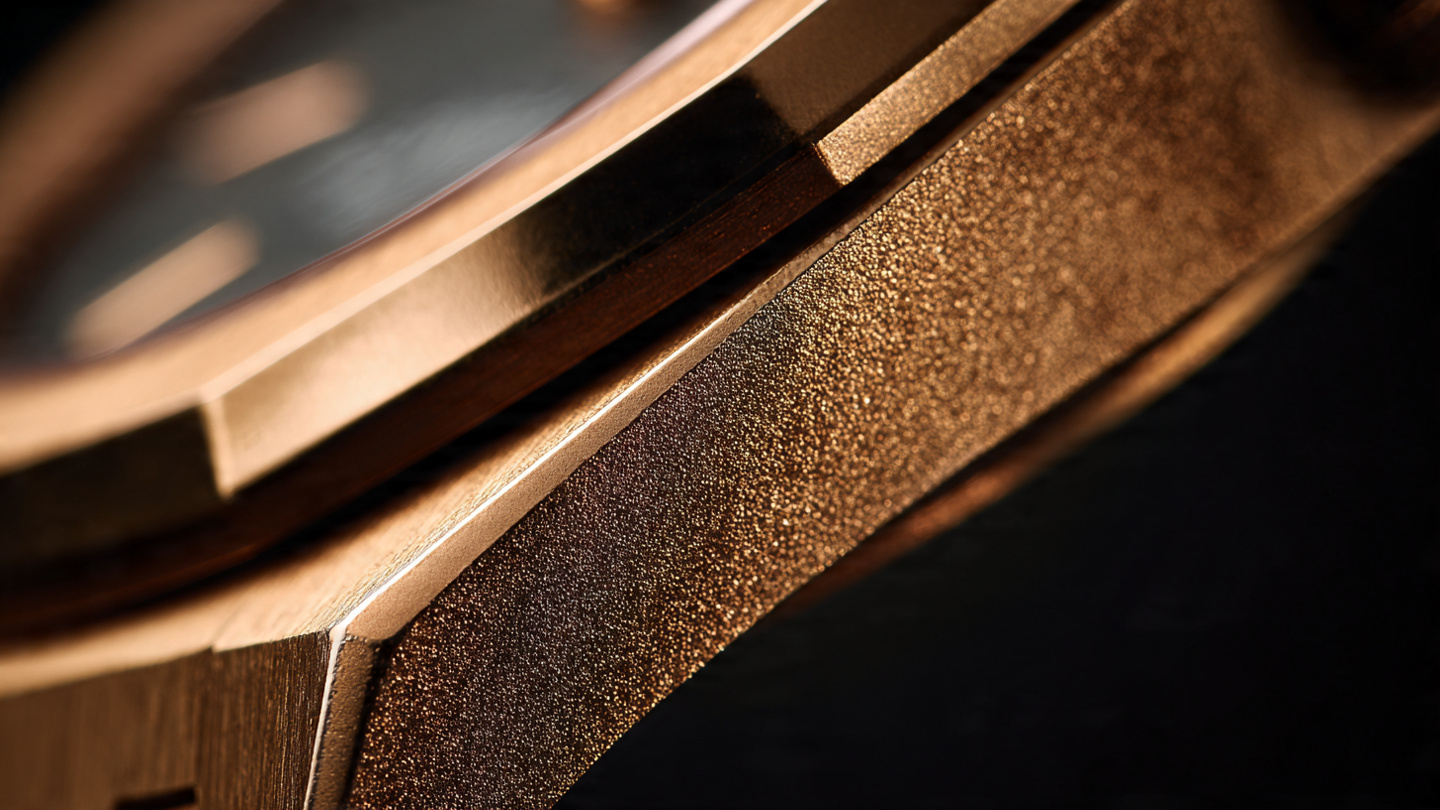
Gold scratches. Every watchmaker knows it, every gold watch owner learns it, and every marketing department avoids mentioning it. An 18-karat gold case that costs five or six figures will pick up desk marks within a week of daily wear. Polishing can remove them, but polishing also removes material, slowly eroding the case geometry over years of ownership. For a metal prized above all others in luxury watchmaking, gold has a fundamental engineering flaw: it is soft.
In 2011, Hublot introduced Magic Gold, the world’s first scratch-proof 18-karat gold alloy. It registers approximately 1,000 Vickers on a hardness scale where conventional 18-karat gold sits at 150 and 316L stainless steel at 200. Only diamond, at roughly 10,000 Vickers, can mark its surface. Hublot’s then-CEO Jean-Claude Biver demonstrated this claim at the launch dinner by attacking a Magic Gold watch with a steak knife and inviting guests to do the same. Nobody scratched it.
What makes Magic Gold unusual is not just the hardness number. It is how the alloy achieves that number without violating the Swiss Precious Metals Control Act, which mandates that any material labeled 18-karat gold must contain at least 75 percent gold by weight. Hublot did not discover a new gold alloy. Instead, working with the Swiss Federal Institute of Technology Lausanne (EPFL), the brand developed a manufacturing process that embeds gold within a structural ceramic skeleton, creating a composite that is legally gold but mechanically ceramic.
Why Gold Is Soft and Alloying Cannot Fix It
Pure gold measures approximately 25 Vickers. It is soft enough to mark with a fingernail. Watchmakers never use pure gold for cases because the resulting watch would deform under normal wrist pressure. Instead, the industry standard is 18-karat gold, where 75 percent gold is alloyed with 25 percent of harder metals: copper and silver for yellow and rose gold, palladium or nickel for white gold.
Alloying improves hardness substantially in relative terms. Rose gold reaches 150 to 180 Vickers depending on the copper ratio. White gold with nickel can approach 200 Vickers. But these numbers still leave 18-karat gold softer than stainless steel and far softer than the everyday abrasives that cause scratches. Quartz dust, the primary component of household dirt and the invisible particles coating most surfaces, measures approximately 1,100 Vickers. Every time a gold watch contacts a countertop, a doorknob, or a shirt cuff carrying microscopic quartz particles, the harder material wins.
Conventional alloying cannot solve this problem because it operates within the gold crystal lattice. Copper atoms substitute for gold atoms at random positions in the face-centered cubic structure, distorting the lattice slightly and impeding dislocation movement. Hardness increases, but the material remains a metallic solid with metallic softness. No combination of gold and conventional alloying metals has produced an 18-karat alloy exceeding approximately 230 Vickers through standard casting and cold-working techniques.
Boron Carbide: From Ballistic Armor to Watch Cases
Boron carbide (B₄C) is the third-hardest material produced in volume, behind diamond and cubic boron nitride. It measures approximately 2,900 to 3,500 Vickers depending on crystallographic orientation and processing conditions. Military applications dominate its use: boron carbide ceramic plates form the strike face of body armor worn by soldiers in every NATO member state. It also serves as the neutron-absorbing material in nuclear reactor control rods, because boron’s isotope B-10 has an exceptionally high neutron absorption cross-section.
In powder form, boron carbide is a dark gray to black material. It can be pressed and sintered into dense shapes, but like all technical ceramics, it shrinks substantially during sintering (typically 20 to 25 percent linearly) and cannot be machined with conventional tools afterward. Only diamond grinding can shape a sintered boron carbide part.
Hublot’s insight, developed in collaboration with EPFL’s Laboratory of Mechanical Metallurgy under Professor Andreas Mortensen, was to exploit boron carbide’s porosity before full densification. Rather than sintering the ceramic to maximum density, Hublot partially sinters the boron carbide preform, leaving a controlled network of open pores throughout the structure. Molten gold then fills those pores under pressure, creating a composite where boron carbide provides the structural framework and gold fills the interstitial spaces.
Infiltration: Filling Ceramic Bones with Molten Gold
Manufacturing Magic Gold begins with boron carbide powder. Workers press the powder into cylinders that approximate the final case geometry but are substantially oversized to account for sintering shrinkage. A partial sintering step fires the preforms at temperatures sufficient to bond the ceramic particles together while preserving porosity. After sintering, each preform is a rigid but porous skeleton of boron carbide, dark gray, with microscopic channels running through its structure like the trabecular bone inside a human femur.
Infiltration follows. Workers place the porous boron carbide preform and a measured charge of 24-karat gold into a sealed chamber. Under inert gas atmosphere (to prevent oxidation) and high pressure, the gold melts and is forced into the ceramic pores. Gold’s low viscosity at its melting point (1,064°C) and excellent wettability on most ceramic surfaces allow it to penetrate the finest channels in the preform. Pressure ensures complete infiltration, eliminating trapped gas pockets that would create voids in the finished material.
When the composite cools, the result is a solid block that is gold by weight and ceramic by structure. Viewed under an electron microscope, the material shows a continuous boron carbide network with gold occupying every pore and gap. Because the ceramic phase is continuous and interconnected, the composite inherits the ceramic’s hardness at the surface. A scratch must penetrate or displace the boron carbide skeleton before it can reach the softer gold beneath, and no common abrasive has the hardness to do that.
Critically, the final composition meets the 75 percent gold threshold for 18-karat certification. Boron carbide has a density of 2.52 g/cm³ compared to gold’s 19.3 g/cm³. Even a modest volume fraction of gold produces a high weight fraction because gold is nearly eight times denser than the ceramic. Hublot controls the porosity of the preform to ensure the infiltrated composite contains exactly 75 percent gold by mass, satisfying the Central Office for Precious Metals Control (a Swiss federal body that hallmarks precious metals).
1,000 Vickers: What That Number Actually Means
Vickers hardness testing presses a diamond-tipped pyramid into a material under a specified load and measures the size of the resulting indentation. Smaller indentation means harder material. At 1,000 Vickers, Magic Gold sits between hardened tool steel (approximately 800 Vickers for high-speed steel) and the boron carbide skeleton itself (2,900+ Vickers). It far exceeds any conventional watch case material.
For practical context: 316L stainless steel, the default watch case material, measures 200 Vickers. Grade 5 titanium reaches 300 Vickers. Zirconium oxide ceramic, used by Rado, Chanel, IWC, and others, ranges from 1,200 to 1,400 Vickers. Magic Gold at 1,000 Vickers falls below full ceramic but above everything else. Unlike ceramic, however, Magic Gold is not brittle. The continuous gold phase provides ductility that pure ceramic lacks. Drop a ceramic watch on a tile floor and it may shatter. Drop Magic Gold and the gold network absorbs impact energy, preventing catastrophic fracture.
Biver’s steak-knife demonstration exploited this property. Steel cutlery measures roughly 500 to 600 Vickers. At Hublot’s manufacture in Nyon, visitors are given hardened steel drill bits and invited to attack both a conventional gold bezel and a Magic Gold bezel. Conventional gold gouges immediately. Magic Gold shows a faint metallic residue from the drill bit, the way a pencil leaves graphite on paper, which wipes away with a finger. No permanent mark remains.
EPFL: When a University Solves a Watch Problem
Hublot’s partnership with EPFL began in 2009 under the direction of Jean-Claude Biver, who recognized that the metallurgical challenge exceeded in-house capabilities. EPFL’s Laboratory of Mechanical Metallurgy had expertise in metal matrix composites and infiltration processing, primarily for aerospace and defense applications. Mortensen’s group had published extensively on aluminum infiltration of ceramic preforms, a technique used to produce brake rotors and electronic packaging substrates. Adapting the process to gold required solving different thermal and chemical problems but followed the same physical principles.
Development took approximately two years. Patent filings from 2011 and 2012 describe the process parameters: sintering temperatures for the boron carbide preform, gold infiltration pressures, atmosphere composition, and cooling rates. Hublot holds the patents exclusively, meaning no other watchmaker can produce Magic Gold without licensing the technology. To date, none have licensed it.
EPFL also contributed the quality-control methodology. Because the composite’s properties depend on complete infiltration, any void or incompletely filled region represents a potential weakness. Non-destructive testing methods, adapted from aerospace composite inspection, verify that each production batch achieves full infiltration. Hublot does not discuss rejection rates publicly, but the complexity of the process and the value of the materials (24-karat gold is not cheap to waste) suggest that quality control is rigorous and scrap costs are significant.
Machining the Unmachineable
After infiltration, Magic Gold blanks must be machined into watch case components. Here the material’s hardness creates a manufacturing challenge: at 1,000 Vickers, conventional carbide cutting tools cannot shape it. Only diamond-tipped tools work. Hublot machines Magic Gold on CNC equipment fitted with polycrystalline diamond (PCD) inserts, the same tooling used to machine technical ceramics and hardened tungsten carbide.
Machining time for Magic Gold components is substantially longer than for conventional gold or even stainless steel. Tool wear is higher. Tolerances are harder to hold because the material resists the cutting forces that help self-center conventional metals during turning and milling operations. Each case component passes through multiple machining stages: rough shaping, semi-finishing, and final finishing, with diamond tools at every step.
Surface finishing presents additional constraints. Conventional gold can be polished to a mirror finish using progressively finer abrasive compounds. Magic Gold accepts polishing, but the abrasive compounds must be diamond-based, and the process takes longer because the surface resists material removal. Satin-brushing, which creates the fine linear texture visible on many Hublot bezels, requires abrasive media harder than the substrate. Diamond-impregnated brushing wheels accomplish this, but at a cost and time penalty compared to brushing steel or gold.
Big Bang Unico Full Magic Gold: The Current Showcase
Hublot’s most ambitious application of Magic Gold is the Big Bang Unico Full Magic Gold, a 44 mm chronograph limited to 200 pieces. Where earlier Magic Gold watches used the material selectively for the bezel or case middle, the Full Magic Gold executes the entire case, including bezel, case middle, caseback, and pushers, in the composite alloy. Only the crown guard, pushers’ internal mechanisms, and movement components use different materials.
Inside sits the UNICO 2 caliber, Hublot’s updated in-house flyback chronograph movement. It operates at 4 Hz (28,800 vibrations per hour) with a 72-hour power reserve from twin barrels. A column-wheel chronograph mechanism is visible through the skeleton dial, and a flyback function allows instant reset-and-restart without stopping the chronograph first. At 330 components, the UNICO 2 represents Hublot’s top-tier movement architecture.
Water resistance is rated at 100 meters. Case thickness sits at approximately 14.5 mm, typical for a 44 mm chronograph with an integrated movement. A black rubber strap with a ceramic-reinforced deployment buckle completes the package. Retail pricing positions the Full Magic Gold at the upper end of Hublot’s Big Bang range, reflecting both the limited production run and the material costs of a full Magic Gold case.
Square Bang Unico in Magic Gold
Hublot also offers Magic Gold in the Square Bang Unico format, a 42 mm cushion-shaped case that emphasizes the material’s machining capabilities. Curved surfaces are harder to machine in a material that resists cutting, and the Square Bang’s rounded corners and multi-faceted lugs demand CNC paths that would be straightforward in steel but require extensive programming and diamond tooling in Magic Gold.
On the Square Bang, the Magic Gold bezel is a solid piece machined from a single infiltrated blank. Its warm, slightly rose-tinted gold tone contrasts with the black ceramic case middle, creating a two-material visual that highlights what each material does well: ceramic for lightweight impact resistance and Magic Gold for scratch-proof luxury signaling. It is a watch built for people who want visible gold on their wrist but cannot accept the marks that normally come with it.
Proprietary Gold Alloys: Hublot vs. the Industry
Hublot is not alone in developing proprietary gold formulations. Rolex’s Everose Gold, introduced in 2005, adds a small percentage of platinum to its 18-karat rose gold recipe. Platinum atoms sit at grain boundaries within the copper-gold alloy, preventing the copper from migrating to the surface and oxidizing. Everose maintains its pink hue indefinitely, but its hardness remains in the conventional range: approximately 160 to 180 Vickers. Scratches accumulate normally.
Omega’s Moonshine Gold adjusts silver, copper, and palladium ratios to achieve a pale champagne tone that resists the fading typical of conventional yellow gold alloys under UV exposure. Again, color stability is the innovation, not hardness. Moonshine Gold scratches like any other 18-karat alloy.
Audemars Piguet’s Sand Gold, introduced in 2023, uses a higher proportion of platinum group metals to achieve a desaturated, warm-gray tone. Hardness is slightly improved, but the material remains a conventional alloy within the normal 18-karat hardness range.
Magic Gold stands alone in its category. Every other proprietary gold alloy in watchmaking optimizes for color, tarnish resistance, or aesthetic longevity. None approaches the structural transformation that boron carbide infiltration achieves. In a Vickers comparison, Magic Gold is roughly six times harder than Rolex Everose and five times harder than any conventional 18-karat alloy, regardless of formulation.
Limitations and Trade-Offs
Magic Gold is not without compromises. Color is one: the boron carbide content gives Magic Gold a slightly warmer, more muted tone than conventional yellow gold. It reads as rich gold under most lighting conditions but lacks the bright, almost brassy reflectivity of a conventional 18-karat yellow gold case. Whether this is a disadvantage depends on taste. Many collectors prefer the subdued warmth.
Repairability is another consideration. A conventional gold case can be polished, refinished, or resized by any competent watchmaker with standard equipment. Magic Gold requires diamond tooling that most independent watchmakers do not stock. Case refinishing must go through Hublot’s service center, which controls the process and the tools. For owners who prefer independent service options, this creates a dependency on the manufacturer.
Weight sits between gold and ceramic. Boron carbide’s low density (2.52 g/cm³) offsets some of gold’s heft (19.3 g/cm³), making a full Magic Gold case lighter than an equivalent solid gold case but heavier than ceramic. On a 44 mm Big Bang Unico, the difference is noticeable. Magic Gold wears heavier than black ceramic Hublots and lighter than King Gold (the brand’s rose gold alloy) variants.
Brittleness lies between the extremes. Magic Gold is less brittle than pure ceramic because the gold phase provides energy absorption during impact. But it is more brittle than conventional gold, which can deform plastically without cracking. A sharp corner impact on granite could potentially chip the surface where pure gold would merely dent. In normal daily wear, this distinction rarely matters. Extreme impacts are a different calculation.
Beyond Watches: Cermet Composites in Industry
Hublot markets Magic Gold as a watchmaking innovation, but the underlying manufacturing process belongs to a well-established family of materials called cermets (ceramic-metal composites). Tungsten carbide cutting tools, the workhorses of industrial machining, are cermets: tungsten carbide particles bonded by a cobalt metal matrix. Aluminum-infiltrated silicon carbide serves as electronic packaging substrate in high-power semiconductor modules. Brake rotors on high-performance vehicles use aluminum-infiltrated carbon-ceramic preforms.
What distinguishes Magic Gold from industrial cermets is the choice of infiltrant metal. Nobody had previously infiltrated a ceramic preform with gold because gold has no structural engineering advantage and costs roughly $70,000 per kilogram at current prices. Industrial cermets optimize for performance at minimum cost. Magic Gold optimizes for legally certifiable precious-metal content at maximum hardness. It is a luxury application of defense-grade materials science, which is exactly the kind of absurd engineering ambition that makes watchmaking interesting.
Fifteen Years On: A Material Still Alone
Magic Gold debuted in 2011. Fifteen years later, no competitor has produced a comparable material. Rolex, Omega, Patek Philippe, and Audemars Piguet collectively spend hundreds of millions annually on research and manufacturing, yet none has attempted a cermet gold alloy. Several factors explain this.
Patent protection is the most direct barrier. Hublot’s filings cover the specific combination of boron carbide preform infiltration with gold under controlled atmosphere and pressure. Designing around these patents would require fundamentally different ceramic phases or infiltration techniques, and the resulting material would need to match Magic Gold’s combination of hardness, gold content, and aesthetic quality.
Manufacturing investment is equally significant. Producing Magic Gold requires sintering furnaces, high-pressure infiltration chambers, inert gas handling systems, and a complete diamond-tooling machining line. These are capital expenditures that only justify themselves if a brand commits to producing Magic Gold watches in meaningful volume over many years. For brands whose gold watches sell well in conventional alloys, the incentive to invest is weak.
Perhaps the most honest explanation is cultural. Swiss luxury watchmaking is conservative about materials. Rado pioneered ceramic cases in 1986. Forty years later, most brands still treat ceramic as exotic. A material that requires defense-sector sintering equipment and a university collaboration is further outside the comfort zone than most Swiss manufacturers care to venture. Hublot, as a brand built on material provocation, occupies that space willingly. Its competitors, for the most part, do not.
Sources
- Hublot, “Innovative Watches & Materials: Craftsmanship,” hublot.com.
- Time and Tide Watches, “Learning about the madness of Magic Gold at the Hublot manufacture,” Andrew McUtchen, July 2024.
- Gear Patrol, “Why This (Nearly) Indestructible Gold Watch Won a Red Dot Award,” Andrew Connor, April 2017.
- Hublot, “Big Bang Unico Full Magic Gold: Full Gold, Zero Compromise,” hublot.com, 2024.
- Hublot, “The Square Bang Unico Reinvented in Magic Gold,” hublot.com.
- EPFL Laboratory of Mechanical Metallurgy, research publications on metal-matrix composite infiltration processing.
- Europa Star, “The Accelerating Race for New Materials,” 2024.
- Luxuo, “Contemporary Alchemy (Part 1): Composites and sapphire crystals in watchmaking.”