1,000 Vickers — How Hublot Infiltrated Tank Armor Ceramic with Molten Gold
Boron carbide stops bullets. Pure gold bends under a fingernail. Hublot forced one inside the other at 1,400°C to create the only scratch-proof 18K gold on Earth.
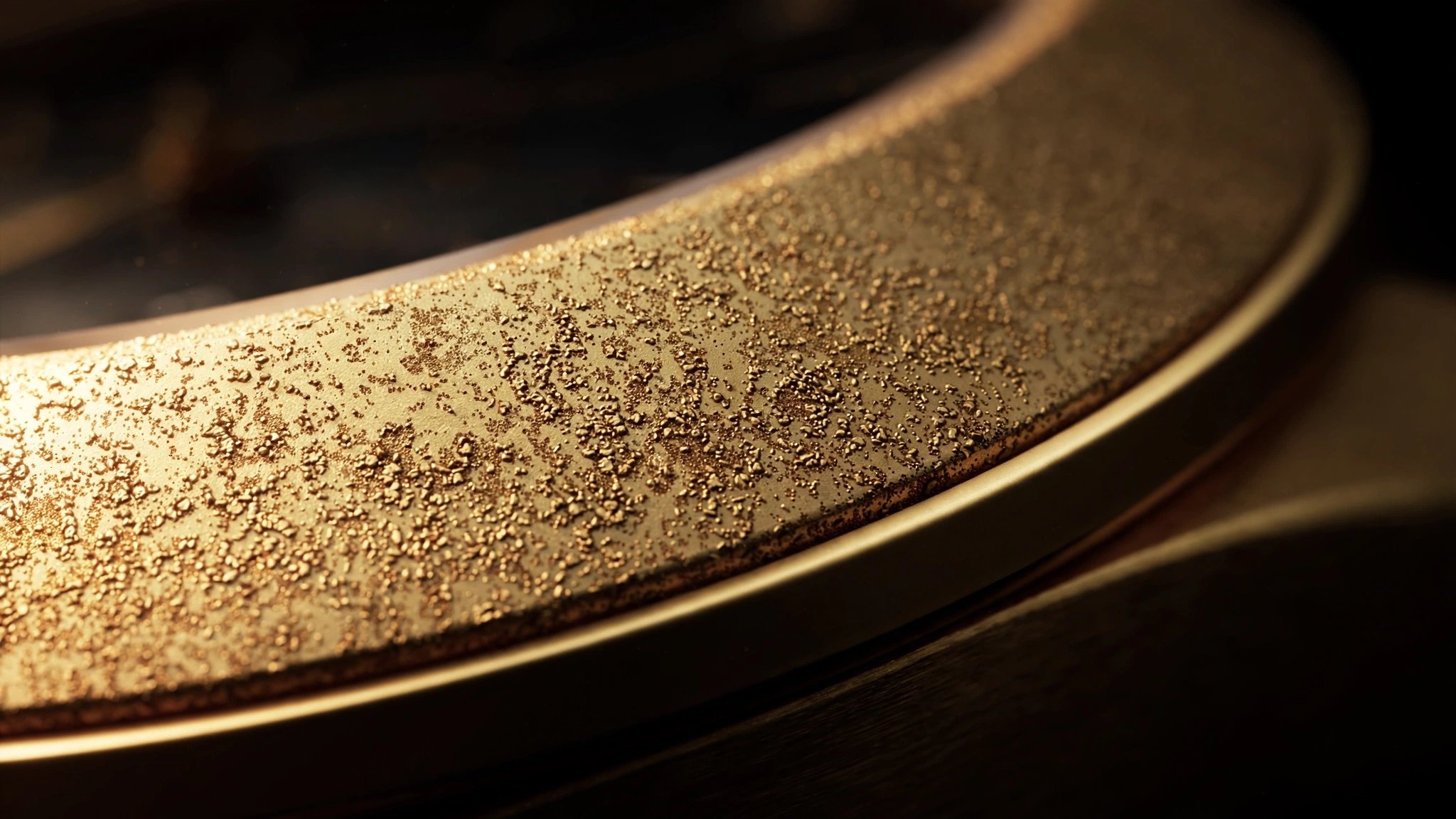
Gold has a problem. It is beautiful, corrosion-resistant, and carries 5,000 years of cultural weight, but it is soft. Even alloyed to the 18-karat standard used in fine watchmaking, where 25 percent of the mass is copper, silver, nickel, or some combination, gold scratches easily. A standard 18K yellow gold alloy measures roughly 150 Vickers on the hardness scale. Grade 5 titanium sits near 300. Hardened steel reaches 600. Every gold watch that leaves a manufacture will accumulate hairline scratches within weeks of daily wear, and no alloy formulation based on mixing gold with harder metals has fundamentally solved this, because the gold matrix remains continuous and ductile.
Hublot's Magic Gold scores approximately 1,000 Vickers. It is certified 18-karat by Switzerland's Central Office for Precious Metals Control, meaning it contains at least 75 percent gold by weight. Yet it cannot be scratched by hardened steel drill bits, steak knives, or anything short of diamond. When Jean-Claude Biver, then Hublot's CEO, unveiled the material at the Nyon manufacture on December 15, 2011, he demonstrated the point by attacking a Magic Gold watch with a steak knife in front of journalists, inviting them to do the same. Nobody left a mark.
How Hublot achieved this requires understanding a material that seems to belong to a completely different world from luxury watchmaking: boron carbide.
B4C: Third-Hardest Known Material
Boron carbide, chemical formula B4C, is a ceramic compound with a rhombohedral crystal structure built from twelve-atom icosahedral clusters linked by three-atom carbon chains. It is the third-hardest material known to science, behind only diamond and cubic boron nitride. Its Vickers hardness exceeds 30 GPa, roughly 3,000 on the Vickers scale used in watchmaking. Its density is just 2.52 g/cm3, less than aluminum. It melts at 2,350°C.
Before Hublot repurposed it, boron carbide was known primarily for two applications: ceramic armor plates in military vehicles and body armor, where its extreme hardness defeats incoming projectiles by shattering them on contact, and neutron absorption shielding in nuclear reactors, where boron's large neutron-capture cross section (approximately 4,000 barns) makes it invaluable. Cutting tools, sandblasting nozzles, and abrasion-resistant industrial components round out its resume. Luxury watchmaking was not on the list.
Boron carbide presents a formidable manufacturing challenge. Its strong covalent bonding makes it extremely resistant to sintering, the process of consolidating powder into a dense solid using heat. Achieving full density through pressureless sintering demands temperatures near 2,200°C and specialized sintering aids. Hot pressing works but limits geometry to simple shapes and costs more. And once densified, boron carbide is so hard that conventional machining is nearly impossible. Only diamond-tipped tools, electrical discharge machining, lasers, and ultrasonic cutters can shape it.
None of these properties suggest a natural partner for 24-karat gold, a metal so soft it can be dented with a thumbnail. But Hublot and a team at EPFL, the Swiss Federal Institute of Technology in Lausanne, spent three years proving otherwise.
Metal Matrix Composite, Not Alloy
Magic Gold is not a gold alloy in the conventional sense. Standard 18K formulations dissolve other metals into the gold crystal lattice, producing a homogeneous solid solution. Rose gold uses copper. White gold uses palladium or nickel. In every case, the gold forms a continuous metallic matrix, and the mechanical properties remain governed by metallic bonding, which means the material stays relatively soft and ductile.
Magic Gold is a cermet, a ceramic-metal composite. Its structure consists of a rigid, interconnected boron carbide skeleton with gold filling the pore spaces. Because boron carbide forms the load-bearing framework, the composite inherits the ceramic's hardness and scratch resistance. Because gold fills the remaining volume and constitutes 75 percent of the total mass, the composite meets the legal definition of 18-karat gold. Switzerland's Central Office for Precious Metals Control certified it as such, a determination that was anything but automatic given how different this material is from every other alloy in the 18K category.
By weight, Magic Gold consists of approximately 75 percent 24-karat gold, 22 percent boron carbide, and 3 percent aluminum, which improves the wetting behavior between the molten gold and the ceramic surface. Mathias Buttet, Hublot's Head of R&D at the time, described the infiltration process by analogy: forcing water into a room full of footballs. Liquid gold, under extreme pressure, fills every void in the porous ceramic preform.
Five Steps to Indestructible Gold
Europa Star documented the manufacturing process in five stages when Hublot first disclosed the procedure:
Step 1: Powder Packing. Boron carbide powder, ground to a controlled particle size distribution, is loaded into molds shaped to approximate the finished watch component, whether a bezel, case middle, or bracelet link. Particle size matters because it determines the porosity and pore geometry of the subsequent preform, which in turn controls how completely the molten gold can infiltrate the structure.
Step 2: Cold Isostatic Pressing. Pressure of 2,000 bar is applied uniformly from all directions, compressing the powder into a dense, rigid preform. Cold isostatic pressing, unlike uniaxial pressing, distributes force evenly through a fluid medium, producing consistent density throughout the part and avoiding the gradients that would cause warping or cracking during sintering. At this stage the preform is fragile but holds its shape.
Step 3: Sintering. Heat of 2,200°C at 100 millibar gas pressure bonds the boron carbide particles into a solid ceramic skeleton. At these temperatures, surface diffusion and limited viscous flow create necks between adjacent particles, locking them into an interconnected framework while preserving a network of open, interconnected pores. Controlling atmosphere pressure prevents oxidation and manages grain growth. If the temperature climbs too high, grains coarsen excessively and mechanical properties degrade. If it stays too low, neck formation is incomplete and the skeleton lacks structural integrity.
Step 4: Gold Casting. Separately, 24-karat gold is melted at 1,100°C and cast into a form factor suitable for the infiltration step. A small percentage of aluminum is added to improve wettability between the molten gold and boron carbide surfaces.
Step 5: Infiltration. Molten gold is forced into the sintered boron carbide preform at 1,400°C under 200 bar of inert gas pressure. At these conditions, capillary forces assisted by external pressure drive the liquid metal into the ceramic's pore network. Because the pores are interconnected, gold penetrates throughout the entire volume, filling every void. As the assembly cools, the gold solidifies in place, locking into the ceramic framework. Two materials that share no chemical affinity, no mutual solubility, and no obvious compatibility become one composite.
Why Infiltration Works and Alloying Cannot
Understanding why Magic Gold is so much harder than conventional gold alloys requires understanding what actually resists a scratch. When a harder object drags across a surface, it plows a groove by plastically deforming the substrate. In a conventional gold alloy, the continuous metallic matrix deforms readily because metallic bonds allow atoms to slide past each other. Adding harder metals to the alloy increases resistance somewhat, but the deformation mechanism remains the same.
In Magic Gold, a scratch attempt encounters the boron carbide skeleton first. Boron carbide does not deform plastically at room temperature. Its covalent bonds resist dislocation motion, the primary mechanism of plastic deformation in metals and softer ceramics. A stylus or abrasive particle that would plow through conventional gold instead meets a ceramic surface with hardness exceeding 3,000 Vickers. Only materials harder than boron carbide, principally diamond and cubic boron nitride, can generate sufficient contact stress to fracture the ceramic lattice and create a visible scratch.
Gold remains visible at the surface because it fills the spaces between ceramic grains, and both materials are exposed after polishing. But the gold is confined within the rigid ceramic matrix. It cannot flow or deform independently because the boron carbide skeleton surrounding it is structurally continuous. Any force applied to the gold surface is transferred almost immediately to the ceramic framework, which absorbs it without yielding.
Machining After Infiltration
Creating the composite is only half the challenge. Shaping it into a finished watch component requires machining a material that resists conventional tooling. Hublot's solution involved acquiring four Mitsubishi Electric electrical discharge machining systems: an MV1200R wire EDM, two MX600 units, and a Start 43Ci EDM drilling machine.
Electrical discharge machining cuts conductive materials by generating a rapid series of electrical sparks between a wire or shaped electrode and the workpiece, eroding material through localized melting and vaporization. Because Magic Gold contains a continuous gold phase that conducts electricity, EDM can cut it despite the ceramic skeleton's extreme hardness. Conventional carbide or HSS cutting tools would dull within seconds against boron carbide. Diamond-tipped tooling and laser cutting handle some operations, but EDM provides the dimensional precision that watch components demand, particularly for the tight tolerances of case flanks and bezel seats.
Polishing presents its own difficulty. Standard polishing compounds, typically aluminum oxide or silicon carbide, are softer than boron carbide and ineffective against it. Diamond paste must be used throughout the finishing process, adding time and cost to every surface.
Hallmarking the Unhallmarkable
A practical absurdity emerged when Hublot prepared Magic Gold for production. Swiss law requires 18-karat gold items to carry a hallmark stamped into the metal by a certified assay office. Hallmarking works by pressing a hardened steel punch into the gold surface, leaving an indentation that certifies purity. Magic Gold's 1,000-Vickers surface destroys the punch. Hublot acknowledged this problem publicly at the 2011 reveal, noting that while the material was certified 18K, conventional hallmarking was physically impossible. Laser engraving became the workaround.
Fifteen Years Later
Hublot installed a dedicated Magic Gold foundry at its Nyon manufacture in 2014. No other watch brand has replicated the process, and Hublot has stated it will not share the technology even within the LVMH group. Patents protect the specific infiltration parameters, though the underlying principle of liquid metal infiltration into porous ceramic preforms is well-established in materials science. What Hublot achieved was adapting an industrial cermet process to precious metals at 18-karat purity while maintaining the surface quality and dimensional tolerances that fine watchmaking requires.
Hublot has also confirmed that the same infiltration process could work with other precious metals, platinum and aluminum chief among them. No Magic Platinum models have materialized, but the process is theoretically sound. Replace the gold with platinum and adjust the infiltration temperature and pressure to match platinum's higher melting point (1,768°C versus gold's 1,064°C), and the ceramic skeleton would accommodate it.
Magic Gold remains limited to a handful of Big Bang and Spirit of Big Bang references. Its muted, distinctive golden tone, slightly different from standard yellow gold because the boron carbide skeleton absorbs and scatters light differently at the surface, gives it an appearance that photographs cannot fully capture. Visitors to the Hublot manufacture who have attacked Magic Gold bezels with hardened steel drill bits report the same result every time: a faint residue that wipes away with a finger, and not a single scratch beneath it.
Fifteen years after Jean-Claude Biver's steak knife left no mark, the material's engineering remains exactly as improbable as it sounds. Gold that cannot be scratched. A sentence that should be a contradiction, built from tank armor and pure gold at 1,400 degrees.