Polo Shirts and Racquets, Sintered Into a Tourbillon Case: Hublot’s Djokovic GOAT Edition and the Engineering of Textile Composites
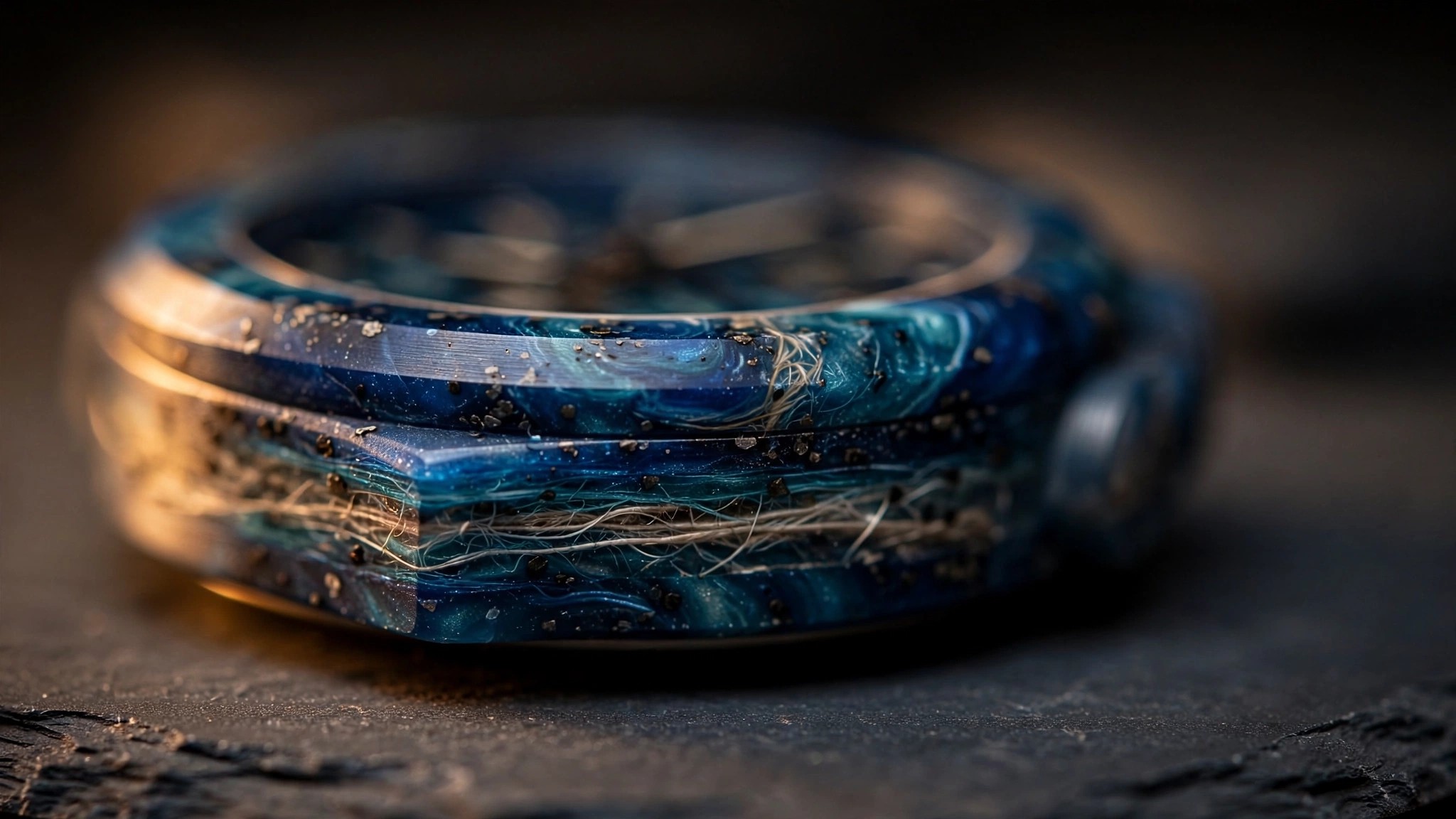
Somewhere inside Hublot’s Nyon manufacture, twelve Lacoste polo shirts and twelve Head tennis racquets went through an industrial shredder, were mixed with epoxy resin and quartz filler, compressed under heat and pressure into solid billets, and CNC-machined into the case components of a $121,000 automatic tourbillon. Worn fabric became structural material, broken carbon fiber stringbeds became bezel, and the resulting watch, fully assembled with movement, crystal, and strap, weighs 56 grams. Less than a tennis ball.
Hublot unveiled the Big Bang Tourbillon Novak Djokovic GOAT Edition at LVMH Watch Week in Milan in January 2026. It is the second Djokovic collaboration to use this textile composite and the first to pair it with the manufacture’s in-house MHUB6035 tourbillon caliber. Three versions map to the three surfaces where Djokovic accumulated his 101 career titles: 72 pieces in blue for hard court victories, 21 in orange for clay, 8 in green for grass. Production is numbered but not capped. Open-ended, which is the clever part. If Djokovic wins another title, Hublot adds another watch in the corresponding color, extending the production run indefinitely and tying the collection’s size to a career that may not be finished.
That is the press release version. What interests me is the engineering underneath: how textile scraps become a machinable composite, why the midcase uses an entirely different polymer, what it costs in scratch resistance to swap sapphire for Gorilla Glass, and how a laser carved the mainplate into a functioning imitation of racquet strings.
Textile Composites: Shredding a Polo Shirt Into Structural Material
Fiber-reinforced polymer composites are everywhere in performance engineering. Carbon fiber reinforced plastic dominates Formula 1 monocoques, wind turbine blades, and aerospace primary structure, while glass fiber reinforced plastic handles boat hulls, printed circuit boards, and pressure vessels, and in every application the logic repeats itself. In all cases, the principle is the same: embed stiff, strong fibers in a polymer matrix that distributes load between them and holds them in position, where fibers carry tension, the matrix carries compression and shear, and together they outperform either constituent alone.
Hublot’s textile composite follows this principle but substitutes purpose-engineered fiber with scrap material of variable composition. Djokovic’s polo shirts are primarily polyester and cotton blends, while his Head racquets contain carbon fiber, fiberglass, and graphene-infused polymer resins, so the feedstock ranges from soft textile to structural composite in a single batch. Neither material was designed for reuse as composite reinforcement. Nobody publishes a datasheet for “shredded polo shirt.” That means Hublot’s R&D team had to characterize the mechanical contribution of randomly oriented textile fragments within their epoxy matrix rather than relying on published fiber-direction properties from a supplier datasheet. No shortcuts available.
Manufacturing starts with mechanical shredding: shirts are cut into fragments small enough to distribute uniformly through a resin pour, and racquets are broken down into chips and short fibers, preserving some of the original carbon fiber content. Both sets of fragments are mixed with an epoxy resin system reinforced with quartz powder and glass veil, a thin nonwoven fiberglass mat that adds isotropic stiffness. Quartz powder increases the composite’s hardness and dimensional stability during machining, while glass veil prevents the resin-rich pockets that would otherwise create weak spots in the cured part.
Compression molding follows: mixed material goes into heated steel molds shaped roughly as oversized case blanks, where temperature and pressure cure the epoxy, cross-linking the polymer chains into a rigid thermoset matrix around the embedded fragments. After demolding, the blanks show a mottled, camouflage-like pattern where textile fibers, carbon chips, and resin create visible contrast. Every blank looks different. Blue polo fragments against darker carbon racquet material produce the translucent marbled aesthetic that distinguishes the GOAT Edition from Hublot’s other composite watches.
CNC machining finishes each blank to final case dimensions: 44mm diameter, 14.4mm thickness, with tolerances tight enough to seat gaskets for 30 meters of water resistance. Not deep, but enough.
Composite materials machine differently from metals because there is no ductile chip formation; instead, the cutting tool fractures the matrix and shears through embedded fibers, producing fine dust rather than metal swarf. Tool wear is higher than for brass or steel, and surface finish depends heavily on fiber orientation relative to the cutting path, which in a randomly oriented composite is unpredictable. Hublot compensates by running multiple finishing passes and selecting feed rates slow enough to avoid fiber pullout on cosmetic surfaces. Slow, careful, expensive.
Titaplast: A Polymer Impersonating Titanium
While the case and bezel use the textile composite, the midcase container is a different material entirely: Titaplast, a proprietary polymer that Hublot describes as “the world’s strongest polymer.” Essentially zero. No third-party datasheet is publicly available, and the trade name does not appear in polymer databases independent of the brand. What Hublot states is that Titaplast has mechanical properties similar to titanium, machines to fine tolerances, delivers an exceptional strength-to-weight ratio, has a soft matte finish, and can be colored through anodization.
Several of those claims narrow the possibilities considerably. A polymer that can be anodized is unusual, because anodization is an electrochemical process that typically requires a conductive substrate, and most structural polymers are insulators, so if Titaplast genuinely anodizes, it likely contains metallic filler particles or a conductive polymer phase, or Hublot uses “anodization” loosely to describe a different coloring process such as plasma treatment or dye impregnation. Claiming titanium-like mechanical properties suggests a tensile strength somewhere above 800 MPa and a modulus of elasticity around 100 GPa, which would place Titaplast firmly in the territory of filled thermoplastic composites rather than unfilled engineering polymers. High-performance candidates include PEEK (polyether ether ketone) filled with carbon fiber or glass fiber, which achieves tensile strengths up to 250 MPa in commercial grades and higher in custom formulations. PPSU (polyphenylsulfone) and PEI (polyetherimide) are additional candidates.
Whatever its exact composition, Titaplast serves a specific structural role: the midcase container bears the mechanical loads that connect case top to case bottom, provides the anchor points for the crown, pushers, and strap lugs, and defines the geometric skeleton around which every other component is assembled. Titanium-like stiffness in this component prevents case flex under wrist motion, which would stress the movement and compromise the gasket seal. Using a polymer instead of actual titanium saves weight while potentially improving vibration damping, because polymers absorb mechanical energy that metals transmit. For a watch designed to weigh less than a tennis ball, every gram matters, and the midcase is a large component. Weight wins.
Hublot will not say what Titaplast is. Not really. Notably, the 2024 Big Bang Unico Novak Djokovic used PEEK carbon, not Titaplast, for its midcase container. PEEK carbon is a well-characterized engineering polymer reinforced with carbon fibers, and switching to Titaplast for the GOAT Edition implies either improved properties or better machinability, though Hublot has not explained which. PEEK is difficult to machine because its high melt temperature creates gummy chip formation at low cutting speeds and thermal damage at high ones. If Titaplast offers cleaner machining at comparable stiffness, the substitution makes engineering sense even if the marketing name obscures the underlying chemistry.
Gorilla Glass: Saving Grams, Sacrificing Mohs
Both front and back crystals use Corning Gorilla Glass with anti-reflective coating instead of synthetic sapphire. Weight. That is the entire reason: sapphire crystal has a density of 3.98 g/cm³, while Gorilla Glass sits at approximately 2.54 g/cm³, and for a 44mm watch with crystals on both sides, the density difference translates to roughly 50 percent weight savings in the crystal alone, a substantial contribution when the total weight target is 56 grams.
Scratch resistance is where the tradeoff bites. Synthetic sapphire scores 9 on the Mohs hardness scale, meaning only diamond scratches it under normal conditions, while Gorilla Glass sits at 6 to 7, right where common silica-based abrasives begin to leave marks. Beach sand, concrete dust, and quartz particles in household dirt will mark Gorilla Glass where they would slide off sapphire. Daily wearers will notice. For a sports watch presumably designed for active wear, this is a significant concession.
Gorilla Glass compensates with superior impact resistance. Sapphire is hard but brittle: its rigid monocrystalline lattice fractures catastrophically when loaded beyond its failure threshold, and dropping a sapphire crystal onto tile can shatter it into fragments. Gorilla Glass, manufactured through an ion-exchange process that creates a compressive surface layer, flexes under impact and absorbs energy elastically. In Corning’s own strength-after-abrasion testing, Gorilla Glass sheets survived loads exceeding 195 kg after 45 minutes of tumbling, while sapphire sheets failed at 73 kg. These are manufacturer tests with inherent bias, but the directional result is consistent with independent materials science: amorphous glass structures handle impact better than crystalline ones.
For a 56-gram watch built for lightness above all else, Gorilla Glass is the rational choice. The weight savings are structural, not cosmetic: sapphire crystals on both sides would add approximately 5 to 7 grams, pushing total weight above 60 grams and undermining the “lighter than a tennis ball” claim that drives the marketing narrative. Whether the scratch resistance penalty matters depends on how the watch is worn. Safe queens tolerate it, but daily beaters will not.
MHUB6035: Micro-Rotor, Tourbillon, and a Mainplate Made of Strings
Underneath the Gorilla Glass sits the MHUB6035, Hublot’s manufacture automatic tourbillon caliber. It runs at 3 Hz (21,600 vibrations per hour) with a 72-hour power reserve, contains 293 components and 26 jewels, and winds via a 22-karat red gold micro-rotor positioned on the dial side at 12 o’clock. A 60-second tourbillon carriage rotates at 6 o’clock. Three functional sapphire elements serve as the barrel bridge, automatic winding gears bridge, and tourbillon bar, making the movement visible from nearly every angle. Ceramic ball bearings in the winding train ensure smooth, efficient energy transfer from micro-rotor to mainspring, a detail that matters enormously when you are trying to wind a 72-hour mainspring through a gold disc barely larger than a shirt button.
None of that is unique to the Djokovic edition; Hublot uses the MHUB6035 across multiple Big Bang Tourbillon references, from the SAXEM crystal series to the SR_A Samuel Ross collaboration, and what distinguishes this version is the mainplate.
In a conventional watch movement, the mainplate is a solid metal disc (typically brass, nickel silver, or German silver) that carries every bridge, jewel, and pivot location, serving as the structural backbone of the entire mechanism. Load paths from the balance wheel, gear train, and barrel all terminate in the mainplate, whose dimensional accuracy determines how precisely each pivot aligns with its jewel bearing, meaning tolerance stackup in this one component cascades through every other part of the movement.
Hublot replaced this solid disc with a three-dimensional lattice patterned to resemble the string bed of a tennis racquet. Individual strands measure 0.55mm across, half a millimeter. They connect to attachment points at the inner rim of the case, and looking at it, you would swear someone wove metal wires by hand and clamped each end. In photographs the texture reads as individually twisted cables crossing each other at regular intervals, with the movement’s components apparently suspended in open air between them, and the effect looks impossible until you learn it is produced by a single piece of metal and a fiber laser. Not woven. Carved.
Each mainplate is a single piece of metal produced through laser engraving, not weaving. A fiber laser selectively removes material between the intended string lines, cutting channels through the metal to create a lattice where solid disc used to be. Because the laser operates in three dimensions, it can vary cut depth and angle to produce the illusion of overlapping, rounded cables from what is fundamentally a flat part with very complex surface geometry. Black PVD coating completes the deception, adding shadow depth that reinforces the three-dimensional appearance. Convincing. Djokovic’s ND1 logo appears on the lattice, and the tourbillon cage is anodized in the corresponding court color: blue, orange, or green.
Structurally, removing material from a mainplate is risky. Less metal means less stiffness and different vibration characteristics. Every channel cut by the laser is material that no longer contributes to load-carrying capacity, and bridge screws and jewel seat locations must fall precisely on remaining solid sections, which leaves no room for error in the lattice geometry. Hublot presumably modeled the lattice geometry using finite element analysis to ensure that deflection under spring torque remained within acceptable limits for positional accuracy. At 0.55mm strand width and with 293 components depending on the mainplate for their positions, the engineering margin is tight. Remarkably tight. Tight enough that this design would not have been possible twenty years ago, before modern laser engraving reached sub-millimeter positioning accuracy on hardened metals.
Completing the tennis theme, the mainspring barrel wears a cap machined and lacquered to resemble a tennis ball, complete with engraved fuzz texture and bright yellow finish. Six titanium screws on the bezel are shaped like miniature tennis balls, each requiring a custom S-shaped screwdriver bit because no existing tool fits the geometry. These details are whimsical rather than functional. Pure theater. But the fact that Hublot engineered a new driver head for six decorative screws says something about how far the brand will push a theme.
Weight Budget: Where 56 Grams Come From
Building a tourbillon watch at 56 grams requires weight accounting at every decision point. Consider the baseline: a typical 44mm automatic watch in stainless steel weighs 120 to 160 grams, in titanium 80 to 100 grams, and even Hublot’s own Big Bang Tourbillon in carbon fiber, the Texalium edition, weighed 68 grams at 43mm. Getting to 56 grams at 44mm with a tourbillon inside required concessions that stack. Everything traded something.
Textile composite case and bezel: epoxy-based composites have densities around 1.3 to 1.6 g/cm³, depending on filler loading, compared to 4.51 g/cm³ for titanium and 7.9 g/cm³ for 316L steel. For equivalent case geometry, composite weighs one-third to one-fifth as much as metal. Titaplast midcase container: lower density than the PEEK carbon used in the 2024 predecessor, or at minimum comparable density with better machinability, allowing thinner wall sections. Gorilla Glass crystals front and back: approximately 50 percent lighter than sapphire equivalents. Aluminum bezel screws with titanium cores shaped like tennis balls: lighter than solid titanium H-screws used on standard Big Bangs. Velcro strap with anodized aluminum buckle: dramatically lighter than a metal bracelet or even a rubber strap with a titanium deployant clasp, which weighs 75 grams alone on the 2024 Unico model.
Movement weight is harder to estimate without a teardown, because the MHUB6035 in standard configuration uses conventional brass-family alloy components, and Hublot has published no lightweight-movement variant for this reference. Unlike the 2024 Unico Djokovic, where Hublot switched the HUB1280 movement to anodized aluminum and achieved a 27 percent weight reduction (saving 6.1 grams), Hublot has not announced a lightweight movement variant for the GOAT Edition. The 22-karat gold micro-rotor adds density where the 2024 model used aluminum throughout. Sapphire bridges offset some of that density (sapphire at 3.98 g/cm³ versus brass at 8.5 g/cm³), and the lattice mainplate removes material that would otherwise contribute dead weight. But the net movement weight is almost certainly higher than the aluminum HUB1280 used in the predecessor. The case and crystal savings make up the difference, and then some.
From 2024 to 2026: What Changed and Why
Comparing the two Djokovic collaborations reveals the engineering priorities at each price point. In 2024, the Big Bang Unico Novak Djokovic was a $52,700 flyback chronograph in a 42mm case, limited to 100 pieces. It weighed 49.5 grams on the elastic strap, powered by the HUB1280 Unico, a 354-component, 4 Hz chronograph with column wheel and flyback function, rebuilt entirely in anodized aluminum to save 6.1 grams over the standard brass caliber. Water resistance rated at 100 meters, Gorilla Glass crystal, PEEK carbon midcase, and material input of 25 racquets and 32 polo shirts. It was a weight exercise first and a Djokovic tribute second.
In 2026, priorities shifted toward horological spectacle. The GOAT Edition is a $121,000 tourbillon in a larger 44mm case, numbered to 101 but open-ended. Weight increased from 49.5 grams to 56 grams. A 13 percent gain. Worth it. Water resistance dropped from 100 meters to 30 meters. Tourbillons seal poorly. That is a physics problem, not a quality problem. Material input decreased to 12 racquets and 18 total polo shirts across three colorways. Movement complexity shifted from chronograph (354 components, 4 Hz) to tourbillon (293 components, 3 Hz), trading timekeeping functions for horological theater. And the lattice mainplate added a signature design element the 2024 model lacked. Bold move.
Both watches share the same crystal strategy, the same composite case philosophy, and the same obsessive attention to weight, but while the 2024 Unico aimed for maximum lightness at moderate complexity, the GOAT Edition is more ambitious. Fitting a tourbillon with a laser-engraved lattice mainplate, sapphire bridges, and a gold micro-rotor into a 56-gram package represents a materially harder engineering challenge than fitting a chronograph into a 49.5-gram one. Chronograph components are small, dense, and well-characterized. Tourbillons are large, fragile, and sensitive to positional error. Nightmares for weight engineers. Doing one on a lattice mainplate is showing off. Doing it at 56 grams? Point proven.
What It Costs and What It Doesn’t Tell You
At $121,000, the GOAT Edition is expensive by most standards but not by tourbillon standards. Hublot’s Big Bang Tourbillon Automatic Green SAXEM, which uses the same MHUB6035 movement in a sapphire-aluminum-exotic-material case, costs $231,000 for 18 pieces. The Full Sapphire Integral Tourbillon reaches $422,000 for 30 pieces. Compared to those, a textile composite GOAT Edition at $121,000 for 101 pieces is relatively accessible, and you are paying for the material story and the Djokovic association rather than the movement or the case finishing, which are simpler than Hublot’s high-end sapphire work and lack the hand-polished beveling that collectors expect at six figures.
Hublot keeps quiet on several details that would complete the engineering picture. What is Titaplast, precisely, and why does no independent polymer datasheet exist? What is the composite’s tensile strength, flexural modulus, or impact resistance? Nobody outside Nyon knows. How was the lattice mainplate validated structurally, and where are the finite element results that would illuminate whether 0.55mm strands can hold positional tolerances under mainspring torque? What is the actual movement weight with gold micro-rotor and sapphire bridges, given that no figure has been published? What is the rejection rate for composite case blanks? Random fiber orientation means inconsistent properties batch to batch, cosmetic variation means some blanks look better than others, and Hublot cherry-picks the best ones for production, but the scrap rate is unknown. Ask Hublot, and they will not say.
Fair enough. These gaps are normal for luxury watchmaking, where proprietary materials and processes are competitive advantages that brands guard carefully, and no brand guards more carefully than Hublot when it comes to composite formulations that constitute their core material identity. But for an engineering publication, they leave the analysis incomplete. We can describe the composite manufacturing process and the laser-engraved mainplate with confidence because the physics and the tooling are well understood, but we cannot fully quantify the material performance without independent testing, and we have not handled the watch to assess build quality, balance, or wearing comfort. Take the engineering claims seriously but not uncritically.
Sources
- Hublot, “Big Bang Tourbillon Novak Djokovic GOAT Edition: A Tribute to the Greatest of All Time,” press release, January 19, 2026.
- Hublot, product page, Big Bang Tourbillon Novak Djokovic GOAT Edition Orange, Ref. 429.QKO.0120.NR.DJO26, hublot.com.
- Monochrome Watches, “First Look: Hublot Big Bang Tourbillon Novak Djokovic GOAT Edition, A Trilogy Fit for the Champion,” January 2026.
- Gear Patrol, “Here’s Why This Ultralight Sports Watch Is Called the ‘G.O.A.T.,’” Johnny Brayson, January 21, 2026.
- Revolution Watch, “LVMH Watch Week 2026: Hublot showcases Samuel Ross, Novak Djokovic and more,” January 2026.
- Prestige Online, “Best of LVMH Watch Week 2026: Hublot,” February 2026.
- Monochrome Watches, “Hands-On: The Polo-and-Racquet-made Hublot Big Bang Unico Novak Djokovic,” November 2024.
- Sports Illustrated, “Hublot Turns Novak Djokovic’s Rackets & Shirts Into Rare Watch,” 2024.
- Hodinkee, “Introducing: The Hublot Big Bang Tourbillon Automatic Green SAXEM,” January 2025.
- Corning, Gorilla Glass technical specifications and strength-after-abrasion testing results.