Furnace in the Valley: How Hot-V Turbocharging Reversed Eighty Years of Engine Layout
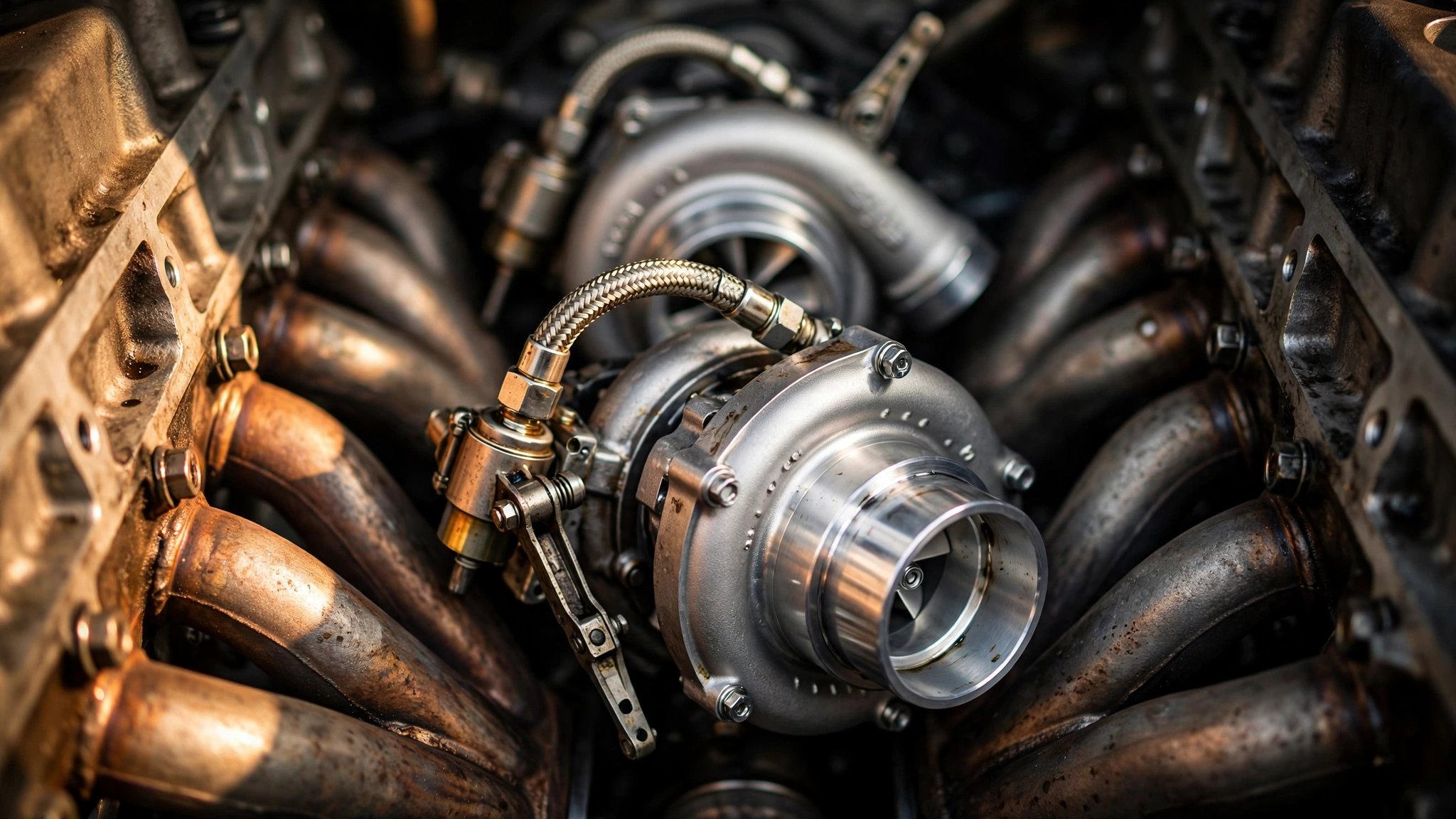
For the better part of a century, V-engine design followed one convention so basic it barely registered as a decision. Cold side in, hot side out. A single intake manifold sat between the cylinder banks, feeding both rows of cylinders through a shared plenum. Exhaust manifolds bolted to the outer faces of each head, routing spent gas down past the block and into the rest of the system. Every production V6, V8, V10, and V12 built between the 1930s and 2007 obeyed this geometry.
BMW broke it in 2008 with the N63. Then nearly destroyed their V8 reputation in the process.
Why Inboard Matters for Turbocharging
Naturally aspirated engines love the traditional layout. One central manifold reduces cost, weight, and ducting complexity. Exhaust manifolds on the outer faces of the heads have open air flowing across them, keeping temperatures manageable without dedicated shielding. For an engine relying on atmospheric pressure alone, this arrangement is elegant and functionally complete.
Add a pair of turbochargers and the elegance collapses. A turbocharger needs exhaust energy, specifically the heat and kinetic velocity of the gas column leaving the combustion chamber. Every centimeter of piping between the exhaust port and the turbine inlet bleeds that energy away. Heat radiates through runner walls into the engine bay. Velocity drops as gas expands through bends, transitions, and increasing cross-sections. By the time exhaust reaches a turbine mounted on the outboard side of a V8 block, a meaningful fraction of its useful energy has already dissipated into the surrounding air.
Packaging compounds the problem. Compressor housings, wastegate actuators, oil feed lines, drain lines, heat shielding, and intercooler plumbing must all fit between the engine and the chassis rails. In performance sedans and SUVs where hood height and bay width are locked to platform architecture, two outboard turbochargers often simply will not fit without raising the hood line or widening the engine bay. Neither is acceptable on a vehicle that must share its platform with naturally aspirated variants.
Flipping the Heads
A hot-V engine reverses the cylinder heads so exhaust ports face inward, dumping gas directly into the valley between the banks. Turbochargers sit inside this valley, practically on top of the engine, with turbine inlets positioned mere centimeters from the exhaust port faces. Intake manifolds split into two separate assemblies and bolt to what were previously the exhaust-side faces of each head.
Both problems vanish at once, and the magnitude of improvement is not subtle. Exhaust runner lengths shrink by roughly 60 percent. In BMW's N63, the turbine inlet sits approximately 150 to 200 mm from the exhaust port face, compared to 400 to 600 mm in a typical outboard installation. Less distance means less volume to pressurize, less surface area radiating heat into the atmosphere, and a hotter, denser, faster-moving gas column arriving at the turbine wheel, which is why spool time drops and lag diminishes in direct proportion to how aggressively the turbos are packed against the exhaust ports. Transient throttle response improves in ways that drivers notice immediately at partial load, where the difference between 200 and 500 milliseconds of boost delay determines whether the car feels responsive or sluggish during a highway merge.
From the outside, the engine actually shrinks despite producing substantially more power than its naturally aspirated equivalent, because two slim intake manifolds on the outer faces displace what would have been two bulky turbocharger assemblies with their associated plumbing. The turbos themselves occupy the valley space that conventionally held nothing more critical than a cam cover and some wiring, meaning a twin-turbocharged V8 now fits in an engine bay designed for a naturally aspirated one without requiring structural modifications to the platform.
Ferrari Did It First
Nobody in the production car world invented the hot-V. Ferrari got there in 1981, though not for a road car.
For that year's Formula One season, Mauro Forghieri and engine chief Nicola Materazzi designed the Tipo 021, a 120-degree V6 with twin KKK turbochargers packed between the cylinder banks. That wide vee angle created a natural cavity, and the team exploited it ruthlessly, positioning the turbos as close to the exhaust ports as metallurgy and heat resistance would allow, producing short runners with minimal volume and maximum energy transfer from combustion chamber to turbine wheel.
Early dyno sessions proved the concept and nearly destroyed the engine simultaneously, with sensors melting and wiring looms disintegrating under the concentrated thermal load that no racing V6 had ever generated in such a confined space. Ferrari developed a specialized crankcase with additional cooling passages and thermal barriers that the original design had not anticipated. When they finally stabilized operating temperatures, Gilles Villeneuve drove the 126CK to victories at Monaco and Jarama, extracting approximately 580 bhp at 11,500 RPM from just 1,496 cc of displacement in race trim, with qualifying boost pushing beyond 600 bhp.
Then everyone forgot about it, and for 27 years no production automaker applied the lesson Ferrari had demonstrated at the pinnacle of motorsport, not until a Bavarian company with a fondness for complicated solutions decided to reinvent the V8.
BMW's N63: Pioneer and Cautionary Tale
When BMW launched the N63 in the 2008 X6 xDrive50i, the engineering rationale was sound. A 4.4-liter twin-turbocharged V8 producing 400 horsepower and 450 lb-ft of torque, with shorter exhaust runners, faster boost response, and a compact engine envelope that slid into BMW's existing longitudinal platform without major structural modifications. Reviewers praised the turbine-smooth power delivery. Peak torque arrived low and spread across a wide plateau.
Within three years, the praise turned to warranty claims.
BMW had created a thermal prison. Two turbochargers generating exhaust temperatures exceeding 900 degrees Celsius sat directly above the cylinder heads, sandwiched between inboard exhaust manifolds below and intake components above. Heat rose from the turbos and soaked into every neighboring component. Valve stem seals degraded at rates BMW's material specifications had not anticipated, allowing oil to seep past the seals into the combustion chambers and burn off during normal operation. Some owners documented consumption of one quart per 500 miles. Fuel injectors, subjected to sustained radiant heat from above and below, failed at 20,000 to 30,000 miles with replacement costs exceeding $3,000 for all eight units. Timing chain guides, molded from plastic compounds chosen for weight savings, softened under continuous heat exposure, stretched, and eventually shattered, sending fragments through the oil system.
BMW responded with a series of escalating fixes. Technical Service Bulletin SI B11 03 13 quietly redefined acceptable oil consumption for all non-M engines as one quart per 750 miles driven. Subsequent revisions designated TU, TU2, and TU3 added thermal shielding around the cylinder heads, redesigned oil catch cans, and substituted more heat-resistant materials for critical seals. A Customer Care Package extended warranties for affected owners. None of these measures fully resolved the core problem: turbochargers produce enormous concentrated heat, and mounting them in an enclosed valley surrounded by engine mass traps that heat exactly where it causes the most damage.
A class-action lawsuit filed in New Jersey specifically identified the hot-V layout as the root cause of the oil consumption defect. It was hard to argue.
Mercedes-AMG Got It Right
Six years after BMW's debut and one reputation-damaging reliability crisis later, Mercedes-AMG introduced the M177 and M178 in the 2014 AMG GT, built on the same fundamental concept and the same turbo-in-the-valley architecture but with radically different execution in every engineering decision that determined whether the engine would survive its own thermal environment.
AMG started with the block itself, choosing closed-deck cast aluminum construction that delivered the structural rigidity needed to manage thermal expansion without distortion across sustained high-temperature operation. Forged pistons with low-friction coatings on the cylinder walls reduced heat generation at the combustion interface itself, addressing thermal load at its source rather than only managing its consequences downstream. Bore dimensions of 83 mm by 92 mm stroke gave a 4.0-liter displacement with a 10.5:1 compression ratio, deliberately moderate for a turbocharged engine to keep combustion temperatures from climbing into the range that destroys seals.
BorgWarner supplied twin turbochargers with the M178 receiving twin-scroll housings and a purpose-designed exhaust manifold geometry that separated exhaust pulses from adjacent cylinders in the firing order, preserving pulse energy that a log-style manifold would have wasted. Dual water-to-air intercoolers sat within the intake tracts on the outer faces of the engine, compact enough to avoid packaging problems and effective enough to keep charge air temperatures stable under sustained load. Where BMW underestimated the cooling demands of the valley, AMG over-engineered them from the start.
Output ranged from 375 kW in the C63 S to 470 kW in the AMG GT63 S 4-Door, and eventually reached 530 kW (720 hp) in the AMG GT Black Series. Aston Martin licensed the M178 derivative for the Valhalla, pairing it with electric motors for combined output exceeding 1,000 horsepower. Through all of this, the M177 and M178 earned a reliability record that the N63 never approached.
One detail often dismissed as marketing actually mattered. AMG builds every M177 and M178 under a "one man, one engine" protocol at its Affalterbach facility. A single master technician hand-assembles each unit and signs the completed engine with a plaque on the cam cover. Beyond the prestige, this process provides a quality control mechanism that automated assembly lines cannot replicate. One builder manages tolerance stacking across every joint, verifies routing of every oil and coolant line through the densely packed valley, and catches heat shield fitment issues that could create localized hot spots. On an engine where thermal management determines longevity, that attention matters more than the signature.
Everyone Else Followed
Audi arrived in 2012 with the 4.0 TFSI, debuting in the C7-generation S6 and S8. Built on the same modular architecture as Audi's V6 program, it shared the hot-V philosophy at identical displacement to AMG's engine. Variants of the 4.0 TFSI spread across the Volkswagen Group, powering the Porsche Panamera Turbo, Bentley Continental GT, and Lamborghini Urus, making it arguably the most widely deployed hot-V design in the industry by production volume alone.
Cadillac's experiment was briefer. A twin-turbocharged 4.2-liter DOHC V8 in the 2019 CT6-V Blackwing used a hot-V layout, produced 550 horsepower, and was hand-built at GM's Bowling Green facility. Fewer than 1,500 CT6-V Blackwing sedans were manufactured before Cadillac discontinued the engine and shifted its V-Series strategy toward the supercharged pushrod LT4 in the CT5-V Blackwing and, eventually, toward full electrification. Among serious collectors, the CT6-V's 4.2-liter DOHC hot-V remains one of the rarest and most technically ambitious American engines of the last decade.
What the Layout Costs
Hot-V engines carry genuine engineering penalties. Split intake manifolds cost more to design, cast, and assemble than a single central plenum. The valley becomes a thermal battleground requiring dedicated cooling circuits, heat-resistant gasket compounds, and more sophisticated sealing strategies than a conventional layout demands. Serviceability suffers because accessing spark plugs, injectors, and turbocharger components means removing substantially more hardware than on an outboard installation, increasing labor hours for routine maintenance.
Oil drain routing from the turbo bearings grows more complex when oil must travel downward against convective heat rising from the exhaust manifolds directly below, and wiring harnesses running through the valley require higher-temperature insulation ratings that add cost per meter of cable. None of these penalties are deal-breakers on their own, but collectively they are real enough to explain why the hot-V has not migrated downmarket to mainstream turbocharged V6 applications where cost sensitivity overrides the boost-response benefits.
For naturally aspirated engines, the traditional layout remains optimal. No reason exists to flip the heads when there are no turbochargers to accommodate. But for forced-induction V-configurations where boost response, packaging density, and exhaust energy preservation all matter, the hot-V has become the default architecture among European performance manufacturers, with the physics too compelling to ignore. BMW proved the concept could work, then proved it could fail catastrophically. Mercedes-AMG proved it could be made reliable, durable, and scalable to 720 horsepower without the thermal self-destruction that plagued the N63. Ferrari, characteristically, did it first and let everyone else figure out the production engineering three decades later.
Hot-V Engines: Production Comparison
| Engine | Manufacturer | Displacement | Peak Output | Debut | Notable Applications |
| N63 | BMW | 4.4 L V8 | 400–600 hp | 2008 | X5, X6, 5/6/7 Series |
| 4.0 TFSI (EA825) | Audi / VW Group | 4.0 L V8 | 420–630 hp | 2012 | RS6, RS7, Panamera Turbo, Urus |
| M177 / M178 | Mercedes-AMG | 4.0 L V8 | 462–720 hp | 2014 | AMG GT, C63, E63, GT Black Series |
| 4.2 DOHC TT | Cadillac / GM | 4.2 L V8 | 550 hp | 2019 | CT6-V Blackwing (<1,500 built) |
| S68 | BMW | 4.4 L V8 | 577–748 hp | 2022 | M5, X5 M, X6 M, XM |
Sources
- MotorTrend, "What Is a Hot Vee Engine and How Does It Work?" June 2021.
- CarBuzz, "How Turbocharging Won: The Rise of Hot Vee Engines in BMW, Audi and Mercedes," October 2025.
- PistonHeads, "What Is a 'Hot V' Configuration? PH Explains," 2017.
- WhichCar Australia, "Great V8s: Mercedes-AMG M177/M178 'Hot Vee' V8," 2019.
- Wikipedia, "Hot Vee Turbocharged Engine" and "Mercedes-Benz M176/M177/M178 Engine," accessed August 2026.
- CarBuzz, "Ferrari's 126C: The World's First Hot-Vee V6 Turbo F1 Car," October 2025.
- F1technical.net, "Ferrari 126CK Specifications," accessed August 2026.
- Motor Sport Magazine, "Ferrari's Forced-Induction Experiment," February 2010.
- Autoblog, "Teardown Reveals Why BMW's Twin-Turbo V8 Was So Unreliable," October 2025.
- BMWTuning.co, "BMW N63 Oil Consumption: Causes and Solutions," 2024.
- BimmerLife, "Updated N63 V8 Focus of New Oil-Consumption Lawsuit," June 2019.
- Ferrari.com, "40 Years of Turbo: The Beginning," March 2021.