Hybrid First, Supercar Second: Horse’s 200-Kilogram W40 V8 and the Engine Lotus Is Betting On
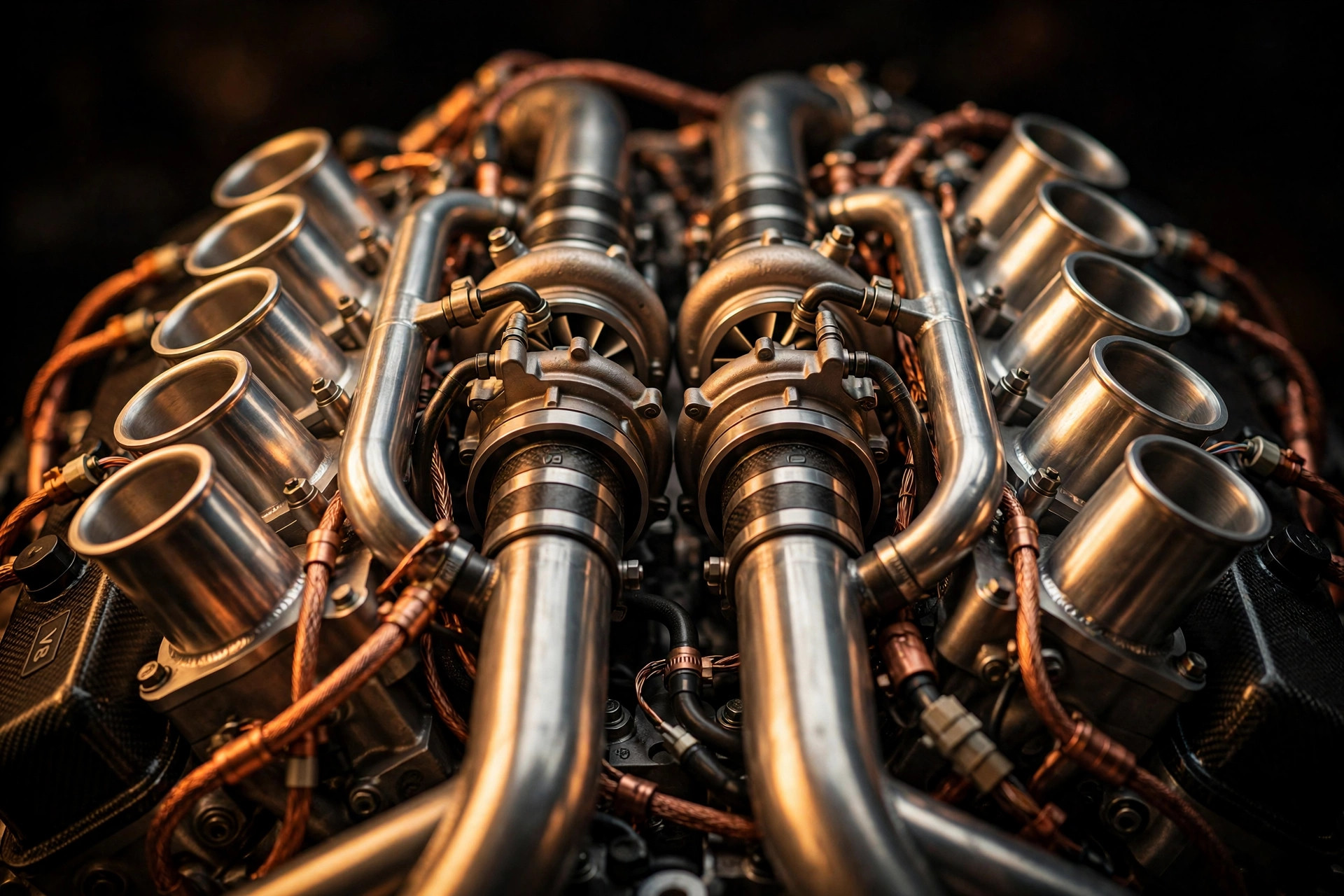
On November 10, 2026, in London, a company that had never built a V8 revealed one. Horse Powertrain is the joint venture Renault and Geely formed in May 2024 by folding their combustion-engine operations into a single business, with Saudi Aramco taking 10 percent that December. Its work until now has been the unglamorous end of the industry: four-cylinder engines, small hybrids, range extenders, the hardware that keeps ordinary cars moving while the rest of the industry argues about the electric transition. Nineteen thousand employees, eighteen plants, five research centers, customers including Volvo, Proton, Nissan, and Mitsubishi. Nothing in that resume suggests a supercar engine was coming. Then Horse unveiled the W40, its first production-ready V8, and confirmed it will debut in the Lotus Type 135, a mid-engine hybrid supercar Lotus plans to reveal and launch in 2028.
Four litres, eight cylinders, two turbochargers nested between the banks in a hot-V layout, direct injection, a shortened intake path. Output is more than 500 kilowatts, which converts to more than 670 horsepower and 680 PS, with 800 newton-metres of torque, about 590 pound-feet. Weight is about 200 kilograms, 441 pounds. Those five numbers are the whole announcement, in a sense. Everything else Horse said on the day was context around them.
Hybrid-First Is a Design Decision, Not a Marketing Line
Every hybrid V8 on the market today started life as a combustion engine and gained electric assistance later. Ferrari's F163 V6 in the 296 GTB was designed with hybridization in mind too, so Horse is not the first to think this way, but the claim still matters because of what it changes inside the engine. A motor that must live beside electric assistance needs different crankshaft damping, different mounting points, different cooling circuits, and a control system that treats torque from two sources as one output. Bolting those things onto a finished engine is possible. Designing them in from the first drawing is cheaper, lighter, and usually more reliable.
Horse says the W40 was designed that way from the start. No independent teardown exists yet to confirm the details, and Horse has published no cutaway drawings, so the claim rests on the company's word and on one piece of circumstantial evidence: the gearbox. An engine designed as half of a hybrid system arrives with a transmission built to match, and Horse revealed the two together, as a set, rather than announcing the engine and promising a gearbox later.
Skepticism is warranted, because hybrid-first is the kind of phrase a press release loves and an engineer can rarely verify from the outside. What can be verified is the power density, and that number is harder to argue with.
The Numbers, and What They Actually Mean
Divide 671 horsepower by 200 kilograms and the W40 makes about 3.35 horsepower per kilogram of engine. That is a strong figure for a road-car V8. For comparison, the 4.0-litre Mercedes-AMG M177, a benchmark hot-V twin-turbo V8, weighs 209 kilograms according to CarNewsChina's comparison, nine more than the W40, while the 630-horsepower version in the AMG GT 63 S makes less power from a heavier unit. Lamborghini's L411, covered on this site, is the sharper contrast: a 4.0-litre twin-turbo V8 making 800 horsepower and revving to 10,000 rpm, or 200 horsepower per litre against the W40's 168. Sant'Agata built a screamer. Horse built a foundation.
Specific output is not the whole story, and here the W40's numbers cut in its favor. A hybrid V8 does not need to chase revs, because electric motors fill the torque hole at low speed that a high-strung combustion engine leaves behind. Ferrari's F163 makes 663 PS from three litres, a higher specific output than the W40, and still leans on its electric motor for low-end response. Judging the W40 against the L411 on revs alone misses the point of the design: this engine is supposed to be the quiet half of a system that makes more than 1,000 PS combined, not the loudest thing in the car.
Lotus's own target for the finished Type 135 is more than 1,000 PS, about 986 horsepower, with the electric motors included. Neither Horse nor Lotus issued a new combined figure on November 10, and the 986-horsepower number dates to Lotus's Focus 2030 announcement in May 2026. Subtract the W40's 671 and the electric side must contribute roughly 315 horsepower, if the peaks add linearly, which they rarely do. That is a substantial motor, or several, and it explains why the gearbox matters as much as the engine.
The Gearbox Is Half the Story
Horse calls it the 8LDCT: an eight-speed wet dual-clutch transmission built for hybrid applications, with an integrated electric motor, a silicon carbide control system and power module housed inside the transmission casing, and a variable-displacement mechanical oil pump. Shift response is under 20 milliseconds, clutch pre-fill under 50 milliseconds, and peak torque capacity is 1,050 newton-metres, about 774 pound-feet.
That last number deserves a second look. Engine torque peaks at 800 newton-metres. Gearbox capacity is 1,050. A 250-newton-metre gap between what the engine makes and what the gearbox can swallow is not an accident. It is the space reserved for the electric motor, or motors, feeding torque through the same housing. Horse has not published the motor's rating, so the arithmetic stays speculative, but the headroom is deliberate: a gearbox rated exactly to the engine's output would have nothing left for the hybrid half.
Silicon carbide inside a gearbox is the other detail worth pausing on. SiC power electronics switch faster and run hotter than conventional silicon, which is why they have become standard in EV inverters. Putting them inside the transmission housing, next to the clutches, collapses two components into one package and shortens the wiring between the power module and the motor it drives. Packaging, not performance, is the win here, and packaging is where mid-engine supercars live or die.
A Joint Venture Builds a Supercar Engine
Horse Powertrain exists because Renault and Geely each decided, in 2024, that combustion engines were a shared problem rather than a competitive advantage. Each owns 45 percent; Aramco holds the remaining 10 percent. Formation completed in May 2024. Since then the company has shipped four-cylinder engines and range extenders in volume, showed a 3.0-litre V6 at the Beijing Auto Show in April 2026, and now, two and a half years after formation, has a production-ready V8. That is a fast climb for a company whose oldest product is a commuter-car engine.
Base versions of the Type 135 will reportedly use a smaller Horse engine, the W30 V6, also with hybrid assistance, according to Carscoops. A family of engines, not a one-off, is the shape of the program: one V8 for the flagship, one V6 for the volume car, one gearbox architecture for both. Lotus, which Geely controls, is the launch customer, and Horse says the W40 also suits pickups and off-road vehicles. A supercar engine with a second career in trucks is either a joke or the entire point, depending on how you look at it.
Look at it as the point. Horse's business is scale. A V8 that only ever powers a few hundred Lotuses a year would be a loss-maker for a company with eighteen plants to feed. A V8 architecture that also serves a pickup, an off-roader, and a smaller V6 sibling spreads the development cost across programs that can actually pay for it. Lotus gets a bespoke-feeling engine without paying bespoke-engine money. Horse gets a halo customer that makes its catalog look serious.
What Horse Has Not Said
No photographs of the W40 exist yet, only a render. Horse has not said whether the crankshaft is cross-plane or flat-plane, a choice that determines whether the engine sounds like a muscle car or a race car, and Carscoops flagged the omission directly. Redline, bore, stroke, compression ratio, and the electric motor's output are all unpublished. Lotus has not confirmed the Esprit name, telling CAR magazine it is an internal project name rather than a production badge, and no chassis, aero, interior, dimension, or final weight figures exist yet. Spy shots of a Type 135 test car have not surfaced.
Gaps like these are normal eighteen months before a launch, and they are also the reason to keep the W40's claims provisional. A render is not an engine. A 200-kilogram claim is not a weighbridge ticket. Horse says the unit is production-ready; production-ready for a car that does not exist yet is a phrase with some elasticity in it. None of that makes the numbers wrong. It makes them unverified, which is a different thing, and worth saying plainly.
The Counterargument: A Catalog Engine in a Supercar
Purists will call this a dilution. Lotus built its reputation on cars like the Esprit, the Elise, and the Evora, machines whose character came from engineering done in-house at Hethel, and the Type 135's heart will arrive from a joint venture headquartered in London, built by a company that also supplies engines to Proton and Nissan. An engine shared, even in principle, with a pickup truck is a long way from Colin Chapman's workshop.
That objection has force, and it also has a counterweight. Lotus nearly went all-electric. Its Focus 2030 plan, announced in May 2026, originally pointed the brand at battery power alone, and the Type 135 itself was first planned as an EV before the company reversed course toward hybrids, targeting a mix of roughly 60 percent hybrids and 40 percent EVs. Without Horse, there would be no V8 Lotus at all, because Lotus no longer has the scale to develop one alone. A catalog engine is the price of a combustion Lotus existing in 2028. Refusing it would not have produced a better engine. It would have produced no engine.
There is a second objection, quieter and harder to dismiss. Power density is a press-release metric. What makes a supercar engine memorable is sound, response, and character at the limit, and none of those appear on a spec sheet. A 10,000-rpm Lamborghini V8 earns its keep every time it is driven. A 671-horsepower V8 that exists to be the sensible half of a hybrid system might be very good and entirely forgettable. Horse will not know which one it built until the first Type 135 is driven, and neither will anyone else.
What the W40 proves, already, is that the hybrid V8 has become a solvable engineering problem rather than a moonshot. Two and a half years ago Horse was a new joint venture building four-cylinder engines for economy cars. Today it has a 200-kilogram V8, a silicon carbide gearbox, and a supercar customer. Lotus gets its first supercar engine. Horse gets proof that its catalog reaches the top of the market. And the rest of the industry gets a reminder that the companies building tomorrow's supercar engines may not be the ones whose badges are on the cars.
Specifications: Horse W40 V8 and 8LDCT Transmission (November 2026)
| Engine | Horse W40, 4.0-litre twin-turbo V8, hot-V layout, direct injection, longitudinal installation |
| Power (engine only) | More than 500 kW (more than 670 hp / 680 PS) |
| Torque (engine only) | 800 Nm (590 lb-ft) |
| Engine Weight | About 200 kg (441 lb) |
| Power Density | About 3.35 hp per kg (author calculation from Horse figures) |
| Design | Hybrid-first: designed from the start for electric-motor integration |
| Transmission | Horse 8LDCT, 8-speed wet dual-clutch hybrid, integrated electric motor |
| Gearbox Torque Capacity | 1,050 Nm (774 lb-ft) peak input |
| Shift Response | Under 20 ms; clutch pre-fill under 50 ms |
| Power Electronics | Silicon carbide control system and power module integrated in the transmission housing |
| Oil System | Variable-displacement mechanical oil pump |
| First Application | Lotus Type 135 mid-engine hybrid supercar, reveal and launch 2028 |
| Combined System Target | More than 1,000 PS (about 986 hp), Lotus Focus 2030 announcement, May 2026 |
| Base Variant | Horse W30 V6 hybrid, reported by Carscoops, unconfirmed by Lotus |
| Manufacturer | Horse Powertrain (Renault 45%, Geely 45%, Aramco 10%), formed May 2024, London |
| Unpublished | Crankshaft type, redline, bore and stroke, compression ratio, electric motor output |
Sources & Methodology
Launch facts, figures, and quotes from the Horse Powertrain announcement of November 10, 2026, as reported by Inside China Auto (November 12, 2026), CarNewsChina (November 11, 2026), The EV Report (November 10, 2026), Jalopnik (November 11, 2026), Autoblog (November 10, 2026), Carscoops (November 13, 2026), Driving Enthusiast (November 12, 2026), and WhichCar (November 11, 2026), corroborated across at least three outlets for every headline figure. Type 135 context, the 1,000 PS combined target, and the 2028 launch date from Lotus's Focus 2030 announcement of May 12, 2026. Lamborghini L411 figures from this site's own article on the engine. Power-density and electric-side arithmetic are the author's calculations from the published figures, not manufacturer claims, and the combined-peak subtraction assumes the combustion and electric peaks add linearly, which they rarely do in practice. Author has not seen or heard the W40, which exists publicly only as a render; weight, output, and shift-time claims are Horse's, corroborated by multiple outlets rather than by independent measurement.