Built to Drown: Horse's B20 Waterproof Engine Claims 48.4% Thermal Efficiency
A 2.0-liter turbo four that keeps running under 1.1 meters of water is the headline. Beneath the drowning trick, an advanced Miller cycle chases 48.4 percent brake thermal efficiency. That is the story worth reading twice.
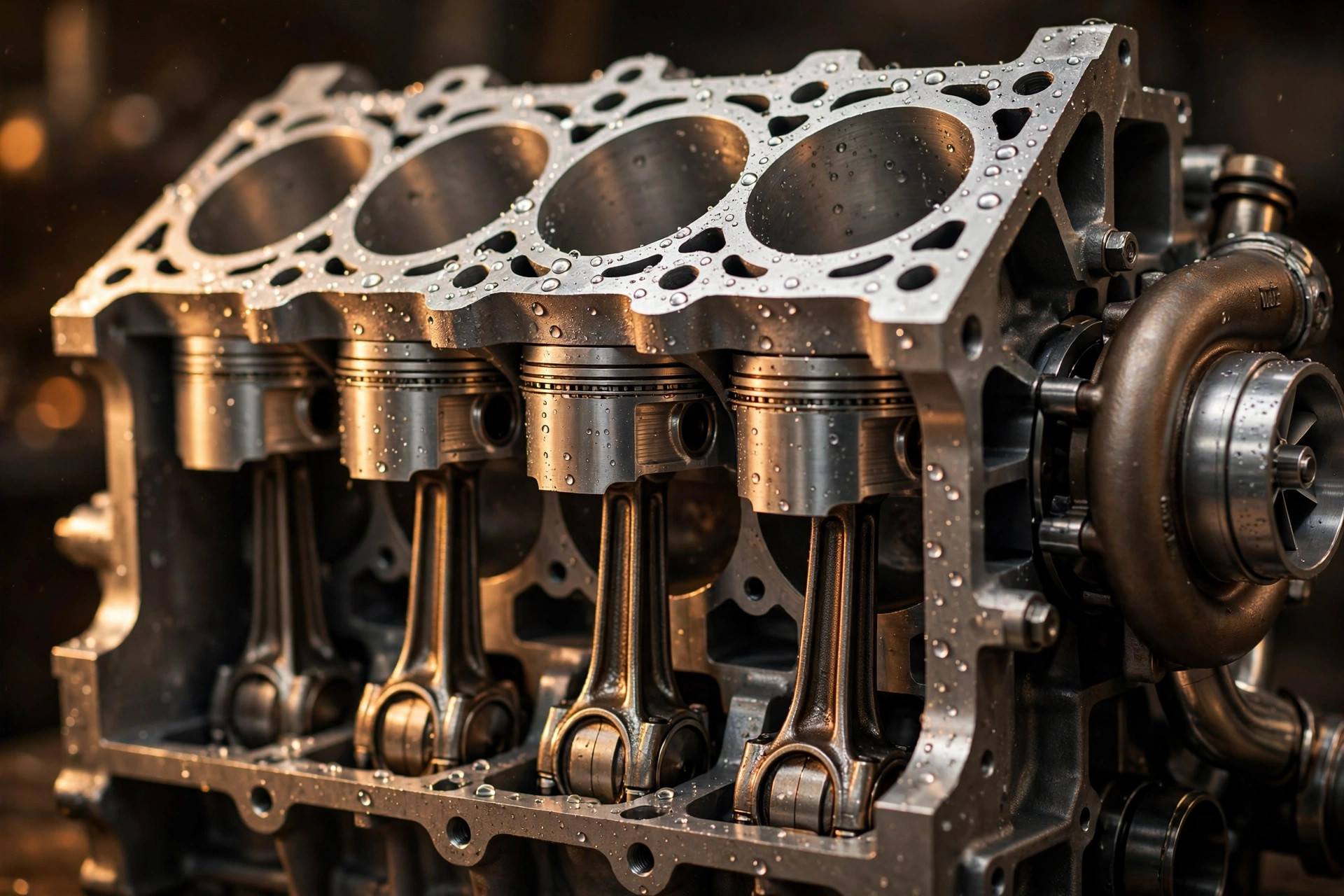
Every few years somebody builds an engine that is supposed to impress you with horsepower, and every few years I find myself more interested in the one that impresses nobody. Horse Powertrain's new B20 makes 188 to 248 horsepower depending on spec, which in 2026 is roughly what your neighbor's crossover makes while complaining about premium fuel. It also runs while submerged in over a meter of water, and its maker claims it converts fuel to work at 48.4 percent efficiency. One of those facts is a party trick; the second is one of the most aggressive combustion claims made by any engine builder this decade.
Start with the trick, because it is the honest kind. Horse designed the B20 from the outset for hybrid duty: a 2.0-liter turbocharged four-cylinder that either propels the vehicle through a hybrid transmission or works as a range-extending generator. To earn its IPX8 waterproof rating, Horse built a fully sealed structure around the engine, fitted dedicated sealing between engine and transmission, added torsional vibration dampers, and specced every electrical component and sensor to the same IPX8 standard. When the engine's sensors detect submersion, the control system adjusts throttle response and limits power on its own. It keeps running in 42 inches of water. Your door seals, meanwhile, are your problem.
That last sentence is the caveat Horse cannot engineer around, and to their credit they have not pretended otherwise. A waterproof engine does not make a waterproof vehicle. Differential breathers, cabin electronics, the air intake snorkel height, and every seal in the passenger compartment still set the real fording limit. What Horse has done is eliminate the engine itself from that list of constraints, which is a smaller claim than it sounds and a bigger one than most suppliers would bother with. Somebody at Horse looked at a bill of materials and decided that drowning the ECU was an acceptable business risk to eliminate.
IPX8 means what the manufacturer says it means
Here is a detail worth pausing on. IPX8, under IEC 60529, does not specify a depth. Under IEC 60529, IPX7 means immersion to 1 meter for 30 minutes; IPX8 means "continuous immersion under conditions specified by the manufacturer," which must be at least as severe as IPX7. Horse specified 1.1 meters, or about 42 inches. So the rating is exactly as honest as Horse's internal test protocol, whose details have not been published: duration, water temperature, thermal cycling between the engine's operating temperature and the water, pressure from flowing current rather than a still tank.
Why does that matter? Because hot metal submerged in cold water is not a sealing problem, it is a thermal shock problem. An engine at operating temperature dropped into a river experiences rapid contraction of the block and head, pressure reversal as the cooling system suddenly gains an infinite heat sink, and contraction of seal materials that were expanded at temperature. Static immersion in a test tank is the friendly version. A real crossing is a 1.1-meter river at 20 mph with hot oil. Horse's claim deserves the benefit of the doubt, and independent verification. Both.
Reading the weather
Strip away the waterproofing and something more subtle emerges. Engine management systems have spent a century defending against internal states: knock, coolant temperature, oil pressure, catalyst light-off. Here the control system defends against an external environmental state. Its sensors monitor the operating environment continuously, and on detecting submersion the engine derates itself, altering throttle response and capping power to survive conditions that would hydro-lock or short a conventional unit.
That is a genuinely new piece of engine philosophy. No other production-intent engine I know treats the environment as a control input rather than a warranty exclusion. One is passive resistance, the other is active defense.
Historically, the engine assumes a dry world and fails gracefully when the world disagrees. The B20 assumes the world is wet and plans accordingly.
48.4 percent, and why that number is startling
Now the efficiency claim, which is where this article gets serious. Horse says the B20 achieves 48.4 percent brake thermal efficiency on an advanced Miller cycle. For context, most production gasoline engines convert 25 to 30 percent of their fuel into useful work. Toyota's celebrated Miller-cycle Prius engine, the benchmark for efficient gasoline combustion, sits around 40 percent. Production diesel passenger engines top out in the low 40s. Marine two-stroke diesels, which have the luxury of being the size of a house, push past 50. A turbocharged gasoline four at 48.4 percent would be, on paper, the most efficient spark-ignition production-intent engine ever claimed.
Would. That claim is Horse's alone; no independent dyno data has been published. Say that loudly, because the number is extraordinary enough to deserve skepticism as the default position. But the hardware list behind it is coherent, and coherence is what separates a credible stretch from marketing. In a Miller cycle, the intake valve closes late in the compression stroke, so the effective compression ratio is lower than the expansion ratio; the piston extracts more work from each charge during the longer expansion than it spent compressing it. A turbocharger restores the low-end air charge that late valve closing sacrifices, which is exactly why turbocharged Miller engines pair so well. On top of that Horse lists direct injection, high-tumble intake ports, and pistons shaped for a cleaner, faster combustion event.
Tumble ports deserve a moment. "High-tumble" means the intake charge enters the cylinder with strong rotational motion, which breaks down into fine-scale turbulence as the piston approaches top dead center. More turbulence at ignition means faster flame propagation, which means more of the charge burns near the ideal constant-volume point, which means more work extracted per unit of fuel. Faster combustion also tolerates leaner mixtures and higher exhaust gas recirculation without misfire, both of which cut pumping losses and heat transfer losses. None of this is new science. What is new is packaging all of it into a 287-pound engine that also survives drowning.
Cooling for the long climb
Then there is the thermal management, which reads like it was specced by people who have actually watched an engine die on a grade. A fully active dual-cooling system keeps temperatures controlled during sustained climbing and other high-load situations, and a variable displacement oil pump matches oil flow to demand instead of dumping excess pressure through a relief valve at cruise, which is the kind of parasitic loss that efficiency engineers hunt with religious intensity. Horse also claims the engine can propel a vehicle up a 100 percent grade, a 45-degree slope, the kind of figure that makes you check whether they mean what they wrote.
I suspect the grade claim and the waterproofing share a customer: the Chinese off-road market, where the B20 has already appeared. It debuted at the 2026 Beijing Auto Show inside the Geely Galaxy Cruiser 700, a plug-in hybrid off-road vehicle sold in China, paired with Horse's own 3DHT230 three-speed hybrid transmission. That is the only application so far, which means every claim in this article rests on one manufacturer's word and one market's vehicle. Independent verification has a way of disciplining extraordinary claims, and I would like to see it.
Engines sold like software
Horse Powertrain itself is arguably as interesting as its engine. Founded in 2024 as a Renault-Geely joint venture, it builds engines for Mercedes-Benz and Renault alongside its own hybrid-first designs, and this week it opened an official office in Southfield, Michigan, in the heart of the Detroit metro. Read that sentence again and consider what it describes: a company whose entire business is designing combustion powertrains for other automakers, at a moment when most automakers have quietly stopped funding their own internal-combustion R&D.
This is the Intel Inside model applied to engines. If every major OEM is winding down its engine development teams while still needing efficient hybrid powertrains for the next decade, the rational move is to consolidate that engineering in one supplier and amortize the development cost across Mercedes, Renault, Geely, and whoever walks into the Southfield office next. This is not just an engine. It is an argument that the combustion engine's future belongs to specialists, and that the specialists will be judged on operating envelopes, thermal efficiency and environmental tolerance, rather than the horsepower figures that used to sell cars. Selling the envelope instead of the output is the most honest transaction this industry has offered in years.
What I do not know
Honesty requires the ledger. I have not seen the B20 run, handled it, or drowned one in a test tank. No third party I can find has verified the 48.4 percent figure. Horse has not published the IPX8 test conditions. Same press materials, same provenance for the 100 percent grade claim. So far the only vehicle application is a China-market SUV I cannot drive. And the most important engineering question, how the sealed structure handles repeated thermal shock across hundreds of hot-to-cold immersion cycles over a 15-year vehicle life, is exactly the kind of durability data that takes a decade to produce and no press release can shortcut.
None of that diminishes what Horse has attempted. Somebody built a 287-pound turbo Miller-cycle four that treats submersion as a control input, chases diesel-level thermal efficiency with gasoline, and sells the whole package to any automaker willing to stop pretending it still develops its own engines. Waterproofing is the hook. Efficiency is the story. And the business model might be the future.
| Spec | Horse B20 (claimed) |
|---|---|
| Configuration | 2.0L turbocharged inline-4, hybrid-first (HEV / PHEV / range extender) |
| Output | 188-248 hp (190-252 PS) depending on spec |
| Torque | 221-280 lb-ft (300-380 Nm) depending on spec |
| Weight | 287 lb (130 kg) |
| Combustion cycle | Advanced Miller cycle, direct injection, high-tumble intake ports, shaped pistons |
| Brake thermal efficiency | 48.4% (Horse claim; unverified independently) |
| Waterproof rating | IPX8; continuous operation submerged to 1.1 m (~42 in) |
| Sealing | Fully sealed structure, engine-to-transmission sealing, torsional vibration dampers, IPX8-rated electrics and sensors |
| Submersion behavior | Control system detects submersion, adjusts throttle response, limits power automatically |
| Cooling | Fully active dual-cooling system; variable displacement oil pump |
| Gradeability | 100% (45-degree) grade claimed |
| First application | Geely Galaxy Cruiser 700 PHEV (China only), with HORSE 3DHT230 3-speed hybrid transmission; Beijing Auto Show 2026 debut |
| Maker | Horse Powertrain (Renault-Geely JV, founded 2024); builds engines for Mercedes-Benz, Renault; US office opened Southfield, MI, Sep 9 2026 |
| Not published | Independent dyno data, IPX8 test protocol, thermal-shock durability data, price |
Sources
- Tom McParland, CarBuzz, "Turbocharged, Electrified, And Waterproof: This New Hybrid Engine Is For 'Extreme' Use," September 8, 2026. https://carbuzz.com/horse-powertrain-waterproof-hybrid-engine-september-2026/
- Carscoops, "Renault And Geely's New Turbo Engine Keeps Running While Fully Underwater," September 2026. https://www.carscoops.com/2026/09/horse-waterproof-hybrid-engine/
- Thames Gazette, "Horse Powertrain Waterproof Engine." https://www.thamesgazette.com/technology/waterproof-engine-horse-b20/
- Joel, CarBuzz, "The Engine Company Building 1,100-HP Hybrid Powertrains Is Setting Up Shop In America," September 9, 2026. https://carbuzz.com/horse-powertrain-opens-american-office-september-2026/