The Blurred Supercar: GWM’s GF Bets a Carbon Tub and a Hot-V V8 Against Ferrari’s SF90
Most supercar reveals start with a sheet pull and a horsepower number. GWM started with an apology. On November 12, 2026, chairman Wei Jianjun posted a video from the company’s proving ground in Baoding, driving a red Ferrari SF90 at speed, while his own company’s first supercar sat behind him with its body blurred out. “I have to apologise to everyone,” he said. “The car I just drove is our very first prototype, and it is still confidential.” Then he added the part that matters: his prototype still falls short of the Ferrari, and the target is to outperform the SF90 when the car goes on sale in 2027.
Car executives do not usually admit, on the record, that their flagship loses to the benchmark. Wei did, twice in the same video, and that candour is the most interesting engineering signal in the whole clip. A company that buys the benchmark, drives it on its own track, and publishes the gap is a company that has decided to be measured against it. Five or six years of development have gone into the GF supercar already, and the 2027 target leaves almost no room for the usual excuses.
A Tub Lighter Than Most Engines
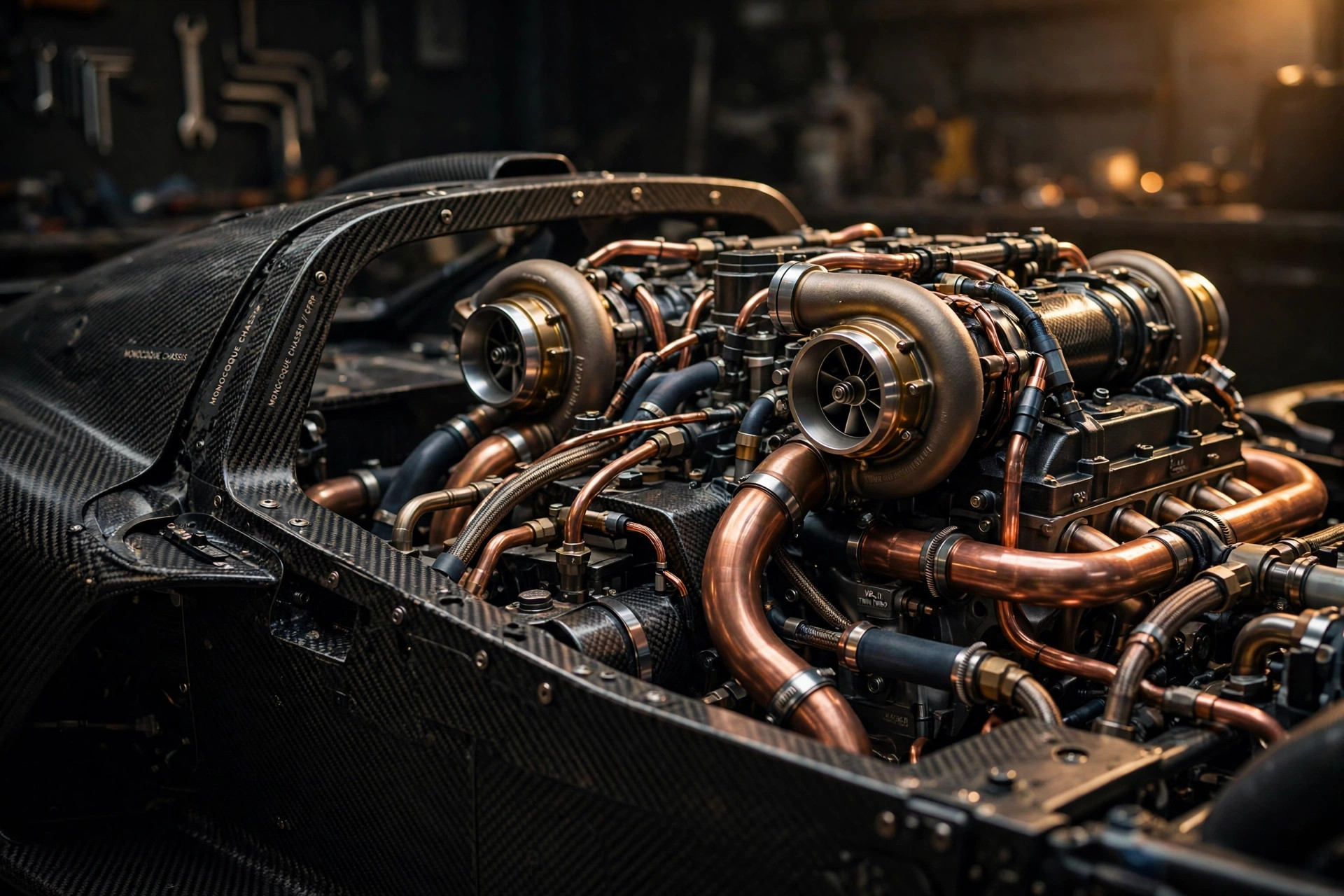
Start with the structure, because GWM did. Elements of the GF architecture were shown at CES 2026 in Las Vegas and again at the 2026 Beijing Auto Show, and the headline figure is the carbon-fibre monocoque: an in-house structure weighing under 130 kilograms, with a claimed torsional rigidity of 40,000 Newton-metres per degree. For scale, 130 kilograms is roughly what a dressed V8 long block weighs. GWM is claiming a passenger cell lighter than the engine it has to carry.
That number deserves both respect and scepticism. McLaren’s MonoCell, the benchmark for production carbon tubs, sits in the same weight class, and McLaren has spent four decades refining the process. GWM building a comparable structure in-house, on its first attempt, is a serious claim. Rigidity per degree matters more than the weight alone, because a stiff tub lets the suspension do the work instead of the body flexing around it. Forty thousand Newton-metres per degree, if real, puts the GF tub in the company of cars costing three times what this one is expected to cost. No independent test exists yet. Treat the figure as a target the company has chosen to be judged against, not as a verified fact.
One detail gives the claim credibility: the tub was not designed for the road car alone. GF is a platform, not a single model. GWM plans a two-seat road supercar, an FIA GT3 race car, and a road-going GT3-derived variant from the same architecture. A tub engineered to survive GT3 homologation loads is a tub engineered with margins a road-only structure would never need. That is the expensive way to build a halo car, and it is also the honest one.
The Engine: A Hot-V V8 Built for a Hybrid
Mounted midship behind the tub sits a 4.0-litre twin-turbo V8, a 90-degree design with a hot-V layout, dry-sump lubrication, dual fuel injection, and a track-oriented engine calibration. GWM displayed the physical engine at CES 2026 and cited a baseline output of approximately 500 horsepower for the combustion unit alone. Chinese media have since cited 549 PS and 770 Newton-metres for the V8, figures GWM has not confirmed. Either way, the engine is a starting point, not the headline. It was designed from the outset to work with electric motors, not to have them bolted on afterwards.
Hot-V architecture puts the turbochargers inside the V of the engine, between the cylinder banks, instead of hanging them on the outside. Exhaust gases travel a shorter path to the turbine, which sharpens response, and the whole package gets narrower, which matters in a mid-engine car where every millimetre of width is fought over by the tub, the cooling system, and the rear suspension. Ferrari has used the layout on the SF90’s V8, which makes the choice a deliberate piece of benchmark engineering: GWM is not copying the SF90’s silhouette, it is copying its thermodynamics.
Dry-sump lubrication is the other tell. A conventional wet sump keeps oil in a pan under the crankshaft, which forces the engine to sit higher and risks oil starvation under sustained lateral load. Dry-sump scavenging lets the engine sit lower in the chassis and keeps oil pressure stable through long corners. It is race hardware, and it is also the reason the engine can sit low enough for the car’s centre of gravity to matter. Dual injection, port plus direct, covers both cold-start emissions and high-load fuelling, which is the kind of unglamorous detail that separates a show engine from one that has to pass real regulations.
Two Motors, One Gearbox, No Pretence
Electrification is where the GF programme stops looking like a tribute act and starts looking like a system. The road car is planned as a plug-in hybrid, with a P4 electric motor at the front axle and a P2 motor at the rear, driving through a nine-speed automatic configured to work with the hybrid system. A P4 motor sits on the axle itself, independent of the gearbox, which gives the front axle torque on demand with no mechanical connection to the engine. A P2 motor sits between the engine and the gearbox, which lets it fill torque during shifts and recover energy under braking.
That split is the same logic Ferrari used on the SF90, which runs three electric motors around its V8, and the same logic Lamborghini used on the Temerario. Nobody in this class builds a hybrid for efficiency anymore. Electrification exists to erase turbo lag, to fill the gaps between gear changes, and to give the front axle something to do while the rear axle is busy. Adam Thomson, the programme’s engineering lead, put it plainly at the Beijing show: “The decision to make the car a hybrid was based on performance delivery. To achieve the targets we wanted to achieve, we needed to electrify the powertrain in some way.”
No combined power figure has been confirmed. Thomson has said the targets are “very firmly decided, and they’re very ambitious,” and that what the hybrid system delivers “will be groundbreaking.” Australian reporting from the Beijing show put the ambition at an SF90-challenging 1,000 kilowatts, which would be roughly 1,340 horsepower. That number is not GWM’s, and it should not be quoted as one. What is GWM’s is the benchmark: the SF90 makes 780 cv from its V8 and another 220 cv from its motors, for 1,000 cv combined. Any car that claims to beat it needs four figures. GWM knows the arithmetic, and it chose the comparison anyway.
The Restart That Explains Everything
Thomson’s background is the strongest credential on the project. He was chief engineer at McLaren GT, and he joined GWM after leading development of the McLaren GT product family. His role has since expanded beyond the supercar to platform and vehicle development across GWM products, with Nürburgring specialists involved in chassis tuning. Hiring one ex-McLaren engineer is a press release. Giving him authority to throw away a year of work is a strategy.
That is what happened. Thomson has said the project was already twelve months in when he arrived, and the initial concepts were scrapped in favour of his architecture. “A lot of the last three years of work is absolutely from a blank sheet of paper, from the ground up, everything,” he told media at the Beijing show. The restart was driven by the GT3 requirement: the original prototype could not be made to satisfy FIA GT3 regulations, so the team rebuilt the programme around the carbon monocoque instead. A road car that shares its structure with a GT3 racer is a road car whose crash structure, cooling, and packaging were all decided by a rulebook rather than a marketing deck.
Scrapping a prototype is expensive and embarrassing, and most manufacturers hide it. GWM’s chairman filmed his blurred replacement next to a Ferrari and admitted it loses. Both decisions point the same way: this programme is being run by people who would rather be embarrassed in public than wrong in private. That is not a guarantee of success, but it is a much better sign than a polished launch video would be.
The Week the V8 Came Back
GWM’s reveal landed in a remarkable week for the eight-cylinder engine. Two days earlier, on November 10, Horse Powertrain, the Renault and Geely joint venture, revealed its W40, a 4.0-litre twin-turbo hybrid V8 making over 500 kilowatts, destined for the Lotus Type 135. Within 48 hours, two separate Chinese-backed programmes had announced clean-sheet V8 hybrids aimed at the same Ferrari benchmark. GWM has also been spotted testing a hybrid NASCAR-style prototype in China, with a “GF NASCAR Expert” role posted on its recruitment platform on November 4. None of that is a coincidence of scheduling. It is a coordinated bet that the V8, electrified and downsized, has a future the EV-only forecasts missed.
Wei has been explicit about why. He told Australian media the V8 strategy “is not aligned with current trends in China, but is designed for global markets,” and that the supercar will be available in Australia and New Zealand. GWM’s Australian engineering team has already worked on ride and handling development for the company’s other vehicles. A Chinese supercar built for export, benchmarked against Maranello, and developed with a British engineer and German track specialists is a global car in the literal sense. Whether buyers in those markets accept a GWM badge at supercar money is a question no amount of carbon fibre answers.
The Counterargument: A Blur Is Not a Car
Scepticism is warranted, and it starts with what GWM has actually shown. A blurred prototype in the background of a video is not a car. No horsepower figure, no acceleration time, no weight, no price, and no lap time has been confirmed. The monocoque rigidity figure is a company claim. The 549 PS engine figure is press speculation. The 2027 launch date is a target set by a chairman who has already watched his own prototype lose to the benchmark on his own track.
Then there is the badge problem. Ferrari sells the SF90 on a century of racing history and a dealer network that treats owners like members. McLaren sells on the same. GWM sells the Tank 700 and the Haval range, competent vehicles with no presence in the supercar conversation at all. A carbon tub and a hot-V V8 do not buy heritage, and heritage is half of what a supercar buyer is paying for. GWM’s answer, implicitly, is that engineering is the heritage, and that a car which beats an SF90 on a track earns its badge the hard way. That is a fair argument. It is also an argument that only works if the car actually beats the SF90.
Finally, the GT3 plan cuts both ways. Building a road car around a race rulebook produces a stiff, focused machine, but it also produces compromises a pure road car would never accept: packaging dictated by homologation, cooling sized for a race, and a development schedule hostage to a rulebook. Thomson’s restart solved the homologation problem. It did not solve the problem of selling a first-generation supercar from a brand nobody associates with supercars.
None of that makes the GF programme a joke. It makes it the most interesting engineering story in the supercar world right now, precisely because it is the least polished. A blurred prototype, an honest chairman, a scrapped first attempt, and a monocoque lighter than most engines add up to a company that is doing the hard parts first and the marketing last. Most supercar programmes do it the other way around. If GWM delivers a car in 2027 that genuinely challenges the SF90, the blur will look like confidence. If it does not, the video will look like a warning the company issued against itself.
I have not seen the car unblurred, driven it, or inspected the monocoque. Everything above comes from GWM’s own disclosures, Thomson’s interviews, and independent reporting, with unconfirmed figures labelled as such. When the covers come off, the numbers will either hold up or they will not, and this site will say which.
Specifications: GWM GF Supercar (as disclosed, November 2026)
| Programme | GWM GF performance sub-brand; first supercar, plus FIA GT3 race car and road-going GT3 variant |
| Chassis | In-house carbon-fibre monocoque, under 130 kg, claimed 40,000 Nm/degree torsional rigidity |
| Engine | Mid-mounted 4.0-litre twin-turbo V8, 90-degree hot-V, dry-sump, dual injection |
| Engine Output | Approximately 500 hp baseline cited at CES 2026; 549 PS / 770 Nm cited in Chinese media, unconfirmed by GWM |
| Hybrid System | Plug-in hybrid; P4 electric motor at front axle, P2 motor at rear |
| Transmission | Nine-speed automatic configured for hybrid drive with P2 motor |
| Benchmark | Ferrari SF90 Stradale: 780 cv V8 plus 220 cv from three electric motors, 1,000 cv combined |
| Engineering Lead | Adam Thomson, former McLaren GT chief engineer, vehicle integration; Nürburgring specialists on chassis |
| Electrical Architecture | GWM One |
| Development Time | Five to six years; original prototype scrapped and restarted around the monocoque for GT3 compliance |
| Timeline | Public debut previously indicated late 2026; launch targeted 2027; availability planned for Australia and New Zealand |
| Confirmed Figures | None for combined power, acceleration, weight, or price as of November 12, 2026 |
Sources & Methodology
Wei Jianjun’s November 12, 2026 Weibo video and statements via CarNewsChina’s November 12 report; GF architecture, monocoque, engine, and hybrid layout details from CarNewsChina, CarExpert, WhichCar, and NZ Autotrader coverage of the 2026 Beijing Auto Show and CES 2026 displays; Adam Thomson’s role, prototype restart, and hybrid rationale from his Beijing Auto Show interviews as reported by CarExpert and WhichCar; Horse Powertrain W40 announcement November 10, 2026 via GlobeNewswire; GWM hybrid NASCAR prototype sighting and November 4 job listing via CarNewsChina, November 7. SF90 specifications from Ferrari’s published figures. Unconfirmed figures are labelled as such. Author has not seen the GF prototype unblurred, driven it, or inspected the monocoque. All engineering claims attributed to the manufacturer or verified against independent coverage from at least two sources.