Twelve Point Three Two Years: The Nuclear Physics Inside Your Watch Dial
Every watch with luminous markers faces the same problem. Night arrives, photons stop, and whatever glow the dial accumulated during the day begins to die. Super-LumiNova, the strontium aluminate pigment that coats the hands and indices of almost every modern mechanical watch, stores energy from ambient light and re-emits it as visible phosphorescence, bright for forty minutes, readable for maybe four hours, gone by dawn. It is an afterglow material, a capacitor of light, and it runs down like one. Flip your wrist at three in the morning and the numbers have already faded into the dial.
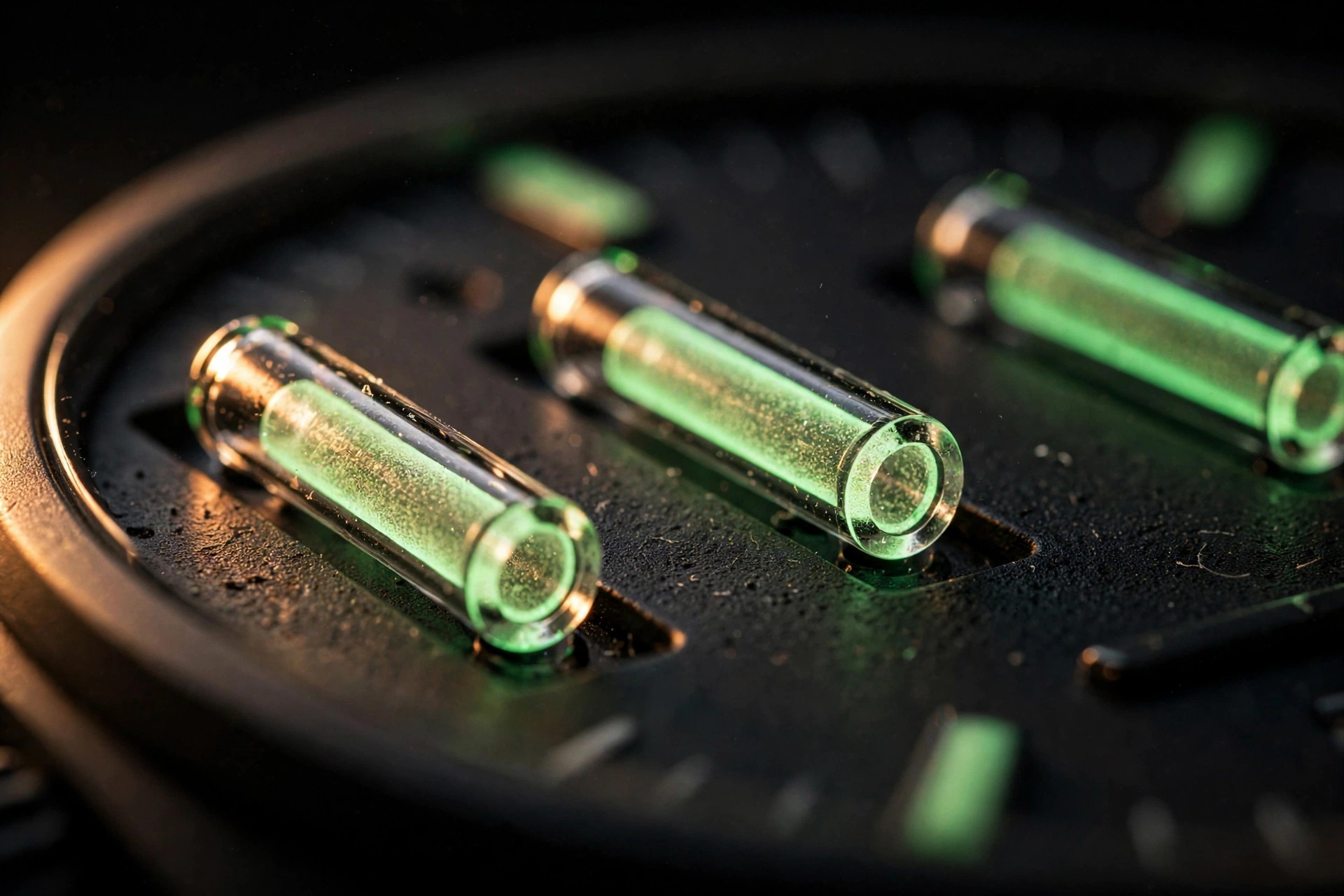
One technology solves the problem completely. Gaseous Tritium Light Sources, known as GTLS, glow continuously for two decades without absorbing a single photon. No battery, no charging, no external energy of any kind. They are tiny sealed glass capsules containing a radioactive gas that throws electrons into a phosphor coating on the capsule's inner wall, and the phosphor converts those electrons into visible light at a rate determined not by the sun or a lamp or a circuit but by nuclear decay. A GTLS tube manufactured in 2026 will still be glowing in 2046, dimmer but readable, its luminescence governed by a half-life that no watchmaker, no engineer, and no law of thermodynamics can accelerate or retard.
That half-life is 12.32 years, the interval over which half the tritium atoms in the tube will have decayed into helium-3, and the number that names everything about how this technology works.
What Happens Inside the Glass
Tritium is hydrogen with two extra neutrons. Where ordinary hydrogen has one proton and nothing else, and deuterium has one proton and one neutron, tritium carries one proton and two neutrons, making it unstable. It decays through beta emission: one neutron spontaneously converts into a proton, ejecting an electron and an antineutrino. The atom becomes helium-3, a stable noble gas, and the ejected electron carries away kinetic energy with an average of 5.5 keV and a maximum of 18.6 keV.
Those numbers matter because they define the safety profile. An 18.6 keV electron cannot penetrate a sheet of paper. It cannot penetrate human skin. It certainly cannot penetrate the borosilicate glass wall of a GTLS capillary, which is typically 0.1 to 2.0 millimeters thick. For comparison, medical X-rays operate at 20,000 to 150,000 eV. A tritium beta particle is roughly a thousand times less energetic than the weakest diagnostic X-ray, which is why a sealed tritium tube worn directly against the skin produces no measurable radiation dose to the wearer. The glass is the containment vessel, and it is vastly more containment than the physics requires.
But those weak electrons are perfect for something else. When a 5.5 keV beta particle strikes a zinc sulfide phosphor crystal doped with copper or silver activators, it excites electrons within the phosphor's crystal lattice from valence band to conduction band. As those electrons relax back to their ground state, they release the energy difference as visible photons, typically in the green spectrum at around 530 nanometers for standard ZnS:Cu formulations. Different activator dopants shift the emission wavelength: copper gives green, silver gives blue, and manganese-doped zinc silicate produces orange. The result is a glass tube that glows a specific color, continuously, powered entirely by nuclear decay.
A single capillary produces light measured in microlumens, which sounds negligible until you consider that the human eye, fully dark-adapted after twenty minutes, can detect luminance levels as low as one microcandela per square meter. A fresh tritium tube at typical loading produces several hundred microlumens. It is not bright enough to read a newspaper by. It is bright enough to tell time at a glance in total darkness, which is the entire point.
Manufacturing a Nuclear Light Source
One company on the planet makes GTLS tubes for watches. mb-microtec AG occupies a factory in Niederwangen, a suburb of Bern in the Swiss canton that also hosts the country's federal government, and it has held this monopoly since physicist Oskar Thüler founded the firm in 1969. Approximately one hundred employees work there, handling a manufacturing process that sits at the intersection of glassblowing, nuclear materials handling, and semiconductor-grade contamination control.
Production begins with borosilicate glass tubing, the same family of glass used in laboratory beakers and pharmaceutical ampules, chosen because borosilicate withstands thermal shock, resists chemical attack, and can be drawn into capillaries with outer diameters as small as 0.5 millimeters. For a watch hour marker, a typical tube might measure 1.5 millimeters in outer diameter and 5 to 8 millimeters in length. For a hand, it could be as small as 0.9 by 4 millimeters. One critical constraint governs the geometry: at least one interior dimension must be shorter than the mean free path of a tritium beta particle in the gas, roughly one centimeter at standard pressures, because electrons that cannot reach the phosphor wall before losing their energy to gas collisions produce no light. Cylindrical tubes satisfy this naturally.
The inner surface of each capillary is coated with phosphor, usually zinc sulfide activated with copper for the green tubes that dominate the market. Each coating must be uniform, adherent, and free of pinholes that would create dark spots on the finished tube. After coating, the tube enters a bakeout phase at 350 degrees Celsius under hard vacuum, down to 10-4 millimeters of mercury, to drive off water vapor, adsorbed gases, and organic contaminants from the glass and phosphor surfaces. Water is the primary enemy: even trace amounts of H2O in a sealed GTLS tube will quench the phosphor, exchange hydrogen atoms with tritium to form tritiated water (which is radiologically more hazardous than gaseous tritium because it is absorbed through the skin), and degrade the tube's brightness over time. Skipping the bakeout is not an option. It is the step that determines whether the tube will still glow in 2041.
Immediately after bakeout, while the glass is still under vacuum and residual gases have been pumped away, tritium gas is introduced. mb-microtec has historically sourced its tritium from facilities like Oak Ridge National Laboratory in Tennessee, receiving gas at a minimum purity of 94 percent elemental tritium with a tritium oxide content below one percent, certified by the supplier. On-site, a uranium getter process purifies the gas further: tritium adsorbs onto finely dispersed activated metallic uranium at room temperature, where contaminants either react irreversibly with the uranium (water forms stable uranium oxides, releasing pure tritium) or remain in the gas phase and get pumped away. When the uranium bed is heated to 400 degrees Celsius, it releases pure tritium for filling. This purification step is borrowed directly from nuclear weapons tritium handling, adapted for a factory making watch components.
The tube is filled to pressures up to 2.5 atmospheres, then flame-sealed at its open end while the glass is still connected to the gas manifold. Hermetic sealing is non-negotiable. Not mostly hermetic. Not hermetic enough. Absolutely hermetic, because any leak path, even at molecular scale, allows tritium to diffuse out of the tube over years, reducing brightness and releasing radioactive gas into the watch case. Every finished tube undergoes leak testing per ANSI N540 standards before it leaves the factory.
In 2019, mb-microtec added a tritium recycling plant to its Niederwangen facility. Production waste, including broken tubes, off-spec capillaries, and end-of-life returns, is processed through an automated system that extracts tritium gas, purifies it, and feeds it back into production. Recycled gas is chemically identical to purchased tritium. Operating under Swiss nuclear regulatory oversight, the plant produces emissions well below regulatory limits, which makes it a small but real example of nuclear material circular economy operating inside a watch component factory.
Why Not Just Use Paint
Super-LumiNova, developed by Nemoto and marketed by RC Tritec, another Swiss company, solved a real problem when it replaced tritium paint in the 1990s. Radium dial paint, used from the 1910s through the 1960s, killed workers who ingested alpha-emitting radium-226 particles while lip-pointing their brushes. The "Radium Girls" litigation and resulting occupational safety regulations drove radium off watch dials entirely. Tritium paint replaced it, a safer option because tritium's beta particles cannot penetrate intact skin, but tritium paint still involved applying a radioactive material as an open-source coating on watch dials, requiring licensed facilities, regulatory oversight, and periodic replacement as the tritium decayed. When strontium aluminate phosphor arrived, offering brighter initial glow than tritium paint and requiring zero radioactive material, the mainstream industry switched almost overnight.
Strontium aluminate is a crystal with the formula SrAl2O4, usually doped with europium and dysprosium. Europium provides the primary emission at around 520 nanometers (green), and dysprosium creates long-lived trap states that extend the afterglow by slowly releasing stored energy over hours rather than minutes. When exposed to light, photons excite electrons into these trap states. When the light source is removed, the electrons gradually escape the traps and recombine, producing the characteristic green glow that fades logarithmically from initial brightness.
For the first hour in darkness, Super-LumiNova is brighter than any GTLS tube. By hour four, the two are roughly equivalent. By hour eight, Super-LumiNova is struggling while the tritium tube has not changed at all. By hour forty-eight, the strontium aluminate phosphor has released essentially all its stored energy and the dial is dark. The tritium tube is exactly where it was when the lights went out, producing the same steady glow it will produce tomorrow, next week, next year, and for the rest of the decade. This is the fundamental asymmetry: Super-LumiNova is a rechargeable flashlight and GTLS is a nuclear battery. One depends on its environment for energy. The other carries its energy supply sealed inside the glass.
For military, diving, caving, search-and-rescue, and any application where extended darkness is not a theoretical edge case but a daily operational condition, the distinction between "glows for four hours after charging" and "glows continuously for twenty years" is not academic. It is the reason Ball Watch Company builds every model with GTLS tubes and has done so since the early 2000s. It is the reason Marathon, the supplier of field watches to numerous NATO armed forces, specifies GTLS on its government-issue models. And it is the reason mb-microtec's trigalight technology, despite being more expensive per lume point than a brushstroke of Super-LumiNova paste, has remained in continuous production for over fifty years while other radioluminescent technologies have been regulated out of existence.
Regulatory Geometry
GTLS watches are legal in most countries under specific activity limits. In the United States, the Nuclear Regulatory Commission exempts self-luminous products containing less than 25 millicuries of tritium under 10 CFR 30.15, a threshold that accommodates a watch with several dozen tubes comfortably. In Switzerland, mb-microtec operates under the Swiss Federal Nuclear Safety Inspectorate (ENSI) and the Federal Office of Public Health (FOPH). In the European Union, individual member states regulate possession of GTLS products, with some, notably the UK, requiring no license for watches and others applying varying thresholds.
Regulatory burden falls almost entirely on the manufacturer, not the wearer. mb-microtec handles tritium as an open radioactive source during production, filling, and sealing, requiring controlled areas, personal dosimetry, waste management protocols, and licensed transport for incoming tritium shipments. Once a tube is sealed, tested, and installed in a watch, it becomes a sealed source below exemption quantity, and the watch itself is a consumer product no different in regulatory status from the luminous exit signs hanging in commercial buildings worldwide, which use the same technology at higher tritium loadings.
This asymmetry explains why only one company makes GTLS tubes for watches. The capital investment in nuclear materials handling infrastructure, regulatory licensing, skilled workforce, and quality control systems creates a barrier to entry that no competitor has cleared in five decades. It also explains why GTLS tubes cost substantially more than an equivalent luminous surface area of Super-LumiNova: each tube contains a certified quantity of radioactive material, processed in a nuclear-licensed facility, sealed to hermetic standards borrowed from pharmaceutical and aerospace industries, leak-tested individually, and shipped under radioactive materials transport regulations. Cost lives not in the glass or the phosphor. It is in every step that handles tritium.
What You See on a Wrist
Ball Watch Company places between 12 and 31 micro gas tubes on a single dial, depending on the model. Its Engineer Hydrocarbon series uses rectangular tubes set into the hour markers and three tubes in each hand. Some models place tubes behind the dial surface, using the dial itself as a diffuser that transforms point sources into broader luminous markers. Ball's patented attachment method bonds each tube to a metal applique that acts as a reflector, directing light forward through the crystal and reducing waste luminescence absorbed by the dial surface. In total darkness, the result is a constellation of steady green (or blue, or orange) points that do not flicker, do not fade, and do not change intensity whether you checked the time five minutes ago or five hours ago.
Marathon's government-issue GSAR (Search and Rescue) specifies tubes rated at 15 millicuries total, with individual tubes color-coded: green for hour markers, orange for the minute hand, yellow for the hour hand. Color differentiation at a glance matters when you are reading elapsed time on a bezel at depth or in a smoke-filled structure, conditions where the cognitive load of interpreting a monochrome dial competes with every other demand on attention.
Traser, mb-microtec's own watch brand, pushed the technology to its limit with the T1000 in 2019: 318 individual trigalight tubes producing over 1,000 microlumens of combined output, certified by METAS, the Swiss Federal Institute of Metrology. It was a proof of concept, not a practical field watch, but it demonstrated that the technology scales. More tubes mean more light. Physics does not care how many tubes you install. Each one is an independent nuclear light source that knows nothing about the others.
Decay Curve
After 12.32 years, half the tritium in a tube has decayed to helium-3. The tube glows at half its original brightness. After 24.64 years, a quarter remains. After 36.96 years, an eighth. The decay is exponential, meaning the tube never truly goes dark. It fades by a fixed percentage per unit time, following a curve that asymptotically approaches zero but never reaches it. In practice, a tube becomes too dim to read around the 20- to 25-year mark, depending on initial loading and the observer's dark adaptation.
The helium-3 produced by decay accumulates inside the sealed tube, gradually increasing the internal pressure. This is not a concern for the borosilicate glass, which was designed to contain pressures well above what a full lifetime of helium production generates. But it does slightly reduce tritium density over time, which marginally decreases the beta particle flux hitting the phosphor beyond what the simple half-life calculation predicts. In practice, the effect is small. Half-life dominates by far.
What cannot be replaced is the tritium itself. Unlike a battery, you cannot recharge a GTLS tube. Unlike Super-LumiNova, you cannot re-expose it to light. When the tritium is spent, the tube is spent, and the watch either gets new tubes (possible for some models through authorized service) or lives with gradually diminishing glow. mb-microtec's recycling plant exists precisely because those spent tubes still contain tritium atoms, just fewer of them, and extracting that residual tritium for reprocessing is more economical and environmentally responsible than sourcing fresh material from a nuclear reactor.
A Factory That Makes Light from Decay
Oskar Thüler filed his first patents in the late 1960s, at a time when radium paint was being phased out but tritium paint was still the standard for military instruments. His insight was that sealing tritium inside glass tubes rather than applying it as a surface coating eliminated every problem the regulators cared about: no ingestible particles, no surface contamination, no need for licensed applicators at every watch assembly line. The sealed tube turned an open radioactive source into a consumer product, and the Swiss regulatory framework, already comfortable with watchmaking as a national industry, adapted to accommodate it.
In 1989, mb-microtec supplied 300,000 watches to the U.S. Army under its Traser brand, the first batch of self-luminous watches produced for a major military contract. Those watches were designed to U.S. Army specification, with tubes placed per MIL-STD requirements for dial legibility under night-vision goggles (NVGs), which require specific phosphor wavelengths to avoid washing out the NVG image. Green ZnS:Cu phosphor at 530 nanometers happens to sit in the optimal range for NVG compatibility, a coincidence of physics that gave tritium tubes a military advantage that Super-LumiNova, with its broader emission spectrum, cannot easily replicate.
Today, the Niederwangen factory produces tubes for watches, weapons sights, aircraft instrument panels, emergency exit signs, compass bezels, and infrastructure safety markers. Watch tubes represent a significant portion of revenue but not all of it. The technology that reads time in a coal mine also reads bearing in a fighter cockpit and marks an emergency stairwell in a skyscraper. Physics is identical in every application. Only the form factor changes.
Fifty-seven years after Thüler sealed the first capillary, his company remains alone in its market segment, protected not by patents (most have long expired) but by the cumulative expertise of handling tritium at industrial scale inside a regulatory framework that no new entrant has attempted to navigate. The factory in Niederwangen is a monopoly built on physics, regulation, and the simple fact that sealing radioactive gas inside glass is easy to describe and extraordinarily difficult to do reliably, ten million times over, for fifty years, without a single containment failure reaching a customer's wrist.
The tube does not know what year it is. It does not know whether it is on a wrist, in a drawer, or at the bottom of the ocean. It glows because tritium decays, and tritium decays because nuclear physics says it must, at a rate set 13.8 billion years ago when the fundamental constants of the universe settled into the values they hold today. Twelve point three two years per half-life, minus one electron per decay event, plus one photon per phosphor excitation, multiplied by every atom of tritium sealed inside the glass. That is the equation. The watch just carries it.