700 Beats 1,064: How the Manthey Kit Lets a 2019 Porsche Humiliate a Brand-New Corvette at Road Atlanta
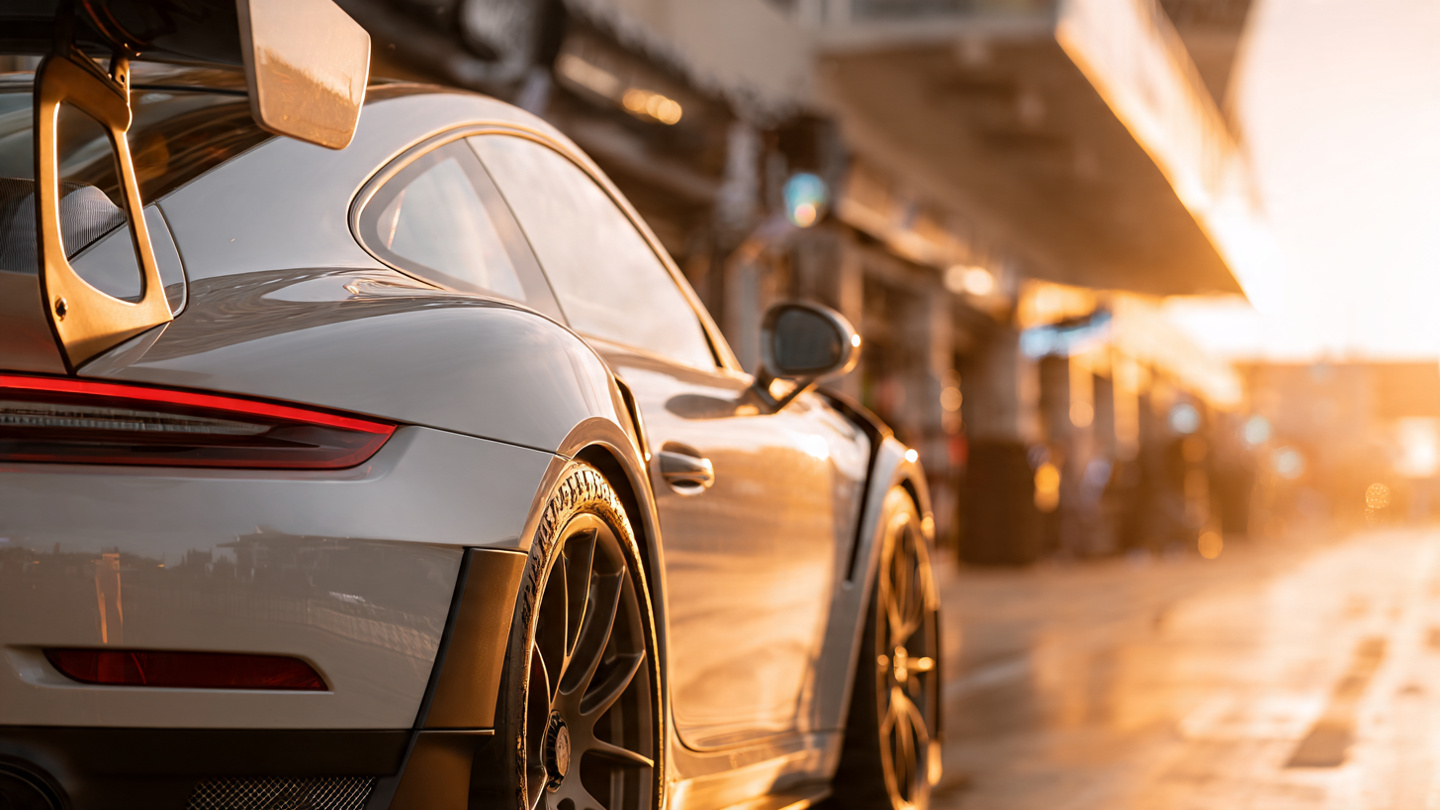
Power matters on a straight. Newton's second law is clear on this point: force equals mass times acceleration, and on a flat stretch of tarmac with no corners to navigate, the car with 1,064 hp will pull away from the car with 700 hp, full stop. But Road Atlanta is not a straight. It is 2.54 miles of twelve turns, significant elevation changes, blind crests, and commitment corners where the driver must trust that the car will do what physics and engineering say it should. On a circuit like this, advantages compound differently. Power advantage is linear and reveals itself primarily in two or three braking zones. Chassis advantage is exponential and reveals itself in every single corner.
What follows is a breakdown of exactly how you beat 1,064 hp without adding any power at all.
Downforce: 43% Front, 115% Rear
At 124 mph, a stock GT2 RS generates approximately 108 lbs of front downforce and 205 lbs at the rear. With the Manthey Kit installed, those numbers become 154 lbs front and 440 lbs rear. That rear increase, from 205 to 440 lbs, represents a 115% gain from parts that bolt onto the existing body without structural modification.
Where does it come from? Start underneath. A full carbon fiber underbody panel replaces the stock belly pan, smoothing airflow beneath the car and reducing turbulent separation that robs the rear diffuser of efficiency. Up front, additional spoiler flaps extend from the existing splitter, increasing the pressure differential across the nose and pulling the front axle into the pavement. At the rear, both the spoiler and diffuser receive revised geometries that work together to extract more energy from the air already flowing over and under the car.
But the most interesting component is the least obvious: rear aerodiscs. These are flat covers that mount over the rear wheel spokes, and their purpose is aerodynamic, not cosmetic. Rotating wheels generate vortices at their leading edges where the tire contacts the ground and at the top where spokes churn through the air. These vortices create a low-pressure, turbulent wake in the wheel arches that disrupts airflow reaching the rear wing and diffuser. By covering the spokes, aerodiscs reduce wheel-arch turbulence enough that Manthey engineers can actually decrease the rear wing angle by 2 degrees while still generating significantly more rear downforce than the higher-angle stock wing.
Read that again: less wing angle, more downforce. Lower angle means less parasitic drag, which means higher straight-line speed for any given power level. Combined with the cleaner underbody airflow feeding the diffuser, the Manthey Kit's aero package produces substantially more downforce at measurably less drag than a stock GT2 RS running its wing at maximum attack. Engineering is not about making things bigger. It is about making airflow cleaner.
Now compare. The 2025 Corvette ZR1's massive rear wing generates up to 1,200 lbs of downforce at speed, nearly three times the Manthey GT2 RS. On paper, that should dominate. But downforce is only useful if the suspension can exploit it, and a wing that generates 1,200 lbs creates enormous variation in rear-axle load between low-speed corners (minimal downforce) and high-speed corners (maximum downforce). Managing that variation is a suspension problem, not an aerodynamic one.
Suspension: 3-Way Front, 4-Way Rear
Factory dampers on production cars are compromised by necessity. Even on a GT2 RS, which is among the most track-focused production cars ever built, the dampers must accommodate road driving, speed bumps, rain, cold tires, and the full spectrum of conditions a customer might encounter between their garage and the paddock. A factory damper setting represents an engineering team's best single answer to a hundred different questions.
Manthey replaces the factory dampers with coilovers: 3-way adjustable on the front axle and 4-way adjustable on the rear. "3-way" and "4-way" refer to the number of independently adjustable damping parameters. A 3-way front damper lets the driver (or engineer) independently set low-speed compression, high-speed compression, and rebound. A 4-way rear adds a second rebound parameter, typically splitting rebound into low-speed and high-speed regimes.
Why does the rear get an extra adjustment? Because the rear of a 911 carries the engine, and in a GT2 RS, the engine is a twin-turbocharged flat-six hanging behind the rear axle. Under braking, weight transfers forward and the rear unloads. Under acceleration, weight transfers rearward and the rear squats. And under cornering, the rear pendulum effect of a rear-engine layout creates complex lateral and longitudinal weight transfer interactions that a front-engine car simply does not experience. A 4-way rear damper gives the engineer separate control over how the rear axle responds to slow body motions (roll, pitch) and fast inputs (kerb strikes, surface irregularities) in both compression and extension, independently.
At Road Atlanta, this matters in specific, measurable ways. Turn 10a is a fast left-hander that leads onto the back straight, and carrying speed through it requires confidence that the rear axle will remain planted over surface undulations mid-corner. A factory damper optimized for road compliance will allow more body movement over those undulations, reducing tire contact patch consistency. A track-tuned 4-way damper can be set soft enough in high-speed compression to absorb the bump without unsettling the chassis, while remaining stiff enough in low-speed compression to resist body roll, and firm enough in high-speed rebound to prevent the wheel from losing contact after the bump, while staying soft enough in low-speed rebound to allow the chassis to settle quickly after corner entry.
Four independent variables on each rear corner. Eight total across the rear axle. Combined with six parameters across the front axle, the Manthey suspension gives an engineer fourteen independently adjustable damping parameters. For a single circuit on a single day with known temperature, surface condition, and tire compound, those fourteen parameters can be dialed to a precision that no factory setting can match.
Unsprung Mass: Magnesium Wheels and Why 25 Pounds Matters
Manthey replaces the stock forged aluminum wheels with magnesium: 20-inch front, 21-inch rear, saving approximately 25 lbs total across all four corners. On a 3,241-lb car, 25 lbs sounds trivial. It is 0.77% of total vehicle mass. But those 25 lbs are unsprung mass, the mass below the springs that the suspension must control, and unsprung mass has a disproportionate effect on dynamic behavior.
Sprung mass is the body, the engine, the driver, everything the springs and dampers support. Unsprung mass is everything they must react against: wheels, tires, brake rotors, hubs, uprights, and the outboard portion of the control arms. When a wheel hits a bump, the suspension must accelerate the unsprung mass upward (or allow it to drop into a depression) and then return it to equilibrium. Lighter unsprung mass changes direction faster, meaning the tire reestablishes contact with the road surface more quickly after a disturbance.
In engineering terms, reducing unsprung mass increases the natural frequency of the unsprung system. Higher natural frequency means faster response to road surface inputs, which translates directly to more consistent tire contact patch area over rough or undulating surfaces. More consistent contact patch means more consistent grip, lap after lap, corner after corner.
Road Atlanta's surface is not billiard-smooth. Repaving campaigns have created sections of varying texture, and the elevation changes at Turns 1 and 12 compress and extend the suspension rapidly. Magnesium wheels let the tires track those surface changes more faithfully than aluminum wheels of equivalent size, and that fidelity accumulates across twelve turns per lap. Half a tenth here, a few hundredths there. Over 2.54 miles, it adds up.
Braking: Braided Lines and Pedal Feel
A brake system converts kinetic energy into thermal energy through friction between pad and rotor. Every production car does this. What separates a good brake system from a great one is not stopping power, which is ultimately limited by tire grip, but controllability: how precisely the driver can modulate braking force at the threshold of lockup.
Stock rubber brake lines expand slightly under hydraulic pressure. At street-level braking pressures, this expansion is negligible. Under track-level braking, with pedal pressures approaching 100 bar and brake fluid temperatures climbing toward 200°C, rubber expansion becomes a compliance in the system that manifests as a slightly soft, slightly delayed pedal response. Braided steel lines eliminate this compliance. Stainless steel braid constrains the outer sheath against expansion, so hydraulic pressure at the caliper tracks pedal pressure more linearly and with less lag.
For a professional driver like Jörg Bergmeister, the former Porsche factory ace who drove the record lap, this linearity translates to later braking points. Not because the car stops faster, but because the driver has higher confidence in exactly when and how the brakes will respond. Confidence lets a driver carry speed 5 meters deeper into a braking zone. At Road Atlanta's Turn 1, approached at well over 150 mph, those 5 meters represent meaningful time.
Thermal Management: The Extra 2.3 Gallons
Turbocharged engines lose power when intake air temperatures rise. A turbocharger compresses ambient air, and compression generates heat. An intercooler cools the compressed air before it enters the combustion chamber, because cooler air is denser air, and denser air contains more oxygen per unit volume, which supports more fuel burn per combustion cycle, which produces more power. On a track, after repeated laps at full throttle, the intercooler's capacity to reject heat diminishes as its core temperature climbs.
Manthey adds a 2.3-gallon auxiliary water tank that feeds a spray system targeting the intercooler. Sprayed water absorbs heat through evaporation, a phase change that extracts far more thermal energy per gram than any air-to-air or liquid-to-air heat exchanger can manage at equivalent flow rates. Formula 1 teams used intercooler water spray systems in the turbo era of the 1980s for the same reason, and the physics have not changed.
Over a timed session at Road Atlanta, where the GT2 RS likely completed multiple warm-up laps before its record attempt, intercooler spray cooling prevents the gradual power loss that would otherwise occur as underhood temperatures saturate the stock cooling system. It is not about peak power. It is about maintaining consistent power output across an entire session, so the engine delivers the same 700 hp on lap eight that it delivered on lap two.
What the Driver Buys
Bergmeister is a relevant variable. A professional driver will extract more from a well-balanced chassis than an amateur will, and the gap between professional and amateur widens as the car becomes more adjustable and more sensitive to driver input. There is an argument that the GT2 RS record reflects Bergmeister's talent as much as the Manthey Kit's engineering, and that argument is partially correct.
But consider what the ZR1 had in its corner. GM's record-setting runs are also conducted by professional drivers, on the same circuit, under comparable conditions. Both cars were on road-legal tires. Both were rear-wheel drive. Both carried ballast in the form of full interiors, air conditioning systems, and DOT-legal exhaust configurations. Professional versus professional, street car versus street car, the Manthey GT2 RS was 0.171 seconds faster with 364 fewer horsepower.
And the GT2 RS was not alone. During the same session, a 2025 911 GT3 RS with the Manthey Kit ran a 1:23.932, setting a new naturally aspirated production-car record. A 992.2 911 GT3 with the Manthey Kit ran a 1:24.639. All three Porsches finished within two seconds of each other, and two of them beat the ZR1. Three cars, three different power levels, one engineering philosophy.
Why Chassis Advantage Compounds
Consider a simplified lap. A car accelerates down a straight, brakes, turns, accelerates out, repeats. On the straight, the faster car is determined almost entirely by power-to-weight ratio and aerodynamic drag. In the braking zone, the advantage goes to the car whose driver can brake later and more consistently. In the corner, the advantage goes to the car that carries more speed through the apex while maintaining tire grip. On corner exit, the advantage goes to the car that puts power down earlier without exceeding the traction limit.
Power helps in one of those four phases. Chassis, aero, and suspension help in three. At Road Atlanta, with twelve turns per lap, that imbalance is decisive. Each of the twelve corners is an independent opportunity for the better-handling car to gain time, while the more powerful car can only respond on the three significant straights: the front stretch, the back stretch, and the short straight between Turns 3 and 5.
Twelve opportunities versus three. The math favors the chassis car at Road Atlanta, and it favors the chassis car at most circuits, which is why racing engineers have always known what this lap record confirms: past a threshold of sufficient power, additional horsepower produces diminishing returns on a road course. The ZR1 has 52% more power than the GT2 RS. That 52% bought it nothing at Road Atlanta except higher straight-line speeds that were immediately surrendered in the next braking zone.
$113,140 of No Additional Power
The Manthey Performance Kit retails for $113,140 before installation. For that price, you receive a carbon fiber underbody, revised aero elements, four magnesium wheels with rear aerodiscs, coilover suspension with fourteen adjustable parameters, braided brake lines, and an auxiliary intercooler spray tank. Installation requires a Manthey Certified Porsche Center, of which 45 exist in the United States.
What you do not receive is a single additional horsepower. No ECU tune. No turbo upgrade. No exhaust modification that might extract 10 or 15 hp from a freer-flowing system. The engine remains a bone-stock twin-turbo 3.8-liter flat-six producing 700 hp and 528 lb-ft, the same numbers it had when the GT2 RS launched in 2017. Porsche and Manthey made a deliberate engineering choice: they decided that 700 hp was enough, and spent $113,140 worth of R&D on everything else.
Manthey-Racing is 51% owned by Porsche AG, spun out from the merger of Olaf Manthey's racing team and Raeder Motorsport. Their kits are Porsche-engineered, Porsche-approved, and maintain the factory warranty. This is not an aftermarket tuner bolting on parts and hoping for the best. It is an extension of Weissach, operating at arm's length to offer what Porsche cannot sell from the factory without compromising the car's road-going certification and compliance obligations.
That distinction matters because it explains why the Kit does not add power. A factory-sanctioned kit that modifies engine output would require re-certification of emissions compliance in every market where the car is sold. Chassis modifications, by contrast, fall outside powertrain certification requirements in most jurisdictions. By leaving the engine completely untouched, Manthey can offer a track-transforming upgrade that any GT2 RS owner can install without warranty anxiety or regulatory complication.
An Old Car Embarrassing a New One
Perhaps the most revealing detail: the GT2 RS launched in 2017. It is approaching its ninth year. In automotive terms, that is ancient. Cars depreciate, technology advances, new models arrive with more power, better tires, revised aerodynamics. A car that was dominant in 2017 should be competitive in 2020, respectable in 2023, and outclassed by 2026.
Instead, the GT2 RS holds the third-fastest Nürburgring Nordschleife time ever set by a production car: 6:43.300, trailing only the Mercedes-AMG One and the Ford Mustang GTD Competition. At Road Atlanta, it just set the outright production-car record. Both achievements were accomplished with the Manthey Kit and without engine modifications.
A well-engineered chassis ages differently than a powerful engine. Horsepower is easy to surpass: any manufacturer can add turbochargers, increase displacement, or bolt on electric motors. The ZR1 proved this by nearly doubling the GT2 RS's output from a production V8. But chassis balance, aerodynamic efficiency, and suspension compliance are harder to replicate because they emerge from the interaction of hundreds of design decisions rather than from a single specification number. You cannot simply add 115% more rear downforce to a car that was not designed for it. You cannot bolt 4-way adjustable dampers onto a chassis whose geometry was not optimized for them. You cannot reduce unsprung mass by swapping to magnesium wheels if the hub and bearing assembly were designed for the loads of heavier aluminum wheels.
The GT2 RS was designed as a complete system. The Manthey Kit amplifies the margins built into that system. Together, they demonstrate that a car designed with sufficient engineering depth does not age the way its specification sheet suggests it should. 700 hp was enough in 2017. It is still enough in 2026. Not because 700 is a large number, but because everything around those 700 hp was engineered well enough that more power was never the limiting factor.
0.171 seconds. 364 fewer horsepower. Zero engine modifications. That is the Manthey Kit's argument, and Road Atlanta is its evidence.
Comparison: GT2 RS Manthey vs. Corvette ZR1 at Road Atlanta
| 911 GT2 RS Manthey | Corvette ZR1 | |
| Lap Time | 1:22.649 | 1:22.82 |
| Engine | Twin-turbo 3.8L flat-six | Twin-turbo 5.5L V8 (LT7) |
| Power | 700 hp / 528 lb-ft | 1,064 hp / 828 lb-ft |
| Transmission | 7-speed PDK | 8-speed DCT |
| Drive | RWD | RWD |
| Model Year | 2019 (launched 2017) | 2025 |
| Front Downforce (124 mph) | ~154 lbs (+43% over stock) | Not disclosed |
| Rear Downforce (124 mph) | ~440 lbs (+115% over stock) | Up to 1,200 lbs |
| Suspension | Coilover, 3-way front / 4-way rear | Magnetic Ride Control 4.0 |
| Wheels | Magnesium 20"/21" | Forged aluminum |
| Brake Lines | Braided steel | Stock rubber |
| Thermal | +2.3 gal intercooler spray | Factory cooling |
| Kit Price | $113,140 (no engine mods) | N/A (factory spec) |
| Driver | Jörg Bergmeister | GM professional driver |
| Tires | Michelin Pilot Sport Cup 2 R | Road-legal (specific compound TBC) |
Sources & Methodology
Lap times and session context from Carscoops, EuropeSays, and BrochuresHub coverage of May 2026 Road Atlanta records. Manthey Kit specifications and pricing from FlatSixes and Stuttcars technical breakdowns. Aerodynamic data (downforce figures at 124 mph, aerodisc function, wing angle reduction) from WhichCar's Manthey-Racing engineering interview. Nürburgring reference time from MotorTrend. ZR1 specifications from GM press materials. Corvette ZR1 rear downforce figure (1,200 lbs) from GM engineering presentations. Unsprung mass and suspension dynamics principles drawn from Milliken and Milliken's Race Car Vehicle Dynamics. Author has not driven either car at Road Atlanta. All lap time claims verified against at least two independent sources.