Chopped and Pressed: Inside the G-Shock Mudmaster's Forged Carbon Bezel
Casio's Mudmaster GWG-2000 uses a bezel manufactured by kneading powdered carbon fiber into resin and heat-pressing it into shape. Lamborghini uses the same compression-molding principle for supercar body panels. One costs under a thousand dollars, and both solve the same materials engineering problem.
Two Kinds of Carbon
Carbon fiber shows up in watches constantly now, and most of it is woven. Continuous filaments, each about 5 to 7 microns in diameter, are bundled into tows of 3,000 or 12,000 strands, then interlaced on a loom into sheets of fabric. Stack several sheets at alternating angles, saturate them with epoxy resin, vacuum-bag the layup, and cure the whole assembly in an autoclave at roughly 180°C and 6 atmospheres of pressure for several hours. What comes out is a rigid laminate with extraordinary tensile strength along the fiber axes. Richard Mille's Carbon TPT stacks 600 layers of woven carbon at precisely 45° offsets. Panerai's CarboTech compresses thin carbon sheets with PEEK polymer at controlled temperatures. Both produce components with the telltale woven checkerboard surface that signals "carbon fiber" to anyone who has walked through a motorsport paddock.
Woven layups are superb when you need strength in known directions. A Formula 1 monocoque, loaded primarily in bending and torsion along predictable axes, exploits this directionality by orienting plies to resist exactly those loads. But directionality is also a constraint, because strength in one direction means relative weakness in another, and the manufacturing process requires hand layup of individual plies, precise orientation, debulking between layers, and long autoclave cycles. Complex three-dimensional geometries with tight radii, undercuts, or varying wall thickness are difficult and expensive. Sometimes impossible.
Forged carbon attacks the problem from the opposite end.
How Forging Works
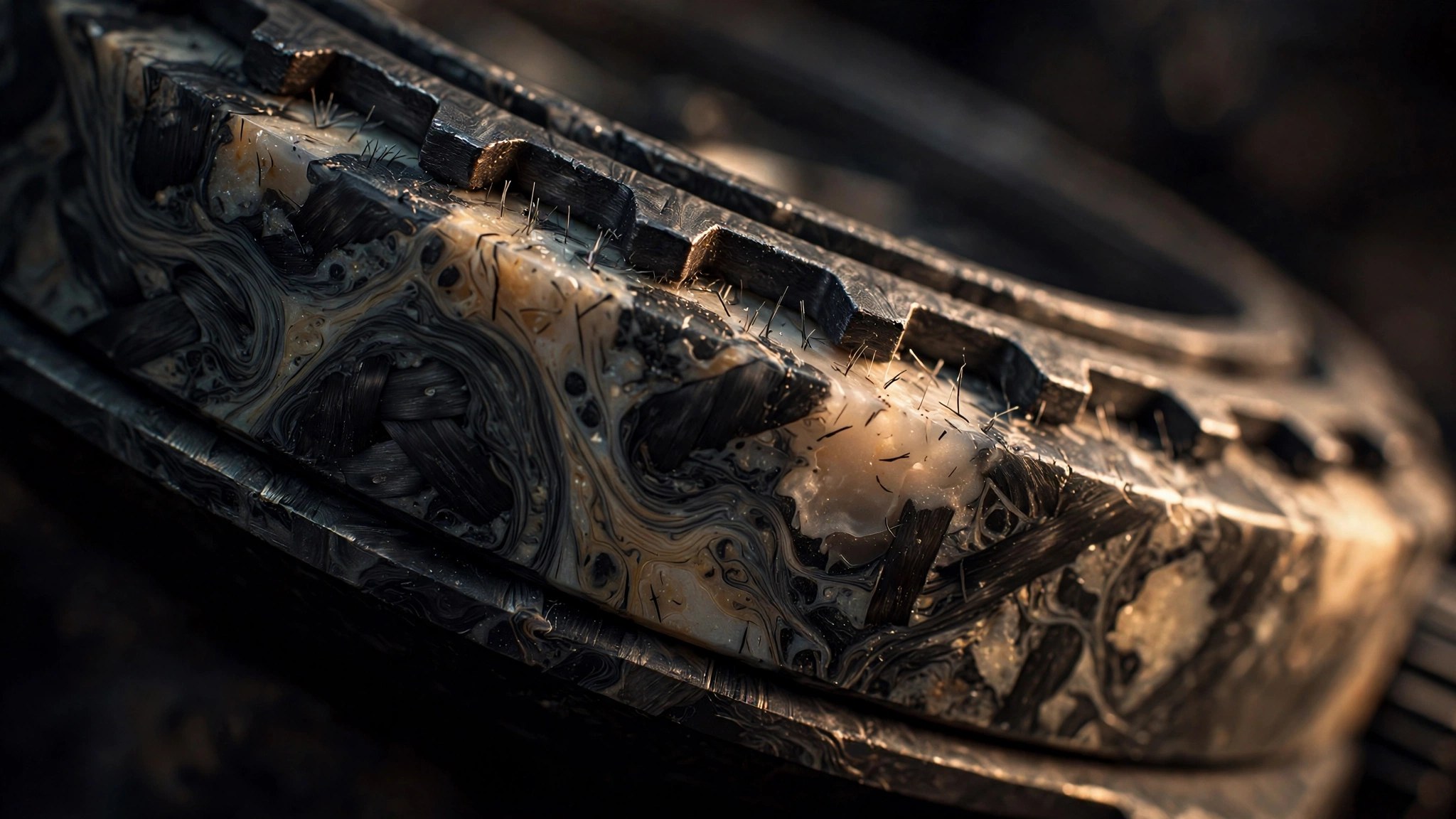
Start with carbon fiber, the same precursor material, and chop it. Cut continuous filaments into short segments, typically 3 to 25 millimeters long. Mix those chopped fibers with a thermoset or thermoplastic resin to create a compound that looks and handles like damp modeling clay. Casio describes their specific process in blunt terms: "Finely powdered carbon fiber is kneaded into resin." No euphemism, no marketing language, just a manufacturing verb: kneaded, like bread dough.
Place that compound into a heated steel mold. Close it. Apply pressure. Published patents for forged carbon manufacturing specify operating temperatures between 160°C and 300°C, with a preferred range of 180 to 200°C, and pressures of 20 to 35 kg/cm². Under these conditions the resin melts, flows around and between the randomly oriented fiber segments, fills every contour of the mold cavity, and begins to cross-link into a rigid thermoset matrix. Hold for 60 to 180 minutes depending on part geometry and resin chemistry. Open the mold and out comes a finished component.
Because the fibers are short and randomly oriented, the resulting composite is quasi-isotropic: roughly equal mechanical properties in all directions, unlike the strongly directional behavior of woven layups. Pull on it north-south or east-west and you get similar resistance. No weak axis. No delamination risk along ply boundaries, because there are no plies. And because the compound flows like a viscous fluid during molding, it can fill complex mold geometries that would defeat a hand-laid woven layup. Tight radii, thin walls, undercuts, and integrated bosses are all achievable in a single pressing operation.
And then there is the visual signature, because random fiber orientation creates a marble-like swirl pattern in the finished surface, with bundles of dark carbon filament flowing through lighter resin channels in patterns that are genuinely unrepeatable from piece to piece. Every forged carbon bezel is unique. Not marketing-unique, where variations are invisible without a loupe. Actually unique, in the way that cut stone or wood grain is unique, with visible differences at arm's length.
Lamborghini Came First
Forged carbon is not Casio's invention. Credit goes to a joint venture between Lamborghini's Advanced Composite Structures Laboratory in Sant'Agata Bolognese and Callaway Golf, through their shared material supplier, Mitsubishi Chemical Carbon Fiber and Composites. Lamborghini trademarked the result as "Forged Composite" and debuted it on the Sesto Elemento concept car at the 2010 Paris Motor Show. A car whose entire monocoque, suspension arms, and body panels were compression-molded from chopped carbon fiber in resin, weighing 999 kilograms without fluids.
Why bother, when Lamborghini already had decades of experience with traditional woven CFRP? Speed and geometry. A woven carbon suspension wishbone requires manual layup around a complex three-dimensional mandrel, individual ply cutting and orientation, vacuum bagging, and autoclave time measured in hours. A forged carbon wishbone goes from raw compound to finished part in a single compression cycle. Lamborghini's published cycle times for Forged Composite components run around two to three minutes of actual pressing time after the compound is placed in the mold, a radical reduction from the multi-hour autoclave cycles of woven layup.
Production Lamborghinis followed: Aventador SVJ suspension components, Huracán STO structural elements, Urus Performante trim. Forged Composite found its niche not as a replacement for woven CFRP in primary structure, where directional strength still matters, but as the superior choice for complex-geometry components that need to be strong, light, and produced in meaningful volume without armies of composite technicians hand-laying fabric.
Watch bezels fit that description exactly.
Carbon Core Guard
Casio did not stop at the bezel. Below the forged carbon bezel sits the Carbon Core Guard, a case architecture that appeared first in the GA-2100 "CasiOak" line and reached its most extreme expression in the Mudmaster GWG-2000. Where traditional G-Shock construction surrounds the module with a resin case and relies on hollow structures and air gaps to absorb impact, the Carbon Core Guard integrates carbon fiber reinforcement directly into the inner case structure. Glass fiber-reinforced resin forms a monocoque-like shell around the module, with the carbon fiber distributed through the resin matrix to increase rigidity per unit wall thickness.
More rigidity per millimeter of wall means thinner walls for equivalent protection. Which means a smaller case. That matters on a watch like the Mudmaster, which already pushes the boundaries of wrist-wearable size at 54.4 × 61.2 millimeters. Without Carbon Core Guard, achieving the same shock resistance would require either thicker walls (and a case too large for most wrists) or softer resin (and inadequate protection for the triple sensor module inside). Carbon fiber reinforcement resolved that tradeoff, allowing Casio to shrink the GWG-2000 noticeably compared to its GWG-1000 predecessor while maintaining identical shock-resistance ratings.
This is the same structural logic that drives carbon-fiber-reinforced polymer monocoques in motorsport. A Formula 1 survival cell is not carbon fiber because carbon fiber sounds impressive. It is carbon fiber because carbon fiber delivers the required crash-load resistance at a wall thickness and weight that aluminum or steel cannot match. Scale that logic down to a wrist-worn instrument case and you get Carbon Core Guard.
Sealing Against Mud
A dive watch fights water. A Mudmaster fights particulate intrusion, which is harder. Water is incompressible and uniform, so a gasket compressed to a known deflection produces a predictable seal. Mud is a suspension of variable-particle-size solids in water, and fine particles can work their way into gaps that would stop water alone. Sand grains can wedge into button shafts and prevent actuation entirely.
Casio's solution on the GWG-2000 is a layered seal system around each button. A stainless steel pipe extends through the case wall, providing a rigid, dimensionally stable channel for the button actuator. Without this pipe, the resin case wall would flex under button pressure, potentially opening micro-gaps at the gasket interface. Steel does not flex. Around each pipe sits a silicone buffer, a compliant gasket that conforms to surface irregularities and maintains seal integrity even when contaminated with fine particles. And the crown uses a screw-lock mechanism, threading into a steel receiver to create a positive mechanical closure rather than relying on spring pressure alone.
None of this is exotic technology: stainless pipes, silicone gaskets, and screw-lock crowns are all off-the-shelf components. What makes it good engineering is that each layer addresses a specific failure mode: the pipe prevents case flex, the silicone prevents particulate ingress, and the screw lock prevents accidental opening. Redundant, purpose-matched, and executed at a price point that makes competing adventure watches look overpriced.
Sensors Small Enough to Fit
Inside the Carbon Core Guard shell sits Casio's Version 3 Triple Sensor, a MEMS package measuring compass heading, barometric pressure (with derived altitude), and temperature. Version 1 of this sensor suite debuted in 2002 and occupied most of the module's real estate. Version 3 sensors are approximately 95 percent smaller and consume roughly 90 percent less power, according to Casio's published specifications. A compass that once required its own dedicated circuit board now fits on a chip smaller than a sesame seed.
Miniaturization is the enabler. Without V3 sensors, there is no room for a triple sensor module inside a Carbon Core Guard case of wearable dimensions. Without Carbon Core Guard, there is no case thin enough to make the Mudmaster comfortable despite its 54mm width. Without forged carbon, there is no bezel strong enough at the wall thickness the Carbon Core Guard geometry demands. Each material choice cascades into the next. Remove any one and the others fail to justify themselves. That interdependence, where no single component makes sense in isolation but the system coheres as a whole, is what separates a designed object from an assembled one.
Forged Carbon Across Watchmaking
Casio is not alone in using forged carbon, but it may be alone in using it honestly. Audemars Piguet introduced the Royal Oak Offshore Forged Carbon (ref. 26400AU) around 2012, placing a compression-molded carbon case on a self-winding chronograph and charging north of $30,000. Gorgeous watch, brilliant use of material. But the price reflects the movement, the finishing, and the AP name, not the carbon manufacturing process itself. Forged carbon is inherently a volume-production material whose entire advantage over woven CFRP is speed and repeatability. Charging luxury prices for a material whose defining virtue is manufacturing efficiency takes some creative accounting.
Panerai's CarboTech follows a different path: thin sheets of carbon fiber compressed under heat with PEEK polymer, producing a layered appearance distinct from forged carbon's marble swirl. PEEK melts at 343°C and offers superior chemical resistance, which matters for a dive watch. Roger Dubuis partnered with Lamborghini directly, using SMC (sheet molding compound) carbon for the Excalibur Aventador S, and completed the circuit between supercar and watch with explicit shared branding.
What none of them did is put forged carbon on a watch that costs less than a set of tires for the cars the material was developed for. Casio did. A GWG-2000 retails for $650 to $800 depending on variant. A set of Michelin Pilot Sport Cup 2 tires for a Huracán runs about $2,400. The material science is the same. The economic positioning is not even in the same conversation.
Specifications
| Parameter | GWG-2000 |
|---|---|
| Module | 5639 |
| Case dimensions | 54.4 × 61.2 × 16.1 mm |
| Weight | ~88 g |
| Bezel material | Forged carbon (powdered carbon fiber / resin composite) |
| Case structure | Carbon Core Guard (glass fiber-reinforced resin) |
| Crystal | Sapphire with anti-reflective coating |
| Water resistance | 200 m (20 ATM) |
| Sensors | V3 Triple Sensor: compass (±1°), altimeter/barometer (-700 to 10,000 m), thermometer (-10 to 60°C) |
| Power | Tough Solar, ~7-month runtime (18 months power-save) |
| Time sync | Multi-Band 6 radio + Bluetooth Smart |
| Mud resistance | Stainless steel pipe buttons with silicone buffers, screw-lock crown |
| Illumination | Double LED (face + digital display), Super Illuminator |
What It Means
Most of the watch industry treats carbon fiber as a luxury signifier, something dark and technical-looking, associated with motorsport and aerospace, and priced accordingly. Casio treats it as what it actually is: an engineering material with specific mechanical properties and manufacturing advantages that happen to solve real problems in their product line. Forged carbon makes complex bezel geometries possible at scale, Carbon Core Guard delivers structural strength in thinner walls, and MEMS sensors squeeze a triple-sensor suite into a space that would have consumed the entire module fifteen years ago. Together they produce a watch that survives conditions that would destroy anything with a movement and a crystal, at a price that makes the technology accessible to the people who actually need it.
Nobody buys a Mudmaster to impress anyone. Nobody wears one with a suit. It is a tool, unapologetically, and the materials science behind it is every bit as rigorous as what sits inside watches costing fifty times more. Sometimes the most sophisticated engineering is the engineering that refuses to be expensive.
Sources
- Casio GWG-2000 product specifications, casio.com (Module 5639, "Finely powdered carbon fiber is kneaded into resin, then heat-pressed")
- TW201518058A, "Method for manufacturing forged carbon fiber product" (operating temperature 160°C-300°C, pressure 20-35 kg/cm²), Google Patents
- Lamborghini Forged Composite technical documentation, Sesto Elemento debut, 2010 Paris Motor Show
- Audemars Piguet Royal Oak Offshore Forged Carbon ref. 26400AU, introduced ~2012
- Panerai CarboTech (PEEK polymer + carbon fiber sheets) technical description, Luminor Submersible 1950 PAM616
- Richard Mille Carbon TPT (600 woven layers at 45° offsets), brand technical documentation
- Casio Triple Sensor V3 MEMS specifications: 95% size reduction, 90% power reduction vs. V1 (2002), casio.com
- "Light As A Feather, Strong As Steel: Carbon Fibre In Watchmaking," The Hour Glass