Shock Detection, Magnetic Pause, and a Topology-Optimized Shell: Inside the G-Shock Gravitymaster GWR-B3000
Casio announced the GWR-B3000 on June 4, 2026, as the new flagship of its aviation-focused Gravitymaster line. Beneath the marketing language about supersonic jets and extreme cockpit conditions sits a genuinely novel collection of engineering decisions: a movement that autonomously responds to physical impacts and magnetic fields, a case structure designed by computational topology optimization, and precision metal components fabricated through injection molding rather than machining. Each of these choices solves a specific, measurable problem.
What TOUGH MVT.2 Actually Does
Every analog watch with physical hands faces the same vulnerability: strong impacts can knock the hands out of alignment with the movement's internal timekeeping. In a standard quartz analog watch, including every previous G-Shock analog, the stepping motor advances the hands one tick at a time. If an impact causes a hand to skip forward or lag behind, the watch displays the wrong time even though the internal oscillator continues counting correctly. Most owners never notice because most impacts are small. Pilots notice because they check their watches constantly and because cockpit vibration is not small.
Casio's original TOUGH MVT., introduced years ago across their solar analog lineup, addressed this with periodic automatic correction. At fixed intervals, the movement checks whether the hands are where they should be and adjusts if they have drifted. TOUGH MVT.2 adds two capabilities that respond in real time rather than waiting for the next scheduled check.
First: auto hand home position correction with shock detection. An accelerometer inside the movement monitors for sudden high-g events. When it detects an impact, the system immediately runs a position check on all three hands (hour, minute, second) and corrects any misalignment. Casio's description of the proprietary algorithm is deliberately vague, but the functional claim is specific: the watch does not wait for the next periodic check cycle. It detects, evaluates, and corrects within the same event window. For a pilot experiencing cockpit vibration during turbulence or high-g maneuvers, this means the displayed time stays accurate through conditions that would knock a conventional analog watch out of sync.
Second: magnetic field detection. A magnetometer inside the movement monitors ambient magnetic field strength. When it senses a field strong enough to affect the stepping motor's operation, the movement pauses hand movement entirely rather than allowing the hands to drift under magnetic influence. Once the field drops below the threshold, the hands resume from where they paused, then advance to the correct current time. Stopping the hands sounds crude, but it is the correct engineering response. A stepping motor driven by electromagnetic pulses will misbehave in a strong external field. Allowing it to continue operating means the hands will advance at the wrong rate, creating a time error that compounds until the field is removed. Pausing and resuming produces zero cumulative error.
Both detection systems operate continuously and autonomously. No button press, no user intervention, no connection to a phone. Solar power keeps the whole system running, with Multi-Band 6 radio time signals and Bluetooth phone sync providing absolute time references when available.
Dual Hollow Structure and Topology Optimization
G-Shock's original shock resistance design, dating to Kikuo Ibe's 1983 prototype, relied on a simple principle: suspend the module inside the case using elastomeric cushioning so the module itself never takes a direct hit. Every G-Shock since has been some variation on this hollow structure concept, where the case absorbs and distributes impact energy before it reaches the movement.
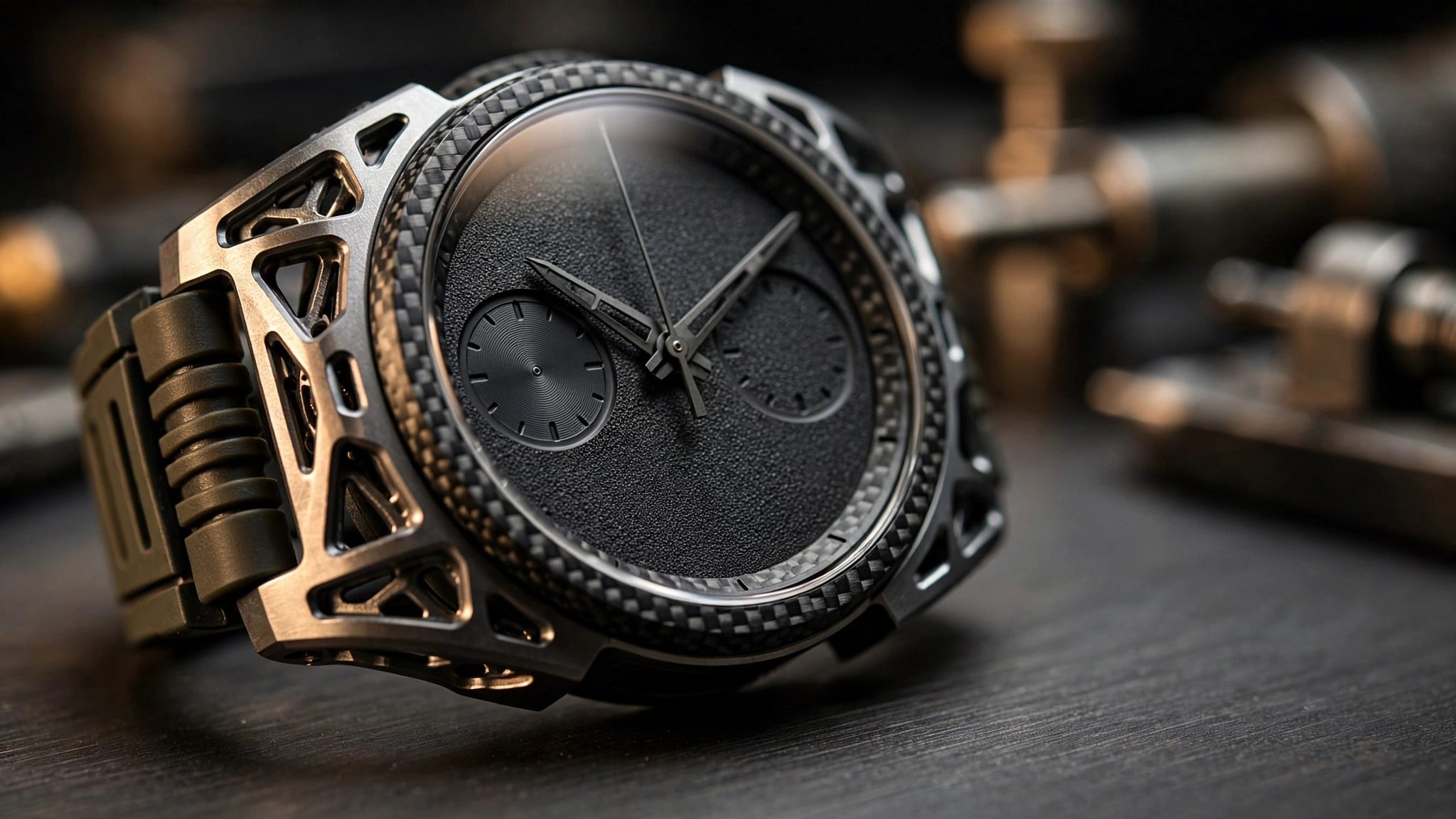
For the GWR-B3000, Casio rebuilt this concept from the ground up with what they call the Dual Hollow Structure. Instead of one layer of protection, there are two: an inner case made from carbon fiber reinforced bio-based resin, and an outer case constructed from multiple stainless steel protectors with resin shock absorbers sandwiched between them. The inner case holds the movement. The outer case takes the hits. Resin buffers between the two decouple them mechanically. On the finished watch, the shock absorbers are deliberately left visible between the metal protectors, making the structural logic readable at a glance.
Here is where the engineering gets interesting. Casio did not design these components by hand-drawing shapes and then testing them. They used topology optimization, a computational method that starts with a defined volume of material and a set of loading conditions, then iteratively removes material from regions where it contributes least to structural performance. What remains is the minimum-mass shape that satisfies all the stress constraints. Casio ran simulations for three distinct loading types: impact (sudden deceleration from drops), centrifugal force (the sustained acceleration experienced in high-g flight maneuvers), and vibration (the continuous cyclical loading of an aircraft cockpit). These are the three threats that define Triple G Resist, and for the first time in Gravitymaster history, the case shape is a direct output of computational analysis against all three simultaneously.
Topology optimization produces organic, often counterintuitive shapes. Structural members end up where stress flows dictate rather than where a designer's aesthetic instincts would place them. In aerospace, this produces the lattice-like bracket structures now common in satellite hardware and rocket engine mounts. In a watch case, it produces complex three-dimensional geometries in the metal protectors that look sculptural but are mathematically derived. Each protector's thickness, curvature, and connection points exist because the simulation said material was needed there, not because someone thought it looked good. That it also looks good is a secondary benefit.
Metal Injection Molding: Why It Matters Here
Topology optimization generates shapes. Someone still has to manufacture them. Traditional watchmaking uses two primary methods for metal case components: CNC machining from solid stock and cold forging followed by finishing. CNC machining can produce nearly any shape but generates enormous waste, sometimes removing 60 to 90 percent of the starting material as chips and swarf. Cold forging is efficient but limited to relatively simple geometries. Neither method handles complex three-dimensional organic shapes economically at production volumes.
Casio chose metal injection molding, or MIM. The process works like this: fine stainless steel powder, typically particles in the 5 to 20 micron range, is mixed with a polymer binder to create a feedstock with the consistency of warm putty. This feedstock is injected into a mold under pressure, just like plastic injection molding, producing a "green part" that holds the desired shape but is roughly 40 percent binder by volume. The binder is then removed through a combination of solvent extraction and thermal decomposition, a step called debinding, leaving behind a fragile "brown part" that is essentially a porous matrix of metal powder. Finally, this part is sintered in a furnace at temperatures approaching 1,350 degrees Celsius, just below the melting point of the steel. During sintering, the metal particles fuse together through solid-state diffusion, the part shrinks by roughly 15 to 20 percent in all dimensions, and the final density reaches 95 to 99 percent of wrought stainless steel.
For the GWR-B3000's outer case protectors, MIM offers three specific advantages. It can reproduce the complex topology-optimized geometries without the per-part machining time that would make CNC prohibitively expensive at volume. Material utilization exceeds 95 percent versus roughly 10 to 40 percent for CNC machining of complex shapes, meaning less waste per watch produced. And the dimensional tolerances, typically plus or minus 0.3 percent, are sufficient for a watch case component that will be finished with surface treatments rather than fitted to sub-micron clearances.
Casio has used MIM before in premium G-Shock models. The MRG-B5000 and MRG-B2100 lines both feature MIM-produced titanium and stainless steel components. But those applications were primarily about achieving fine surface detail and reducing weight. For the GWR-B3000, MIM is the enabling technology that makes the topology-optimized case shapes physically producible. Without MIM, Casio would have had to simplify the protector geometries to accommodate machining constraints, compromising the structural optimization that the simulations produced.
Carbon Core Guard and Bio-Based Resin
Inside the metal outer shell sits the inner case, constructed from carbon fiber reinforced resin using Casio's Carbon Core Guard technology. Carbon Core Guard has appeared across the G-Shock lineup since the GA-2100 "CasiOak" introduced it as a way to reduce weight and increase rigidity in the mid-case. In the GWR-B3000, the inner case serves as the primary structural container for the movement, and Casio has switched the resin matrix from conventional petroleum-derived polymer to a bio-based alternative.
Bio-based resin deserves a reality check. "Bio-based" means some portion of the polymer's feedstock comes from renewable biological sources (typically plant starches or sugars) rather than fossil petroleum. It does not mean biodegradable, and it does not necessarily mean the entire polymer is bio-derived. The mechanical properties, resistance to moisture, UV stability, and long-term durability of the bio-based resin in the GWR-B3000 are, by Casio's own specification, equivalent to conventional resin. If they were not, Casio would not use it in a watch rated to 200 meters of water resistance and designed for cockpit environments. The environmental benefit is real but bounded: reduced petroleum consumption in the resin's production chain, not a watch that returns to nature when you are done with it.
Carbon fiber reinforcement in this context means short chopped fibers distributed through the resin matrix rather than the continuous woven carbon fiber sheets used in aerospace composites or high-end bicycle frames. Chopped fiber reinforcement increases the resin's stiffness and impact resistance isotropically (equally in all directions) rather than creating the directional strength that continuous fibers provide. For an injection-molded watch case that must resist impacts from any angle, isotropic reinforcement is the correct choice.
A Dial Designed Against Light
Cockpit readability drove the dial design, and Casio approached the problem from the physics of light reflection rather than from aesthetics. Standard watch dials, whether sunburst-finished, lacquered, or matte-painted, all reflect ambient light in ways that can wash out hands and indices under certain angles. In an aircraft cockpit, light sources include direct sunlight through the canopy, instrument panel backlighting, and reflections off other surfaces. All of these vary continuously as the aircraft banks, climbs, and descends.
Casio developed a new dial surface using what they describe as microfabricated surface textures. Instead of a uniformly smooth or uniformly rough surface, the dial features precisely controlled microscale geometry that diffuses incoming light rather than reflecting it specularly. Diffused light scatters in all directions rather than bouncing coherently into the pilot's eyes, reducing glare while maintaining the dial's deep black appearance. The effect is similar in principle to the anti-reflective microstructures found on moth eyes (and now replicated synthetically on camera lens coatings), though Casio has not disclosed the specific scale or geometry of their surface treatment.
Combined with large hands and indices, the GWR-B3000's dial functions as what Casio calls an instrument panel on the wrist. Three analog hands display the time, with date and day windows. Two subdials handle dual time zone display (essential for aviation), a 24-hour indicator, and double duty for stopwatch and countdown timer modes. No digital LCD appears anywhere on the face. Everything is analog, and everything is sized to be read in peripheral vision while the pilot's primary attention stays on the flight instruments.
In-Dial Solar: Hiding the Power Source
Analog G-Shock models with Tough Solar power have traditionally faced a design compromise. Solar cells need light exposure to generate current, which means they need surface area on the dial. Visible solar cells typically appear as slightly different-toned regions or subtle grid patterns that interrupt the dial's intended aesthetic. Some models, like the Frogman GWF-A1000, solved this by making the solar cells a deliberate design element. Others simply accepted the visual compromise.
Casio's approach with the GWR-B3000 is different. Solar-receptive material is integrated into the inset subdials rather than the main dial surface. According to Casio, these subdial-integrated cells alone capture sufficient light to power the watch, allowing the main dial surface to be the deep, opaque black that the microfabricated anti-reflective treatment requires. No solar cell compromise on the primary time display. The subdials, which already have a different visual treatment from the main dial, carry the power generation burden without disrupting the contrast-optimized primary face.
Solar-powered operation in this context means the watch runs indefinitely under normal wearing conditions without battery replacement. Casio rates it for approximately five months of operation from a full charge with no additional light exposure, which covers nightstand storage, sleeve coverage, and winter months of limited sun. Multi-Band 6 radio time calibration occurs automatically at night, syncing to atomic clock signals from transmitters in Japan, China, the US, UK, and Germany. Bluetooth connectivity to the Casio Watches smartphone app provides a secondary time sync path and adds features like the flight log, which records GPS-tagged timestamps when the pilot holds the lower-right pusher.
Specifications and Variants
| Specification | GWR-B3000 |
|---|---|
| Case dimensions | 56.7 x 47.3 x 14.1 mm |
| Weight | 102 g |
| Inner case material | Carbon fiber reinforced bio-based resin (Carbon Core Guard) |
| Outer case material | Stainless steel (MIM), resin shock absorbers |
| Bezel | Stainless steel with world time city codes |
| Crystal | Sapphire with anti-reflective coating |
| Water resistance | 200 meters (20 bar) |
| Movement | TOUGH MVT.2 (solar-powered analog) |
| Time calibration | Multi-Band 6 radio + Bluetooth smartphone sync |
| Protection | Triple G Resist (shock, centrifugal force, vibration) |
| Band | Soft urethane, dual-layer, two-tone construction |
| Band size | 145 to 215 mm |
| LED light | Super Illuminator (high-brightness LED) |
| Other functions | World time, UTC direct access, stopwatch, countdown timer, daily alarm, flight log (via app) |
| Made in | Japan |
Three launch variants arrive in July 2026. The GWR-B3000-1A pairs a silver stainless steel bezel with a black dial and black band. The GWR-B3000A-2A adds blue ion plating to the front bezel, a blue dial, and a blue band. The GWR-B3000B-8A uses gray ion plating on the bezel with a gray dial and gray band. Each band features a contrasting underside color. Japanese pricing runs from 110,000 yen (approximately $750 USD) for the base model to 137,500 yen (approximately $870) for the gray IP variant. UK pricing, already listed as "coming soon," ranges from 750 to 870 GBP.
For context within the Gravitymaster lineage: the GWR-B3000 succeeds the GWR-B1000, which launched in 2019 at similar price points and was reportedly discontinued in 2024. There was never a GWR-B2000. Casio skipped a generation number, suggesting the B3000 represents a sufficiently large leap to warrant the jump. Given that the B1000 used neither topology optimization, MIM manufacturing, nor the TOUGH MVT.2 movement, the numbering gap seems justified by the engineering delta.
What This Watch Represents
Most watch companies, when they talk about innovation, mean new dial colors, new materials applied to existing case shapes, or movements that beat a little faster. Casio is doing something structurally different with the GWR-B3000. Topology optimization, computational stress analysis across three simultaneous loading conditions, and MIM manufacturing of the resulting shapes represent a design methodology borrowed wholesale from aerospace and automotive structural engineering. No one in the watch industry outside of Casio is doing this at production scale.
TOUGH MVT.2's dual detection system is similarly novel. Magnetic resistance in watches has traditionally meant shielding: wrapping the movement in a soft iron cage that diverts magnetic flux around it. Rolex's Milgauss uses a ferromagnetic shield. Omega's Master Chronometer specification requires resistance to 15,000 gauss through the use of non-ferromagnetic movement components. Both are passive solutions. Casio's approach is active: detect the field, respond to it by pausing, then resume. Different philosophy, different engineering, and arguably more honest. Instead of pretending the magnetic field is not there, the watch acknowledges it and adapts.
At 102 grams, 14.1 mm thick, and priced under $900, the GWR-B3000 lands in a space that no Swiss manufacturer occupies. Pilot's watches from IWC, Breitling, and Bell & Ross cost multiples of this and offer none of the computational design methodology, active shock correction, or active magnetic response. They offer prestige, heritage, and beautifully finished mechanical movements. Casio offers solutions to specific, quantifiable problems. Different markets, different value propositions, but the engineering in the GWR-B3000 is doing things the Swiss are not attempting at any price.