Banned at Anderstorp, Redeemed in Surrey: The Gordon Murray T.50 and the Fan That Replaced Every Wing
On June 17, 1978, at the Scandinavian Raceway circuit in Anderstorp, Sweden, Niki Lauda drove the Brabham BT46B to victory in the Swedish Grand Prix. The car carried a large fan at its rear, ostensibly for engine cooling. In reality, the fan generated enormous ground-effect suction beneath the flat undertray, pulling the car onto the tarmac with a force that conventional aerodynamics could not match. Lauda won by over half a minute, a dominant performance. Other teams protested immediately, and Gordon Murray, who designed the BT46B, knew the concept was legal under the existing regulations.
Bernie Ecclestone, who owned the Brabham team, knew that fighting the protest would fracture the Formula One Constructors' Association he was trying to hold together. So he withdrew the car voluntarily. One race. One win. Gone.
Murray never forgot what that fan could do. More than four decades passed while the idea sat in his engineering notebook, waiting for a car worthy of it. In 2020, he revealed the T.50, a road car built around the same fundamental principle: a rear-mounted fan that controls the boundary layer beneath the vehicle, generating downforce without the drag penalties of wings and splitters. Except now the fan is a 400-millimeter carbon fiber disc spinning on a 48-volt electric motor, the car weighs 997 kilograms dry, and the engine behind the driver is the highest-revving production V12 in the history of road cars.
Why Diffusers Stall
Every car generates some aerodynamic downforce from its underbody. Air flowing beneath a vehicle accelerates through the narrowing gap between the flat floor and the road surface. As that air reaches the rear diffuser the channel opens up and the expanding volume slows the air, converting kinetic energy to pressure energy, and because faster air under the car creates lower pressure than the air flowing over the body above, the resulting pressure differential pushes the car down toward the road surface, a phenomenon known as the Venturi effect applied at vehicle scale.
At high speed, the system works because air velocity maintains attached flow through the diffuser. But at low and moderate speeds, turbulence accumulates along the underbody surface as the boundary layer thickens. Boundary layer separation occurs when the air closest to the floor loses momentum, detaches from the surface, and creates chaotic vortices that destroy the orderly pressure gradient. Downforce collapses, and recovery is unpredictable.
Conventional solutions attack this problem from the outside. Front splitters create a high-pressure zone ahead of the car to force air beneath it, rear wings generate downforce independently of the underbody to compensate for diffuser inefficiency, and vortex generators and strakes attempt to re-energize the boundary layer, but each of these solutions adds drag, weight, and complexity to the exterior surfaces. A large rear wing on a modern GT3-class race car can generate 500 kilograms of downforce, but at the cost of a substantial drag penalty that reduces top speed by 20 to 30 kilometers per hour.
Murray's argument, consistent since 1978 and unchanged by any development in computational fluid dynamics or active aero regulation in the intervening four decades, was simple. Manage the boundary layer directly. Control the air at the surface where it actually matters rather than bolting increasingly elaborate devices onto the exterior.
The Fan
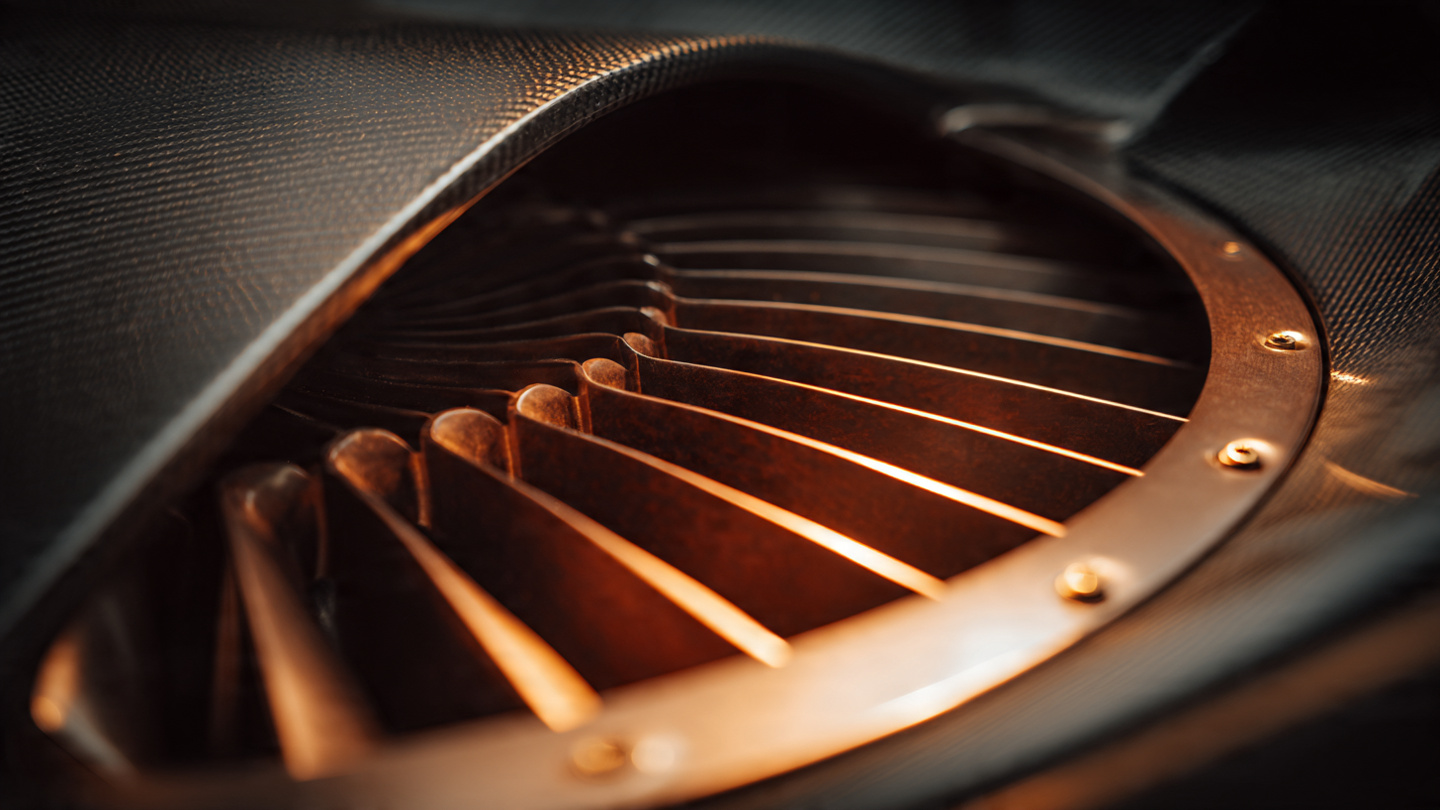
Mounted at the center of the T.50's rear, between the twin exhaust outlets, sits a 400-millimeter carbon fiber fan. An 8.5-kilowatt electric motor on a 48-volt system spins it to 7,000 RPM. At full speed, the fan draws air from beneath the car, through carefully shaped ducts in the rear diffuser, and expels it rearward. The effect is immediate and mechanical: air at the boundary layer gains velocity, reattaches to the underbody surface, and the diffuser operates as designed.
Crucially, the fan does not generate downforce by itself. It enables the underbody to generate downforce that would otherwise be lost to separation and stall. Think of it as an aerodynamic guarantee: at 200 kilometers per hour, a well-designed diffuser works without assistance, but at 80 kilometers per hour, it does not, and Murray's fan bridges that gap by providing consistent ground effect regardless of vehicle speed, ensuring that the driver feels the same planted confidence whether threading through city traffic at modest pace or entering a high-speed corner where any loss of downforce would be immediately and dangerously apparent.
Racing Point's Formula 1 wind tunnel in Silverstone, now operated by Aston Martin, hosted the aerodynamic development program. A 40-percent scale model of the T.50 underwent thousands of runs with the fan operating at various speeds and with the underbody ducts in different configurations. Murray's team at Gordon Murray Design in Windlesham, Surrey, iterated the duct geometry, fan blade pitch, and intake routing until the system delivered predictable downforce across the entire speed range.
Six Modes, One Fan
A rotary controller in the cockpit selects from six aerodynamic modes. Each adjusts the fan speed, the position of two active rear spoiler elements, and the routing of underbody airflow through different duct paths.
In Auto Mode, the default setting, the fan runs at moderate speed to maintain laminar flow through the diffuser during normal driving, with downforce tracking smoothly as vehicle speed increases.
Braking Mode activates automatically when the driver hits the brake pedal hard. Both rear spoiler elements deploy to 45 degrees of attack, acting as air brakes while the fan runs at maximum speed, doubling total downforce. Murray claims this combination cuts stopping distance from 240 kilometers per hour by approximately ten meters compared to a conventional aerodynamic setup. Ten meters is the length of a London bus.
High Downforce Mode opens additional underbody ducts that channel air perpendicular to the vehicle's direction of travel, increasing suction across a wider area of the floor. Total downforce increases by roughly 50 percent over Auto Mode, generating approximately 220 kilograms of downward force at 250 kilometers per hour and rising to 460 kilograms at the car's top speed of 364 kilometers per hour, all without a single wing visible on the exterior.
Streamline Mode does the opposite. Floor vents close. The fan redirects expelled air into the low-pressure wake behind the car, and the turbulent cavity that normally forms behind any moving vehicle shrinks, which GMA describes as a "virtual long tail," referencing the long-tail Le Mans cars of the 1960s and 1970s that extended their bodywork rearward to reduce base drag, achieving the same drag reduction without any physical extension of the body. Invisible aerodynamics, with total drag dropping 12.5 percent.
V-Max Boost combines Streamline's drag reduction with a ram-air induction effect that forces additional air into the engine intake, yielding approximately 50 extra horsepower on top of the engine's standard output and pushing total power toward 690 horsepower for the maximum straight-line speed run where the T.50 reaches 364 kilometers per hour.
Test Mode is a static diagnostic setting for aerodynamic development. It runs the fan at a fixed speed with the car stationary, allowing engineers to check duct pressures and flow rates.
The Engine That Started at the Wrong End
Murray's brief to Cosworth was simple in language and extreme in ambition. Build the greatest naturally aspirated road car engine ever made. Make it light. Make it small. Make it rev to at least 12,000 RPM. Make it sound like the best mechanical thing a human ear has ever processed.
Cosworth responded with the GMA, a 3,994 cubic centimeter V12 with a 65-degree cylinder angle, a bore of 81.5 millimeters and stroke of 63.8 millimeters that makes this an aggressively oversquare design optimized for the high piston speeds demanded by extreme RPM, running a compression ratio of 14:1 that would be dangerously high in a turbocharged engine but is achievable here because the Cosworth runs exclusively on premium fuel with no forced induction pressures threatening detonation.
Peak power is 663 PS at 11,500 RPM. Torque peaks at 467 newton-meters at 9,000 RPM. Redline: 12,100 RPM. Highest of any production road car engine ever manufactured. At peak revolutions the crankshaft turns 201 times per second. Each of the twelve pistons fires 100 times in that same second. The titanium valves open and close faster than a hummingbird beats its wings. Read those numbers again.
Despite the stratospheric redline, a surprising 71 percent of peak torque is available at 2,500 RPM. Murray originally insisted that Cosworth provide two engine maps, one for high-RPM power and another for low-speed torque. After driving the first prototype, he retracted the request and apologized, because Cosworth had delivered both characteristics in a single calibration that somehow made 663 PS feel accessible from 2,500 RPM while still screaming toward a 12,100-RPM ceiling. Murray later admitted the engine exceeded every target he had set.
178 Kilograms
An engine that revs to 12,100 RPM and weighs 178 kilograms requires materials choices that would be considered excessive in most automotive applications. Here they are merely appropriate.
Block and cylinder heads are cast from high-strength aluminum alloy. Dual overhead camshafts operate four valves per cylinder, with variable valve timing on both intake and exhaust. The camshafts drive titanium valves, lighter than steel for equivalent strength; at 12,000 RPM the difference between a titanium intake valve and a steel one is the difference between controlled reciprocation and catastrophic valve float. Every gram in the valvetrain multiplied by 12,100 cycles per minute multiplied by twelve cylinders defines the boundary between an engine that works and one that destroys itself.
Connecting rods are forged titanium, while the pistons use metal matrix composite, an aluminum alloy reinforced with ceramic particles that maintains dimensional stability at the temperatures and pressures where conventional forged aluminum begins to soften. The crankshaft is machined from a single billet of high-strength steel and weighs 13 kilograms, making it the lightest V12 crankshaft ever produced. For reference, a typical V8 crankshaft in an American performance car weighs between 22 and 27 kilograms.
The exhaust system combines inconel, a nickel-chromium superalloy developed for gas turbine applications where temperatures exceed 1,000 degrees Celsius, with titanium structural elements throughout. In the T.50, inconel manifold walls are thinner than in any previous road car application, saving weight while surviving exhaust gas temperatures that would anneal conventional stainless steel. Four catalytic converters with lambda sensors and secondary air injection handle emissions compliance. Even at 12,100 RPM, the T.50 meets Euro 6 standards.
Gold foil lines the engine bay. Murray pioneered this on the McLaren F1 in 1992, exploiting gold's property as the most effective natural reflector of infrared radiation, because the V12 generates enormous heat in a tightly packaged mid-engine compartment surrounded by carbon fiber structures that begin to degrade at sustained temperatures above 180 degrees Celsius. Gold foil reflects infrared energy back toward the engine rather than allowing it to conduct and radiate into the bodywork. Extravagant? Yes. Also the most practical thermal management solution available.
Four Throttle Bodies, Not Twelve
McLaren's F1 used twelve individual throttle bodies on its BMW S70/2 V12, one per cylinder. Each butterfly valve responded independently to throttle input, contributing to the engine's legendary response but also creating complexity in calibration, idle stability, and emissions management. Murray considered twelve throttle bodies essential in 1992; by 2020, Cosworth had convinced him otherwise, demonstrating that modern fuel injection mapping and engine management software could replicate the response with fewer mechanical variables.
Cosworth's GMA V12 uses four throttle bodies feeding a direct path induction system. Cosworth's argument was that modern fuel injection and engine management software could achieve identical response with fewer mechanical variables, and because fewer throttle bodies meant shorter intake runners, a more compact induction package, and measurably less weight sitting above the engine's center of gravity, the engineering case was straightforward. Murray resisted initially, having built an entire philosophy around individual throttle body response. Cosworth built the prototype their way, Murray drove it, and the discussion ended.
Fuel delivery uses a dual injection system: port injectors handle idle and low-load conditions, optimizing atomization when cylinder pressures are modest. Direct injectors take over under high load and RPM, delivering the volume of fuel required when the engine consumes approximately two gallons per minute at full power. That fuel consumption figure means the T.50's tank would empty in roughly nine minutes of sustained maximum output. Nobody drives at full throttle for nine minutes. But the engineering must accommodate the possibility, because the one time someone tries, the fuel system cannot be the component that fails.
Sub-Tonne
Dry weight is 997 kilograms, three below one metric tonne, a number Murray treated as an absolute ceiling throughout the development program. The carbon fiber monocoque, designed and built in-house using Murray's iStream Superlight manufacturing process, provides the structural backbone. Murray developed iStream over two decades as an alternative to the traditional carbon fiber autoclave process used by most supercar manufacturers. Where conventional carbon fiber construction requires laying up pre-impregnated sheets in a mold and curing them in an autoclave under heat and pressure for hours, iStream bonds carbon fiber panels to a tubular steel frame in a process that is faster, more repeatable, and produces less waste.
Suspension components are machined from forged aluminum, and brake calipers are lightweight aluminum units paired with carbon ceramic rotors. The six-speed manual transmission, built by Xtrac with an H-pattern gate, is a transverse unit mounted behind the V12. Murray wanted a manual. Period. No paddle shifters. No automated clutch. No dual-clutch pre-selection. A third pedal, a shift lever, and the assumption that the driver knows what they are doing.
The seating layout places the driver at the center, slightly forward, with two passenger seats flanking and set back. Murray used this configuration on the McLaren F1 because it gives the driver equal sightlines to both sides and positions them on the vehicle's centerline, where weight transfer and lateral forces are perceived most accurately. Every other manufacturer since has acknowledged the layout's superiority and declined to adopt it because it complicates cabin packaging and reduces storage space. Murray does not care about storage space, so he used it again.
Anderstorp to Windlesham
Between the Swedish Grand Prix in 1978 and the T.50's reveal in 2020, the fan car concept appeared exactly once in serious automotive engineering. The McMurtry Spéirling, a small electric prototype, used twin fans to generate extraordinary downforce and set the Goodwood Festival of Speed hill climb record in 2022. But the McMurtry was a single-seat, 1,000-kilogram technology demonstrator. No plates. No passengers. No road-legal ambitions. It validated the physics; the T.50 productionized them for a road car built to last decades.
One hundred T.50 road cars will be built in Surrey, and every single one was spoken for within 48 hours of the car's public reveal. Twenty-five track-only T.50s Niki Lauda variants will follow, each named for the driver who won the fan car's only Formula 1 race. The track version cuts weight to 852 kilograms, raises engine output to 772 PS using a ram-air roof intake and unrestricted exhaust, and generates up to 1,500 kilograms of downforce.
In April 2026, chassis 009 sold at auction in Paso Robles, California, for $8,035,000 including buyer's premium. Twenty-seven miles on the odometer. Practically unworn. Eight million dollars for an analog car with three pedals, a naturally aspirated V12, and a fan. No hybrid assist. No active torque vectoring. No configurable drive modes that soften the steering and raise the suspension for comfort. Just boundary layer control, titanium valves, and a four-decade engineering argument settled in carbon fiber.
Sources
- Wikipedia, "Gordon Murray Automotive T.50," citing Evo, Top Gear, Car and Driver, and GMA official materials.
- Wikipedia, "Cosworth GMA," citing Cosworth case study and Evo production review, 2023.
- Hagerty/HotCars, "The 12,100-RPM V12 That Makes Every Supercar Engine Look Lazy," Alina Moore, March 2026.
- WhatSmyCarWorth, "Gordon Murray Automotive T.50: Specs and $8M Auction Result," covering Broad Arrow Auctions, April 2026.
- Goodwood Road & Racing, "Hear the GMA T.50's screaming V12 at 12,100rpm," dyno test footage and technical specifications.
- Gordon Murray Automotive official specifications, gordonmurrayautomotive.com.
- CarBuzz, interview with Gordon Murray on Cosworth engine development and throttle body configuration.
- AirShaper, "Gordon Murray T50 Aerodynamics," CFD analysis of fan-assisted downforce and drag reduction modes.