Three Bridges and a Sports Watch: Girard-Perregaux's 1867 Architecture, Recast in Rose Gold
Girard-Perregaux's oldest idea is now a permanent-collection Laureato. The bridges hold the movement together, as they always have.
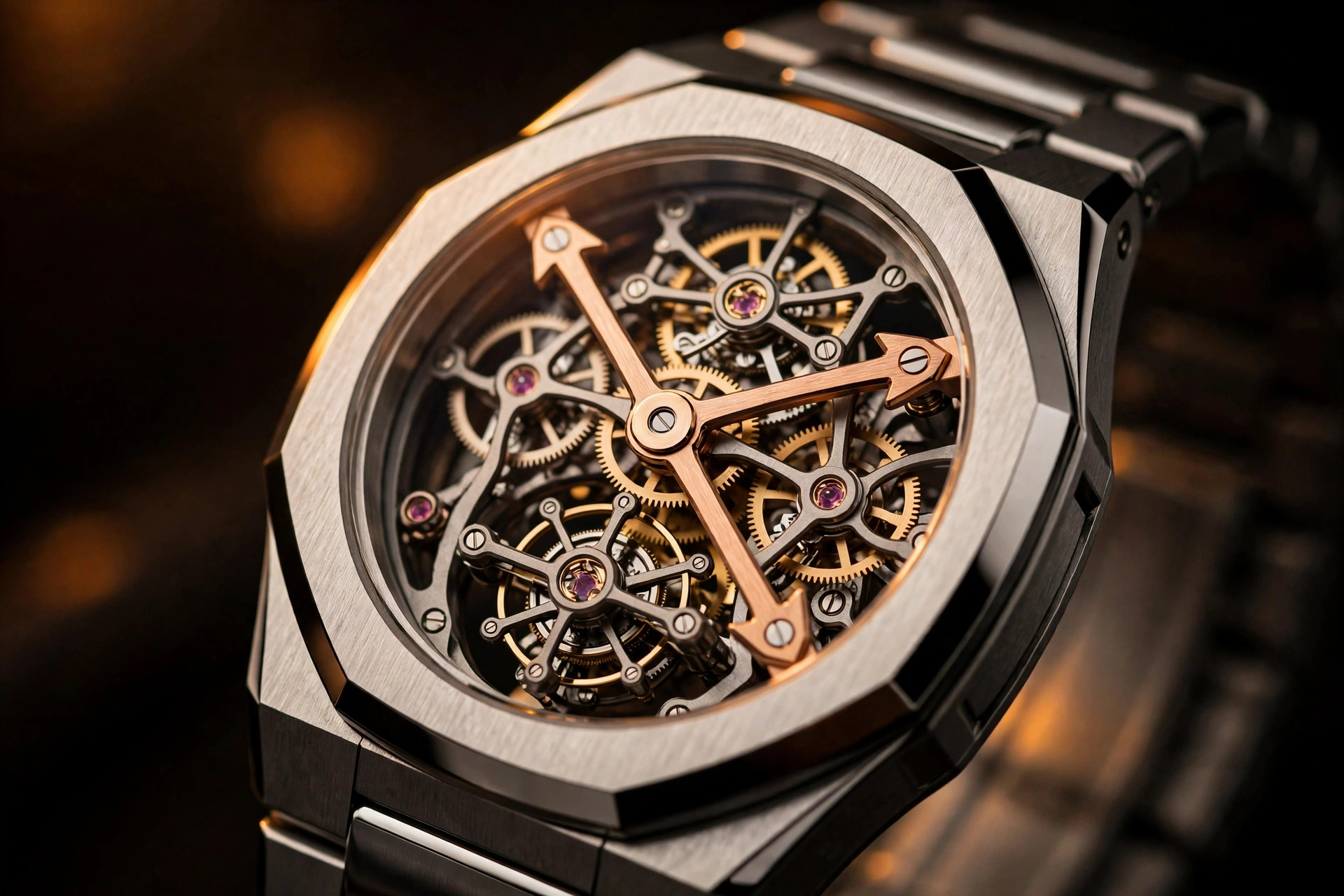
In 1867, Constant Girard drew a tourbillon movement whose barrel, gear train, and tourbillon sat in a straight vertical line, each held by its own parallel bridge. No dial hid the work, which was the point. That same year the watch took first prize at the Neuchatel Observatory competition, and in 1889 its gold-bridged descendant, La Esmeralda, won a gold medal at the Paris Exposition Universelle inside a pink gold case engraved by Fritz Kundert. Girard-Perregaux has been selling that drawing ever since, and the newest version is a steel sports watch with an integrated bracelet, a tourbillon at six o'clock, and a price of $182,000.
Last November, at Dubai Watch Week, the same watch appeared as a 50-piece limited edition with white gold bridges, and it sold through its run. Now the Laureato Fifty Three Gold Bridges returns in the permanent collection, reference 99112-58-3619-1CM, with the bridges, hour markers, and hands recast in rose gold, water resistance raised from 30 to 50 metres, and nothing else changed. A limited edition tests whether anyone wants the idea. A permanent reference says the brand believes the answer.
That distinction matters more than the metal swap. Girard-Perregaux owns two icons: the Three Bridges from 1867 and the Laureato from 1975. For fifty years they lived apart, one a pocket-watch chronometry exercise, the other an integrated-bracelet sports watch. Merging them was the obvious move and the risky one, because a tourbillon is a fragile answer to a problem a wristwatch barely has, and a sports watch is supposed to survive the life its owner actually lives. Putting the two together only works if the engineering is honest about both halves.
A floor plan, not a skeleton
Most skeleton watches start with a conventional movement and cut away whatever the eye does not need. Girard worked the other way, and his 1867 sketch made the bridges the architecture: three parallel, arrow-shaped members spanning the movement, each carrying one part of the going train, with nothing else in front of them. Skeletonization here is not decoration applied after the fact. It is the original construction, with the decoration being the fact that the construction is visible at all.
Calibre GP9620, the movement inside the new Laureato, follows the same floor plan. Barrel and micro-rotor sit at twelve o'clock, gear train and central hands in the middle, one-minute tourbillon at six. Three rose gold Neo Bridges hold the line together, and the openworking is so complete that the view runs straight through the calibre from dial to caseback, where the bridge layout repeats. Girard-Perregaux developed the GP9620 exclusively for this model, in this one size, a 32mm movement for a 41mm case, which is the kind of commitment a shared caliber can never make. Case and movement were conceived together, so nothing is adapted, shimmed, or filled with a spacer ring.
That single-size decision is the quiet engineering statement of the watch. A tourbillon caliber built for one case can be sized so the barrel, the gear train, and the tourbillon sit exactly where the bridges want them, with no room wasted and none left over. Most tourbillon watches hide a compromise somewhere: a movement designed for a 44mm case dropped into a 40mm one, or a module stacked on a base caliber. Here the fit is the point, and the 10.85mm case thickness is the evidence. A tourbillon in a steel sports watch at under 11mm thick, with an automatic winding system inside, is a packaging result, not a styling choice.
Three hundred and three components make up the GP9620, with 33 jewels, beating at 21,600 vibrations per hour. It carries a minimum 55-hour power reserve from a single barrel, driven by a platinum micro-rotor. Those numbers deserve a closer look, because two of them are choices most brands would not make.
The heaviest part is the one you cannot see
Automatic winding in a watch this open presents a problem. A full-size rotor would park a half-moon of metal across the view, hiding exactly the architecture the watch exists to show. Girard-Perregaux's answer is a patented platinum micro-rotor, tucked behind the barrel at twelve o'clock, invisible from the dial side and barely visible from the back. It winds the watch without interrupting the view, and that is the advertised reason for it.
Platinum is the interesting choice, because a micro-rotor is small by definition and a winding rotor works by mass, so the heavier the rotor, the more energy each wrist movement delivers to the barrel. Platinum, at 21.45 grams per cubic centimetre, is denser than gold at 19.32, which means a platinum rotor of the same volume carries about 11 percent more mass than a gold one, and far more than steel at 7.8. In a rotor the size of a coin, that density is the difference between winding adequately and winding well. Girard-Perregaux chose the densest practical metal for a part nobody sees, which is the opposite of how luxury usually spends its materials budget.
There is a cost to hiding the rotor, of course. A micro-rotor winds less efficiently than a full rotor of the same mass, because its smaller radius gives it less leverage on the winding gears, and its position behind the barrel means it works through a longer gear path. Girard-Perregaux answers that with a 55-hour minimum reserve from a single barrel. Whether 55 hours is enough depends on wear patterns no press release can predict. A watch worn daily never notices. A watch rotated through a collection will stop, and its owner will wind it from the crown like a hand-wound watch, which rather defeats the purpose of the rotor.
Three hertz, on purpose
GP9620 beats at 21,600 vibrations per hour, or 3 Hz. Most modern tourbillon calibers run at 4 Hz, and the choice of the slower rate is deliberate. A tourbillon exists to average out positional error by rotating the escapement through every orientation, so the escapement spends no more time in one gravity position than another. That averaging does some of the work a higher beat rate would otherwise do, which makes the marginal gain from 4 Hz smaller in a tourbillon than in a conventional watch. What 3 Hz buys is less wear on the escapement, less energy drawn from the barrel, and a longer power reserve from the same mainspring.
It is a defensible trade, and it is also a confession. A tourbillon on the wrist corrects for gravity in one plane while the wrist moves through many, which is why its practical benefit in a wristwatch has been debated since the first tourbillon wristwatches appeared a century ago. Girard-Perregaux is not claiming the tourbillon makes this watch more accurate than a well-regulated conventional movement. No accuracy figures have been published for the GP9620 at all, and that absence is worth noting. What the tourbillon does here is declare what the watch is for: it is a piece of 1867 chronometry, worn on a steel bracelet, and its accuracy is measured against history rather than a timing machine.
Inside the tourbillon, the cage is lyre-shaped titanium, another Girard-Perregaux signature, and it carries a small hand that marks the running seconds. Titanium matters here for the same reason platinum matters in the rotor: mass. A tourbillon cage rotates once a minute, and every gram in it is a gram the gear train must accelerate and stop, sixty times an hour, all day. Titanium, at 4.5 grams per cubic centimetre against steel's 7.8, cuts the cage's mass by more than 40 percent. Lighter cage, less energy, steadier amplitude. The lyre shape is the 19th-century part and the metal is the 21st-century part, yet both serve the same mechanism.
The finishing bill
Openworking a movement to this degree creates a finishing problem that no machine can solve. Girard-Perregaux counts 418 hand-polished bevels across the GP9620, and 362 inner angles. An inner angle is where two polished bevels meet in a sharp internal corner, and it cannot be produced by machine: no cutter reaches into it, no polishing wheel fits it, so each one is filed and polished by hand, under magnification, one at a time. Three hundred and sixty-two of them, in a movement 32mm across.
That number is the real labour bill behind the price, more than the rose gold or the white gold bezel or the platinum rotor. Gold is bought by weight, while hand finishing is bought by the hour, and inner angles are the slowest hours in watchmaking. A collector who counts value in materials will look at this watch and see a steel case with a gold bezel. A collector who counts value in labour will look at the same watch and see 362 corners that only a human hand could finish, in a movement that will never be made in large numbers because no factory can scale that work.
Whether that labour is worth $182,000 is a question the market will answer, not this article. What can be said is that the finishing is load-bearing in a way most luxury finishing is not. In a conventional movement, the decoration sits on surfaces the owner never sees. Here the bevels and inner angles are the visible structure, so a missed angle would show, and the finishing is the watch rather than something applied to it.
A sports watch that cannot get wet
For all its engineering, the Laureato Fifty Three Gold Bridges has a sports-watch problem. Water resistance is 50 metres, up from 30 on the limited edition, and that is still modest for a watch on an integrated steel bracelet, a form invented for active wear. Fifty metres covers rain, hand washing, and a cautious swim. It does not cover the diving the bracelet's clasp, with its 4mm micro-adjustment for a wetsuit-thick wrist, seems to anticipate. Girard-Perregaux improved the number without explaining how, and the improvement reads as a response to criticism of the limited edition rather than a design goal the watch was built around.
That tension runs through the whole watch, because a tourbillon is a chronometry device from the pocket-watch era while a steel integrated-bracelet sports watch is a product of the 1970s. Each is a superb answer to a different question, and their combination is a statement that the wearer values the mechanism more than the use case. There is nothing wrong with that statement, and plenty of superb watches make it. But a buyer should make it knowingly: this is a tourbillon that happens to be shaped like a sports watch, not a sports watch that happens to contain a tourbillon.
One more honest note is that Monochrome reports the price as unchanged from the 2025 limited edition, while Gear Patrol reports it as up $7,000, from $175,000 to $182,000. Both outlets agree on the franc and euro prices, CHF 162,000 and EUR 178,000, which are identical to the limited edition's, so the disagreement is confined to the dollar figure, most likely a matter of which 2025 dollar price each outlet recorded. Girard-Perregaux's own US page lists $182,000, and that is the number a buyer will pay. Treat the $7,000 increase as unresolved, not as fact.
What this watch is really for
Girard-Perregaux turns 160 years of the Three Bridges design in 2027. Moving the Laureato Fifty Three Gold Bridges into the permanent collection a year early, with no production ceiling and no numbered edition, positions the architecture as the brand's core line rather than an anniversary stunt. The 50-piece limited edition was the test, and this is the commitment.
That commitment has a risk attached, because a permanent collection tourbillon at $182,000 competes with every other haute horlogerie tourbillon a buyer could choose, and most of them come from brands with larger service networks and deeper secondary markets. Girard-Perregaux is betting that the Three Bridges architecture, which no other brand can copy without copying Girard-Perregaux, is a stronger draw than the reassurance of a bigger name. It is a bet on distinctiveness over scale, and it is the same bet Constant Girard made in 1867 when he showed his movement with nothing hiding it.
Two things remain unknown, and both matter. No accuracy or chronometry figures have been published for the GP9620, so the tourbillon's performance is a matter of faith in the brand's regulation rather than evidence. And no production volume or waiting time has been stated, so a permanent collection reference at this price may still be effectively allocated rather than available. Neither unknown is fatal, though both are worth knowing before the money moves.
What endures is the drawing: three bridges, arrow-shaped, holding a barrel, a gear train, and a tourbillon in a straight line, with nothing in front of them. Constant Girard sketched it when watchmaking was still a bench trade, filed it in Washington because Switzerland had no patent office, and won a gold medal for it in Paris. Girard-Perregaux has spent 159 years finding new cases to put it in. This one, steel and rose gold, on an integrated bracelet, is the most contradictory case yet, and the contradiction is the point: the oldest idea in the manufacture, worn like the newest watch in the collection.
| Specification | Detail |
|---|---|
| Reference | 99112-58-3619-1CM |
| Case | 41mm x 10.85mm; stainless steel middle and caseback; 18k white gold octagonal bezel on circular plinth; octagonal crown; sapphire front and back |
| Water resistance | 50m (30m on the 2025 limited edition) |
| Dial | Openworked; sloped flange with applied rose gold markers, Super-LumiNova filled; rose gold pencil hands with lume; three solid rose gold Neo Bridges |
| Movement | Calibre GP9620-2856, in-house automatic; 303 components; 33 jewels; 21,600 vph (3 Hz); 55h minimum power reserve |
| Complication | One-minute tourbillon, lyre-shaped titanium cage, small seconds on cage |
| Winding | Patented platinum micro-rotor behind the barrel |
| Finishing | 418 hand-polished bevels; 362 inner angles |
| Bracelet | Integrated stainless steel; triple-folding clasp with 4mm micro-adjustment |
| Edition | Permanent collection, not limited (2025 edition limited to 50 pieces, white gold bridges, ref 99112-58-3576-1CM) |
| Price | USD 182,000; CHF 162,000; EUR 178,000 |
Limitations: this watch has not been handled for this article, so wearability and legibility claims are drawn from published geometry and photography, not the wrist. No accuracy figures have been published for calibre GP9620. The USD price comparison with the 2025 limited edition differs between outlets, as noted above. Production volume and waiting times for the permanent collection reference have not been stated.
Sources
- Girard-Perregaux product page, Laureato Fifty Three Gold Bridges, ref 99112-58-3619-1CM, price USD 182,000, calibre GP9620 specifications
- Monochrome, "First Look: The new Girard-Perregaux Laureato Fifty Three Gold Bridges," October 28, 2026, specifications and permanent-collection status
- Gear Patrol, "An Iconic Swiss Sports Watch Achieves Its Ultimate Form," October 27, 2026, launch report and USD price comparison with the 2025 edition
- Time on the Move, "GP Laureato Fifty Three Gold Bridges: $182,000, Specs," November 3, 2026, reference confirmation and price-discrepancy analysis
- Monochrome, "The 10 Best Watches Launched at Dubai Watch Week 2025," November 2025, 50-piece limited edition at CHF 162,000
- WatchPro, "Top 10 Watches From Dubai Watch Week 2025," steel edition EUR 178,000, white gold gem-set variant EUR 241,000
- Girard-Perregaux, "The unique history of our manufacture," 1867 Tourbillon with Three Bridges and 1889 La Esmeralda gold medal
- Escapement Magazine, "Girard-Perregaux La Esmeralda Tourbillon 'A Secret' Eternity Edition," 1867 Neuchatel Observatory first prize, US patent 1884, Porfirio Diaz provenance, museum acquisition 1970
- Swiss Watches Magazine, "Manufacture Visit to Girard-Perregaux," 418 hand-polished chamfers including 362 inner angles that cannot be produced by machine
- Time+Tide, "Girard-Perregaux Laureato: The Icons," Three Bridges history and Laureato 1975 origins