Three Stones, Three Generations: The Engineering Inside Frederique Constant's Elements Set
Announced October 1, the 2026 Elements Collection pairs three manufacture movements with mineral dials: onyx on the moonphase date, heliotrope on the tourbillon, turquoise on the perpetual calendar. Eighty-eight box sets, $42,285 for the trio, and a spec sheet that reads as a twenty-year history of one brand's in-house program.
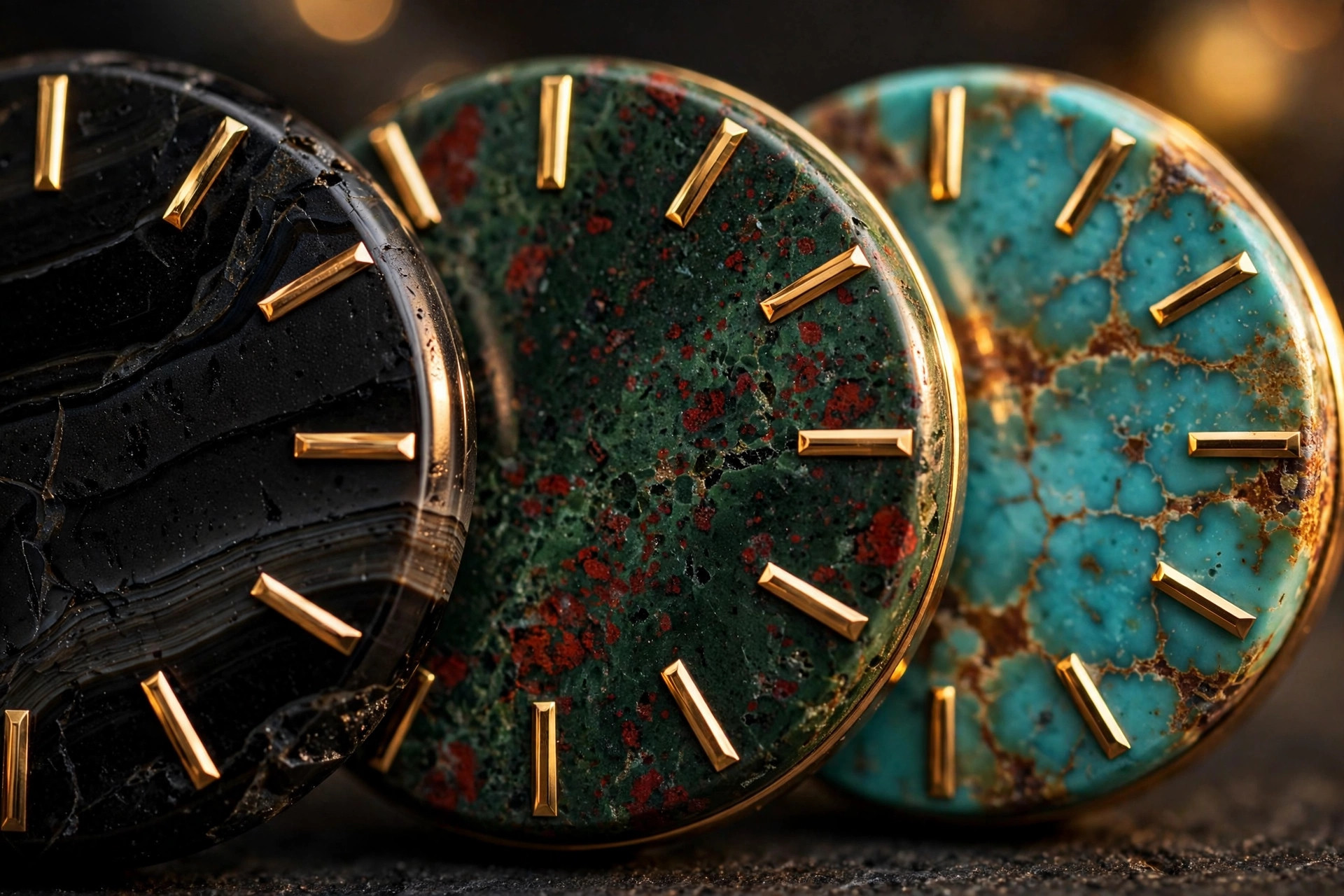
A museum you can strap on
Frederique Constant has made the Elements box set an annual ritual, and the 2026 edition is the most disciplined one yet. Last year the set carried five complications; this year it carries three, each paired with one mineral dial, each in the Classic steel case with an onion crown and a sapphire back, each individually numbered out of 88 to mark the year the company was founded.
What makes the set interesting is not the stones. It is the calendar. Inside are three generations of in-house watchmaking: the FC-980 tourbillon architecture from 2008, the FC-776 perpetual calendar platform from 2016 revisited in 2025, and the FC-716 moonphase date overhauled in 2024. That is three generations of in-house watchmaking in a single box, and you can read the generations on the spec sheet: the tourbillon runs 38 hours on a wind, the other two run 72. Two decades of reserve progress, side by side on your wrist, expressed in nothing but numbers.
This is the right way to read Frederique Constant. Since 1988 the brand's entire argument has been accessible manufacture, more than thirty in-house calibers built on the premise that a tourbillon or a perpetual calendar should not require a second mortgage. Its 2016 perpetual calendar arrived as the most affordable on the market. So did the 2008 tourbillon. This set is that democratization thesis, dressed in evening clothes.
Stone is a materials problem, not a decor problem
Stone dials look like decoration. They are a fabrication nightmare.
Four sheets of paper. That is the thickness of a watch dial, roughly 0.4 millimeters, and stone at that thickness is a brittle film waiting for an excuse to crack. You cannot solder dial feet onto mineral the way you solder them onto brass, so the feet get bonded with adhesive instead, and the stone slice gets laminated to a carrier plate that carries the mechanical load. Every aperture has to be drilled or milled through a material that fractures instead of cutting. Moonphase disk, date ring, tourbillon opening at six: each one is a hole in glass-like stone with zero tolerance for chipping.
Then there is the matter of the three stones chosen, because they could not be more different to work with. Onyx is black chalcedony. Hard, fine-grained, 6.5 to 7 on the Mohs scale, it takes a polish well enough to read as a night sky behind the silver stars of the moonphase disk. Heliotrope is bloodstone. Green chalcedony flecked with red iron oxide, equally hard, its inclusions running through the stone in unpredictable patches no cutter can plan around. No two heliotrope dials can match, which the brand states as a feature and the fabricator experiences as a yield problem.
Turquoise is the troublemaker: at 5 to 6 on the Mohs scale it is soft, porous, and prone to discoloration, which is why most commercial turquoise is stabilized with resin before anyone cuts it. A porous stone also moves with humidity and temperature differently than the brass movement plate underneath it, so the adhesive joint has to absorb differential expansion across a wrist-worn range without letting the dial creep. Cutting turquoise to dial thickness without it crumbling at the edges is genuinely skilled work. When collectors talk about stone dials as a trend, this is the part of the trend that deserves respect: somebody solved fracture mechanics at four-tenths of a millimeter, three times over, eighty-eight times each.
The 2008 tourbillon still carries the box
Inside the heliotrope case sits the FC-980-4, the descendant of Frederique Constant's first in-house tourbillon from 2008, a milestone for two reasons: one, it put a manufacture tourbillon at a price the industry had not seen, and two, it used a silicon escapement, wheel and anchor both, years before silicon became the industry default.
Silicon matters here for the same reason it matters everywhere in modern horology: it is anti-magnetic, which in a tourbillon cage spinning at one revolution per minute is not a minor virtue, and it needs no lubrication, which removes the single most failure-prone variable in a long-term rate. Add deep reactive ion etching, which holds tolerances a traditional milling machine cannot reach, and you get the full picture. FC bet early that photolithography belonged inside a watch, and eighteen years later the same architecture is still in the catalog, hand-adjusted, individually numbered on the upper bridge, running at 28,800 vibrations per hour.
Against the 72-hour reserves of its box-mates, the tourbillon's 38 hours looks thin. Read it as honesty instead. By now the FC-980 is an older architecture, and the brand chose not to disguise that by pairing it with two newer movements. It documents the program as it actually is: brilliant at democratizing complications, still working through its generations.
The quietest movement in the box
Do not overlook the onyx moonphase. Newest of the three calibers is the FC-716 inside it, the product of a full 2024 overhaul of the brand's moonphase date, and it tells you where the manufacture's energy actually goes. A 72-hour reserve at 28,800 vph in a 40 by 11.98 millimeter steel case, a combined moonphase and date subdial at six against a star-dusted black disk, applied dagger indices diamond-cut and hand-polished across all three models.
Moonphase date was the brand's second in-house caliber, launched in 2005. Twenty-one years later it is still in the lineup, still being revised, still the volume piece that funds the exotic stuff. That is how manufacture programs survive: one workhorse complication pays for the tourbillon program's experiments. Onyx does the marketing; the FC-716 does the business.
And the perpetual calendar, the FC-776, sits between them in every sense. Month and leap year at noon, date at three, day at nine, moonphase at six, all on a turquoise dial that FC wisely left free of the peripheral railway track the 2025 edition carried. Seven indications on a stone that crumbles if you look at it wrong. Three-day reserve came with the 2025 revisit. The trickiest dial in the box comes with the 2026 edition.
What I would still want to know
I have not handled these watches, and the press materials leave the fabrication questions I care about unanswered. What adhesive system bonds the stone to its carrier, and how does it age over decades of thermal cycling. Whether the turquoise is stabilized and with what. What the dial blank thickness actually measures on each of the three stones, because heliotrope and turquoise will not cut the same way and I would bet the blanks are not identical. Whether the feet are bonded or whether FC uses a clamping carrier system, which some makers prefer for stone exactly because adhesives are forever until they are not.
None of that diminishes the set. If anything it sharpens the achievement: three brittle minerals, three manufacture calibers, eighty-eight sets, and a price for the trio that undercuts a single comparable Swiss tourbillon. Strip it down and the Elements Collection is Frederique Constant doing the one thing it has always done, putting real manufacture watchmaking in front of people who are not billionaires, and this time the dials happen to be older than the company by several hundred million years.
| Model | Dial | Caliber | Reserve | Case | CHF |
|---|---|---|---|---|---|
| Classic Moonphase Date Manufacture | Black onyx | FC-716 automatic (new, 2024 overhaul) | 72 h | 40 mm steel | 4,895 |
| Classic Tourbillon Manufacture | Heliotrope (bloodstone) | FC-980-4 automatic, silicon escapement | 38 h | 39 mm steel | 15,995 |
| Classic Perpetual Calendar Manufacture | Turquoise | FC-776 automatic (2025 revisit) | 72 h | 40 mm steel | 10,995 |
Sources: Monochrome, 2026 Elements Collection introduction (October 2026); Buying Time, Issue #263 (October 7, 2026); Frederique Constant, Elements Collection 2026 official page.