A Case That Moves: Formex's Full-Ceramic Dark Matter Redshift
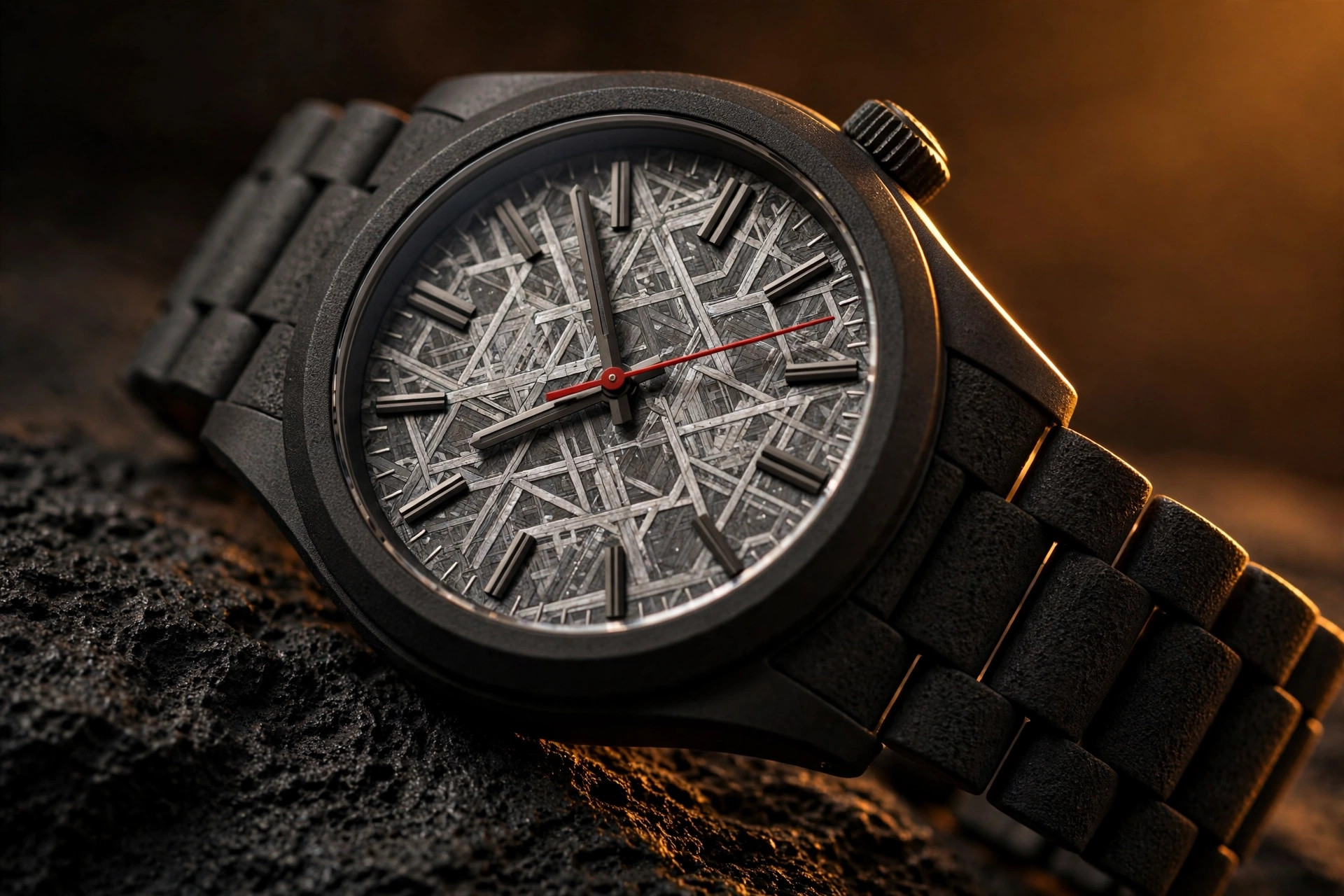
Windup Watch Fair NYC, October 16, 2026, gave the watch world a study in restraint. Formex showed a watch that is almost entirely black, matte enough to swallow light, with exactly one color allowed to speak: red, on the seconds hand, the logos, and the minute track. Everything else on the Essence Ceramica Dark Matter Redshift is black ceramic, black-gold meteorite, or gunmetal, and the discipline of that palette is the point. When a watch refuses every easy flourish, whatever engineering remains has to carry the whole argument, and here the engineering is genuinely worth carrying.
Start with the obvious superlative, because it is also the most misunderstood one. Zirconium-oxide ceramic rates around 1,200 on the Vickers hardness scale, roughly seven times harder than typical watchmaking steel, which means the Redshift's case, bracelet, and clasp will shrug off the scratches that scar a steel watch in a month of desk diving. Hardness, though, is only half of a material's character, and ceramic's other half is less flattering: it is brittle, far less able than steel to absorb a sharp impact by deforming, which is why a ceramic case that hits a doorframe can chip where steel would merely dent. Most ceramic watch marketing stops at hardness and hopes nobody asks about the rest. Formex built a suspension system instead.
A movement on springs, inside a shell that cannot bend
Every Formex watch since the patent in 2000 carries the company's Case Suspension System, and the Ceramica re-engineers it for a case material that makes the idea more necessary, not less. Inside the black ceramic outer case sits a grade 2 titanium container holding the movement, suspended on springs so the whole inner assembly can shift slightly with wrist movement and absorb shocks before they reach the caliber. Four internal springs decouple the container from the outer chassis, according to the brand's technical descriptions, which turns a rigid shell into a two-stage structure: a hard outside that resists scratches, and a sprung inside that forgives impacts.
Motorsport is where the idea came from, per Gear Patrol's launch coverage, and the lineage shows in the priorities. A race car's suspension does not exist to make the car comfortable. It exists to keep the tires in contact with an uneven surface while the chassis does something else, and Formex's system does the same job at wrist scale, keeping the movement isolated while the case takes the abuse. Side benefits follow from the same mechanism, and they are the ones an owner actually feels daily: because the inner case can travel, the watch conforms to the wrist as it flexes instead of pressing a crown into the back of the hand, a small ergonomic win that matters more over twelve hours than any specification sheet admits.
Credit where the design earns it, and skepticism where it has not yet been tested. Formex publishes no shock-test rating for the suspension system, no G figure, no drop-test protocol, so the protective benefit remains a mechanism description rather than a measured result, and this article will not invent a number to fill the gap. What can be said is structural: a sprung titanium container inside a ceramic shell is strictly more forgiving than a movement bolted rigidly into the same shell, because something in the chain is allowed to move, and in impact engineering, movement is what turns a crack into a shrug. Suspension, at any scale, is the art of giving force somewhere to go.
A dial cut from a rock older than Earth, then finished thinner than a fingerprint
Dial material is where most brands cheat, and Formex's method deserves a close read because it avoids the usual cheat entirely. Many meteorite dials are thin slices glued onto a brass backing plate, which is cheap, stable, and slightly dishonest about what you are looking at. Formex uses a solid slice of Muonionalusta meteorite, thick enough that the dial feet can be soldered directly to its back, with no brass plate underneath, and machines the date aperture's bevel directly into the meteorite itself, so the white numeral at 6 o'clock sits inside a sloping frame of actual space rock rather than a stamped hole in a laminate.
Etching brings out the Widmanstätten pattern, the intersecting crystalline bands that form only when iron-nickel alloy cools over millions of years in space, and then a black-gold galvanic plating less than one micron thick darkens the surface while letting that structure show through. One micron is thinner than a fingerprint ridge, which means the coating tints rather than buries, and each slice carries a different natural pattern, so no two Redshift dials will ever match. Against that darkness, gunmetal applied indices and hands filled with BGW9 Super-LumiNova keep the watch legible, and the red seconds hand does the job red has always done on instruments: it marks the one thing moving right now.
Think about what the solid-slice choice costs the manufacturer, because cost is where sincerity shows. A glued slice tolerates thin, flawed stock and hides behind brass. A solid slice has to survive soldering, machining, and plating as a structural part, and any slice that cracks in production is scrap, not salvage. Meteorite is a finite, inconsistently patterned raw material, which may be one reason production is capped at 100 pieces a year, though Formex has not said so, and readers should treat that connection as inference, not fact. What is certain is that a dial made this way cannot be faked with a printed pattern, and in a market full of printed patterns, that matters.
Trading a boutique caliber for a longer reserve
Inside the titanium container, the Redshift makes a quieter change that says a lot about Formex's priorities. Earlier Dark Matter watches used the Soprod Newton P092, a caliber Formex co-developed, with a full transverse balance bridge and a 44-hour power reserve. Redshift switches to the recently unveiled Sellita SW200-2 Power+, an evolution of the ubiquitous SW200 with a revised gear train, winding system, and regulating mechanism, lifting reserve to 65 hours, and every unit is COSC-certified, meaning each movement survived 15 days of testing across five positions and three temperatures with an average daily rate between minus 4 and plus 6 seconds.
On paper, swapping a co-developed caliber for a revised workhorse looks like a step down in romance and a step up in sense, and the numbers support the sensible reading. Sixty-five hours covers a full weekend off the wrist, where 44 hours does not quite, and a COSC certificate on every unit is a promise a buyer can verify rather than a story a buyer must trust. Sellita's ubiquity also means any competent watchmaker can service the movement decades from now, a practical advantage the boutique caliber could never match. Purists may mourn the Soprod's transverse bridge. Owners who wear the watch daily will take the extra 21 hours and the serviceability, and they will be right to.
One more mechanical detail earns its paragraph, because it is the kind of thing that only matters after you own the watch. A screw-down crown in a ceramic case demands extremely tight tolerances, since ceramic cannot be threaded and re-threaded the way metal can, and Formex pairs it with a ceramic caseback carrying a sapphire window, holding water resistance at 100 meters despite a multi-part suspension case. One hundred meters is not a dive rating, and nobody should pretend otherwise, but for a watch whose case is built from a material that cannot flex, holding that rating through a sprung, multi-part assembly is a manufacturing achievement in its own right. Seals and springs and ceramics all have to agree, and agreement across materials is the hard part.
The bracelet is the flex nobody else has matched
Here is where the Redshift quietly embarrasses watches costing several times its price. Case, bracelet, and clasp are all solid ceramic, sandblasted matte with diamond-polished bevels, and the clasp carries a patented micro-adjustment mechanism offering 5 millimeters of total adjustment in four 1.25-millimeter steps, operable on the wrist with the clasp closed and no tools. Gear Patrol notes it was the industry's first ceramic clasp with tool-free micro-adjustment when the Ceramica platform launched, and it remains the feature most rivals have not matched, because machining a reliable micro-adjustment mechanism from a brittle material is exactly the kind of problem that punishes shortcuts.
Weight completes the picture, and the numbers reward the material choice. Hourstriker reports the case alone at 56 grams, rising to 137 grams on the full ceramic bracelet, which is light for a 41-millimeter sports watch and lighter than most steel equivalents, while the quick-release system lets the bracelet swap for rubber, nylon, or leather straps in seconds. Ceramic's thermal behavior helps too: it transmits temperature changes more slowly than metal, so the watch feels less cold on a winter wrist and less hot in summer sun, and its color is UV-stable over time, meaning the black stays black. None of these are headline features. All of them are the difference between a watch you admire and a watch you actually wear.
Price puts the whole package in perspective. At $4,450 on the ceramic bracelet (CHF 3,500, EUR 4,190), the Redshift combines a full ceramic case, bracelet, and clasp with a meteorite dial, a COSC-certified movement, and a suspension system, a combination that is unusual at this price, and it does so in a 100-piece annual production run with the inaugural series individually numbered 001 to 100. Limited production at this price is unusual: most brands reserve small runs for high prices, or low prices for mass production, and Formex chose neither default. First shipments are expected at the end of November 2026, which means early buyers are ordering a watch nobody has independently reviewed yet, a fact that belongs in any honest account.
What is not settled yet
Three open questions deserve space, because the launch coverage mostly skips them. First is the suspension system's measured performance, already noted: without a published shock rating, buyers are trusting a mechanism description, and the first independent test that drops the watch onto something hard will be more informative than every press release combined. Second is long-term wear on the ceramic clasp and the bracelet's pin-and-tube links, a mechanism with moving ceramic parts that has no decades-long track record the way a steel clasp does, and early owners are effectively the durability test. Third is the meteorite supply question: if each dial needs a solid, machinable slice, and each slice is unique, then scaling beyond 100 pieces a year may be a materials constraint rather than a marketing choice, and Formex has not clarified which.
One smaller discrepancy belongs in the record, because scholarly habits start with small discrepancies. Monochrome's specification table lists lug-to-lug length at 46.2 millimeters, while one other outlet lists 46.5 millimeters, a 0.3-millimeter gap that changes nothing about how the watch wears but says something about how launch data propagates. This article uses 46.2 millimeters from the specification table and flags the alternative, the same way it flags the movement change and the missing shock rating, because a publication that rounds away its uncertainties will eventually round away something that matters. Forty-one millimeters across, 11.2 millimeters thick, 100 meters of water resistance, and 65 hours of reserve are the numbers that count, and all four are corroborated across multiple outlets.
| Specification | Formex Essence Ceramica Dark Matter Redshift |
|---|---|
| Launch | October 16, 2026, Windup Watch Fair NYC; part of Windup 2026 novelties |
| Reference | 0336.4.6208.411 (per retailer listings) |
| Case | 41mm diameter, 11.2mm thick, 46.2mm lug-to-lug (one outlet lists 46.5mm), 22mm lug width; black zirconium-oxide ceramic, sandblasted with diamond-polished bevels and a new lower-bezel facet |
| Weight | 56g case alone, 137g on ceramic bracelet (per Hourstriker) |
| Suspension | Patented Case Suspension System (patent 2000, motorsport-derived); grade 2 titanium movement container on springs; screw-down ceramic crown; sapphire crystals front and back |
| Water resistance | 100 meters |
| Dial | Solid Muonionalusta meteorite slice, dial feet soldered directly, no brass plate; black-gold galvanic plating under 1 micron; etched Widmanstätten pattern; beveled date aperture machined into the meteorite; gunmetal indices and hands with BGW9 Super-LumiNova; red seconds hand, logos, and minute track |
| Movement | Sellita SW200-2 Power+, automatic, 26 jewels, 28,800 vibrations per hour, 65-hour power reserve, hacking seconds, date; COSC-certified (minus 4 to plus 6 seconds per day); replaces Soprod Newton P092 (44 hours) used in the earlier Dark Matter |
| Bracelet and clasp | Solid-link zirconium-oxide ceramic bracelet, sandblasted with polished bevels; patented ceramic clasp with 5mm micro-adjustment in four 1.25mm steps, on the fly, tool-free; quick-release; optional rubber, nylon, and leather straps |
| Production and price | 100 pieces per year; inaugural series numbered 001 to 100; CHF 3,500 / USD 4,450 / EUR 4,190 on ceramic bracelet; first shipments end of November 2026 |
| Predecessors | Essence Ceramica launched March 2025 (full ceramic case, bracelet, clasp); Dark Matter meteorite dial added end of 2025 |
| Unresolved | No published shock-test rating for the suspension system; long-term ceramic clasp wear unproven; meteorite supply constraint unconfirmed; no independent review yet |
Honesty block: This article is based on coverage from Monochrome Watches (October 16, 2026), Gear Patrol (October 19, 2026), Time+Tide Watches, Hourstriker, Timekeepers Club, and Watchespedia, plus Formex's published specifications as reported by those outlets. I have not handled this watch, and no independent review exists yet. The suspension system's shock protection is a mechanism description, not a measured rating; the meteorite-supply reading of the 100-piece cap is inference, flagged as such in the text. Lug-to-lug length is 46.2mm in the manufacturer's specification table and 46.5mm in one other outlet. Price and availability are as announced at launch, with first shipments expected at the end of November 2026.
Ceramic watches usually ask to be admired for being hard. Formex asked a harder question instead: what breaks when something hard gets hit, and what would it take to give that force somewhere to go? A sprung titanium heart inside a black ceramic shell, a dial cut from a rock that fell from space, and a clasp machined from the same brittle material it adjusts: the Redshift answers with engineering, not adjectives, and at $4,450 it leaves the big houses with very little excuse left.