Killing the Line: Ford's Assembly Tree and the Two-Casting Truck
In August 2026, Ford named the first truck off its Universal EV Platform, the Fathom, and the engineering is the story: An assembly tree replaces the moving line Ford invented in 1913, two 9,000-ton aluminum unicastings form the front and rear structures, the wiring harness is 1.3 kilometers shorter than the Mach-E's, and the battery pack doubles as the floor.
In 1913, Ford's Highland Park plant set a chassis on a moving line and cut assembly time from 12 hours to about 90 minutes. It became the century's defining manufacturing idea, and Ford owned it. Now Ford is killing it.
On August 11, 2025, Jim Farley stood in the Louisville Assembly Plant and announced the Universal EV Platform, calling it a "Model T moment." The platform's production system replaces the single linear conveyor with what Ford calls an assembly tree. Three sub-assemblies, the front structure, the rear structure, and the structural battery pack with seats, console, and carpeting already installed, travel down three separate lines in parallel and join together only near the end. First vehicle off the tree: the midsize electric pickup named Fathom, with production slated for Louisville in 2027.
Ford's claimed deltas read like a teardown engineer's wish list. Twenty percent fewer parts than a typical Ford vehicle, twenty-five percent fewer fasteners, forty percent fewer workstations dock-to-dock. Assembly 40 percent faster in gross terms, with some of that time reinvested into insourcing and automation for a net 15 percent gain. Every one of those numbers is Ford's, and none of them are proven, because Louisville will not build a single production vehicle on this system until 2027. Keep that in mind, because it matters more than the numbers.
Why a Tree Beats a Line
The moving line is a serial process, which means every station shares one takt time and the slowest operation sets the pace for the whole plant; parallel branches break that coupling. Start with the battery module: it is the heaviest thing in the vehicle, and on a conventional line its contents get installed by workers leaning into a body shell at awkward angles. On the tree, the pack is built as its own module, cells, seats, console, carpet, at ergonomic working height, by a crew whose takt time has nothing to do with the crew bolting suspension to the front casting. When the three branches converge, the vehicle is nearly finished.
Put bluntly, Ford is admitting the 1913 idea optimizes for one thing, throughput of identical operations, and a battery-electric truck is not a set of identical operations. Workers receive parts in kits, fasteners and tools in the correct orientation, which cuts strain and assembly errors at the same time. This is not just a layout; it is a confession that the product changed and the process had to follow.
Two Castings
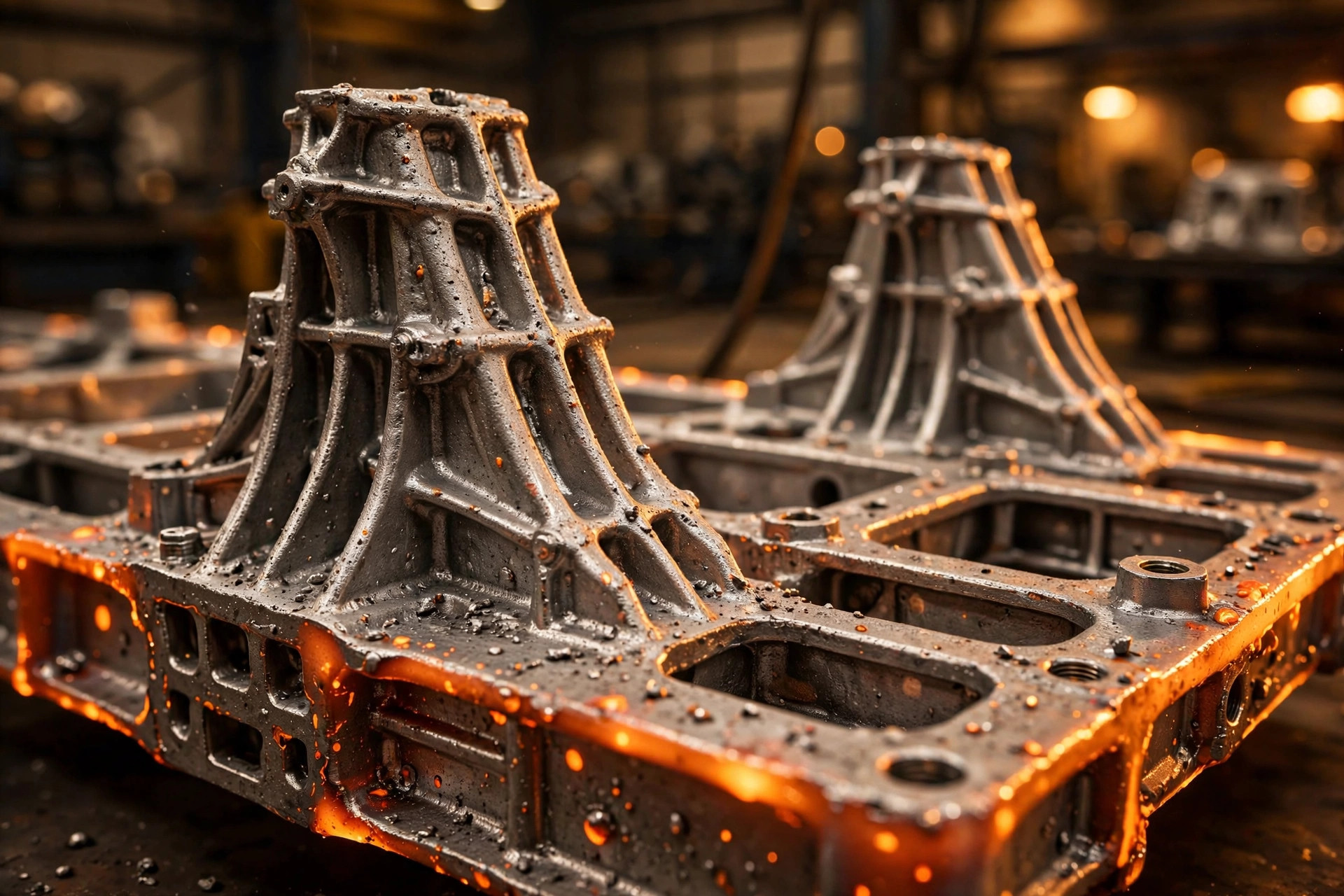
Each branch of the tree depends on one enabling technology: the unicast. Ford's word, pointedly not Tesla's "gigacasting." Two 9,000-ton die-casting machines from Switzerland's Bühler Group are being installed at Louisville, with installation reported underway in August 2026, to pour the Fathom's front and rear structures as single aluminum pieces. One hundred forty-six stamped and welded parts condense into two castings. That is Farley's number, from February 2026, and it invites a raised eyebrow until you remember Tesla has been doing the same thing to the Model Y's rear structure for years.
What makes the tree possible is structural completeness. Each unicast leaves the die as a finished load-bearing structure, so the front and rear modules can be fully populated, suspension, steering, thermal hardware, before they ever meet the battery module or each other. On a welded unibody, the structure only becomes rigid at the end of the body shop; everything before that is fixturing. Here rigidity arrives at the casting machine. So the sequence inverts: instead of building fragility into strength, you start with strength and bolt the fragility on.
1.3 Kilometers of Missing Wire
The wiring harness in the Fathom is 1.3 kilometers shorter and 10 kilograms lighter than the harness in the Mustang Mach-E. Wire does not disappear by tidying. A kilometer of copper vanishes when there are fewer things to connect and shorter paths between them: fewer discrete modules because functions consolidated, shorter runs because the castings and the structural pack put the endpoints closer together. Ford has not said the words "zonal architecture," and I will not put them in the company's mouth, but a harness that shrinks by over 4,000 feet is what a zonal electrical architecture looks like from the outside.
Ten kilograms of copper is also ten kilograms the motors never have to accelerate, and every kilogram deleted from the harness is a kilogram that needed no battery cell to carry it. This is the quiet compounding of efficient design. Castings save parts, the shorter harness saves mass, the saved mass shrinks the battery, and the smaller battery costs less. That compounding is where the $28,350 base price comes from.
Battery as Floor
There is no floor pan. A prismatic lithium-iron-phosphate pack serves as a structural sub-assembly, and the interior mounts directly to the top of it: seats, console, carpet, all of it. LFP is the deliberate, unglamorous chemistry choice. No cobalt, no nickel, cheaper materials, longer cycle life, and a thermal-runaway profile that lets engineers sleep. Energy density is the trade. LFP carries less energy per kilogram than the nickel chemistries in the Mach-E, which is exactly why the structural integration matters: the pack skips the mass penalty of a separate floor structure, and the low, central mass drops the center of gravity while freeing cabin volume. Ford claims more passenger room than a RAV4 in a midsize pickup footprint, plus a lockable bed and a frunk.
Those cells come from BlueOval Battery Park in Michigan, a wholly owned Ford plant, pointedly not the BlueOval SK joint venture with SK On that Ford exited in the December 2025 reset. Cell production there is slated to begin in the summer of 2026. Building an LFP supply in Michigan, for trucks that will work Michigan winters, is a bet that pack thermal management can cover LFP's worst trait: it charges slowly and gives back less when cold. That problem is now Ford's to solve in-house, with no partner to share the blame.
Honest Ledger
Nothing here is proven. Louisville builds its first production Fathom in 2027, so every percentage in this article is a target in costume. Ford has earned the skepticism. On December 15, 2025, the company took a $19.5 billion write-down on its EV investments, ended pure-electric F-150 Lightning production, with the nameplate returning as an extended-range hybrid carrying a gas generator, and walked away from its SK On battery joint venture. Fathom survived that cull. That is either a vote of confidence or the last project standing, and both readings are available.
Castings carry the oldest criticism in the gigacasting book. A single-piece front structure is wonderful until a moderate collision cracks it, at which point the repair is not a panel swap but a structural write-off. Ask any insurer pricing a Model Y. Ford has said nothing about a repair strategy for the unicasts. Large castings also concentrate tooling risk: when the front structure is one part from one die in one plant, a die problem is a plant problem.
And the feature list, BlueCruise hardware on every trim, bidirectional charging, a 15.4-inch touchscreen with embedded Apple Maps, Mustang EcoBoost acceleration, five-year ownership costs below a three-year-old used Model Y, is a press release until trucks reach customers. I have not driven the Fathom. Nobody outside Ford has. What can be said is that the engineering logic is sound in a way the Lightning's never was. Lightning was a converted F-150, batteries fitted to a truck designed around an engine, and it failed at the thing conversions always fail at: being designed for the job. Fathom is designed for the job twice over, once as a vehicle and once as a manufacturing system. Whether the arithmetic survives contact with Louisville is the entire story, and it starts in 2027.
| Specification | Ford Fathom / Universal EV Platform |
|---|---|
| Platform | Ford Universal EV Platform (announced Aug 11, 2025) |
| Production system | "Assembly tree": front, rear, and structural-battery modules built in parallel, joined near end |
| Castings | 2 single-piece aluminum unicastings; 9,000-ton Bühler die-casting machines at Louisville |
| Parts delta | 20% fewer parts, 25% fewer fasteners, 40% fewer workstations vs typical Ford vehicle (Ford claim) |
| Assembly time | 40% faster gross, 15% net after reinvestment in quality/automation (Ford claim) |
| Wiring harness | 1.3 km shorter, 10 kg lighter than Mustang Mach-E harness |
| Battery | Structural prismatic LFP pack, cobalt/nickel-free; pack serves as vehicle floor |
| Battery plant | BlueOval Battery Park Michigan, wholly Ford-owned; cell production from summer 2026 |
| Motors | RWD: Ford-designed permanent-magnet motor; AWD adds front induction motor |
| Truck | Fathom midsize pickup, named Aug 6, 2026; $28,350 + $1,595 destination; Louisville from 2027 |
| Investment | $5B total ($2B Louisville retool, $3B battery park); ~4,000 jobs created or secured |
- MotorTrend, "Official: Ford's $29,495 Small EV Truck Is Called Fathom, Not Ranchero," August 6, 2026.
- TechTimes, "Ford Names $28,350 Fathom Electric Truck Built for Full Features at Every Trim," August 7, 2026.
- Repairer Driven News, "Ford installs gigacasting equipment as it moves to make cheaper EVs," August 28, 2026 (Bühler 9,000-ton machines via Industry Arsenal / Luca Greco).
- Ford announcement via Mach-E Forum, "Ford Universal EV Platform Announced," August 2025 (assembly tree, harness, structural LFP pack, Mustang EcoBoost 0-60 claim).
- BatteryIndustry.net, "Ford Universal EV Platform: Ford announces 'Model T moment' for electric cars," August 2025 (20%/25%/40%/15% figures, 1.3 km harness).
- AutoConnectedCar, "Ford Innovates Silicon Valley-style with Affordable Mid-Size Truck & Platform," August 2025 (kitted parts, ergonomics, 22 lb harness saving).
- Engadget, "Ford shows off the tech going into its $30,000 electric pickup truck," February 2026 (146 parts into 2 castings, $5B investment, Louisville expansion).
- Automotive Logistics, "Ford highlights in-plant logistics gains in $5 billion rollout," 2025 (BlueOval Battery Park Michigan wholly owned; SK On JV distinction).
- FordAuthority, "Midsize Ford EV Pickup Side Mirror Turn Signals, Tail Lights Revealed," July 2026 (prototypes in camo, LFP from Michigan).
- WardsAuto, "Ford abandons F-150 Lightning, looks to gasoline range extender replacement," December 17, 2025 ($19.5B write-down, EREV successor).
- Wall Street Journal, "You Were Right to Hate EV Pickups. Automakers Want a Second Chance," ~June 2026 (chapter-three framing, Slate/Telo/Scout context).
Disclaimer: this article was written without driving or handling the vehicle. All technical claims rest on Ford's published materials and press reporting; projections for 2027 production are Ford's, not verified. Where data has not been published, the article says so.