Five Hertz: The Engineering Penalty for Running a Watch Movement at 36,000 Vibrations per Hour
Frequency and Accuracy: The Clean Part
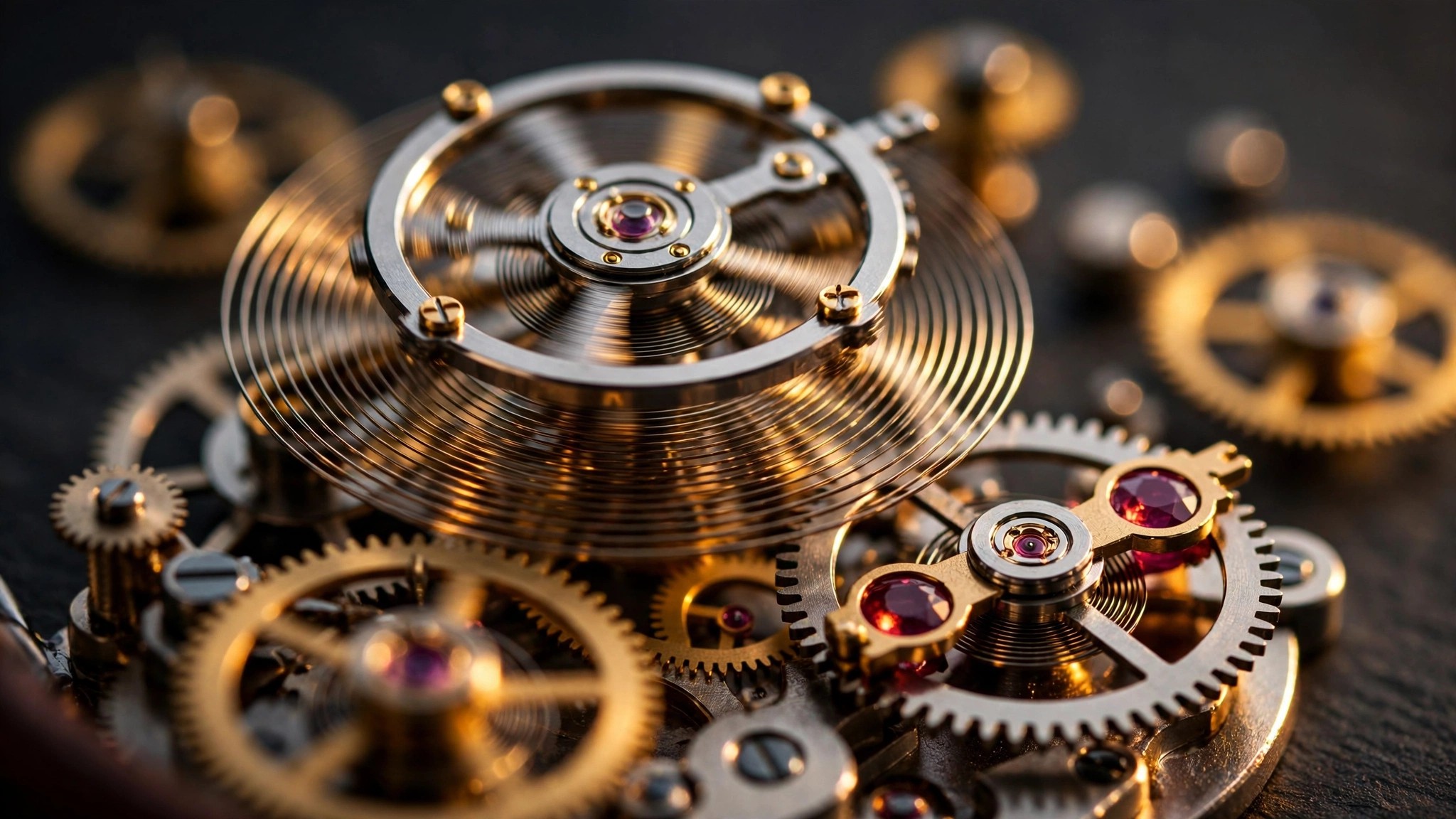
A balance wheel is a torsional oscillator. It swings clockwise, the hairspring pulls it back, it swings counterclockwise, the hairspring pulls it back again, and that single full cycle, in a 28,800 vph movement, repeats 4 times per second, producing 8 semi-oscillations (the "ticks" you hear, alternately locking and unlocking the escape wheel) every second. Bump that to 36,000 vph and the wheel completes 5 full cycles per second, delivering 10 semi-oscillations in the same interval.
Why does this matter? Because the balance wheel is not swinging in a vacuum, and gravity pulls on it differently depending on whether the watch is dial-up, crown-down, or at some intermediate angle, while wrist motion imparts random accelerations and temperature shifts change the elastic modulus of the hairspring, altering its restoring force. Every one of these disturbances nudges the oscillation period away from its design value by some small amount, and each deviation accumulates as a timing error.
Faster oscillation rate dilutes these errors, because a given perturbation, say a wrist jolt that shifts the period of one oscillation by 5 microseconds, affects the total accumulated time by 5 microseconds regardless of frequency. But a 5 Hz balance wheel completes 432,000 oscillations per day while a 4 Hz wheel completes only 345,600. The same perturbation gets averaged across 25 percent more cycles. Statistically, the error contribution per unit time drops. This relationship was formalized in the mid-twentieth century by horological researchers at the Neuchâtel Observatory, where chronometer trials consistently showed that higher-frequency movements produced tighter daily rate variations when all other variables were held constant.
Straightforward. Almost obvious. Run the balance wheel faster, get better accuracy.
The problem is everything else.
The Energy Budget
A mainspring stores a finite amount of energy. That energy must sustain the oscillation of the balance wheel, drive the gear train, advance the hands, and overcome friction at every pivot, jewel bearing, and sliding surface in the movement. Power reserve, the number of hours a movement runs on a full wind, is determined by the ratio of energy stored to energy consumed per unit time. Increase the consumption rate and the reserve shrinks, simple arithmetic with no appeal.
Running a balance wheel at 5 Hz instead of 4 Hz increases the number of escapement impulses per second by 25 percent. Each impulse transfers a discrete packet of energy from the mainspring, through the gear train, to the balance wheel via the escape wheel's pallet fork interaction. More impulses per second means more energy drawn from the mainspring per second. If you change nothing else about the movement, going from 28,800 to 36,000 vph cuts your power reserve by roughly 20 percent, because the relationship between frequency and energy consumption is not perfectly linear due to the dynamics of the escapement interaction, but it is close enough to punish any designer who tries it without compensating elsewhere.
In the late 1960s, Longines introduced the Ultra-Chron with Calibre 431, a 36,000 vph automatic movement that delivered a power reserve of approximately 43 hours. Respectable, but short by the standards of the era when 48 hours was considered a minimum for a daily-wear automatic. Zenith's El Primero 3019 PHC, released in January 1969 as one of the first automatic chronograph calibres, ran at 36,000 vph and achieved a remarkable 50-hour power reserve, but only by using a larger mainspring barrel relative to the movement's diameter, consuming precious space that other chronograph functions also needed. Girard-Perregaux went to 36,000 vph with its Calibre 32A for the Laureato line, achieving excellent chronometric results but never fully solving the service interval problem that the higher frequency created.
Every manufacturer that chased five hertz found the same wall: you can make the mainspring longer, but the barrel gets larger. You can make the barrel thicker, but the movement gets taller. You can reduce friction in the gear train to stretch each energy packet further, but the escapement itself is the dominant energy consumer and its physics do not negotiate.
Lubrication: The Clock That Ticks Inside the Clock
Lubricants in a mechanical watch have a finite lifespan measured not in years but in contact cycles. The pallet stones of a Swiss lever escapement engage the escape wheel teeth once per semi-oscillation, and each engagement involves a sliding contact between polished synthetic ruby and hardened steel under the pressure of the escapement's restoring force. Oil degrades. Specifically, the base oil undergoes oxidative breakdown accelerated by the shearing forces at the contact interface, and the additive package that prevents metal-on-jewel adhesion depletes at a rate proportional to the number of contact events.
At 28,800 vph, the pallet stones make contact 691,200 times per day. At 36,000 vph, the number jumps to 864,000. Over a typical five-year service interval, that is an additional 316 million contact events. The difference is not trivial: Moebius Synta-HD-I, one of the most widely used modern escapement lubricants, was reformulated in the mid-2000s specifically to extend service intervals, but its performance envelope was developed and tested primarily against 28,800 vph duty cycles. Running it at 36,000 vph accelerates degradation, and field data from service centers in the 1970s showed that high-frequency movements reliably needed escapement re-lubrication two to three years sooner than their 4 Hz counterparts, a maintenance penalty that manufacturers knew would annoy consumers and complicate warranty economics.
Dry friction is the endgame of lubricant failure, and it is ugly. Without a functional oil film, the ruby pallet stones scrape directly against the escape wheel teeth, generating microscopic wear particles that contaminate the remaining lubricant, accelerating its breakdown in a self-reinforcing cycle. Rate stability deteriorates first, then amplitude drops as friction steals energy from the balance wheel, and eventually the movement stops entirely, and the cost of repair includes replacing worn escapement components rather than simply re-oiling them.
This was the real killer of high-frequency movements in the 1970s. Not accuracy. Not prestige. Warranty claims.
The 1960s Frequency Wars
Between 1966 and 1970, half a dozen Swiss manufacturers raced to higher oscillation rates with the urgency of Cold War missile programs and approximately the same disregard for long-term maintenance logistics. Longines led the charge with its Ultra-Chron, introduced in 1966 with Calibre 430 (hand-wound) and followed by the automatic 431, which used a 36,000 vph balance specifically to win chronometer trials at the Neuchâtel Observatory, where tighter daily rate variations meant higher scores, more prestigious certifications, and the bragging rights that drove high-end Swiss watchmaking in an era before luxury branding replaced chronometric performance as the primary selling proposition.
It worked. Brilliantly. In 1966, an Ultra-Chron prototype set accuracy records at Neuchâtel with a mean daily rate variation under 1 second per day across multiple positions and temperatures. Seiko, watching from Suwa, responded with the 36,000 vph Lord Marvel 5740C in 1967, a hand-wound chronometer that demonstrated Japan could match Swiss beat rates and, in several observatory trials, beat them. Girard-Perregaux entered with the Gyromatic HF in 1966, also at 36,000 vph. Zenith raised the stakes by combining 36,000 vph with an automatic winding system and a chronograph complication in the El Primero, an act of engineering ambition that bordered on recklessness given the lubrication technology available.
Then quartz happened. Seiko's Astron, introduced on Christmas Day 1969, rendered the entire accuracy argument irrelevant by delivering timekeeping precision measured in seconds per month rather than seconds per day. A quartz crystal oscillating at 32,768 Hz does not care about positional errors, wrist jolts, or lubricant degradation. The frequency wars ended not because anybody lost but because the battlefield was vaporized. When the Swiss mechanical watch industry rebuilt itself in the 1980s on the back of luxury positioning rather than chronometric competition, the default oscillation rate reverted to 28,800 vph. Nobody needed 36,000 vph to sell a Rolex Submariner. The lower frequency was easier to manufacture, cheaper to service, and long enough in power reserve to satisfy customers who expected their automatic to survive a weekend on the nightstand.
Why 28,800 Won by Default
The number 28,800 is not arbitrary. It equals 8 semi-oscillations per second, which produces a sweep second hand that advances in discrete steps too fast for the human eye to distinguish from continuous motion under normal viewing conditions. Below this threshold, at 21,600 vph (6 ticks per second, used in many vintage and some modern movements), the stepping of the second hand becomes visible, a cosmetic defect that luxury buyers perceive as cheapness regardless of the movement's actual quality.
Above 28,800, the visual smoothness of the second hand improves marginally, but the human perceptual system cannot distinguish 8 steps per second from 10. The cosmetic return is zero while the engineering cost, as described above, is steep. From a pure product-engineering standpoint, 4 Hz occupies the minimum viable frequency for smooth hand motion with the maximum power reserve and service life. Not the most accurate, not the most elegant, just the most practical, which is what matters when you are manufacturing a half-million movements per year and warranting them for two years with a recommended service interval of five.
ETA, which supplies the majority of Swiss mechanical movements through its family of base calibres, standardized on 28,800 vph across its workhorse 2824, 2892, and 7750 platforms. Rolex settled there for Calibres 3135, 3235, and successors. Omega, Patek Philippe, Audemars Piguet, and nearly every volume manufacturer converged on the same number by the early 1990s. Four hertz became the industry's equilibrium not because it was optimal in any single dimension but because it was acceptable in all of them.
Zenith alone refused to retreat, keeping the El Primero at 36,000 vph through every market upheaval from the quartz crisis to the smartwatch scare, making it the longest-running high-frequency automatic calibre in continuous production. That stubbornness turned out to be prescient.
Silicon Changes the Arithmetic
The escape wheel and pallet fork are where the overwhelming majority of a movement's frictional energy loss occurs, and where lubricant degradation causes the most damage. Conventional escapements use steel escape wheels and synthetic ruby pallet stones, both hard materials that nevertheless generate friction at their interface because their surfaces, however finely polished, are not atomically smooth. Oil bridges the gap between microscopic surface asperities, reducing friction and preventing adhesive wear. Remove the oil and the system self-destructs.
Silicon does not need oil, because monocrystalline silicon, etched by deep reactive ion etching (DRIE) from a single-crystal wafer, produces surfaces with roughness measured in single-digit nanometers, two orders of magnitude smoother than even the best-polished steel. Silicon-on-silicon contact at these surface qualities generates so little friction that lubrication becomes optional at the pallet interface, eliminating the contact-cycle degradation problem that made high-frequency movements impractical for three decades.
Patek Philippe introduced silicon escapement components with its Calibre 324 S C in the late 2000s. Omega adopted a silicon balance spring across the Master Chronometer line. Rolex developed its proprietary Syloxi silicon hairspring and Parachrom balance spring. But it was Zenith that connected silicon to the high-frequency question most directly with the Defy Lab in 2017, using a monolithic silicon oscillator vibrating at 15 Hz (108,000 vph) with a theoretical accuracy of 0.3 seconds per day, using no conventional escapement at all, no oil, and no pivots, just a silicon flexure oscillating in a single plane, a fundamentally different approach that bypassed every historical limitation of high-frequency watchmaking by eliminating the components that created those limitations.
Too radical for production, and the Defy Lab remained a concept demonstrator, but the message was received clearly enough: silicon changes the energy and wear equations enough that frequencies above 4 Hz become viable again, and the accuracy advantage that drove the 1960s frequency wars is still real.
Longines Reopens the File
In 2024, Longines revived the Ultra-Chron name with a new movement, the L836.6, based on the ETA A31.L21 platform. Running at 36,000 vph with a silicon hairspring and a conventional Swiss lever escapement, the movement delivers a COSC-certified chronometer-grade accuracy of -4/+6 seconds per day. Power reserve: 52 hours, a number that deserves attention.
Fifty-two hours at 36,000 vph from a movement 30.4 mm in diameter and 7.9 mm tall is a meaningful engineering achievement, because it implies that the total energy consumption per oscillation has been reduced substantially compared to the 1960s Ultra-Chron calibres, which achieved only 43 hours from a comparable mainspring. The silicon hairspring contributes by reducing internal friction losses in the oscillating system itself: a silicon spring has a higher Q factor (quality factor, the ratio of energy stored to energy dissipated per cycle) than a conventional Nivarox alloy spring, meaning more of the energy delivered by the escapement goes into sustaining the oscillation and less is lost to internal damping. Lower damping per cycle means less energy needed per cycle, which extends power reserve without enlarging the barrel.
Modern lubricants help too, because Moebius 9010 and its successors use synthetic base stocks with additive packages specifically formulated for extended service intervals, and their performance at 36,000 vph duty cycles is substantially better than anything available in the 1960s. Combined with silicon's friction reduction at the hairspring, the net effect is a high-frequency movement that can maintain its rate stability over a five-year service interval comparable to a standard 28,800 vph calibre. Not identical. Comparable. Close enough that the warranty math works.
Longines prices the Ultra-Chron at approximately $3,200, which positions it as the most affordable modern 36,000 vph COSC chronometer on the market and a pointed statement that high-frequency watchmaking no longer requires exotic engineering or exotic price tags. Whether the accuracy advantage actually manifests in daily wear on a human wrist, rather than in the controlled conditions of a chronometer trial, is a separate and more honest question.
Dual-Frequency: Zenith's Elegant Dodge
Rather than forcing the entire movement to run at a single elevated frequency, Zenith's Defy 21, powered by the El Primero 9004, runs two separate oscillating systems at different frequencies for different purposes. The timekeeping regulator oscillates at 36,000 vph, maintaining the El Primero's traditional accuracy advantage for hour, minute, and second display. A second, independent escapement and balance wheel drive the chronograph function at 360,000 vph, ten times the timekeeping frequency, producing a chronograph second hand that completes one revolution per second and can resolve elapsed time to one-hundredth of a second.
This is clever for a reason that goes beyond the obvious spectacle of a 50 Hz chronograph hand. By separating the two oscillating systems, Zenith avoids imposing the energy and wear penalties of extreme frequency on the timekeeping function. The chronograph escapement runs at 360,000 vph only when the chronograph is active, consuming its own dedicated mainspring barrel at a rate that would drain it in approximately 50 minutes of continuous timing. The timekeeping escapement runs at 36,000 vph continuously, consuming its own separate barrel with a 50-hour power reserve, completely isolated from the chronograph's energy demands. Neither system compromises the other. The architecture is, in effect, two movements in one case, each optimized for its specific duty cycle.
At roughly $12,000, the Defy 21 costs four times the Longines Ultra-Chron, but it is arguably the most intellectually honest solution to the high-frequency problem: use it where it pays, isolate it where it costs, and let each oscillator do exactly what it was designed for without dragging the other into its trade-off space.
Does It Actually Matter on the Wrist?
The uncomfortable truth is this: under controlled conditions with a movement clamped in a testing machine at fixed positions and temperatures, a well-regulated 36,000 vph calibre will outperform a well-regulated 28,800 vph calibre by a measurable margin, typically 0.5 to 1.5 seconds per day in mean daily variation across positions. Neuchâtel Observatory data from the 1960s, COSC testing statistics from the 2000s, and internal data from manufacturers all confirm this relationship. No dispute.
On a human wrist, the picture changes completely. Wrist-worn watches experience a chaotic sequence of positions, accelerations, shocks, and temperature gradients that far exceed the controlled test protocol, including thermal shocks from cooking dinner, repetitive micro-vibrations from typing on a keyboard, and accelerations from playing tennis that no chronometer test simulates. In this noisy environment, the theoretical 1-second-per-day advantage of 5 Hz over 4 Hz drowns in the much larger noise floor of real-world perturbations.
Published wrist tests by independent watchmakers and review sites consistently show that the spread between individual examples of the same movement, caused by manufacturing tolerances and regulation differences, exceeds the systematic frequency-dependent accuracy difference. You will find 4 Hz movements that keep better time than 5 Hz movements on the same wrist, simply because the 4 Hz example happened to be regulated more carefully or manufactured to tighter tolerances. Frequency is one variable in a system with dozens, and on a wrist, it is not the dominant one.
Does this mean five hertz is pointless? No, but it does mean the accuracy advantage is real but small, measurable but rarely decisive, and overwhelmed by other factors in daily wear. The honest case for high-frequency movements is not that they keep dramatically better time but that they are more resistant to specific types of disturbance, particularly positional changes, and that this resistance narrows the worst-case timing error. A 5 Hz movement is less likely to run 8 seconds fast in one position and 6 seconds slow in another. The spread tightens, and for a wearer who changes wrist position constantly, that tighter spread feels like better timekeeping even if the absolute daily rate is no different.
And there is the chronograph argument, which is unambiguous. Measuring elapsed time with a chronograph directly benefits from higher frequency because the minimum resolvable time interval equals one divided by the beat frequency. At 4 Hz, the smallest measurable interval is 0.125 seconds. At 5 Hz, it is 0.1 seconds, and at Zenith Defy 21's 50 Hz, it is 0.01 seconds. For timing events in the real world, whether a lap on a track or a cooking interval, higher frequency produces genuinely higher resolution. No statistical averaging required, just a sharper ruler.
The Materials Science Horizon
Silicon solved the immediate problems of lubrication and friction that killed the first wave of high-frequency movements, but it introduced constraints of its own. Monocrystalline silicon is brittle, genuinely fragile in a way that steel is not. A shock that a steel escape wheel absorbs through plastic deformation will shatter a silicon one. Manufacturers have mitigated this with shock protection systems, including Patek Philippe's Spiromax design that flexes rather than breaks under impact, and Omega's METAS testing protocol that subjects movements to 15,000 gauss magnetic fields and simulated daily-wear shocks. But brittleness remains the fundamental weakness of silicon in an object designed to be worn on a wrist and occasionally dropped on a tile floor.
Diamond-like carbon (DLC) coatings on conventional steel escapements represent an alternative path, reducing friction without introducing brittleness. Sinn's Diapal technology, applied to pallet fork and escape wheel surfaces, achieves sufficiently low friction coefficients to eliminate escapement lubrication while retaining the ductility of a steel substrate. If DLC-coated steel escapements can match silicon's friction performance at high frequencies, the brittleness trade-off disappears entirely, and the remaining obstacle to five hertz is only the energy budget, which mainspring metallurgy and barrel engineering continue to improve.
Nivarox-FAR, the Swatch Group subsidiary that produces the overwhelming majority of the world's hairsprings and balance assemblies, has been experimenting with high-frequency oscillator designs that minimize air resistance by reducing balance wheel diameter while maintaining moment of inertia through mass redistribution to the rim. Smaller diameter, heavier rim, same inertia. Less aerodynamic drag at higher angular velocities. The energy saving is modest, perhaps 5 to 8 percent at 36,000 vph compared to a conventionally sized wheel, but every percent counts when the power reserve is the binding constraint.
Five hertz is not the end of the road. It is the first stop beyond the consensus. Zenith has already demonstrated 50 Hz in a wristwatch. Theoretical limits for silicon flexure oscillators, calculated by EPFL researchers and published in the journal Microsystems & Nanoengineering, suggest that frequencies up to 100 Hz are achievable in principle with current DRIE fabrication tolerances, though power delivery at those frequencies remains an open problem. The real question is not how fast you can run a mechanical oscillator but how fast you should, and the answer depends entirely on what the oscillation is for.
For timekeeping in a wristwatch, five hertz is probably enough. The accuracy gains beyond that point flatten against the noise floor of real-world wrist wear, so for timekeeping in a wristwatch, five hertz is probably enough. For chronograph resolution, higher is genuinely better, up to the point where the display mechanism cannot keep pace with the measurement. For competitive differentiation and engineering spectacle, the sky has no limit, and watchmakers have never been accused of restraint when engineering spectacle is on the table.
The penalty for five hertz was real in 1968 and it is smaller in 2026. Silicon, synthetic lubricants, and optimized escapement geometry have bought back most of what the frequency wars spent. What has not changed is the fundamental relationship between oscillation rate and energy consumption, and that relationship will constrain mechanical watchmaking for as long as mainsprings store energy and balance wheels spend it. Every additional hertz is purchased with power reserve, component life, or engineering complexity. The only question is whether the purchase is worth it.
At five hertz, for a chronometer, I think it is. Barely. The accuracy advantage is real but modest, the engineering costs are now manageable, and the chronograph resolution improvement is unambiguous. Beyond five, you are buying spectacle. and spectacle, in watchmaking, has always been reason enough.