A Refrigerator on the Turbocharger: Ferrari's Peltier Patent
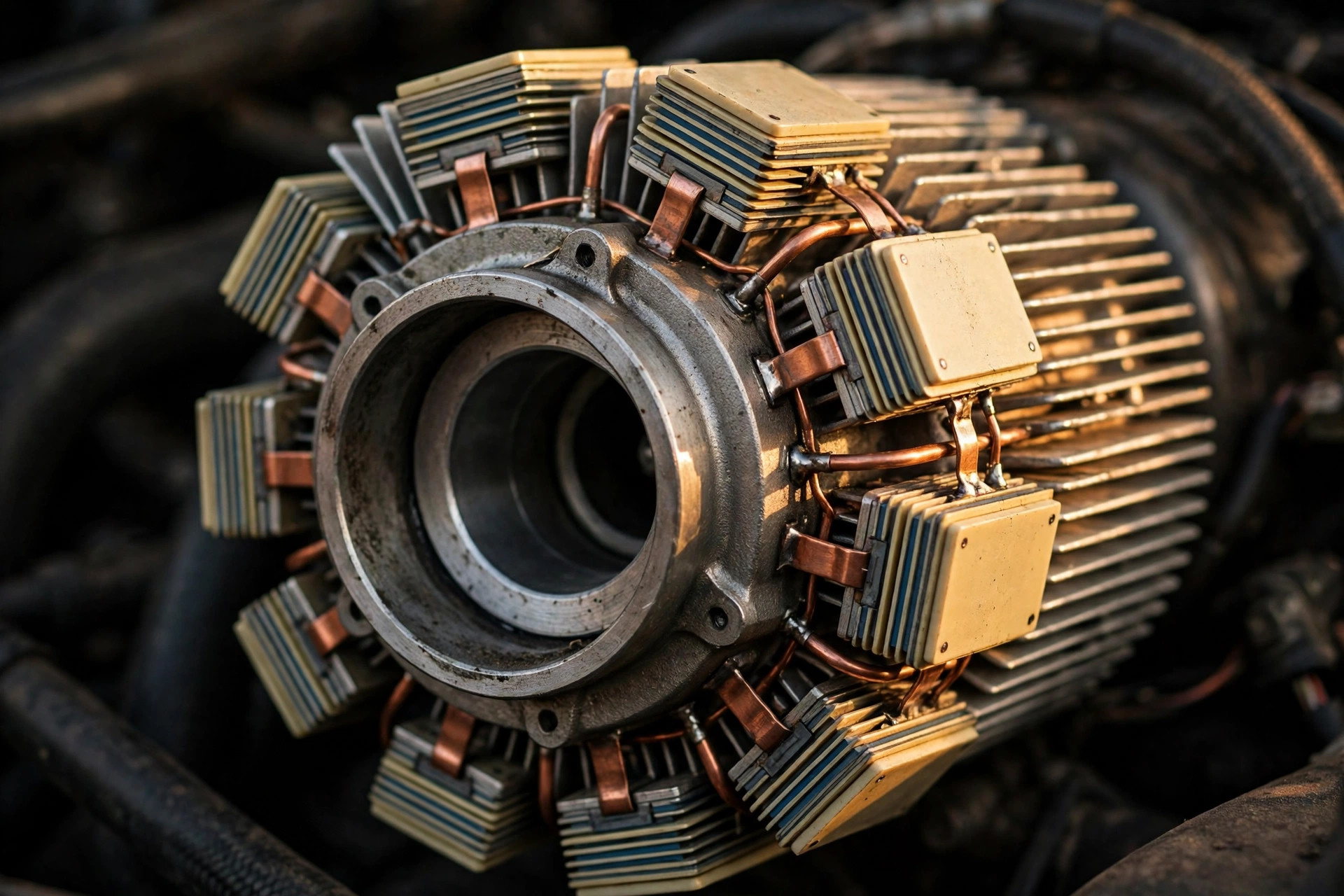
Ferrari has patented a turbocharger wearing a refrigerator. CarBuzz found the filing in US Patent and Trademark Office documents and reported it on October 16, 2026, and the drawings are the interesting part: the turbo housing bristles with fin spikes that CarBuzz compared to an air-cooled VW engine, while the real machinery hides at the inlet, where multiple Peltier thermoelectric coolers wrap the compressor housing and chill the intake air before it gets compressed.
Not after. Before.
Every turbocharged engine already cools its charge air, with an intercooler sitting downstream of the compressor to clean up the heat that compression adds. Ferrari's proposal adds a second cooling event on the other side of the compressor, cooling the air before the blades even touch it, and the distinction is the whole story, because it changes which thermodynamics you get to exploit.
Cool Before You Compress
Air density follows the ideal gas law with the loyalty of a well-trained dog: at fixed pressure, density is inversely proportional to absolute temperature, so a 20-degree drop in intake temperature near a 300-kelvin ambient hands the cylinders roughly six to seven percent more oxygen per gulp. More oxygen means more fuel burned, which means more power, which is the entire sport.
Colder air also costs less to compress. A compressor's shaft work scales with absolute inlet temperature for a given pressure ratio, so chilling the inlet means the exhaust side of the same turbo does less work for the same boost, and the cooled air arrives denser without asking the turbine for anything extra. An intercooler can only recover density after the compressor has already spent the energy; pre-compression cooling means the compressor never spends it. That is the elegant half of the idea.
Then there is detonation. Hot intake charge pushes an engine toward pre-ignition, the uncontrolled early burning that can tear pistons and ring lands apart in moments, and every turbo engine's calibration carries a permanent tax paid in retarded ignition timing and enriched mixtures whenever intake temperatures climb. Lower the inlet temperature and that tax shrinks, which means the engine keeps more of its timing advance on hot days and long pulls. Ferrari sells cars that are expected to make full power repeatedly, not just on the first dyno run, so heat management is not a footnote in Maranello. It is the job.
The 1834 Physics
Jean Charles Athanase Peltier discovered in 1834 that passing a current across a junction of two dissimilar conductors makes one side hot and the other cold. No refrigerant, no compressor, no moving parts, just current in and a temperature difference out, which is why the same modules that cool PC overclockers' CPUs and keep truck-stop food cold are now, apparently, candidates for turbocharger duty.
A commercial thermoelectric cooler is a sandwich: bismuth telluride semiconductor pellets, alternating p-type and n-type, wired in series between two ceramic plates, with copper interconnects shuttling the current. Bismuth telluride is the workhorse because its thermoelectric properties peak near room temperature, which is exactly where a turbocharger inlet lives, as opposed to the turbine side, where lead telluride or silicon germanium would be needed to survive the heat. Ferrari put the modules at the cold end of the turbo, not the hot one, which tells you someone did the materials homework before filing.
Materials people grade these devices with a dimensionless figure of merit called ZT, combining the Seebeck coefficient, electrical conductivity, absolute temperature, and thermal conductivity into one number that has to be high for the device to be any good. Commercial bismuth telluride modules sit near ZT of 1. Laboratory tin selenide has touched 2.6. Broad competitiveness with conventional refrigeration wants something like 3 to 4, which nobody has shipped. Ferrari is not proposing a breakthrough in thermoelectric materials. It is proposing to use a mature, inefficient technology in a place where its inefficiency might not matter.
The Energy Accounting Problem
This is where the patent's silence gets loud. A Peltier module's coefficient of performance sits between 0.3 and 0.7, meaning it routinely consumes more electrical power than the heat it moves, while a vapor-compression system manages 2 to 4, so for the same cooling capacity a thermoelectric module can demand three to ten times the electricity. The filing does not say where that electricity comes from, and CarBuzz flagged exactly this gap.
Worse, the heat does not disappear. A Peltier device pumps heat from its cold side to its hot side, then adds its own electrical input as Joule heating on top, so the hot side has to reject the cooling load plus the power bill, which is what those VW-style fin spikes are for: dumping the hot side's heat into the passing airstream inside an engine bay that is already the hottest place in the car. Mount a device deep in the bay that makes its hot side hotter and you have created a packaging problem to solve a packaging problem.
Ferrari's answer, presumably, is current it already has. The company's hybrid architecture runs high-voltage electrical systems with real power to spare, the kind of electrical backbone that a 12-volt starter-alternator car cannot offer, and a brief, on-demand chill of the turbo inlet is exactly the sort of transient load a hybrid battery is good at. None of that is in the patent. But the filing comes from a company whose hybrid flagships already carry the high-voltage hardware, and the energy budget only works if you read it that way.
A Patent Spree, Not a One-Off
This filing did not arrive alone. In September 2026 Ferrari published a separate patent, "Engine Assembly for a Motor Vehicle and Control Method Thereof," listing engineer Silvio Rabbolini as inventor, pairing one large conventional turbocharger with two electrically powered compressors to attack turbo lag from the opposite direction: big turbine for top-end airflow, electric compressors for instant low-rpm response, no compromise on either end. CarBuzz spotted that one too.
Read the two filings together and the program comes into focus. Ferrari is not tinkering with one idea. It is building a patent portfolio around the two permanent enemies of the turbocharged engine, heat and lag, and attacking each with electricity: thermoelectric modules to manage the inlet temperature, electrically driven compressors to manage the transient response. The F80 already ships twin 48-volt electric turbochargers spinning to 130,000 rpm and making 3.7 bar of boost, the highest ever on a production car, so these filings read less like blue-sky research and more like the roadmap for the generation after.
Patent filings are chess moves, not product announcements, and Maranello files plenty of ideas it never builds. But a one-off filing is a curiosity, while two filings in two months on the same battlefield is a program. The program says Ferrari believes the turbocharged combustion engine still has headroom worth mining, and that the mining equipment is electrical.
Same Physics, Your Wrist
There is a watchmaking footnote here, because thermoelectrics keep showing up on wrists. The Matrix PowerWatch, the crowdfunded oddity from 2016, ran on thermoelectric generators that harvested body heat to power a smartwatch, the same Seebeck physics in reverse: temperature difference in, current out, instead of current in and temperature difference out. It worked, in the sense that it told time off your forearm, and it flopped, in the sense that nobody wanted a thick puck that needed your wrist to stay warm.
Both ideas fail the same way and for the same reason. Thermoelectrics are wonderful where packaging, silence, or precision matter more than efficiency: cooling a laser diode, holding a sample at exactly 4 degrees, harvesting microwatts from a wrist. They are terrible where bulk energy moves, because a ZT of 1 cannot compete with a compressor. Ferrari's proposal is interesting precisely because it sits on the border, a small, transient, precision application of cold in exactly the spot where a few degrees buy real power, in a car that can afford the electricity. Whether the border holds is the entire engineering question, and it is a better question than "can you patent a cold turbo."
Limitations, Honestly
I have not seen the patent drawings beyond the published reporting, and everything here rests on CarBuzz's October 16, 2026 account of the USPTO filing plus the established thermoelectric literature, so treat the packaging claims as informed reasoning rather than witnessed fact. The filing's silence on the electrical power budget is the largest unknown, and any version of this that reaches production would need its hot-side heat rejection validated in a real engine bay, not a drawing.
There is also the defensive-IP reading, which deserves its weight: automakers patent broadly to fence off territory, and Ferrari may never intend to build a Peltier turbo, only to own the idea if someone else proves it works. The September electric-compressor filing strengthens the program reading, but it does not kill the defensive one. Both can be true.
Still. A company that could simply add displacement or boost is choosing instead to refrigerate its intake air with 1834 physics, and that choice tells you something about where the easy gains are gone. A century of optimization has wrung the turbocharged engine nearly dry. What is left is the strange stuff: cold where it should not be cold, current doing a compressor's job, fins like a Beetle bolted to Maranello's finest. That is not a press release. That is a company running out of normal ideas, which is when engineering gets fun.
Sources
- CarBuzz, October 16, 2026, "Ferrari Just Made Turbochargers Even More Complex Than Ever," reporting a new Ferrari patent found in US Patent and Trademark Office documents proposing multiple Peltier thermoelectric coolers around the turbocharger inlet to cool the housing and lower inlet temperatures before compression, with external fin spikes compared to an air-cooled VW engine for hot-side heat rejection, and noting the patent does not address the electrical power requirement, smaller intercoolers as a potential packaging benefit, detonation resistance, and that patent filings do not confirm production intent.
- CelebTattler, September 2026, reporting a Ferrari patent application titled "Engine Assembly for a Motor Vehicle and Control Method Thereof," published September 10, 2026, with engineer Silvio Rabbolini listed as inventor, combining one large conventional turbocharger with two electrically powered compressors to address turbo lag.
- Thermoelectric performance literature: commercial bismuth telluride modules reach ZT near 1.0, laboratory tin selenide approaches 2.6, and ZT above roughly 3 to 4 would be needed for broad competitiveness with conventional refrigeration; Peltier cooler coefficients of performance generally range from 0.3 to 0.7 against 2.0 to 4.0 for compressor-based systems.
- Thermoelectric materials survey: bismuth telluride (Bi2Te3) is the workhorse material near room temperature, lead telluride (PbTe) serves higher-temperature applications, and silicon germanium (SiGe) covers very high temperatures above 600 C; standard modules sandwich p-type and n-type pellets between ceramic plates with copper interconnects.
- Matrix PowerWatch (2016 crowdfunded launch), a smartwatch powered by body-heat thermoelectric generators using the Seebeck effect, the reverse of the Peltier cooling effect.
- MotorTrend, 2026 Ferrari F80 technology explainer, confirming the F80's twin 48-volt electric turbochargers spinning to 130,000 rpm, producing 3.7 bar (55.5 psi) of boost, the highest ever on a production car.