Bend Without Breaking: Inside Ferrari's Elastically Deformable Aerodynamic Bodywork
Three patents filed in six months reveal how Maranello plans to replace rigid active aero with bodywork that physically changes shape under load. Corrugated substructures, composite-elastomer hybrids, and suspension arms doubling as airfoils. Not one actuator required.
Why Rigid Active Aero Has a Problem
Every deployable spoiler, every motorized flap, every hydraulically tilting wing carries the same set of engineering compromises. Actuators add weight. Hinges create gaps. Gaps disrupt laminar airflow. Seals wear. Motors draw current. And the rigid panel behind each mechanism can only occupy two states: up or down, open or closed. Binary aerodynamics for a fluid problem that is anything but binary.
Modern supercars have pushed rigid active aero to impressive extremes. Porsche's 992 GT3 RS deploys a swan-neck rear wing with a DRS-style flap for low-drag straights. McLaren's W1 runs an active long-tail rear section that extends and retracts. Zenvo built a centripetal wing that tilts on two axes to direct downforce toward the inside wheel in corners. All of these systems work, and work well. But they share a fundamental limitation: the aerodynamic surfaces themselves do not change shape. They move, but they remain rigid while moving.
Ferrari, across three separate patent filings between January and June 2026, has outlined a different approach entirely. Instead of moving rigid panels to new positions, make the panels themselves deform. Build the bodywork from materials that flex under aerodynamic pressure, reshape the airflow around the car, and spring back to their original form when the pressure drops. Not moveable aerodynamics. Morphing aerodynamics.
Patent One: Bodywork That Breathes
Filed in January 2026 and discovered by CarBuzz researchers at the World Intellectual Property Organization, Ferrari's first morphing patent addresses the oldest conflict in automotive design: stylists want smooth sculpture, engineers want aggressive aero. A rear fender that channels air beautifully at 30 mph may need a very different profile at 180 mph. Conventional solutions bolt active elements onto the bodywork, disrupting the designer's lines. Ferrari's patent eliminates the bolt-on entirely.
In the filing, Ferrari describes an "elastically deformable morphing material" that can serve as any exterior surface. Rear fender, door panel, engine hood, trunk lid, side skirt, nose, tail. Any of them. Under the deformable skin sits a corrugated structural element that provides directional stiffness, allowing the panel to flex in one axis while resisting deformation in another. Picture an accordion that bends easily along its pleats but refuses to stretch sideways. That anisotropic stiffness is critical. Without it, the panel would simply balloon outward under pressure rather than reshaping along a controlled curve.
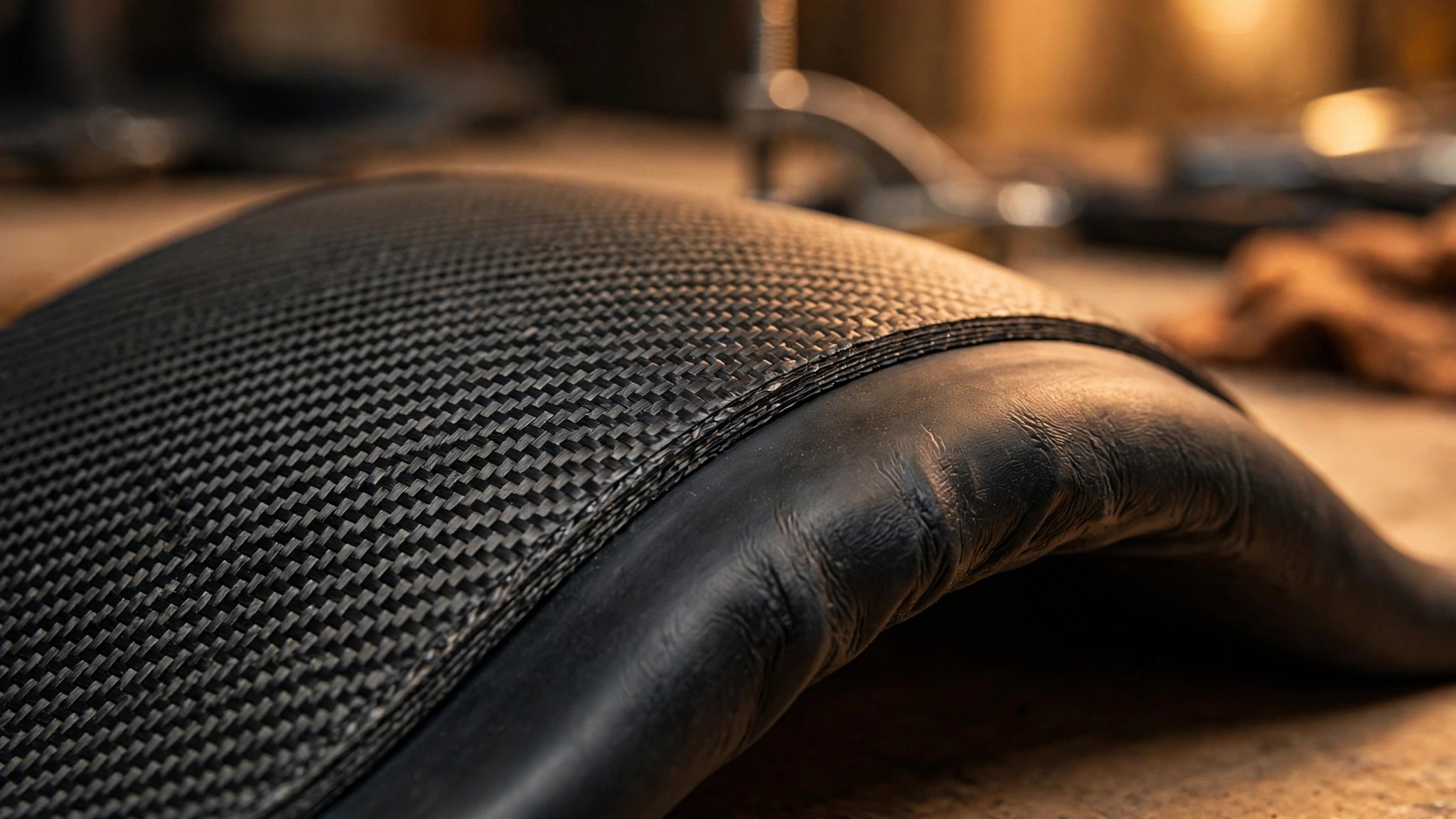
Ferrari's patent language identifies the material as "a composite material and elastomers," without disclosing specific compounds. In materials science, this description points toward a class of structures where rigid reinforcing fibers (carbon, glass, or aramid) are embedded in a flexible elastomeric matrix rather than the rigid epoxy matrix used in conventional carbon fiber composites. Swap the matrix, and the same carbon weave that forms a rigid body panel becomes a panel that bends under load and recovers elastically.
Beneath the deformable skin, the patent also describes an optional internal tensioning system. Hidden from view, this mechanism could pre-stress the panel to hold a default shape at low speeds and release progressively as aerodynamic forces build. A car sitting still in a showroom looks like a sculpture. At 200 mph, its fenders, nose, and tail have subtly reshaped themselves to extract maximum downforce. No visible actuators. No panel gaps. No hinges.
Patent Two: A Wing on a Wishbone
Filed in June 2026, Ferrari's second morphing patent is architecturally the simplest and conceptually the most radical. Instead of placing aero elements on the car's exterior, it puts them inside the wheel arches, mounted directly on the suspension arms.
Suspension arms are among the last aerodynamically unexploited structural elements on a performance car. Porsche has pushed this boundary with the 992 GT3 RS and 992.2 GT3, which use aero-profiled double-wishbone front suspension arms shaped as teardrop cross-sections to manage airflow inside the wheel well. Porsche also filed its own patent for a suspension-mounted wing whose angle of attack changes with suspension travel. Ferrari's version goes further.
In Ferrari's design, a small airfoil wraps around the suspension arm and rotates freely, like a flag around a pole. What prevents it from spinning uncontrollably is an "abutment element," a U-shaped bracket mounted to the wheel hub, the body, or the shock absorber. As the suspension compresses and extends, the arm moves, the wing rotates on the arm, and the abutment stop limits its angular range. At different suspension positions, the wing presents different angles of attack to the airflow rushing through the wheel arch.
No motors. No wiring. No actuators of any kind. Aerodynamic forces push the wing, suspension travel repositions it, and mechanical stops define its operating envelope. Ferrari explicitly notes in the filing that this absence of mechanical drive "represents a clear advantage in terms of weight reduction and production costs," making it particularly suitable for electric vehicles where every gram carries range implications.
One constraint is geometric. Patent drawings show very long suspension arms extending nearly to the vehicle's centerline, providing enough chord length for the wing to generate meaningful aerodynamic force. This is feasible on a mid-engine or rear-engine sports car with double-wishbone or multilink suspension, where long arms are standard for geometric reasons. It is not feasible on a MacPherson strut economy car. This is suspension aerodynamics for supercars, by design.
Patent Three: A Wing That Bends Both Ways
Filed in late June 2026, the third patent returns to the rear wing but reimagines it completely. Rather than a single rigid airfoil, Ferrari describes multiple separate airfoils mounted on a flexible plate on each side of the wing. Actuators bend the plates, and the airfoils follow. Under braking, both plates curve upward to maximize drag and downforce simultaneously. In a corner, one plate can curve more than the other, applying asymmetric downforce to load the inside rear tire.
Lateral downforce modulation is not new in concept. Zenvo's TSR-S centripetal wing tilts mechanically to direct force toward the inside wheel. But tilting a rigid wing shifts its force vector without changing its aerodynamic shape. Ferrari's bendable wing physically reshapes its profile, altering the camber and chord distribution of each airfoil along its span. On corner exit, the wing progressively returns to a neutral shape, reducing drag for straight-line acceleration. Continuous modulation, not binary switching.
What the patent does not resolve is the surface integrity problem. Bending a painted composite surface tens of thousands of times over the life of the vehicle will crack any conventional automotive paint system. Clearcoat finishes are rigid by design, engineered to resist stone chips and UV degradation, not cyclic strain. A morphing wing surface would need either a flexible coating system that maintains gloss and color fidelity under repeated deformation, or a material whose surface finish is inherent to the composite itself rather than applied as a paint layer. Neither solution exists commercially in automotive applications today.
What the Material Actually Needs to Do
Strip away the patent language and the challenge distills to a single materials science problem: build a structural composite that deforms elastically under aerodynamic loads measured in hundreds of newtons, returns to its original shape within milliseconds, and survives hundreds of thousands of deformation cycles without fatigue failure, delamination, or surface degradation.
Conventional carbon fiber reinforced polymer (CFRP) uses an epoxy thermoset matrix. Cured epoxy is stiff, brittle, and essentially non-deformable. Strain it past 1 to 2 percent and it cracks. For morphing applications, the matrix must be an elastomer, a polymer that recovers elastically from large strains. Silicone rubbers tolerate 300 percent strain. Polyurethane elastomers handle 500 percent or more. But embedding rigid carbon fibers in a soft matrix creates its own problems. Fiber-matrix interface bonding becomes unpredictable under cyclic loading. Fibers can debond, creating internal delamination that grows with each cycle until the panel fails structurally.
Academic research into morphing aircraft structures has explored this space extensively. NASA's work on ultralight lattice-based morphing wings used a programmable material system with stiffness comparable to an elastomer (2.6 MPa) at a density comparable to aerogel (5.6 mg/cm³). Researchers at Toronto Metropolitan University and others have investigated compliant mechanisms using flexure hinges, where controlled deformation replaces joints. Shape memory polymers offer another pathway, transitioning from rigid to flexible above a glass transition temperature, then recovering their original shape when cooled. But automotive duty cycles involve continuous high-speed airflow at unpredictable temperatures, not controlled laboratory conditions.
Ferrari's corrugated substructure addresses part of this challenge. By constraining deformation to specific axes, the corrugation reduces the strain magnitude that any given fiber must accommodate. A panel that bends only along its corrugation axis might experience 3 to 5 percent local strain rather than 10 percent. At lower strain amplitudes, even moderately flexible composites can survive high cycle counts. And corrugated structures are inherently fatigue-resistant because they distribute stress across a large surface area rather than concentrating it at hinge points.
Precedent at Maranello
Ferrari is not entering morphing aerodynamics from a standing start. In 2009, the 458 Italia launched with passive aeroelastic front winglets that bent backward under aerodynamic pressure at high speed, reducing frontal area drag and allowing more air to reach the rear diffuser. At low speeds, the winglets maintained their aggressive angle, maximizing front downforce for cornering. No actuators, no electronics. Pure material response to fluid force.
At the time, the FIA reviewed the winglets for Formula One implications, questioning whether they constituted "moveable aerodynamic devices" under regulations that banned them. Ferrari successfully argued that the deformation was an intrinsic material property, not an actuation. This distinction matters. An actuated aero element requires regulatory approval, software control, and fail-safe mechanisms. A material that simply flexes under load is a passive structural property, no different from a tire deforming under lateral force.
Sixteen years later, Ferrari's 2026 patents extend that same philosophy from a single pair of front winglets to the entire body. If the material deformation is controlled, predictable, and reversible, the car does not need active aero systems in the conventional sense. It needs better materials.
From Patent to Pavement
Patent filings do not guarantee production. Ferrari files dozens of patents each year, and many represent intellectual property protection rather than product roadmaps. But the density of three morphing-related filings in six months, each addressing a different application (body panels, suspension components, rear wing), suggests a coordinated engineering program rather than speculative filings.
If morphing bodywork reaches production, it will change how supercars look and feel in fundamental ways. A parked Ferrari could exhibit clean, sculptural lines with no visible aero elements. At speed, those same lines would subtly reshape, channeling air through invisible ducts and over surfaces that barely existed at rest. Downforce would emerge not from bolted-on wings but from the body itself changing curvature in response to the air rushing over it.
Whether the materials science catches up to the aerodynamic ambition remains an open question. Building a composite panel that bends, recovers, holds paint, resists UV, tolerates temperature extremes from desert heat to alpine cold, and does it all for 150,000 miles without degradation is a problem that no automotive supplier has solved at production scale. But problems like that are exactly what Maranello has built its reputation on solving. And based on these filings, the engineers in the composites lab may already be further along than the patents reveal.