Thirty Thousand RPM and Zero Steel: Inside the Ferrari Luce's Four-Motor Architecture
A 2,260-kilogram sedan should not feel nimble. Mass is the enemy of lateral response, of steering precision, of the connection between driver input and chassis reaction that defines whether a car communicates or merely complies. A five-seat hatchback weighing as much as a Range Rover Sport belongs in the comfortable-and-competent category, not the category that includes vehicles engineered to rotate on command.
Ferrari disagrees. The Luce, unveiled in Rome on May 25, 2026, is Maranello's first fully electric production vehicle, and its engineering thesis is built around a single provocation: a car this heavy can handle like one weighing 1,860 kg if you redistribute enough of its physics. Four independent motors, 200-hertz torque vectoring, active rear steering, spool-valve active dampers with no anti-roll bars, and a center of gravity sitting 95 mm lower than the Purosangue. The yaw moment of inertia drops 15%. Put numbers to it and the Luce's rotational dynamics genuinely approximate a car nearly 400 kg lighter.
Bold claim, undriven and unverified, but the engineering underneath it deserves examination on its own terms because what Ferrari assembled in Maranello over more than five years goes well beyond bolting a battery to a skateboard platform.
Four Motors From the F80 Program
Every wheel has its own motor. That much is now standard practice among high-performance EVs, from the Rimac Nevera to the Rivian R1 quad-motor trucks. Where Ferrari's approach separates itself is in the specific hardware and the asymmetry of the layout.
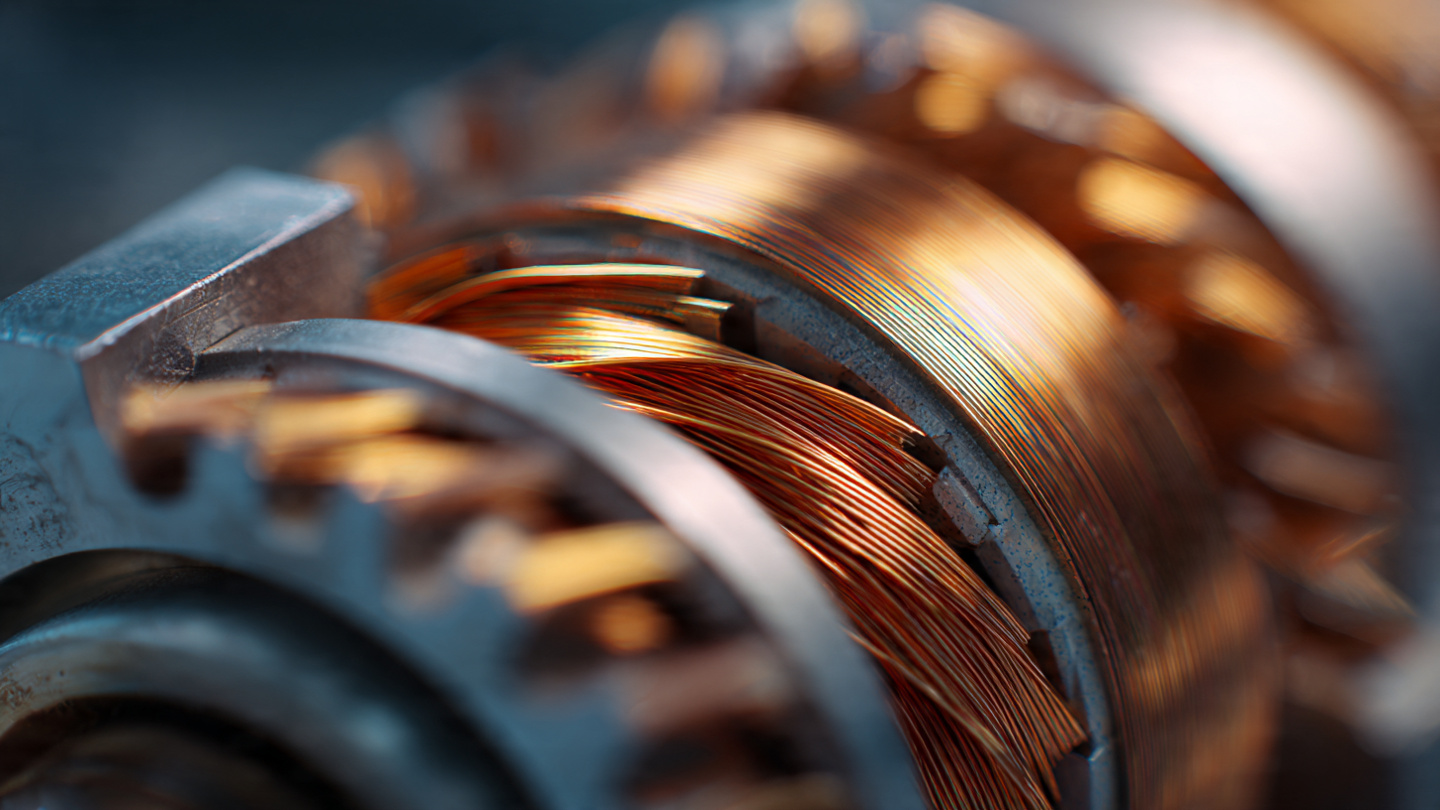
All four units are radial flux permanent magnet synchronous motors derived from the powertrains Ferrari developed for its GT racing program and the F80 hypercar. The rear pair are the larger units. Each produces 416 bhp and 262 lb-ft of torque, with rotors spinning at up to 25,500 RPM. At the front, two smaller motors contribute 141 bhp and 103 lb-ft each, reaching 30,000 RPM. The different peak speeds reflect different outer rotor diameters, different gear ratios, and different wheel sizes front to rear (23-inch front, 24-inch rear, the largest ever fitted to a Ferrari).
Combined system output reaches 1,036 bhp and 739 lb-ft, with a dramatic rear bias that reflects Ferrari's fundamental conviction about where driving pleasure originates, and with each front motor-and-gearbox module weighing just 65 kilograms, a figure that would be unremarkable for the gearbox alone in many performance cars, while the rear assemblies come in at roughly 130 kg each.
Ferrari rates combined system output at 1,050 cv (1,035 bhp), but the four motors' individual peaks sum to 830 kW: 210 kW from the front pair, 620 kW from the rears. The battery's peak discharge rate covers that full 830 kW, meaning the pack can sustain all four motors at their individual maximums simultaneously without thermal derating at launch. Battery, inverters, and motors are dimensioned so that peak power is a sustained engineering reality, not a two-second marketing number.
Side Slip Control X: 200 Updates Per Second
Having four independent motors is an enabler, but having a vehicle control unit capable of exploiting them in real time is what actually matters.
Ferrari's new Vehicle Control Unit, debuting on the Luce, manages all four motors independently with actuation targets refreshed 200 times per second through what Ferrari calls Side Slip Control X. Each wheel receives its own torque command. Not a shared front-rear split adjusted twice a second. Individual wheel-level control at a rate fast enough to intervene within a single degree of steering angle change at highway speed.
The system integrates torque vectoring, active suspension control, and independent rear-axle steering into a unified feedback loop. When a driver requests a steering input at speed, testing chief Raffaele de Simone described the result as a fusion where "you don't know if the main actors are the steering or the engines." Steering response is 15% faster than the Purosangue despite using an identical rack. The additional yaw authority comes entirely from torque manipulation across the four contact patches, not from mechanical changes to the steering geometry.
This is the core engineering argument for the Luce's claimed dynamic equivalence to a lighter car. Yaw moment of inertia is a function of mass distribution and distance from the center of gravity. By placing heavy motor modules at the axle lines rather than concentrating drivetrain mass centrally, and by lowering the battery pack's center of mass into the floor structure, Ferrari reduced rotational inertia by 15% relative to the Purosangue while simultaneously distributing torque to wherever the chassis needs it most, millisecond by millisecond. Weight does not disappear. But its rotational consequences can be counteracted.
The Electric Guitar Problem
Sound has been the existential anxiety of performance EVs since the category emerged. Strip away the intake howl, the exhaust note, the mechanical percussion of combustion, and you lose one of the primary emotional channels between car and driver. Most manufacturers have responded by either embracing silence or generating synthetic noise through speakers.
Ferrari rejected both options. What they built instead might be the most original piece of engineering on the entire car.
A precision accelerometer is mounted at the center of the rear axle, directly capturing the vibrations produced by the electric motors and gear sets as they rotate and mesh under load. That raw vibrational signal is filtered, equalized, and amplified through a system that operates on the same principle as an electric guitar's signal chain: a real physical vibration from the source instrument, processed and projected through an amplifier, retaining the harmonic structure of the original event while making it audible and emotionally resonant in the cabin.
Not synthesized from a library, not sampled from pre-recorded engine notes, not a V12 growl triggered by throttle position. The Luce's sound is rooted in the actual physics of its own rotating machinery, varying continuously with load, speed, and the unique micro-vibrations of each driving moment. Ferrari's team spent five years and logged 40,000 km of dedicated track testing developing the filtering and equalization algorithms that shape the raw signal into something that retains what de Simone called a "continuous harmonic structure with micro-variations that keep it from ever feeling artificial or repetitive."
It is optional and activated in Performance mode, which matters because Ferrari is not forcing synthetic emotion onto drivers who prefer the whisper of electric propulsion. But for those who want it, this approach sidesteps the fundamental problem with speaker-generated engine sounds: they are always divorced from what the machinery is actually doing. A pre-recorded growl synced to throttle position is karaoke. An amplified vibration from the drivetrain itself is a live performance.
Torque Shift Engagement: Power in Slices
Ferrari's steering-column paddles are iconic. Losing them in an electric car with no gearbox would feel like Ferrari without the Prancing Horse. Keeping them as fake gear-change simulators, the approach taken by Hyundai in the Ioniq 5 N, would feel worse.
Torque Shift Engagement does neither, and the way it works is more interesting than either alternative. The right paddle increases available power while the left paddle increases regenerative braking and simultaneously reduces the ceiling on acceleration, with five levels available in each direction. Pull a right paddle and roughly 0.2g of additional acceleration becomes available at full throttle. Pull a left paddle and the car decelerates at up to 0.33g on throttle lift alone, which de Simone noted is "more or less the same as the engine braking in a 12Cilindri in second gear."
In practice, this creates an active decision-making layer during corner management. Approaching a tight bend, the driver pulls left paddles to increase retardation and limit power, managing the car through the apex with a constrained torque envelope that prevents wheelspin on exit. On the straight, right paddles unleash the full 1,035 bhp. Any combination can be pulled at any speed. "It's not a fake gearbox," de Simone said. "The power is cut in slices, not speed. We keep the interaction, to keep decision-making active."
Whether this approach reproduces the visceral satisfaction of a downshift through a dual-clutch transmission remains to be discovered by the first journalists who drive the car, but the concept is genuinely original: no other production EV offers this specific form of driver-managed torque stratification, and instead of simulating something the car lacks, it creates something that could not exist without electric motors.
800 Volts, 210 Cells, Built in Maranello
The battery is a 122 kWh pack operating at 800 volts, co-developed with Korean cell manufacturer SK On but designed, assembled, and integrated entirely within Ferrari's Maranello facility. Its internal architecture reflects the floor-mounted packaging demands of a vehicle 5,026 mm long with a 2,961 mm wheelbase.
Two hundred ten cylindrical cells connect in series. They arrange into 15 modules of 14 cells each: one module sits centrally behind the front axle, followed by pairs mounted longitudinally toward the rear, with the final four modules stacked two-high beneath the rear seats. The pack weighs 630 kg and occupies much of the structural floor, acting as a stressed member that contributes to the body's torsional rigidity.
Peak charge rate reaches 350 kW. Ferrari quotes a more operationally relevant figure: 70 kWh replenished in 20 minutes, implying a sustained average charging rate of 210 kW over that window. WLTP range targets exceed 530 km, though homologation testing remains incomplete.
Ferrari buried a quiet but significant design philosophy inside the battery's modularity. Ninety percent of all Ferraris ever built remain on the road. A car sold in 2027 may still be driven in 2057. The Maranello-built pack is designed so that future cell chemistry can be installed into the existing pack architecture, the same way Ferrari currently produces F80-derived replacement packs for aging LaFerrari batteries. This is long-game engineering. Most EV manufacturers design batteries for the production run. Ferrari designed this one for the service life of the car across decades.
All Aluminum, No Steel, 35% Stiffer
The body-in-white contains no steel whatsoever, with the entire structure built from aluminum in three forms: extrusions for the primary load paths, castings for the complex junction nodes, and stamped sheets for the panel surfaces. Ferrari claims the Luce achieves 35% greater torsional rigidity than the Purosangue, a remarkable figure for a body that is both longer (5,026 mm vs. 4,973 mm) and lower (1,544 mm vs. 1,589 mm) than its V12 sibling.
Recycled aluminum alloys feature prominently. Ferrari does not disclose the exact recycled content percentage, but the word "recycled" appears in official materials alongside descriptions of the body structure, not as an afterthought in a sustainability appendix. The 47:53 front-to-rear weight distribution, with the center of gravity sitting 95 mm lower than the Purosangue, results directly from the floor-mounted battery pack and the lightweight upper structure.
One structural innovation stands out: Ferrari's first elastically mounted rear subframe. Rather than rigidly bolting the rear subframe to the body, the Luce isolates it with compliant mounts, significantly improving NVH characteristics. Lower suspension arms and the rear motor module attach to this subframe, meaning the entire rear drivetrain assembly is partially decoupled from the passenger cell. In a car weighing 2,260 kg with motors spinning at 25,500 RPM directly at the rear axle, controlling the transmission of high-frequency vibrations into the cabin is not a luxury. It is a structural necessity.
Active Suspension Without Anti-Roll Bars
The Luce runs double-wishbone suspension at all four corners, controlled by an evolution of the 48-volt Multimatic TrueActive spool-valve dampers first deployed on the Purosangue. These are not adaptive dampers with adjustable firmness. They are fully active units that can push and pull each wheel independently, eliminating the need for conventional anti-roll bars entirely.
Active roll cancellation, active pitch control, and active heave management are all handled by four spool valves receiving commands from the central vehicle dynamics controller at the same 200 Hz refresh rate governing the motor torque distribution. In the Luce iteration, the internal ball screw pitch has been increased by 20% compared to the Purosangue units, improving the dampers' ability to absorb vertical impacts. Each corner unit is also 0.5 kg lighter.
Chief product development officer Gianmaria Fulgenzi described the Luce as potentially "the most comfortable Ferrari ever produced." That phrasing from a company whose most comfortable previous offering was a V12 SUV designed primarily for rear-seat occupants suggests genuine confidence in the active system's ability to simultaneously manage body control at performance speeds and ride quality at urban ones. Two objectives that are, in passive suspension systems, fundamentally at war with each other.
Aerodynamics: Drag First, Downforce Second
Most Ferraris optimize for downforce. Splitters, diffusers, active aero surfaces, venturi tunnels. The Luce inverts this priority. For an EV, drag is range. Every unit of aerodynamic resistance translates directly into energy consumed per kilometer. Ferrari's aerodynamicist Matteo Biancalana stated it plainly: "Drag means range loss."
What emerges is Ferrari's lowest drag coefficient on any road car, 25% lower than the Amalfi while generating comparable downforce. The design team ran 2.5 times more CFD simulations than the Purosangue program required, reflecting how much aerodynamic optimization was worth in terms of real-world range.
Several functional details contribute. Front-door strake vents extract air from the front wheel arches. Rear arches vent at the trailing edge. Active cooling fins at the front open only when thermal management demands it, staying closed for minimum drag at cruise. Windscreen wipers mount vertically at the screen edges rather than across the base, maintaining the smooth profile of the glasshouse. Floating front and rear spoilers separate from the black passenger cell volume, allowing air to flow between body elements with minimal turbulence.
The two-tone design language, a dark glasshouse contained within a painted outer shell, is not purely aesthetic. By treating the upper volume as a smooth, inherently aerodynamic shape inserted within the lower body panels, the design creates natural channels for airflow management that would require explicit scoops and vents on a conventionally styled body. It is aerodynamic engineering disguised as a design choice, which is, arguably, the most Ferrari thing about the entire car.
Sixty Patents and a Deliberate Absence
Ferrari claims more than 60 new patents across the Luce program. That number, if accurate, places the Luce among the most patent-dense production vehicles in recent memory. Most new vehicle programs generate between 10 and 30 patents. Sixty suggests that Ferrari's engineering teams were working without templates from the company's existing combustion-powered portfolio, forced to invent solutions rather than adapt proven ones.
John Elkann, Ferrari's executive chairman, framed the Luce as "not going electric as a response to change, but as a decision to lead what comes next," which is marketing language, certainly, but the engineering record supports the claim more than it contradicts it. This is not a compliance car or a platform-shared derivative of an existing architecture or a rushed entry into a segment Ferrari felt obligated to address; it is the product of five years of development, in-house battery assembly, bespoke motors derived from the hypercar and racing programs, a body structure containing no shared panels with any existing Ferrari, and sixty patents.
Deliveries begin October 2026, priced at approximately 550,000 euros. Whether the Luce delivers on its dynamic promises will not be known until independent testing begins. Until then, the engineering stands on its own: four motors spinning at speeds that would destroy most production EV rotors, a body structure that eliminated an entire material category, a sound system that treats its own drivetrain vibrations as a musical instrument, and a torque management interface that creates a form of driver engagement impossible in any combustion car. Ferrari did not build an electric car. Ferrari built a car that could only be electric.