A Digital Twin in the Passenger Seat: Ferrari's 849 Testarossa
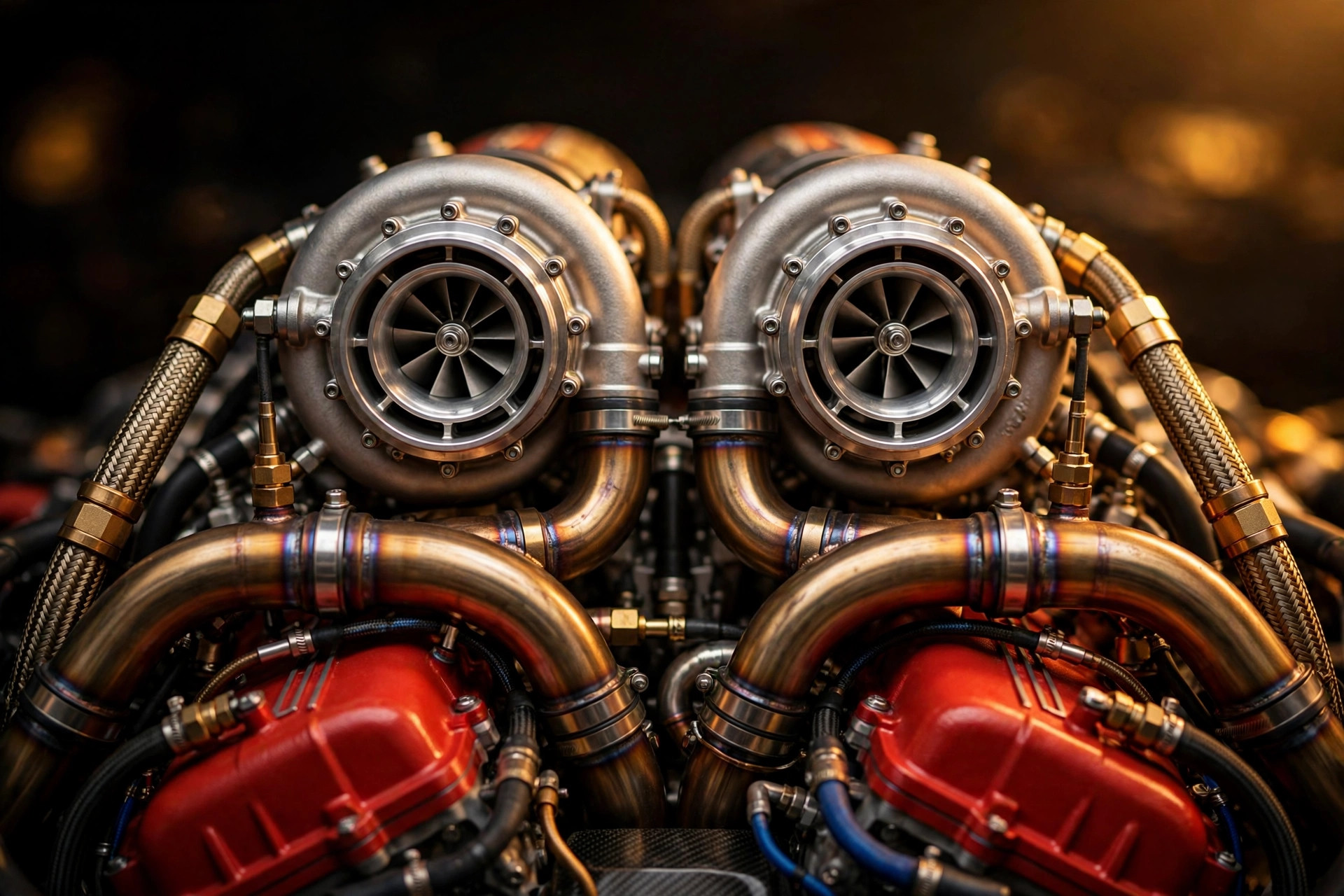
Ferrari named its new flagship with arithmetic.
Eight cylinders, 490 cc each: that is what 849 is supposed to mean, and Testarossa is the legend bolted onto the front of the sum, red head, the red-painted cam covers of the 1957 250 Testa Rossa. Revealed on September 9, 2025 as the replacement for the SF90 Stradale, the 849 Testarossa entered production in mid-2026 and reached first-drive reviewers in early 2026, with the Spider following the coupe into the press fleet by July. It is the most powerful series-production Ferrari ever built, and its name is a spec sheet wearing a ghost.
Even the arithmetic is approximate. Eight times 490 is 3,920 cc, seventy short of the actual 3,990, so the badge rounds down. That sloppiness is oddly fitting, because the car itself is an exercise in precision applied to a problem Ferrari has been circling for a decade: how do you hand a driver 1,036 horsepower, three electric motors, and all-wheel drive, and still have the result feel like a Ferrari rather than a PlayStation with a prancing horse on the boot screen?
Maranello's answer has two parts, and neither one is the horsepower figure. One is the largest pair of turbochargers ever fitted to a road Ferrari. The other is a computer that drives a digital copy of the car a fraction of a second ahead of the real one.
The biggest turbos Maranello has ever bolted to a road car
Start with the engine, because Ferrari clearly started there and refused to compromise on it. Internal code F154FC, a 3,990 cc twin-turbo flat-plane V8, makes 830 cv at 7,500 rpm and 842 Nm at 6,500 rpm, with an 8,300 rpm redline and a 9.54:1 compression ratio. Against the SF90's V8, that is roughly 50 cv more from the combustion engine alone, and the hardware list reads like a teardown report: new cylinder heads, a new engine block, reshaped intake plenums, Inconel exhaust manifolds with enlarged runners, titanium fasteners, an upgraded fuel rail, and a reshaped intercooler.
Headlining that list are the turbos themselves, the largest ever fitted to a production Ferrari, running low-friction bearings borrowed from the F80 hypercar and a turbine heat shield derived from the 296 GT3 race car. Big turbos are usually a bargain with lag, and Ferrari knows it, because the whole point of the bearing and heat-shield work is to keep a huge compressor spinning freely and hot without waiting for exhaust gas to catch up. First-drive reports suggest the bargain held: CAR magazine calls the part-throttle response fabulous with virtually imperceptible lag, and evo found the V8 simmering in the background at small throttle openings while hybrid torque did the early work, then surging without a step when asked.
There is a quieter detail in the engine castings, which now use recycled aluminum. Ferrari frames it as environmental awareness, and it is, but recycled castings also mean a second melt, tighter control of alloy composition, and a foundry process that has to be good enough that nobody can tell the difference in a part spinning to 8,300 rpm. Nobody at Maranello is going to admit the sustainability story doubles as a quality-control story. It does anyway.
Three motors, one of them axial
Behind the V8 sits the hybrid system, familiar in outline from the SF90 and reworked in the details. Two radial-flux motors drive the front wheels individually, forming Ferrari's RAC-e system for on-demand all-wheel drive and torque vectoring, while a single axial-flux MGU-K sits between the engine and the eight-speed dual-clutch gearbox. Together the three motors contribute 220 cv, bringing the combined total to 1,050 cv, about 1,036 horsepower, with 842 Nm from the engine alone.
Axial-flux at the rear and radial-flux at the front is not a styling choice. An axial motor is short along its shaft and wide across it, which makes it the right shape to sandwich into a driveline, while radial motors package neatly inside the front axle line where width is available and length is not. Ferrari is matching motor topology to packaging constraint the same way Toyota matched a conical gearset to the GR GT's transaxle, and the same way AMG matched axial-flux motors to the GT XX's drive units. Three manufacturers, three different answers to the same packaging exam.
All three motors draw from an 80-cell, 7.45 kWh lithium-ion battery, which buys up to 25 km of silent electric driving at speeds up to 130 km/h. That range figure is honest in the way only a small number can be: 25 km is enough to leave a neighborhood without waking it and not enough to pretend the car is an EV. Ferrari also leans on the front motors for reverse, so the gearbox never has to, which is a small packaging win that deletes an entire reverse gear set from an already crowded transmission.
FIVE, the twin in the passenger seat
Here is where the 849 stops being an SF90 with bigger turbos and becomes something new. FIVE stands for Ferrari Integrated Vehicle Estimator, a system first seen on the multimillion-dollar F80 hypercar, and it works by running a simplified mathematical model of the car in real time, fed by a 6D sensor measuring acceleration and rotation on all axes. Out of that model comes a live digital twin: an estimate of speed, yaw, and available grip at each tire, computed continuously, before the tires actually lose traction.
Most stability systems are reactive. They wait for a wheel to slip, then cut power or grab a brake. FIVE is predictive, which means the electronic differential, the e4WD front-axle torque distribution, and the traction control all act on an estimate of what is about to happen rather than a measurement of what just did. Paired with the new ABS Evo brake-by-wire system, Ferrari claims later, harder, and more repeatable braking, because the brake controller knows what the tires can take before the driver asks.
Put the three flagship answers side by side and the contrast is the story. Toyota's GR GT fills the torque hole during gear changes so acceleration never pauses. AMG's GT SUV cools continuously so its 530 kW never derates. Ferrari predicts grip so 1,036 horsepower never overwhelms the tires in the first place. One fills, one cools, one foresees. All three are responses to the same problem, which is that four-figure power has outgrown the driver's ability to manage it by feel alone, and the interesting engineering now lives in the layer between the driver's foot and the contact patch.
First drives back the theory, at least on dry roads. MotorTrend's Spider drive on Tenerife found the handoffs between electric motors and gas engine imperceptible in every mode, with a throttle gain so linear the reviewer stopped thinking about the powertrain entirely. CAR's coupe test at Monteblanco, in damp and greasy conditions on Cup 2 tires with the Assetto Fiorano pack, found the car deft and predictable where a 1,036 hp car on a greasy track has no business being either. Both reviewers use the same word for the experience, in different ways: easy. That is a strange word for a car this fast, and it is the word FIVE exists to earn.
Air, and where it goes
Downforce peaks at 415 kg at 250 km/h, 25 kg more than the SF90, with 35 percent of it generated by the underfloor rather than by wings. Cooling capacity is up 15 percent, which the bigger turbos made non-negotiable, and the active rear spoiler switches between low-drag and high-downforce configurations in under a second, contributing 100 kg in its high-downforce setting. Air that cools the engine is not wasted, because the same inlets feed the aero surfaces that keep the car planted, and the twin-tail rear treatment is part of that airflow management rather than decoration.
Opt for the Assetto Fiorano package and the deal changes: about 30 kg comes off, Multimatic dampers replace the standard setup, Cup 2 tires go on, and the rear wing swaps to a more aggressive configuration that, according to duPont Registry's reporting, uses twin rear wings to triple the downforce of the standard twin-tail setup. That is the package CAR tested at Monteblanco, and it is the package behind the 1:17.5 Fiorano lap, a time that sits two tenths behind the track-focused SF90 XX. A series-production car lapping within two tenths of the previous track special is the kind of number that reframes what series production means.
Spider buyers give up a little: 1:18.1 around Fiorano and about 90 kg over the coupe, the retractable hardtop's tax. MotorTrend's verdict on the open car was that the roof-down experience is the better one anyway, which is either a compliment to the Spider or an indictment of how little the extra mass matters when FIVE is doing the thinking.
The weight that did not happen
Dry weight is 1,570 kg, identical to the SF90 Stradale, and that flat number is the quietest achievement in the car. Bigger turbos, a reworked block, more cooling, and the same hybrid hardware should have added mass, and Ferrari's own reporting at launch acknowledged the hybrid system alone was expected to add more than 20 kg. Holding the scale flat meant finding that mass somewhere else: a lighter active spoiler, titanium fasteners throughout the engine, the recycled-aluminum castings, and a chassis that carries its 45:55 front-to-rear balance without ballast.
Weight distribution deserves a pause, because 45:55 in a mid-engine car with a front-axle drive system is not a given. Two motors and their inverters sit ahead of the driver, pulling mass forward, and the battery sits low and central, which is where it helps least for balance and most for center of gravity. Ferrari held the split anyway, which means the rear of the car carries the V8, the gearbox, the MGU-K, and the aero hardware, and the front motors were packaged as light as the topology allowed. Nobody publishes the front-axle mass figure. The lap time implies it is small enough.
What the name gets wrong
Testarossa is a heavy name to carry, and the 849 wears it awkwardly in one respect: the original 1984 Testarossa announced itself with side strakes feeding its flat-12's radiators, and the new car deliberately avoids them. Evo's review puts it plainly, calling the 849 more extrovert than the SF90 yet resistant to the obvious nostalgia trip of slats and strakes. Ferrari chose not to fake the cooling story, because the cooling story is now under the floor and behind the rear wing, where it belongs.
Sound is the other honest gap. Every first drive says some version of the same thing: the V8 is vocal but mechanical rather than musical, raw-edged like an LMP car, and no match for the V12 opera a Revuelto offers for similar money. A turbo V8 with the largest compressors Ferrari has ever fitted was never going to sing like a naturally aspirated twelve, and the hybrid motors fill the torque curve so completely that the engine rarely has to work in the vocal part of its range. Ferrari spent development effort on the sound and got a fast car that sounds fast, which is not the same as a Ferrari that sounds like a Ferrari.
That is the real tension in the car, and it is not a flaw so much as a trade. The 849 is the most powerful series-production Ferrari, the quickest around Fiorano short of the F80 and the SF90 XX, and the easiest 1,036 hp car to drive that anyone has yet built. It earns those superlatives with engineering, not with romance. The name promises red cam covers and a flat-12 wail. The car delivers arithmetic, a digital twin, and a turbo V8 that does its best work quietly. Most buyers will take the trade. Whether the name survives it is a question for the collectors, not the engineers.
Engineering judgment
FIVE is the story here, not the horsepower. A thousand horsepower stopped being a differentiator years ago, and the manufacturers who understood that first are now competing on the software layer that makes it usable. Ferrari's version is the most ambitious of the three flagship approaches, because prediction is harder than filling or cooling, and because a wrong prediction is worse than a late correction. If FIVE's grip estimate is optimistic on worn tires or a damp road, the car acts on a fiction. Ferrari's answer is the 6D sensor and the simplified model, which trades completeness for speed, and the first drives suggest the trade works, at least on fresh Cup 2s in southern Spain.
Caveats belong here, because I have not driven the car and every performance figure in this article is Ferrari's own, corroborated by first-drive reporting but not independently verified. Top speed is the one number where outlets disagree: Ferrari quotes more than 330 km/h, about 205 mph, while Auto Express reports more than 210 mph, and the two cannot both be the same claim. Treat the top speed as approximate until an independent test settles it. The 25 km electric range is a best case, the 1:17.5 lap is a manufacturer time on the Assetto Fiorano package, and the long-term question is whether FIVE's predictions stay honest as tires wear, sensors age, and owners skip software updates.
None of that diminishes what Maranello shipped. Ferrari took the largest turbos it has ever fitted to a road car, bolted them to a reworked V8 with race-derived bearings and heat shielding, wrapped the result in a hybrid system that deletes its own reverse gear, and put a computer in the passenger seat that knows what the tires are doing before the driver does. Then it held the weight flat, lapped Fiorano a second and a half quicker than the car it replaces, and named the result after a red-headed legend from 1957. The arithmetic on the badge is off by seventy cubic centimeters. Everything else adds up.
| Spec | 849 Testarossa (Ferrari figures) |
|---|---|
| Engine | F154FC 3,990 cc twin-turbo flat-plane V8, 9.54:1 compression |
| V8 output | 830 cv (819 hp) at 7,500 rpm, 842 Nm (621 lb-ft) at 6,500 rpm, 8,300 rpm redline |
| Electric motors | Two front radial-flux RAC-e motors plus one rear axial-flux MGU-K, 220 cv combined |
| Combined output | 1,050 cv (1,036 hp) |
| Battery | 7.45 kWh lithium-ion, 80 cells, 25 km eDrive up to 130 km/h |
| Transmission | 8-speed dual-clutch, front motors provide reverse |
| 0-100 km/h | Under 2.3 seconds |
| 0-200 km/h | 6.35 seconds |
| Top speed | More than 330 km/h (about 205 mph); Auto Express reports more than 210 mph |
| Fiorano lap | 1:17.5 coupe, 1:18.1 Spider |
| Downforce | 415 kg at 250 km/h, 35% from underfloor, active spoiler 100 kg in high-downforce mode |
| Dry weight | 1,570 kg, 45:55 front/rear |
| Vehicle dynamics | FIVE digital twin with 6D sensor, ABS Evo brake-by-wire, eDiff, e4WD |
| Assetto Fiorano | About 30 kg lighter, Multimatic dampers, Cup 2 tires, twin rear wings |
I have not driven the 849 Testarossa. Everything here comes from Ferrari's published specifications and magazine coverage, the September 9, 2025 reveal reporting in duPont Registry and carsales, first drives in CAR magazine, evo, MotorTrend, and Drive, and the engineering background on axial-flux and radial-flux motor packaging. If the production car's FIVE calibration differs from the press cars, or if the top-speed discrepancy resolves against Ferrari's figure, the judgment above needs revisiting. Both are worth checking before treating any single number as settled.
Sources
- Ferrari, "Ferrari 849 Testarossa," Ferrari magazine, documenting the 1,050 cv combined output, 830 cv V8, three electric motors, 0-100 km/h in under 2.3 seconds, top speed beyond 330 km/h, Fiorano lap of 1:17.5, 25 km electric range, and FIVE as a real-time digital twin.
- duPont Registry, "Ferrari Revives the Testarossa Name With 1,036-HP Hybrid Coupe and Spider," September 9, 2025, reporting the reveal, 1,036 hp combined output, 62 mph in under 2.3 seconds, 124 mph in 6.35 seconds, Fiorano 1:17.5 coupe and 1:18.1 Spider, 915 lb downforce at 155 mph, active spoiler switching in under a second, twin rear wings tripling downforce over the standard twin-tail setup on the Assetto Fiorano package, Spider weight 3,660 lb, and European deliveries from mid to late 2026.
- CAR magazine, "Ferrari 849 Testarossa (2026) review," reporting the 1,036 bhp figure, 0-62 mph in 2.25 seconds, 0-124 mph in 6.35 seconds, 205 mph top speed, 1,570 kg dry weight, FIVE as the big news, 49 bhp gain for the V8 from a new turbo design, revised heads, block, manifolds, plenums, titanium fasteners and valvetrain, all-wheel drive below 130 mph, and the Monteblanco track test in damp conditions with the Assetto Fiorano pack.
- evo, "Ferrari 849 Testarossa review," February 2, 2026, reporting the SF90 successor brief, 1,036 bhp combined output, 819 bhp V8 plus 217 bhp electric, 2.3 seconds to 62 mph, 6.35 seconds to 124 mph, top speed above 205 mph, 1,570 kg dry weight, 1,772 kg dry weight for the Revuelto comparison, the deliberate avoidance of strakes nostalgia, and the Andalucia road and track test.
- MotorTrend, "2027 Ferrari 849 Testarossa Spider First Drive," July 21, 2026, reporting the Tenerife road test, imperceptible handoffs between electric motors and gas engine, linear throttle gain, Pirelli P Zero R tires, 1,035 hp and 621 lb-ft, and the eManettino drive modes.
- Drive, "2026 Ferrari 849 Testarossa review: International first drive," reporting the largest turbochargers ever fitted to a road Ferrari, turbine heat shield from the 296 GT3, low-friction bearings from the F80, 773 kW combined output, 842 Nm torque, recycled aluminum engine castings, 7.45 kWh battery with 25 km electric range, FIVE as a digital twin fed by a 6D sensor, ABS Evo brake-by-wire, and 15 percent more cooling.
- Auto Express, "New Ferrari 849 Testarossa: famous name, massive power and stunning looks," September 9, 2025, reporting 1,035 bhp, 818 bhp from the V8, 415 kg downforce at 155 mph with 35 percent from the underfloor, active rear wing switching in under a second for 100 kg of downforce, 0.2 seconds off the SF90 XX at Fiorano, and top speed of more than 210 mph.
- carsales, "2026 Ferrari 849 Testarossa unleashed," September 10, 2025, reporting the 772 kW combined output, 37 kW and 38 Nm gains, two radial front motors at 162 kW combined with a next-generation axial-flux rear motor, 8,300 rpm redline, 15 percent more cooling, and production beginning before the end of 2025 with Australian deliveries in the second half of 2026.