Four Lobes, 160 Degrees: How Eaton's TVS Supercharger Rewrote the Roots Blower
Cadillac announced the CT5-V Blackwing F1 Collector Series at the Miami Grand Prix in early May 2026. Limited to 26 units, it produces 685 horsepower, making it the most powerful internal-combustion Cadillac ever built. Publications led with the exclusivity angle, the F1 branding, the matte Midnight Stone Frost paint. But the engineering change that produced those 17 additional horsepower was almost comically modest: a slightly smaller drive pulley and a taller lid on the supercharger housing.
That the most powerful Blackwing in history required nothing more than two dimensional tweaks to an existing supercharger says something important about the component underneath. Eaton's TVS R1740 is not a blunt instrument strapped to an engine for raw power. It is a precision air pump refined over three decades of Roots-type supercharger development, operating at the intersection of rotor geometry, thermodynamics, and packaging constraints that most forced-induction coverage ignores entirely.
From Straight Lobes to Twisted Rotors
Philander and Francis Roots patented their positive-displacement air pump in 1860 for blast furnace ventilation. By the 1930s, automotive engineers had adapted the concept for forced induction: two meshing rotors spinning inside a tight-clearance housing, trapping pockets of ambient air and pushing them into the intake manifold at above-atmospheric pressure. Early Roots blowers used straight-cut lobes. Air entered one end of the rotor pair and exited the other in discrete, violent gulps. Each lobe pass created a pressure pulse, generating the characteristic whine that defined supercharged muscle cars for decades. Thermodynamic efficiency was secondary to the brute simplicity of the design.
Eaton entered the automotive supercharger business in the early 1990s with its M-series blowers. Ford's 1996 Mustang Cobra received the M90 (900cc per revolution), and the 2003 SVT Cobra used the larger M112 (1,120cc). These units improved on primitive Roots designs by introducing a 60-degree helical twist to three lobes, which smoothed the airflow transition between intake and discharge. But three lobes meant each rotor only had three sealing events per revolution, creating noticeable pulsation at low speeds and significant noise at high rpm. Parasitic drag was substantial. Outlet air temperatures climbed quickly under sustained load, limiting both power output and the durability of downstream components.
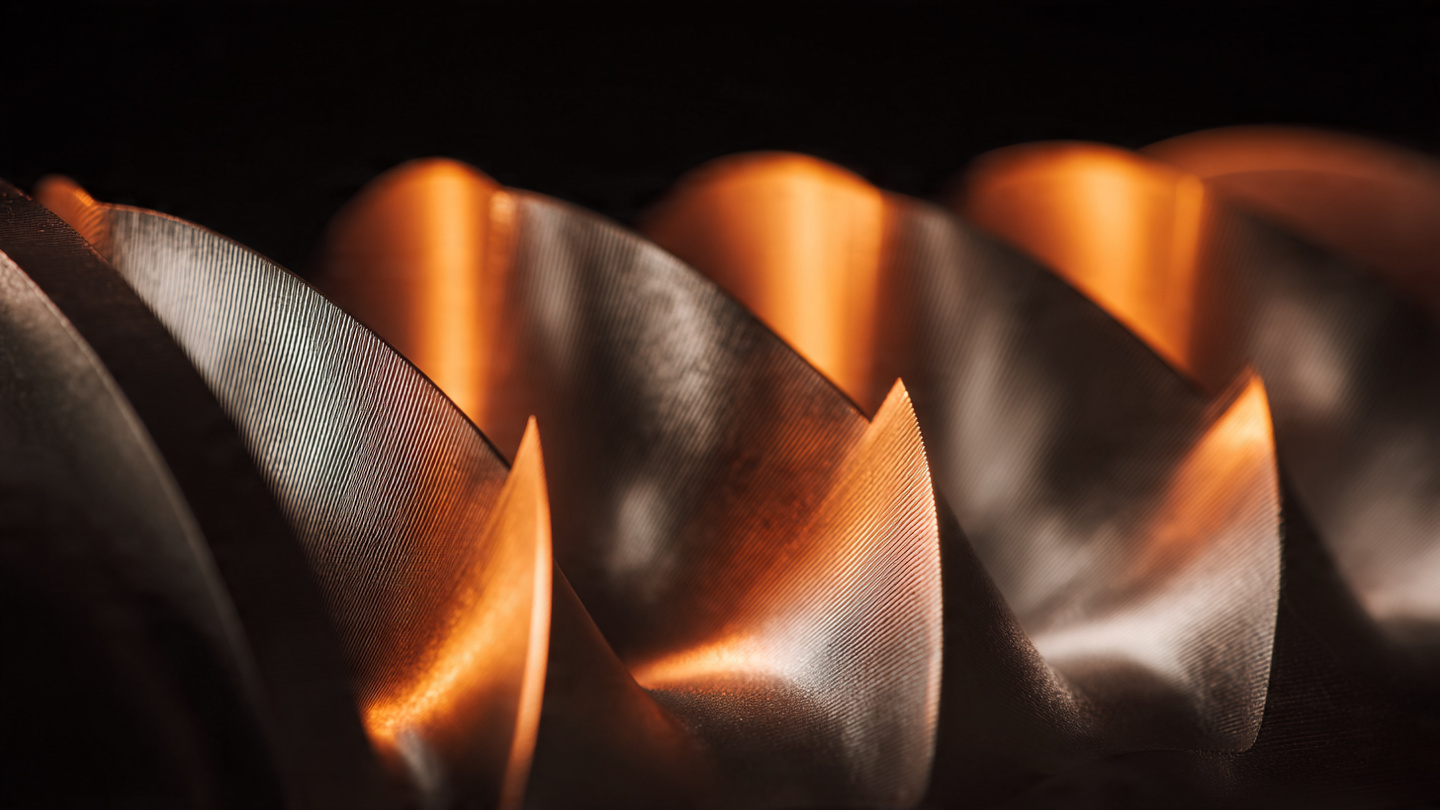
In the mid-2000s, Eaton's engineering team in Marshall, Michigan, developed the Twin Vortices Series as a clean-sheet replacement. Two changes defined the new architecture. First, rotor count increased from three lobes to four. Second, helix angle more than doubled, from 60 degrees to 160 degrees. Both modifications addressed the fundamental weakness of every Roots-type blower: because it is a positive-displacement pump without internal compression, all pressure rise occurs at the discharge port, where incoming air collides with higher-pressure air in the manifold. That collision is what makes Roots blowers noisy and thermally wasteful. Reducing the violence of that collision was the entire design objective.
Why 160 Degrees Matters
A four-lobe rotor with a 160-degree twist creates dramatically different airflow behavior compared to a three-lobe rotor with a 60-degree twist. At any given instant, more of each lobe is engaged with the housing bore, which means the sealing line between the rotor tip and housing wall is longer and more continuous. Air moves through the rotor pair in a smoother, more helical path rather than in the abrupt, piston-like gulps of a low-twist design.
Consider what happens at the discharge port. With straight or low-twist lobes, a pocket of trapped air suddenly opens to the higher-pressure manifold all at once. Manifold air rushes backward into the pocket, creating a momentary backflow event that generates noise, heat, and wasted energy. With a 160-degree twist, the pocket opens to the discharge port progressively along the length of the rotor. Air does not burst into the manifold in a single event. Instead, it transitions continuously as the rotor turns, blending into manifold pressure over a longer angular span. Each sealing event overlaps with the next, producing four smooth handoffs per revolution instead of three jarring ones.
Eaton measured the practical results. Noise dropped by roughly half compared to the M-series at equivalent boost levels. Thermal efficiency exceeded 70 percent across the operating range, meaning less input energy was wasted as heat. Parasitic drag decreased because the smoother airflow reduced the pumping work required at any given pressure ratio. And critically, the four-lobe design allowed the rotors to be physically shorter and smaller in diameter while delivering the same displacement per revolution, because each lobe carried a proportionally larger share of the trapped-air volume.
R1740: Smaller, Faster, Hotter
When GM developed the Gen V LT4 engine for the 2015 Corvette Z06, the previous-generation LS9 in the outgoing ZR1 served as the engineering baseline. Both engines displace 6.2 liters. Both use superchargers sitting in the intake valley atop the block. But the supercharger GM selected for the LT4 was strikingly different from the one in the LS9.
For the LS9, Eaton supplied the R2300, a TVS unit displacing 2,300cc per revolution. Its rotors measured 4.4 inches in diameter and 8.3 inches long. It spun at a maximum of 15,000 rpm through a 2.32:1 drive ratio off the crankshaft, producing 9.7 psi of peak boost. Total system output was 638 horsepower.
GM's engineers chose the smaller R1740 for the LT4: 1,740cc per revolution, with rotors measuring 3.9 inches in diameter and 7.9 inches long. Smaller rotors meant lower rotating inertia, faster spool-up response, and a more compact package that fit within the LT4's requirement to be only one inch taller than the naturally aspirated LT1. To compensate for the reduced displacement, GM increased the drive ratio to 3.10:1, spinning the R1740 up to 20,150 rpm, more than 5,000 rpm faster than the R2300 had ever turned.
Running a smaller supercharger faster rather than a larger one slower was a deliberate trade. A smaller-diameter rotor at higher rpm moves the same volume of air but does so with less moment of inertia, which means less rotational energy stored in the rotor mass. Response to throttle changes is quicker. Transient boost recovery after a gear change is faster. And because the rotor tips are closer to the center of rotation, centrifugal loads on the rotor tips are lower at any given rpm, despite the higher absolute speed. Eaton validated this by working with GM on bearing durability analysis, ensuring the R1740's grease-packed ball bearings could survive 20,000-plus rpm across the engine's intended service life.
Peak boost in the LT4 application measures 9.4 psi, marginally lower than the LS9's 9.7 psi. But the power output is meaningfully higher: 650 horsepower at 6,400 rpm in the original Z06 application, and 668 horsepower in the CT5-V Blackwing's calibration. Where did the extra power come from if boost was lower? From everything surrounding the supercharger: revised cylinder heads with larger CNC-machined combustion chambers, stronger forged internals, direct injection combined with port fuel injection, and an improved intercooling system that kept charge-air temperatures lower, allowing more aggressive spark timing before knock became a limiting factor.
Intercooling in the Valley
Compressing air generates heat. At 9.4 psi of boost, the R1740 raises intake air temperature significantly above ambient. Hot air is less dense than cool air, which means it carries fewer oxygen molecules per unit volume. Fewer oxygen molecules means less fuel can be burned per combustion event, directly limiting power output. Worse, hot intake charges are more prone to detonation, the uncontrolled ignition event that can destroy pistons and head gaskets in milliseconds. Every supercharged engine needs a strategy for removing that heat before the compressed air reaches the combustion chamber.
In the LT4, GM integrated the intercooler directly into the supercharger assembly. Two bar-and-plate heat exchangers, commonly called intercooler bricks, sit inside the manifold plenum between the supercharger's discharge port and the intake runners feeding each cylinder. Compressed air exits the rotor pair, flows downward through the intercooler bricks, and enters the intake runners cooled by 50 to 80 degrees Fahrenheit depending on ambient conditions and load.
A separate low-temperature cooling circuit services the intercooler bricks. This circuit has its own coolant reservoir, electric pump, and dedicated heat exchanger mounted in front of the radiator, isolated from the engine's primary cooling system. Keeping the intercooler circuit independent ensures that rising engine coolant temperatures during hard driving do not compromise charge-air cooling. At a track like Laguna Seca, where sustained high-load corners follow each other without recovery straights, the ability to reject heat from the intake charge independently of engine cooling is the difference between consistent power output and progressive heat soak that pulls timing and costs horsepower with each successive lap.
GM's engineers devoted considerable CFD resources to the discharge port geometry, optimizing the path air takes as it exits the rotor pair and turns into the plenum area above the intercooler bricks. Air leaving a positive-displacement supercharger carries significant turbulence from the rotor-to-housing interaction. If that turbulent flow hits the intercooler bricks at poor angles, heat transfer efficiency drops and pressure losses increase. John Rydzewski, assistant chief engineer for GM's small-block program, described this as one of the most intensive computational efforts in the LT4's development. Finite-element analysis ensured the housing structure maintained tight bore geometry under thermal and mechanical loading, because even small distortions in the gap between rotor tip and housing wall would increase internal leakage and reduce volumetric efficiency.
What GM Motorsports Changed for the F1 Edition
For the CT5-V Blackwing F1 Collector Series, GM Motorsports made two targeted modifications to the R1740 assembly. Neither required changes to the rotors, bearings, gears, or fundamental architecture. Both operated on the boundary conditions surrounding the existing hardware.
First, the drive pulley diameter decreased, raising the supercharger drive ratio from 3.14:1 to 3.24:1. In the standard Blackwing, the crankshaft spins the supercharger at 3.14 times engine speed. In the F1 edition, every crankshaft revolution turns the rotors 3.24 times. At a given engine rpm, this means the rotors spin approximately 3.2 percent faster, trapping and compressing slightly more air per unit time. More air into the same displacement engine, combined with the additional fuel required to maintain stoichiometric mixture, produces more power. It is the oldest trick in supercharger tuning, and it works because the R1740's bearing and rotor systems were engineered with margin beyond the standard application's demands.
Second, GM Motorsports replaced the standard cast supercharger cover with a taller unit machined from CNC billet aluminum. The taller cover increases the air volume within the supercharger housing above the rotor pair. A larger plenum volume serves as a thermal buffer during sustained high-load operation, giving hot compressed air slightly more residence time and expansion volume before entering the intercooler bricks. Under track conditions where the engine operates at or near full throttle for extended periods, this additional volume helps manage charge-air temperature creep that would otherwise force the engine control module to retard ignition timing as a knock-prevention measure. Retarded timing costs power. A cooler charge prevents it.
Combined, these two changes produced 17 additional horsepower (685 versus 668) and 14 additional lb-ft of torque (673 versus 659). GM Motorsports also CNC-machined the F1 logo into the new cover and laser-etched FIA markings, but those modifications did not contribute to the power increase.
Crankshaft-Driven: Simplicity as Engineering Advantage
Every discussion of forced induction eventually reaches the turbocharger comparison. Modern twin-turbo V8s from Mercedes-AMG, BMW, and Porsche produce extraordinary power with high efficiency. Turbochargers recover energy from exhaust gas that would otherwise be wasted, making them thermodynamically elegant in ways a crankshaft-driven blower cannot match. A roots supercharger consumes engine power to compress intake air. A turbocharger harvests otherwise-lost exhaust energy to do the same work.
But the engineering calculus is more nuanced than raw thermodynamic accounting suggests. A turbocharger's boost response depends on exhaust gas flow, which depends on engine speed and load. At low rpm and part throttle, exhaust energy is insufficient to spin the turbine fast enough to generate meaningful boost. This creates turbo lag: the delay between the driver's throttle input and the engine's power response. Anti-lag systems, electric compressors, and twin-scroll housings mitigate the problem but never fully eliminate it.
A Roots-type supercharger produces boost proportional to engine speed from the moment the crankshaft turns. At 1,500 rpm in a parking garage, the R1740 is already pumping air. At 2,500 rpm merging onto a highway, it delivers 90 percent of peak torque. Boost builds linearly and predictably because the relationship between crankshaft speed and rotor speed is fixed by the drive pulley ratio. No exhaust gas mass flow dependency. No spool-up delay. No wastegate to manage. For a 4,100-pound luxury sedan that must feel immediate and authoritative from idle to redline, this characteristic matters more than peak specific power.
Parasitic cost is real. At wide-open throttle, the R1740 consumes roughly 60 to 80 horsepower of crankshaft energy to compress air, energy that a turbocharger would recover from exhaust enthalpy. But at cruise and part throttle, a bypass valve opens to recirculate supercharger output back to the inlet, unloading the rotors so they spin freely without compressing air. Parasitic losses drop to bearing friction and belt drag, typically a few horsepower at most. On the highway at 70 mph, the LT4's fuel economy rivals that of its naturally aspirated LT1 stablemate because the supercharger effectively disappears from the drivetrain's energy budget.
Sizing Philosophy: Displacement Is Not Destiny
Eaton's TVS family spans from the R410 (410cc per revolution, used on engines as small as 1.0 liter) to the R2650 (2,650cc, used on Ford's 5.2-liter Predator V8 in the Shelby GT500). A 2022 aftermarket addition, the X3100, pushed displacement further to 3,100cc with a return to a three-lobe design, using a wider lobe profile to increase per-revolution volume while maintaining the same physical footprint as the R2650.
GM's choice of the R1740 for a 6.2-liter V8 was deliberately conservative in displacement. Rather than sizing the supercharger for maximum airflow at peak rpm, GM sized it for the broadest possible torque band. A supercharger that is too large for its engine produces excessive boost at high rpm but bleeds off boost at low rpm through internal leakage. One that is too small reaches its flow limit before the engine reaches redline, effectively creating a power ceiling. At 1,740cc per revolution driven at 3.10 to 3.24 times crank speed, the R1740 sits in a sweet spot: it produces meaningful boost by 2,000 rpm and does not run out of airflow capacity before the LT4's 6,400 rpm power peak.
Ford took the opposite approach with the GT500's Predator engine. A 2,650cc R2650 spinning at a lower drive ratio delivers comparable peak boost to the LT4's R1740 but with more reserve airflow capacity at high rpm. Ford's engine revs higher (7,500 rpm) and makes more power (760 hp), but the torque curve peaks later and the supercharger package is physically larger. Neither approach is wrong. Each reflects its manufacturer's priorities: GM optimized for low-end response in a heavy sedan. Ford optimized for high-rpm output in a dedicated sports car.
Beyond Supercharging: TVS as Industrial Air Pump
Eaton markets TVS technology for applications beyond automotive forced induction. Fuel-cell compressors use TVS rotors to pressurize hydrogen and oxygen feed streams, exploiting the design's oil-free operation (critical for membrane durability) and precise volumetric delivery. Marine applications put TVS blowers on jet ski engines where instant throttle response at any rpm prevents the potentially dangerous lag that turbochargers introduce on water. Eaton claims the TVS platform improves efficiency by up to 12 percent across these non-automotive applications compared to conventional positive-displacement alternatives.
This industrial breadth feeds back into the automotive product. Manufacturing volume across multiple industries drives down per-unit rotor costs. Engineering lessons from fuel-cell durability testing inform bearing life predictions at automotive speeds. And each new sizing variant developed for a marine or industrial customer expands the portfolio available to future automotive programs.
What a Pulley and a Lid Reveal
Engineering maturity shows itself in the narrowness of the interventions required to extract more performance. An immature system needs wholesale redesign to gain 17 horsepower. A mature one needs a pulley swap and a taller lid. That Cadillac could hand the R1740 to GM Motorsports and receive 685 horsepower back from two dimensional changes speaks to the margins Eaton and GM built into the original LT4 program.
Bearing life was validated beyond the standard application's demands. Rotor-tip clearances were set with thermal growth calculations that accounted for sustained track temperatures. Housing rigidity was verified through FEA to maintain bore geometry under conditions more severe than a street car would encounter. When GM Motorsports spun the rotors slightly faster and gave the housing slightly more air volume, they were spending margins that the original engineering team had deliberately banked.
Roots-type superchargers will not power the next generation of performance cars. Electric motors, turbochargers, and compound boost systems are displacing them in every segment. But for the vehicles that still use them, including the CT5-V Blackwing in what may be its final production years, the engineering inside the R1740 deserves recognition. It took Eaton three decades and a fundamental redesign of rotor geometry to transform a 165-year-old air pump into something that spins at 20,000 rpm, fits under a factory hood, and extracts 685 horsepower from modifications a competent shop could execute in an afternoon. Not every engineering achievement announces itself with revolutionary fanfare. Some just twist four lobes 160 degrees and let the airflow do the talking.
Sources
- Eaton Corporation, “TVS R1740 Supercharger” product specification sheet, eaton.com.
- EngineLabs, “High-revving Supercharger Key to LT4’s Impressive Power Curve,” enginelabs.com, 2014.
- FordMuscle, “Inside TVS Supercharger Technology,” fordmuscle.com, featuring Eaton’s Grant Terry.
- GM Authority, “Cadillac CT5-V Blackwing F1 Collector Series Gets a New Supercharger,” gmauthority.com, May 5, 2026.
- MotorTrend, “Cadillac CT5-V Blackwing F1 Collector Series Is a Rear-Drive Manual Monster With More Power,” Justin Banner, May 1, 2026.
- GM Powertrain, John Rydzewski, Assistant Chief Engineer, Small Block Program. Interview excerpts via EngineLabs.
- Hot Rod, “The 2015 Corvette Z06’s LT4 V8,” hotrod.com, 2014.
- Eaton Corporation, “TVS Technology Overview,” eaton.com/superchargers.