A Day of Drift Per Millennium: De Bethune's DB25 Digitale and the Gear Train Behind It
Unveiled at Geneva Watch Days 2026, the DB25 Digitale pairs a jumping-hour aperture with a rotating minute disc and a spherical moon phase whose gearing drifts one lunar day every 1,112 years. Inside, the third-generation Calibre DB2144V3 runs a titanium balance with grey-gold inserts, a silicon escape wheel, and a display that rolls on micro ball bearings.
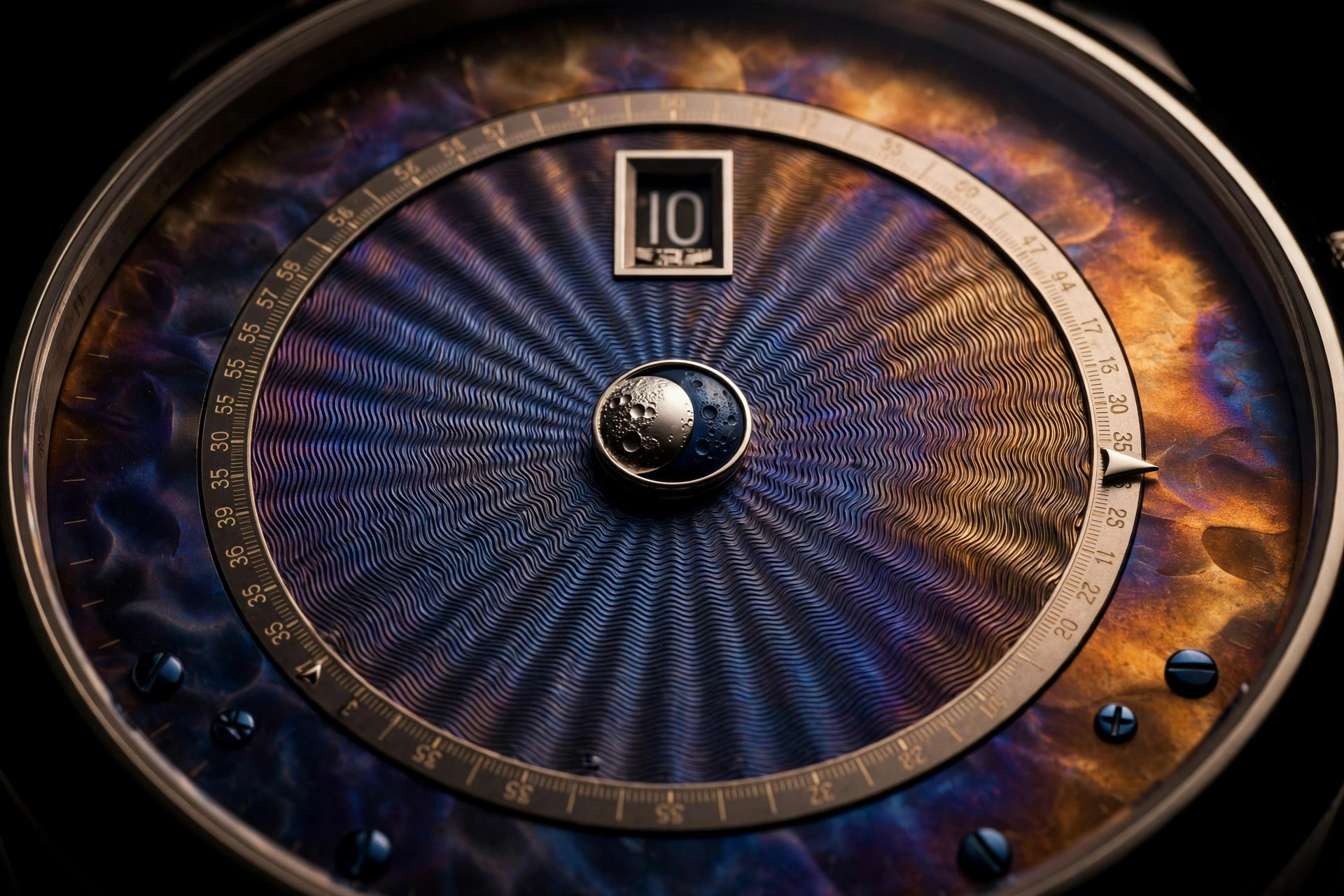
De Bethune promises the moon on its new DB25 Digitale will be wrong by exactly one day. One lunar day of drift, across 1,112 years. Buy the watch at Geneva Watch Days, wear it for a lifetime, hand it to your heir, and the moon indicator still owes you less than a single correction through the fall of everything built after the year 914.
This is a watch with no hands. Hours appear as a jumping numeral in an aperture at twelve; minutes ride a rotating disc at six; a polished sphere of palladium and flame-blued steel floats at the center, tilted at sixty degrees, waxing and waning in three dimensions while you read the time around it. Eighty-two separate components make up the dial alone, and the whole display turns on a micro ball-bearing mechanism buried under the blued titanium.
Nothing about that is practical, which is the entire point. Denis Flageollet, De Bethune's co-founder and master watchmaker, frames the intent without apology:
"To break free from the traditional codes of telling the time is to open up a space for creation: working deep into the material, exploring finishes, playing with light, until an almost painting-like harmony emerges. Time is no longer something you register, it becomes something you contemplate."
The math behind the moon
Most moon phases cheat, and the cheat has a number: fifty-nine. A conventional moonphase wheel carries fifty-nine teeth and advances one tooth per day, so one full rotation covers two nominal lunar months of twenty-nine and a half days each. The actual synodic month runs 29.53059 days, which means the shortcut loses 0.0306 days per cycle, and the error compounds to a full day in roughly two years and eight months. That is why the feature comes with a corrector you will eventually use.
De Bethune replaces the shortcut with a compound gear train whose ratio lands far closer to the true month, and the 1,112-year claim tells you exactly how close. One day of drift per 1,112 years means about 13,751 lunar months per day of error, which implies the train's month value deviates from the real synodic month by roughly six seconds per month. Six seconds. The brand's spherical moonphase architecture dates to a 2004 patent, and two decades of refinement have turned it into a parts-per-million problem solved with brass and steel. That ratio math is my own inference from the stated accuracy, not a published gear count, but the arithmetic is unforgiving either way: to be right for a millennium, the train has to be wrong by almost nothing.
Accuracy expressed in centuries is the opposite of useful and exactly the kind of engineering that deserves a column like this one. Nobody needs a moon phase that outlives the building it is sold in. Building it anyway is the whole discipline.
A digital watch with no electronics
Jumping-hour displays are a lineage, not a novelty. Aperture time readouts go back to the guichet watches of the early twentieth century, and the seventies put glowing numerals in cases before quartz made the idea cheap. What De Bethune did differently starts with the bearings, because the hour numeral wheel and the minute disc are large, heavy components sitting far out on the movement's radius, exactly where conventional jewel bearings would bleed friction. So the display rolls on micro ball bearings: a rolling-element solution inside a world of sliding pivots.
That choice is really about energy management. The snap of a jumping hour is a torque event, stored energy released in a fraction of a second, and if the friction budget is wrong the numeral either lands late or steals energy the moon train needs for its slow, precise crawl. Hence the movement's self-regulating twin barrel, a De Bethune innovation from 2004 that exists to flatten the torque curve across the calibre's five-day reserve. A jump mechanism fed by dying torque on day four would make a mockery of the precision printed on the dial, so the barrel and the bearings are not separate stories. They are the same story told from opposite ends.
Calibre DB2144V3, the third generation of the architecture, measures thirty millimeters across, carries four hundred sixteen components and thirty-two jewels, beats at 28,800 vibrations per hour, and stores its five days in that twin barrel. Turn the watch over and the deltoid bridge wears De Bethune's random guilloche for the first time, a visual rhyme between the dial and the movement, over a concave titanium mainplate and a hand-bevelled titanium barrel bridge.
Titanium that thinks about air
Buried in the specification sheet is the detail I keep coming back to: a titanium balance wheel with grey-gold inserts, patented in 2004 and reworked in 2016 for temperature stability and aerodynamic efficiency. Aerodynamic efficiency sounds like copywriting until you remember that the balance beats 28,800 times an hour, its rim sweeping back and forth through the air on every oscillation. Shaping the wheel to disturb less air is the same impulse that puts dimples on a golf ball, and it sits alongside the brand's flat-terminal-curve balance spring, a silicon escape wheel the maison adopted in 2005, well before silicon became industry furniture, and the triple pare-chute shock absorber that wears its inspiration from Abraham-Louis Breguet openly.
The dial's blue is not a coating either. De Bethune flame-blues its titanium: controlled heating grows a titanium-oxide film whose thickness selects which wavelengths reflect, a thin-film interference effect from the same physical family as the structural color on Casio's recent MR-G anniversary bezel, achieved here with heat instead of a laser. Over that oxide, the random guilloche, a De Bethune invention from 2023, breaks the pattern so no two angles of light repeat, while the silvered minute sector gets the traditional barleycorn cut by hand and grey-gold stars ring the moon. The case is mirror-polished Grade 5 titanium, forty-two millimeters across and 11.9 thick, which undersells the work: titanium resists polishing, galling and smearing where steel cuts clean, and De Bethune polishes it anyway, bullet lugs and all.
What one hundred six thousand francs buys
De Bethune prices the DB25 Digitale, reference DB25VD, at CHF 106,000 before taxes, and it is not a limited edition, which puts it in strange company. The useful comparison comes from Watchonista's coverage: A. Lange and Sohne's Zeitwerk starts at EUR 104,000 including taxes and adds jumping minutes to its jumping hours, a complication the De Bethune does not attempt. Inside the brand, the DB28XS Starry Seas sits at CHF 77,000 and the Starry Varius range opens at CHF 65,000, so the Digitale is the dearest ticket in the hand-free display line that began with the DBD and passed through the DB28 Digitale. A Zeitwerk buyer cross-shopping this is really choosing between German industrial maximalism and Genevan poetic engineering, and I would not argue with either pick.
Here is the honest accounting. The money buys a movement that was already interesting twenty years ago and has spent two decades being refined, a moon phase that stays honest longer than the building it is sold in, and a dial that eighty-two components conspire to make look effortless. A quartz Casio tells the time for less. It always does. What the extra five figures buy is a machine that treats the lunar month as a parts-per-million problem and answers it with gears. Worth it is a taste question. The engineering is not.
Specifications
| Reference | DB25VD |
|---|---|
| Case | Mirror-polished Grade 5 titanium, 42 × 11.9 mm, openworked bullet lugs |
| Display | Jumping-hour aperture at 12, rotating minute disc at 6, micro ball-bearing drive |
| Moon phase | Central spherical indication, palladium and flame-blued steel hemispheres tilted at 60°, accurate to one lunar day per 1,112 years |
| Dial | Blued titanium, random guilloché (82 components), silvered barleycorn minute sector, grey-gold stars |
| Movement | Calibre DB2144V3, hand-wound, 30 mm, 416 components, 32 jewels |
| Frequency | 28,800 vph (4 Hz) |
| Power reserve | 5 days, self-regulating twin barrel |
| Regulating organs | Titanium balance with grey-gold inserts, flat-terminal-curve balance spring, silicon escape wheel, triple pare-chute shock absorber |
| Crystals | Sapphire front and back, double anti-reflective coating |
| Water resistance | 3 ATM |
| Strap | Extra-supple dark blue alligator, hand-stitched; polished Grade 5 titanium pin buckle |
| Edition | Not limited |
| Price | CHF 106,000 before taxes |
| Announced | Geneva Watch Days, September 2026 |
References
- De Bethune, "DB25 Digitale" (debethune.ch journal, September 2026): 82 dial components, micro ball-bearing display mechanism, jumping-hour aperture at 12, rotating minute disc at 6, palladium and flame-blued steel spherical moon tilted at 60°, one lunar day per 1,112 years, DB2144V3 innovations (self-regulating twin barrel, titanium and grey-gold balance, flat terminal curve spring, triple pare-chute), Flageollet quote.
- Timekeepers.club, "De Bethune DB25 Digitale" (technical specifications): 42 mm × 11.9 mm Grade 5 titanium case, 30 mm calibre, 416 parts, 32 jewels, 28,800 vph, 5-day reserve, random guilloché innovation 2023, spherical moonphase patent 2004, silicon escape wheel innovation 2005, triple pare-chute innovation 2005, CHF 106,000.
- Watchinsanity.it, "De Bethune DB25 Digitale: Jumping Hours and Spherical Moon" (September 2026): concave titanium mainplate, hand-bevelled titanium barrel bridge, random guilloché on the deltoid bridge for the first time, 3 ATM, blue alligator strap, CHF 106,000 excluding taxes, calibre lineage over two decades.
- Deployant.com, "New GWD26 release: De Bethune DB25 Digitale" (September 2026): CHF 106,000 before VAT (SGD 185,000 incl. GST), DBD and DB28 Digitale as stable-mate predecessors.
- Watchonista, "De Bethune DB25 Digitale: Dressy Development Turns Their Beast Into a Beauty" (September 2026): Zeitwerk comparison at EUR 104,000 including taxes, DB28XS Starry Seas at CHF 77,000, Starry Varius from CHF 65,000.
- Watches by SJX, "De Bethune Revives the Digitale in Style" (September 2026): DB25VD reference, 42 × 11.9 mm, DB2144V3, 28,800 vph, five-day reserve, alligator strap, not a limited edition, CHF 106,000 before taxes, triple pare-chute inspired by Breguet.
- 5DWatches, "De Bethune DB25 Digitale: Jumping Hour Watch Explained" (September 2026): complex gear ratio versus the simple 59-tooth wheel used in most moonphase watches; one-day-per-1,112-years precision framing.
- Hypebeast, "De Bethune Unveils the Hand-Free DB25 Digitale at Geneva Watch Days 2026" (September 3, 2026): unveiling date and venue, 42 mm polished Grade 5 titanium case, exhibition caseback, 416-component DB2144V3.
Limitations: the moonphase gear-ratio arithmetic (six seconds per month, 2.5 parts per million) is the author's inference from De Bethune's stated 1,112-year accuracy; exact tooth counts are unpublished. The ball-bearing friction reading and the twin-barrel torque argument are engineering analysis, not brand claims. No hands-on access; all specifications are as reported by De Bethune and the coverage above. Synodic month 29.53059 days is the standard astronomical value.