How GM Motorsports Squeezed 17 More Horsepower from an Already-Maxed V8
Seventeen horsepower. On paper, that’s nothing. A cold air intake and a tune will give you seventeen horsepower on a Civic. But the LT4 supercharged V8 in the CT5-V Blackwing was already pushing the Eaton TVS R1740 blower near its volumetric efficiency ceiling at 668 hp, which means the 685 hp in the F1 Collector Series required GM Motorsports to rethink two specific thermal and mechanical constraints without redesigning the entire forced-induction system.
They changed two things, and both are elegant.
A Smaller Pulley, a Faster Rotor
The primary modification is a reduction in supercharger drive pulley diameter. Cadillac’s standard Blackwing runs a 3.14 drive ratio between the crankshaft and the twin four-lobe rotors inside the Eaton unit. For the F1 Collector Series, a smaller pulley raises that ratio to 3.24, spinning those rotors approximately 3.2% faster at any given engine speed.
Faster rotors move more air. More air, combined with the engine’s existing fueling calibration headroom, produces more power. That’s the simple version. Understanding why Cadillac didn’t just spin the rotors faster from the factory requires grappling with thermodynamics.
Heat kills power.
Roots-type superchargers compress air inside the housing, and compression generates heat, which raises the temperature of the intake charge and lowers its density as it enters the combustion chambers, reducing the amount of oxygen available per cycle and degrading the fuel-to-air ratio that determines how much energy each combustion event can release. Run the rotors too fast for the available charge cooling capacity and you get diminishing returns: the dyno curve flattens, the intake air temperatures climb past 160°F under sustained load, and the ECU starts pulling timing to protect the engine. On a short acceleration run you might see peak numbers. After three consecutive hot laps at VIR, you’d lose them.
So the pulley change alone would create a car that was quicker in a straight line but inconsistent on a circuit. GM Motorsports needed the second modification to make the first one work.
The Taller Lid
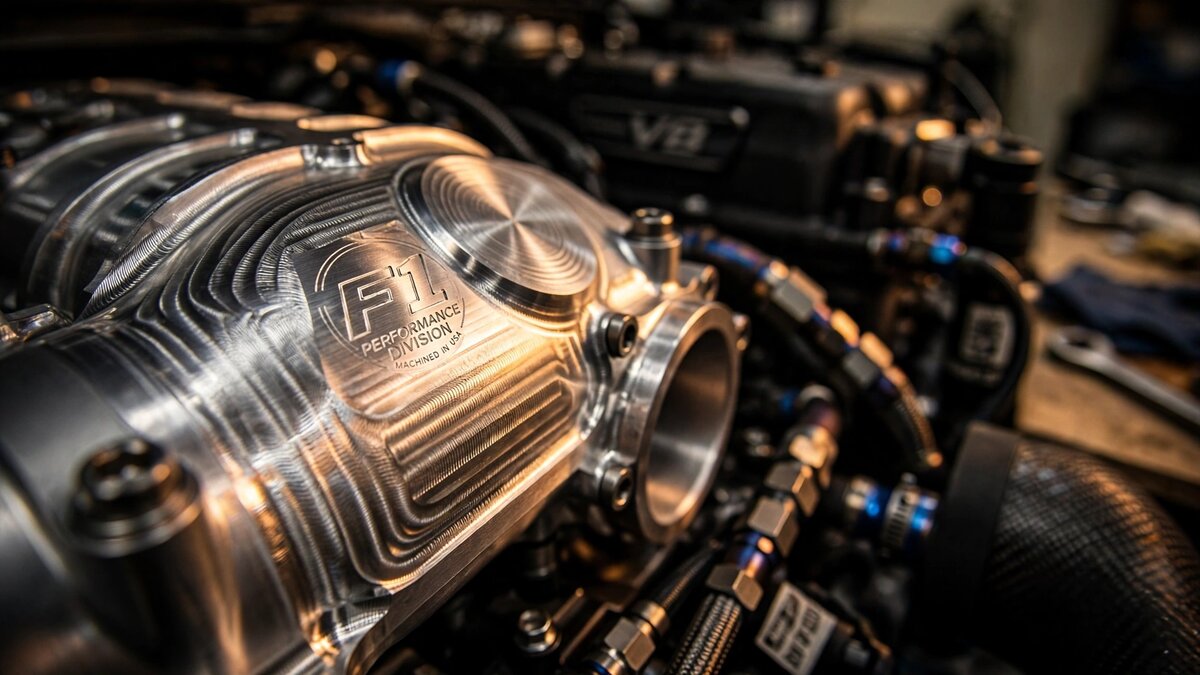
Every R1740 supercharger sits underneath a cast aluminum cover that forms the upper boundary of the intake plenum. Cadillac replaces this cast cover with a CNC-machined billet aluminum piece that is measurably taller than the standard unit. That additional height increases the total air volume within the supercharger assembly.
A larger plenum does two things simultaneously: it creates a bigger thermal reservoir, spreading the heat generated by compression across a greater volume of air and metal, and it provides a buffer zone between the rotor discharge and the intake runners, giving the compressed charge slightly more time and surface area to shed thermal energy before entering the cylinders. Results are particularly pronounced during sustained high-load conditions, exactly the scenario where a track car needs consistent power delivery rather than a one-pull peak number that evaporates after a single flying lap.
CNC billet construction matters beyond the dimensional change, because cast aluminum has a rougher internal surface finish with microscopic porosity that traps heat, while machined billet has tighter grain structure and smoother walls that improve heat transfer characteristics. Each cover is produced in-house by GM Motorsports, not sourced from Eaton’s production line.
Combined result: 685 horsepower and 673 pound-feet of torque, delivered consistently across multiple consecutive laps without the thermal fade that plagues incremental blower mods. That consistency is the real achievement.
The Precision Package: Where the Chassis Catches Up
More power demands more chassis. Each F1 Collector Series includes the $18,000 Precision Package as standard equipment, and understanding what it contains explains why it costs what it does.
Start with the springs. Front rates are 70% stiffer than the standard Blackwing, rear rates 60% stiffer, and those are enormous increases for a car that already rode firmly. A 70% front spring rate increase on a 4,000-pound sedan fundamentally changes weight transfer behavior during braking and turn-in, reducing dive and keeping the front contact patches loaded more evenly through transient maneuvers. Rear rates accomplish the same for squat under acceleration and lateral load distribution during corner exit.
Then there’s the rear cradle bushing: one thousand percent stiffer, and that is not a typo. Cadillac’s standard car uses a relatively compliant bushing at the rear subframe mount to isolate NVH from the cabin, a concession to luxury-sedan expectations that introduces measurable rear-end compliance under hard cornering. Its replacement is essentially rigid, locking the rear suspension geometry to the body structure so the alignment engineers’ careful camber and toe settings actually survive contact with a curb at Road Atlanta’s turn seven.
Adjustable Geometry
New front steering knuckles permit up to 2.8 degrees of negative camber, 0.4 degrees more than the standard car allows. Billet rear toe-control links open up 2.0 degrees of negative camber at the rear, a gain of 0.5 degrees over stock. Those fractions sound trivial, but they are not.
Negative camber tilts the top of the tire inward, and under lateral load in a corner, the tire contact patch deforms while the effective contact area shifts toward the outer edge, so more static negative camber compensates for this deformation by keeping the tire’s working surface flatter against the pavement when cornering forces peak. At 2.4 degrees, the standard Blackwing’s level of front camber was already aggressive for a production sedan. At 2.8 degrees, the F1 Collector Series sits in territory normally reserved for dedicated track builds.
An 11% stiffer front anti-sway bar rounds out the mechanical changes. Combined with the wider Michelin Pilot Sport Cup 2R tires, 10 millimeters broader than the standard Pilot Sport 4S rubber, the front axle gains both mechanical grip from the contact patch and resistance to body roll from the bar. Cup 2R is a semi-slick formulation that Michelin developed for the endurance racing paddock: phenomenal grip in the dry, essentially useless in standing water. Cadillac includes the standard PS4S tires as well, because nobody should commute on Cup 2Rs in February.
MagneRide at Its Finest
All of this new hardware required completely recalibrated damping. The CT5-V Blackwing uses GM’s fourth-generation Magnetic Ride Control, a system where each damper body contains magnetorheological fluid, a carrier oil suspended with iron particles roughly 3 to 10 micrometers in diameter. When an electromagnetic coil in the piston generates a magnetic field, the iron particles align into chain-like structures that resist flow through the damper’s orifices, stiffening the damper in milliseconds.
Stock MagneRide tuning is already a dual-personality calibration, compliant enough for the Merritt Parkway and stiff enough for Lime Rock. Precision Package recalibration narrows that window, allowing more damper force at high piston velocities, which correspond to aggressive cornering and curb strikes, while maintaining a livable baseline at low velocities for highway cruising. Brandon Vivian, Cadillac’s executive chief engineer, described the target as “incredibly light on its feet at all speeds.” Both the eLSD and steering rack also received new calibrations matched to the stiffer platform.
Carbon-ceramic brake rotors replace the standard iron discs, and the difference is not subtle. Ceramic composites weigh roughly 50% less than equivalent iron rotors, which reduces unsprung mass at each corner and decreases the rotational inertia the suspension must control during direction changes. Under repeated hard braking from 150 mph, iron rotors absorb heat until they glow, expanding unevenly and introducing both pedal pulsation and a reduced friction coefficient that makes late-braking corner entries progressively more terrifying as a track session wears on. Carbon-ceramic rotors maintain dimensional stability and friction performance to temperatures above 1,400°F, which means the braking zone at the end of VIR’s back straight feels the same on lap fifteen as it did on lap one. For a track-focused sedan that weighs over 4,000 pounds, the difference between consistent braking and fading brakes is the difference between a fast car and a useful one.
Manual Only
The F1 Collector Series is available exclusively with the Tremec TR6060 six-speed manual transmission. No ten-speed automatic option exists. At a quarter-million dollars, this is a statement: the 26 buyers Cadillac intends to reach are drivers, not collectors who park their acquisitions in climate-controlled garages and wait for Bring a Trailer to call.
Or maybe they are collectors. But Cadillac chose not to give them the easy option.
The TR6060 is a triple-cone synchronizer design on first and second gears, double-cone on third and fourth, with rev-matching electronics that blip the throttle on downshifts. It handles the LT4’s 673 pound-feet without structural drama, a fact that becomes more impressive when you consider the Tremec unit was originally rated for lower output levels and has been incrementally validated upward across the Blackwing’s production run. At 685 hp, the manual gearbox is absorbing peak torque loads that exceed many dedicated racing transmissions.
Last of the Line
Cadillac confirmed in late 2025 that 2026 is the final production year for both the CT4 and the current CT5. A next-generation CT5 with internal combustion power has been announced for Lansing Grand River Assembly, but whether it will carry a supercharged V8 remains unconfirmed. The Blackwing badge is migrating to electric vehicles, with the OPTIQ-V and LYRIQ-V already in showrooms.
So the F1 Collector Series is the most powerful V8 Cadillac sedan ever built, and it may remain so permanently. It edges out the Escalade-V’s 682 hp by three horsepower, a margin so slim it suggests Cadillac’s engineers deliberately calibrated it to sit exactly at the top of the hierarchy without wasting effort on a larger numerical gap. The engineering is about precision, not excess. Every modification in the supercharger and chassis serves a specific dynamic purpose, and nothing is cosmetic except the badges.
Twenty-six units at $260,000 each. F1 and FIA badging sanctioned by the governing bodies themselves, a first for an American production car. Production begins mid-2026, and every unit will be shipped via enclosed trailer.
The engine stamps an F1 logo into its CNC-machined supercharger cover and an FIA mark laser-etched beside it. Beneath those logos sits a blower spinning 3.2% faster than the standard unit, cooled by a taller billet lid that GM Motorsports machined from solid aluminum to keep intake temperatures from ruining the math. It is a very specific kind of engineering restraint: not how much power can we add, but how much power can we add and sustain for twenty consecutive laps on carbon-ceramic brakes and Cup 2R rubber, with a six-speed manual and the most aggressively sprung Alpha platform chassis Cadillac has ever bolted together.
Seventeen horsepower. Done right.
Sources
- GM Authority, “Cadillac CT5-V Blackwing F1 Series Gets New Supercharger,” May 2026, exclusive technical breakdown of the supercharger drive ratio change (3.14 to 3.24) and CNC billet supercharger cover design.
- Cadillac Pressroom, “Blackwing hits the track: Introducing the Cadillac CT5-V Blackwing F1 Collector Series,” May 2026, official specifications, 685 hp / 673 lb-ft output, 26-unit production, Precision Package standard inclusion.
- Autoblog, “2025 Cadillac CT5-V Blackwing Precision Package is tuned for lap times,” July 2024, Precision Package specifications via Car & Driver testing at VIR: spring rates, camber angles, bushing stiffness, Cup 2R tires.
- Motor Authority, “Review: 2025 Cadillac CT5-V Blackwing cuts lap times with sharp new package,” November 2024, detailed Precision Package component breakdown including front damper cartridge changes, rear J57 knuckle updates, and Alex MacDonald’s $18,000 pricing commentary.
- Autoevolution, “The 2026 Cadillac CT5-V Blackwing F1 Collector Series Will Set You Back $260,000,” May 2026, pricing confirmation and enclosed trailer delivery via GM Authority order guide reporting.
- Carscoops, “Cadillac Built Its Most Powerful Blackwing Ever For Only 26 People,” May 2026, power figures, manual-only specification, and F1/FIA badging details.
- The Drive, “Why the Cadillac Escalade V’s Supercharger Is Much Bigger Than the CT5-V Blackwing’s,” interview with Eaton product engineer Jake Ridenour on the R1740 1.74L displacement and airflow constraints.