Sixteen Pistons and 2.7 Megawatts: Inside the Braking System Built to Stop 1,250 Horsepower
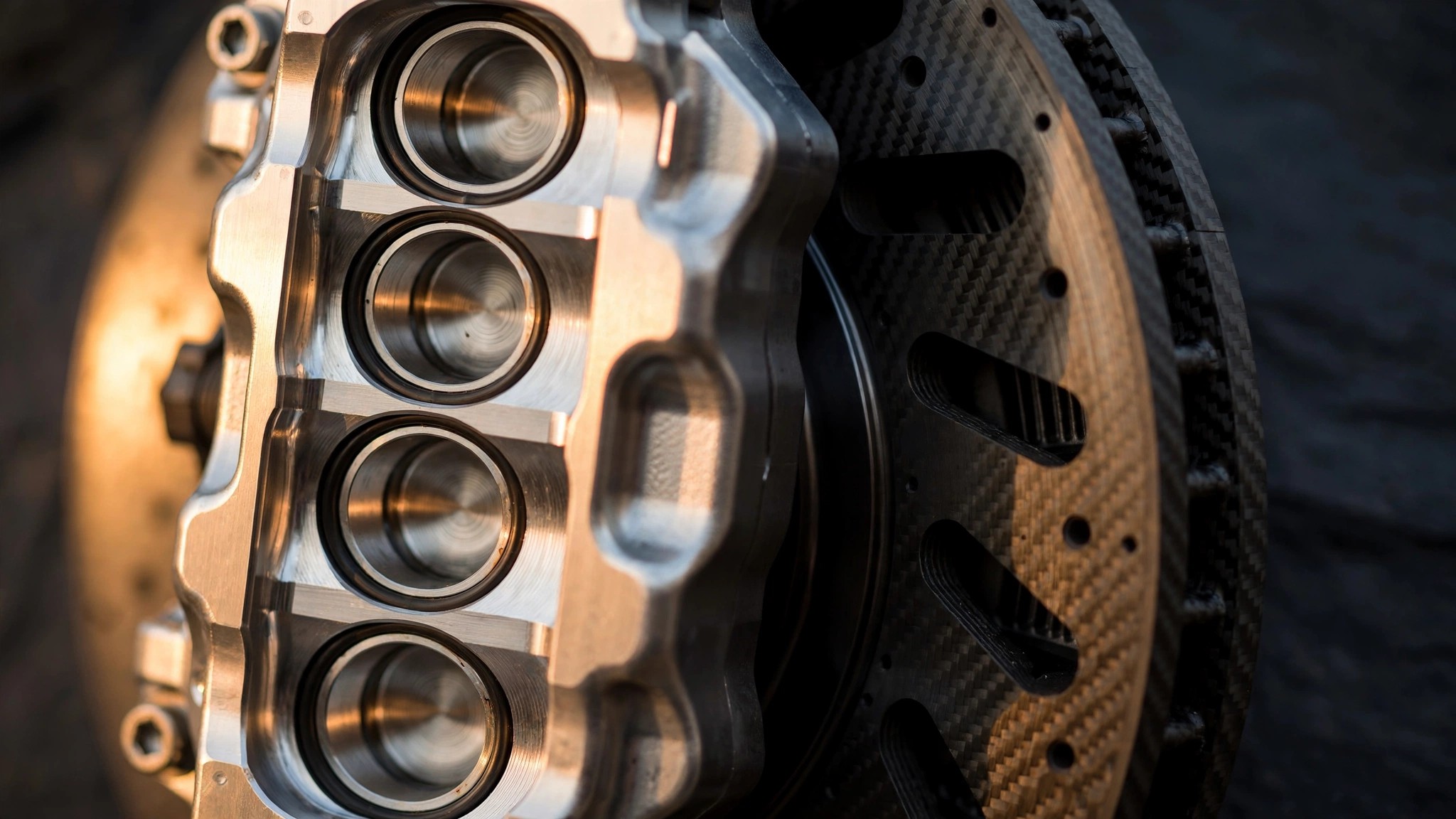
Horsepower sells cars. Brakes save drivers. Chevrolet understood this problem when it started developing the ZR1X, a car producing 1,250 combined horsepower from a twin-turbocharged 5.5-liter flat-plane-crank V8 and a front-axle electric motor, per GM's engineering presentation at the model's unveiling. Capable of exceeding 200 mph on a straightaway and clearing the quarter mile in under nine seconds, the ZR1X's powertrain is an engineering challenge with known solutions: forced induction, advanced metallurgy, electronic engine management calibrated by thousands of dyno hours. Building a brake system that repeatedly stops that power from track speed without fading, warping, or terrifying the driver is the harder problem, and the one fewer people talk about.
GM went to Tamworth.
A Company Built on Group B Rally Cars
Alcon Components was founded in 1983 by John Moore specifically to build brake systems for Audi Sport's Group B rally cars, according to the company's own corporate history, which remains one of the most violent applications a brake has ever been asked to survive: short stages on mixed surfaces, massive power-to-weight ratios, and thermal cycles that would destroy ordinary equipment within minutes. Moore took the company from rally to Formula One, Le Mans prototypes, touring cars, and eventually OEM supply for brands including Aston Martin, Bentley, and Porsche. Alcon's facility in Tamworth, Staffordshire, still designs and manufactures every caliper and disc in-house, a fact that matters when tolerances measured in hundredths of a millimeter determine whether a caliper flexes under load or holds rigid.
When GM approached Alcon for what would become the J59 braking package, the brief was specific. Stop a car weighing approximately 3,900 pounds from 180 mph repeatedly, on a racetrack, without the driver feeling degradation in pedal firmness or stopping power across a full session. GM's published test data claims 1.9 g peak deceleration with the kind of linear pedal response that lets a driver modulate braking force precisely at corner entry rather than stabbing and hoping. Survive the thermal budget imposed by 1,250 horsepower feeding kinetic energy into the brakes every time the car reaches a braking zone.
Alcon's answer was the largest, most aggressive caliper configuration ever fitted to a production car.
Why Ten Pistons
Brake calipers have carried as few as one piston and as many as twelve in race applications, and the number is not vanity. Each piston pushes against the back of a brake pad, and the pad presses against the rotor. Clamp force is a function of hydraulic pressure multiplied by total piston area. A single large piston can generate the same total force as ten small ones, given identical hydraulic pressure. So why bother?
Pressure distribution. A single piston pushes on one point of the pad backing plate, and the pad deforms around that contact point, concentrating pressure at the center while the leading and trailing edges of the pad carry less load. Uneven pressure means uneven wear. It means uneven temperature distribution across the rotor surface. It means the effective friction coefficient changes depending on where the pad is making hard contact and where it is barely touching. Under street conditions, where temperatures stay low and the pads' elastic compliance keeps things roughly even, a four-piston caliper is fine. Under track conditions at 180 mph braking zones, uneven pressure creates hot spots that can locally overheat the pad compound and cause gases to form at the friction interface, a phenomenon called green fade in new pads and thermal fade in experienced ones, and both feel identical to the driver: the pedal goes long and the car does not slow down.
Ten pistons across the front pad distribute force along the entire length of the friction surface. Alcon staggers the piston bore diameters from leading edge to trailing edge of the caliper, with the smallest pistons at the leading edge where the pad enters the rotor's spinning surface first and the largest at the trailing edge where pad material has been heated by friction on its way through. Staggering compensates for a phenomenon called taper wear: because the leading edge of the pad contacts fresh rotor surface at lower temperature while the trailing edge contacts surface that has already been heated by the leading portion of the pad, the trailing edge experiences higher friction and wears faster. Smaller leading pistons apply less force where less wear correction is needed. Larger trailing pistons apply more force where the pad would otherwise thin unevenly. Over thousands of miles of track use, the pad wears flat instead of tapering, and flat pads maintain the even pressure distribution that ten pistons were designed to achieve.
Six pistons at the rear follow the same logic at a smaller scale, because the rear brakes carry less of the total braking load due to forward weight transfer under deceleration. A car slowing at 1.9 g shifts roughly 65 to 70 percent of its effective weight to the front axle, so the front brakes do the majority of the work, and the rear brakes' primary job is contributing proportional force without locking and destabilizing the car. Six pistons provide adequate distribution for that role. Going to ten at the rear would add weight and complexity without meaningful performance benefit, because the rear pads see lower temperatures and lower total energy input per stop.
Forged From One Piece
Every J59 caliper is a monobloc forging. "Monobloc" means the caliper body is a single piece of aluminum alloy, not two halves bolted together across a bridge. Almost every aftermarket performance caliper and many OEM calipers use a two-piece construction where the inboard half, containing the pistons on one side, bolts to the outboard half containing the opposing pistons, with high-strength fasteners clamping the two halves across the bridge that spans the rotor. Two-piece designs are cheaper to manufacture because each half can be cast or machined independently and assembled later. They also flex.
Flex is the enemy of brake feel. When a caliper deflects under clamping load, it introduces compliance into the system. Compliance eats pedal travel. The driver pushes the brake pedal harder, expecting proportionally more deceleration, and instead gets a soft, spongy pedal feel as the caliper body expands slightly before the additional force reaches the pad face. At moderate temperatures this is manageable. At 600 degrees Celsius rotor temperatures sustained over multiple laps, the bolted joint connecting the two halves softens, thermal expansion pulls at the fasteners unevenly, and the caliper's effective stiffness drops. The driver compensates by pushing harder, which increases the pedal travel further. Trust erodes. Braking becomes defensive rather than aggressive, and lap times suffer.
A monobloc forging eliminates the bolted joint entirely. No joint, no compliance path, no excuses.
Alcon starts with a billet of aerospace-grade aluminum alloy, heats it, and forge-presses it into the rough caliper shape in a single operation. Forging aligns the grain structure of the aluminum along the load paths, creating a part that is both stiffer and stronger than a casting of the same geometry and wall thickness. After forging, the caliper is CNC-machined to final dimensions, including the piston bores, the pad mounting surfaces, the bleeder ports, and the mounting ears. Every bore must be concentric within microns. Every sealing surface must be finished smooth enough to prevent fluid weep past the piston seals at sustained temperatures above 300 degrees.
Forging monobloc calipers in this size is expensive. A 10-piston caliper requires a forging die that can produce a part roughly 400 millimeters long and 200 millimeters wide, with internal passages for hydraulic fluid that feed each of the five piston bores on each side from a single inlet. Machining ten bores to tolerance in a single block takes significantly longer than machining five bores in each half of a two-piece design, because the tool must reach through complex internal geometry without collision. Alcon has been doing this for four decades, starting with Group B rally calipers that had to survive impacts with rocks at 120 mph on a forest stage, and the manufacturing process reflects that history.
419 Millimeters of Woven Carbon
Calipers clamp rotors, and the J59's rotors are exceptional even by carbon ceramic standards. At 419 millimeters in diameter, front and rear, they are the largest rotors Chevrolet has ever fitted to a Corvette. For context, the standard J55 iron rotors on a Corvette Stingray measure 345 millimeters at the front. The Z06's optional J57 carbon ceramic rotors measure 380 millimeters. Going from 380 to 419 millimeters adds 10 percent more effective radius, which increases braking torque proportionally for the same clamping force, because torque is force multiplied by the distance from the center of rotation. More lever arm, more stopping power, without needing to increase hydraulic pressure.
The rotors themselves are constructed from continuously woven carbon fiber threads infiltrated with silicon carbide. This is the same manufacturing process used by Surface Transforms in Knowsley, England, which interweaves long-fiber carbon into a three-dimensional matrix rather than using chopped short fibers pressed into resin, the method Brembo and most other OEM carbon ceramic suppliers employ. Continuous fibers create unbroken thermal pathways from the friction surface into the rotor's core and out through the ventilation channels, conducting heat roughly three times faster than chopped-fiber alternatives. Lower operating temperature under identical load means less thermal stress on every component in contact with the rotor: pad compound, caliper piston seals, brake fluid, and the rotor itself.
For the ZR1X application, faster heat dissipation is not a luxury. Back to the physics: at 180 mph, the ZR1X carries approximately 5.8 megajoules of kinetic energy. Decelerating to 120 mph at 1.9 g removes roughly 3.2 megajoules in about 1.4 seconds. Peak thermal power during that event exceeds 2.7 megawatts at the moment braking begins, dropping to roughly 1.8 megawatts by the time the car passes through 120 mph. Average power across the stop is approximately 2.25 megawatts shared across four rotors, which means each front rotor is absorbing on the order of 800 kilowatts of thermal power sustained for over a second. This is thermal energy delivered at a rate that would melt iron rotors. Carbon ceramic survives it because silicon carbide maintains its structural integrity above 1,000 degrees and because continuously woven fiber architecture distributes that heat instead of concentrating it.
Continuously woven rotors also resist chunking, the failure mode where sections of the friction surface delaminate in irregular patches during aggressive track use. In chopped-fiber rotors, each short fiber terminates at random points in the matrix, and those terminations become nucleation sites for cracks under thermal cycling. Once a crack forms, no fiber bridges it across a meaningful distance, so it propagates until a section of the surface breaks away. In a continuous-fiber rotor, developing cracks encounter fibers that span the entire fracture plane and must be broken individually, absorbing far more energy and effectively arresting propagation. Surface Transforms' published engineering data shows their rotors wear uniformly and can be resurfaced, providing service life measured in thousands of track miles rather than hundreds.
Software Behind the Hardware
Stopping a car is not purely a mechanical act anymore. The ZR1X's braking system integrates with GM's PTM Pro, which stands for Performance Traction Management Professional, a suite of electronic controls that remains active even when the driver switches off traction and stability control. Two features are relevant to braking.
Regen Brake Torque Vectoring uses the front-axle electric motor as a generator during corner entry, recovering kinetic energy as electrical charge while simultaneously creating a braking force at the front wheels. Unlike friction braking, regenerative braking applies force smoothly and proportionally through the motor's torque curve, without pad wear, without heat, and without the abrupt force transitions that can unsettle a car at the limit of adhesion. PTM Pro blends regenerative braking with friction braking so the driver feels a single, consistent brake pedal response while the system quietly routes some of the braking work through the motor and into the battery. Less thermal energy into the friction brakes means lower rotor temperatures after each braking event, which extends the thermal margin before fade becomes a factor.
Front Axle Pre-Control manages the inner front brake during corner exit. When a driver powers out of a turn, the inside front wheel unloads as weight transfers to the outside, and an unloaded tire provides less grip. Pre-Control applies a calculated amount of brake force to the inside front wheel, effectively increasing resistance on that corner, which rotates the car's yaw axis toward the apex and allows the driver to apply power earlier without waiting for mechanical grip to catch up. It is the same principle behind a limited-slip differential, applied at the front axle through the brake system rather than through a mechanical diff. On a mid-engine car with all-wheel drive and 1,250 horsepower, the ability to manage front brake pressure independently and in real time is the difference between a car that pushes wide at corner exit and one that rotates precisely where the driver wants it.
Four Tiers of Stopping
None of this hardware exists in isolation. GM offers four distinct brake packages across the C8 Corvette range, and the hierarchy reveals how seriously the engineering team treats thermal management as power levels increase.
| RPO Code | Caliper | Rotor Size | Rotor Type | Application |
|---|---|---|---|---|
| J55 | Brembo 4-piston front / 4-piston rear | 345 mm front / 350 mm rear | Iron | Stingray, Grand Sport |
| J56 | Brembo 6-piston front / 4-piston rear | 370 mm front / 370 mm rear | Iron (high-perf compound) | Z06 standard, Grand Sport Z52 |
| J57 | Brembo 6-piston front / 4-piston rear | 380 mm front / 380 mm rear | Carbon ceramic | Z06 Z07 package, Grand Sport X |
| J59 | Alcon 10-piston front / 6-piston rear | 419 mm front / 419 mm rear | Carbon ceramic (continuous fiber) | ZR1X standard, ZR1 ZTK option |
Notice what happens at the J59 level. GM does not simply scale up the Brembo components that serve every other Corvette. It switches suppliers entirely, moving from Brembo to Alcon for the calipers and from conventional chopped-fiber carbon ceramic to continuously woven carbon ceramic for the rotors. It increases piston count from six to ten at the front and from four to six at the rear. Rotor diameter jumps by 39 millimeters. Every variable in the braking equation changes simultaneously, because scaling up a 670-horsepower brake system to handle 1,250 horsepower is not a matter of making the same parts bigger. The thermal load nearly doubles, the kinetic energy at top speed roughly quadruples compared to a Stingray, and the expectations for lap-after-lap consistency ratchet up to a level where Brembo's standard product line, excellent as it is, gives way to a specialist motorsport manufacturer that has spent forty years solving exactly this problem.
What $1,500 Buys
On the ZR1, the J59 package is part of the ZTK Performance Package, which costs $1,500 on top of the Carbon Aero Package. That pricing is almost certainly subsidized, because a set of Alcon monobloc calipers in equivalent piston configurations retails for $8,000 to $15,000 through Alcon's aftermarket division, and the continuously woven carbon ceramic rotors carry their own premium above chopped-fiber alternatives. GM is absorbing a significant portion of the brake system cost into the car's base price or spreading it across the ZTK package to keep the option sheet reasonable. On the ZR1X, where J59 comes standard, the cost is fully baked into the car's sticker.
This is how GM competes with $300,000 European hypercars at half the price. Not by cutting corners on the braking hardware, which would be suicidal with this much power, but by leveraging production volume and supplier relationships to get tier-one motorsport braking into a car that starts around $170,000 per GM's configurator. Porsche's 911 Turbo S with PCCB carbon ceramic brakes uses Brembo 10-piston front calipers and 6-piston rears as well, but those are matched to a 701-horsepower car per Porsche's spec sheet, not a 1,250-horsepower one. McLaren's W1, rated at 1,275 combined horsepower, uses a bespoke carbon ceramic system from Akebono at a starting price north of $2 million. The ZR1X delivers comparable stopping performance at a fraction of the cost, and that disparity is the entire point of the C8 Corvette program.
Stopping Is the Hard Part
Building power is a solved problem. Turbos, electric motors, sophisticated engine management, clever metallurgy. Every manufacturer has access to the same engineering toolkit, and the arms race to four-digit horsepower has produced a half-dozen production cars above 1,000 horsepower in the past three years alone. But making those cars safe, predictable, and repeatable on a racetrack requires braking systems that can absorb megawatts of thermal power, dissipate it fast enough to be ready for the next braking zone sixty seconds later, and communicate to the driver through the brake pedal with enough precision that they can modulate force within a few percent of the tire's grip limit.
Alcon's 10-piston front calipers, forged from single blocks of aerospace aluminum, clamping 419-millimeter rotors woven from continuous carbon fiber and infiltrated with silicon carbide, integrated with regenerative braking and active front-axle torque management through PTM Pro, represent the current limit of what a production brake system can do. GM's engineers recorded 1.9 g deceleration from 180 to 120 mph with this hardware. That number is not the interesting part. Running that number lap after lap without degradation is. These are manufacturer-published figures; independent track tests from outlets with their own data acquisition will determine whether the system delivers that consistency in civilian hands, session after session, in ambient temperatures GM's engineers did not choose.
Power gets the headlines. Brakes get you home.