One Thousand Degrees Behind the Driver: How the ZR1's Split Window Became a Vent
In 1963, Bill Mitchell drew a line down the center of the Corvette Sting Ray's rear glass. It was a styling choice, born from Mitchell's belief that a dorsal seam would give the C2 a more aggressive profile from behind. Zora Arkus-Duntov opposed it. He argued that the bar split the driver's rearward field of view and served no structural purpose. Mitchell won the argument but lost the war: after a single model year, the split window was deleted. Production records show 10,594 split-window coupes left the St. Louis plant before the feature disappeared from the Corvette line entirely.
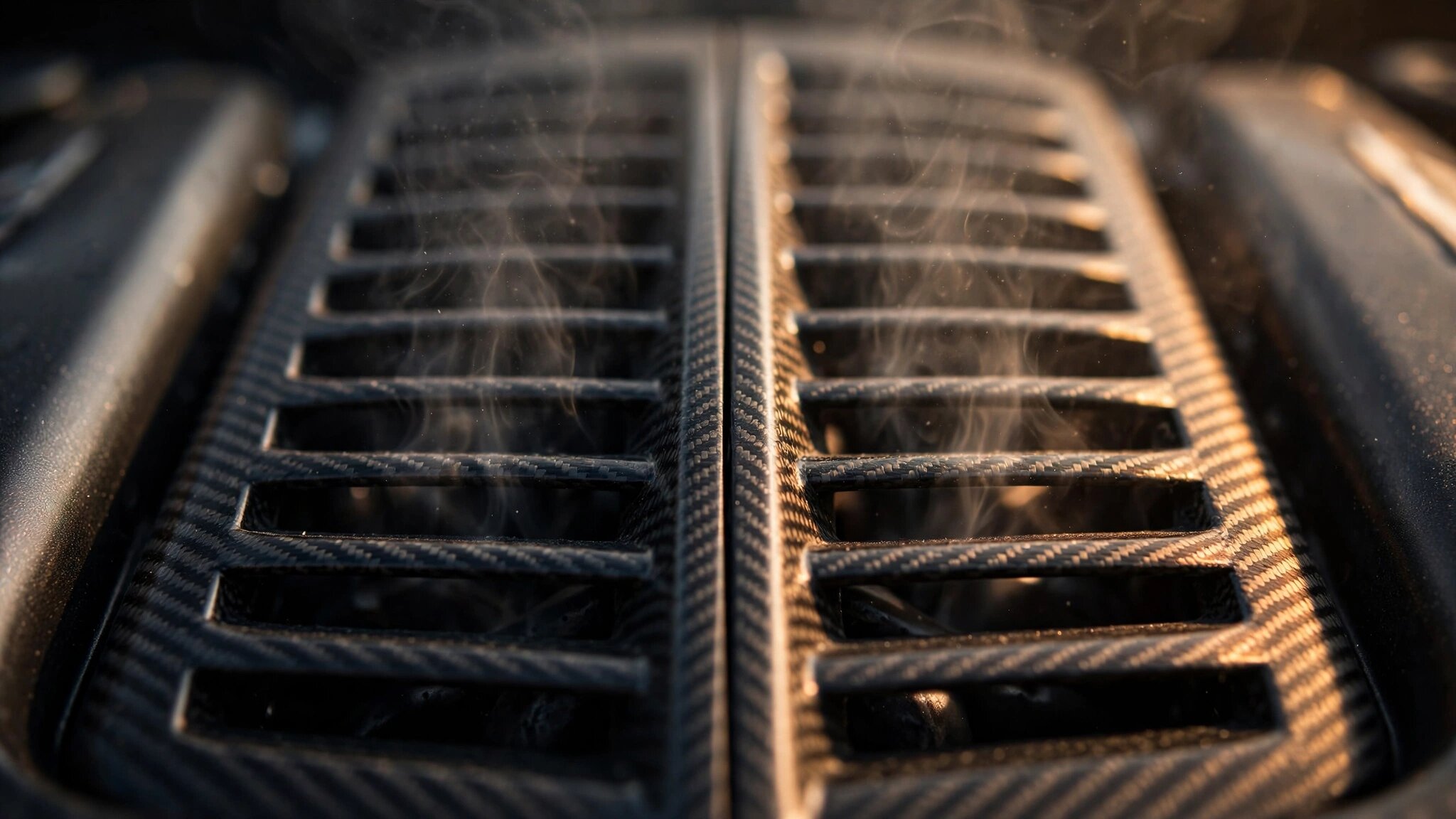
Sixty-two years later, the split window is back on the 2025 Corvette ZR1. This time, it is not a styling exercise. A carbon fiber spine runs down the center of the engine hatch, louvered on both sides, channeling hot air out of an engine bay that sits directly behind the driver's head. Corvette chief engineer Tadge Juechter confirmed to media at the car's reveal that this vent provides roughly 50 percent better engine bay cooling than the standard C8 rear window configuration. In a mid-engine car producing 1,064 horsepower from twin turbochargers that reach 1,000 degrees Fahrenheit during sustained track driving, that is not a design tribute. It is a thermal necessity.
The Problem With 1,000 Degrees Behind Your Seat
Every mid-engine car places the powertrain between the passenger cell and the rear axle. In a naturally aspirated application like the Z06's LT6, this layout produces manageable heat. The engine runs hard, the exhaust exits through short headers, and convective airflow through the engine bay handles the thermal load without extraordinary intervention.
Add twin turbochargers, and the math changes completely. Each of the LT7's two BorgWarner units houses a 76-millimeter turbine wheel spinning at up to 135,000 revolutions per minute inside a single-scroll housing. At peak load, the exhaust gas driving those wheels reaches approximately 1,000 degrees Fahrenheit. Chevrolet's own engineers described that figure as roughly two-thirds of the Space Shuttle's surface temperature during atmospheric reentry. The turbine wheels survive because they are cast from Mar-M, a nickel-based superalloy that maintains structural integrity up to 1,900 degrees. Mar-M outperforms Inconel, the alloy used in most production turbocharger applications, by several hundred degrees of thermal headroom.
That heat does not stay inside the turbine housings. It radiates into the engine bay, soaks into surrounding components, and rises. In a front-engine car, rising heat exits through the hood gap and dissipates into the airstream flowing over the roof. In the ZR1's mid-engine layout, rising heat pushes directly against the rear glass and the structural panels that separate the engine bay from the cabin. Without aggressive ventilation, that heat accumulates. At a track day, a driver completing consecutive hot laps can generate enough residual heat that, according to Juechter, "when somebody takes off hard, so much hot air comes out of the exhaust it's like the whole car disappears into a mirage."
A Vent That Was Hiding on the Race Car
When the ZR1's split window was revealed at the car's unveiling, most coverage described it as a callback to 1963. Juechter corrected that framing. "We've had the split window, the additional engine compartment venting, on the C8.R the whole time," he explained. "People see it but it just hasn't registered. It's a road car, but the venting strategy is the same."
The C8.R is Chevrolet's factory IMSA and WEC race car, competing in the GT class since the 2020 season. Its engine hatch has carried a louvered center spine throughout its racing career. In a competition environment where every aerodynamic surface is scrutinized by rival teams and homologation officials, nobody in the paddock or the press gallery flagged the vent as unusual. It read as a standard heat extraction feature, the kind that appears on virtually every endurance racing car that runs a mid-mounted engine at sustained high loads for hours at a time.
Moving that vent from the race car to the road car required material changes. The C8.R's spine is functional fiberglass, lightweight and easily replaced after contact. The ZR1's spine is carbon fiber, offered in either body color or exposed weave. Its louvers are shaped to permit airflow while maintaining visual continuity with the rear glass panels on either side. From certain angles, the effect reads as a design element. From the engineering perspective, it is a chimney.
Three Vent Systems, Three Thermal Problems
The split window addresses one thermal challenge: evacuating rising heat from the engine bay. But the ZR1's thermal management architecture requires solving three distinct problems simultaneously, each handled by a dedicated vent system that Dustin Gardner, assistant chief engineer for the LT7, detailed in technical briefings.
The first is the split window itself, functioning as a passive heat extractor. Hot air rises from the turbocharger housings, the exhaust manifolds, and the engine block, and exits through the louvered spine. This is buoyancy-driven ventilation at its most fundamental, enhanced by the car's forward motion creating a low-pressure zone above the engine hatch that pulls air upward.
The second is a pair of quarter-panel vents unique to the ZR1 coupe. All C8 Corvettes draw intake air through the channels behind the cabin doors. The ZR1 adds secondary air inlets along the rear quarter panels, tapping into a pocket of cooler air that flows over the body surface. These are not exhaust vents. They are supplementary cool-air inlets for the engine, providing additional oxygen supply beyond what the primary intakes deliver. When the turbochargers are operating at full boost, the volume of air passing through the compressors demands every available feed path.
The third is the wishbone vent, present on all ZR1 variants including the convertible. Located in the wishbone-shaped bezel behind the cabin doors, this vent routes cool air directly to the rear brake calipers through an internal duct system. Chevrolet describes the design as similar to the brake cooling arrangement used on the C7-generation Z06 and ZR1, adapted to the C8's wider body. Unlike the other two systems, the wishbone vent handles a thermal load that has nothing to do with the powertrain. At speeds where the ZR1 generates over 1,200 pounds of downforce, the brakes absorb enormous kinetic energy during deceleration zones, and fade resistance depends on keeping caliper temperatures within operating range.
The Seventh Stage
Ventilation handles the ambient heat inside the engine bay. Keeping the turbochargers themselves alive requires a more intimate intervention. Each turbo rides on a ball-bearing shaft interface lubricated by engine oil, fed through dedicated cooling lines. In the Z06's naturally aspirated LT6, a six-stage dry sump oiling system circulates and scavenges oil throughout the engine. The LT7 adds a seventh stage.
That seventh scavenge pump exists for one reason: the turbochargers are mounted low on the engine's flanks, positioned below the crankshaft centerline where gravity alone cannot drain oil from the ball-bearing journals. Without active scavenging, oil would pool around the bearing surfaces, overheat, coke, and eventually starve the rotating assembly. A dedicated pump stage pulls oil away from the turbo shafts under pressure, returning it to the dry sump tank where it can be cooled before recirculating.
What makes this detail remarkable is that it was visible from the beginning. When Chevrolet first presented the LT6 engine to automotive media, the seven-stage dry sump system was fully visible on the display block. Nobody noticed the extra stage. Like the split window on the C8.R, the engineering was present in plain sight before anyone realized what it implied. GM had been planning the turbocharged variant long before the Z06 launched, and the seventh stage was already built into the shared architecture, waiting for the turbochargers that would need it.
Two Gallons Per Minute
The thermal challenge extends to fuel delivery. At wide-open throttle, the LT7 consumes fuel at a rate that Chevrolet engineers describe as approximately two gallons per minute. At that consumption rate, the ZR1's fuel tank would be empty in roughly nine minutes of sustained maximum output. This figure represents one of the highest specific fuel consumption rates of any production road car engine currently manufactured.
Managing that fuel flow required a dual injection strategy. Each cylinder receives fuel from both a port injector and a direct injector. Gardner explained the reasoning: a single large direct injector sized for peak demand would deliver fuel too coarsely at low engine speeds and light loads, degrading drivability and increasing emissions during normal driving. Blending port and direct injection allows the calibration team to optimize metering across the entire operating envelope, from idle to the 7,000-rpm peak power point.
On the intake side, compressed air from each turbocharger passes through a charge-air cooler, or intercooler, mounted atop the cylinder head on each bank. Coolant circulates between these intercoolers and a dedicated radiator positioned at the front of the car, occupying the space where the C8 Stingray's front trunk would normally sit. The ZR1 has no frunk. Where other C8 variants offer a shallow storage compartment under the front hood, the ZR1 dedicates that volume entirely to heat rejection hardware. The front grille feeds air through the intercooler radiator and exits through a flow-through hood, creating front downforce as a secondary benefit of the cooling architecture.
Forty Pounds of Thrust from the Exhaust
At maximum boost, the volume of compressed air entering and exiting the LT7 produces a measurable propulsive effect. Chevrolet claims the four exhaust outlets at the rear of the car contribute approximately 37 pounds of thrust at peak output, meaning the exhaust gas velocity is high enough to generate meaningful forward force. This is not a gimmick. It is a byproduct of the volume flow rate. When two 76-millimeter compressors are cramming air through 5.5 liters of displacement at 24 psi of boost, the resulting exhaust mass flow is comparable to what a small jet engine produces at low thrust settings.
Each turbocharger's wastegate is electronically controlled, limiting boost to 20 psi under normal operation with 24 psi available during specific calibration conditions that the engine management system determines in real time. Dynamic Boost Control, a software strategy developed by GM's calibration engineers, keeps the turbos partially spooled during throttle lifts by briefly maintaining exhaust energy to the turbine. This is a form of intelligent anti-lag that reduces turbo lag on corner exit without the fuel-wasting, component-stressing approaches used in aftermarket rally and drift applications. The system monitors wheel speed, throttle position, and gear selection to determine how much residual energy to maintain in the exhaust tract during deceleration phases.
Carbon Fiber as Structural Insurance
There may be one additional reason the split window uses carbon fiber rather than a simpler vented panel. Before the C8 was revealed in 2019, industry rumors circulated that prototype ZR1 variants had experienced chassis flex severe enough to stress the engine hatch, causing the rear glass to crack. If any portion of those reports was accurate, a carbon fiber spine bonded to the engine hatch would add torsional rigidity to a panel that must withstand aerodynamic loads, thermal cycling, and vibrational harmonics from a 1,064-horsepower engine mounted directly beneath it.
GM did not confirm or deny the chassis flex reports when asked. But the material choice speaks for itself. Carbon fiber is heavier per unit area than a simple louvered aluminum vent, and it is significantly more expensive. Choosing it for a vent cover makes engineering sense only if the cover is doing double duty: evacuating heat and reinforcing the panel it spans. A standard production car would use a stamped aluminum grille. The ZR1 uses aerospace-grade composite, the same class of material used for the car's optional 1,200-pound downforce wing and its front dive planes.
The Window That Stopped Being Glass
Bill Mitchell wanted the 1963 split window because it looked fast standing still. Zora Arkus-Duntov wanted it gone because it blocked the mirror. Both of them treated the rear glass as a visual surface, a design element measured in aesthetics and sightlines.
Sixty-two years later, the split window is back, and it is neither glass nor a design statement. It is a louvered carbon fiber chimney that extracts heat from an engine bay operating at temperatures that require nickel superalloys in the exhaust tract and a dedicated seventh oil pump stage for the turbocharger journals. It delivers 50 percent more cooling than the panel it replaces. It was developed on a race car and migrated to the road car not because customers asked for it but because the thermal load demanded it. Nobody noticed it on the C8.R for four full racing seasons. On the ZR1, it became the car's most talked-about visual feature, and nearly every review called it a tribute to 1963.
It is not a tribute. It is what happens when you put 1,000 degrees Fahrenheit six inches behind the driver's head and need to get it out.