The Corvette That Learned to Whisper: Inside the Grand Sport X
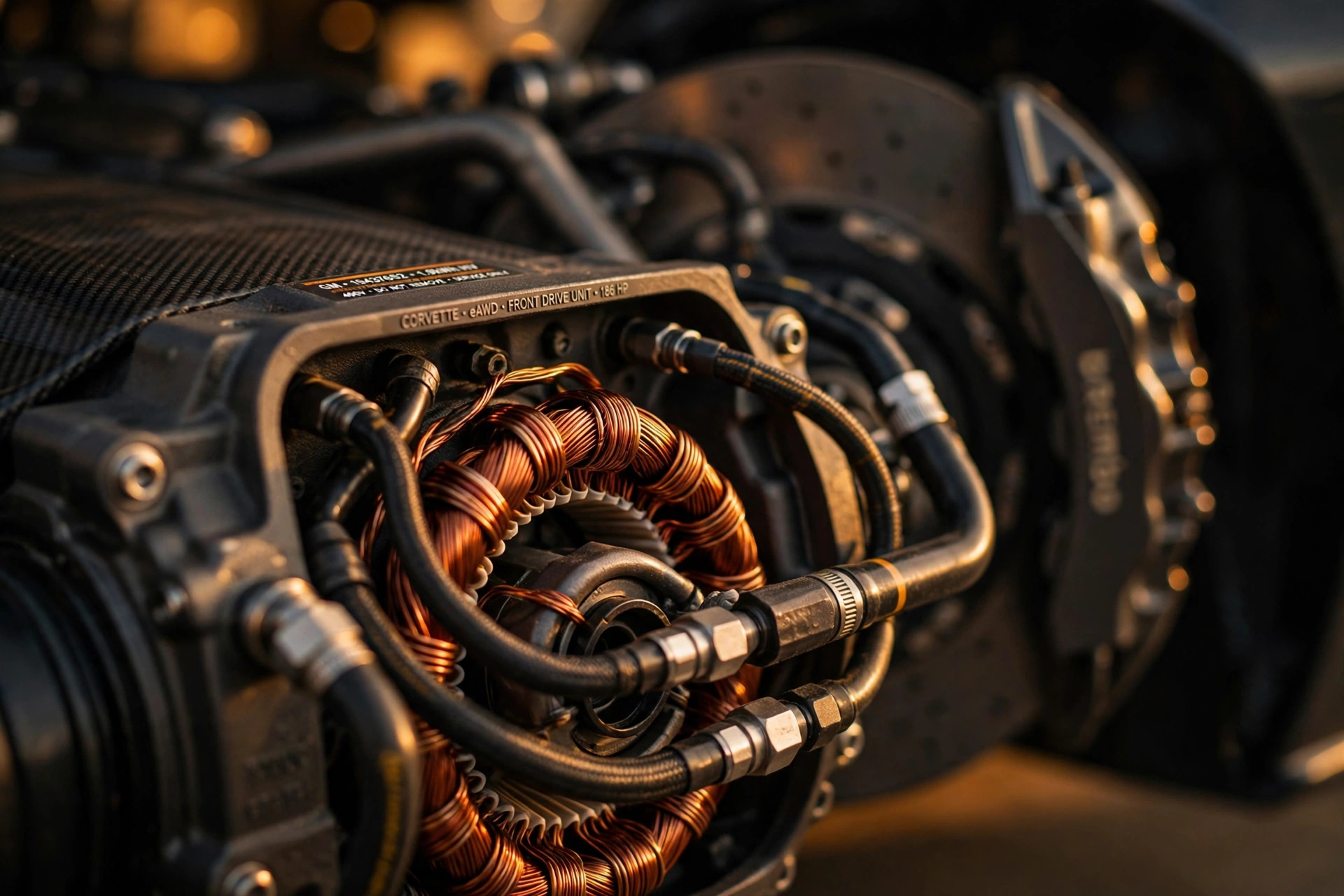
Bowling Green is building them now. After a summer launch and an August production start, the 2027 Corvette Grand Sport X has moved from reveal-season curiosity to cars coming off the line in increasing numbers, with the plant's fall production mix shifting toward ZR1s and Grand Sport Xs while the Stingray's share recedes. On paper the headline is 721 combined horsepower, 66 more than the E-Ray this car replaces, and the first Grand Sport in history to outgun the Z06. That headline is also the least interesting thing about it.
What matters is quiet. Press a button and the Grand Sport X becomes a silent electric car, good to 50 mph, with a second mode, Shuttle, that creeps along at 23 mph for maneuvering without ever waking the V8. Corvette spent seventy years getting louder. Its engineers just spent real development money on making one go quiet, and the reasons why tell you more about where performance cars are heading than another 66 horsepower ever could.
What Replaced the E-Ray
Start with lineage, because GM's naming now carries meaning. X means eAWD across the Corvette range, a convention established by the 1,250-horsepower ZR1X and now applied to the middle of the lineup. Grand Sport X is not a trim package or an appearance option. It is the E-Ray's successor under a new name, inheriting the E-Ray's job description, all-wheel-drive traction and instant front-axle torque in a car that still has a pushrod V8 behind the seats, and then upgrading nearly every number attached to that job.
Compare them directly. E-Ray: 655 combined horsepower from a 6.2-liter LT2 plus a 160-horsepower front motor, Stealth mode to 45 mph, front motor assistance to 150 mph. Grand Sport X: 721 combined horsepower from a new 6.7-liter LS6 plus a 186-horsepower front motor, Stealth mode to 50 mph, front motor assistance to 160 mph. Every figure moved in the same direction, and none of it required a plug. Like its predecessors, the Grand Sport X charges its 1.9-kWh battery only through regenerative braking and generator operation of the front motor, never from a wall socket.
Two standard-equipment changes mark the step up in intent. Carbon-ceramic brakes, 398 mm front and 390 mm rear with dark gray calipers, come standard on the X, where the E-Ray made do with iron unless optioned otherwise. A head-up display is standard too. Both signal that GM no longer treats the hybrid Corvette as a novelty variant. It is a core model, specified like one.
The Engine Underneath Is All New
None of the hybrid numbers work without the LS6, and the LS6 deserves its own paragraph because it is the first engine of GM's sixth small-block generation. Displacement grows to 6.7 liters, 409 cubic inches, from the LT2's 6.2, achieved with the same 103.25 mm bore and a stroke stretched from 92 mm to 100 mm. Compression climbs to 13.0:1, the highest of any production Corvette V8. A tunnel-ram intake with high-velocity ports breathes through a 95 mm throttle body, fuel arrives through direct and port injection together, and forged pistons and connecting rods plus a revised dry-sump lubrication system handle the loads. Output is 535 horsepower and 520 lb-ft of torque, the most torque ever from a naturally aspirated V8 in a production Corvette, with a 6,600-rpm limit.
That torque curve is the whole argument for pairing this engine with a front electric motor. A big pushrod V8 makes its torque low and wide, exactly where a heavy car needs it for street driving, while an electric motor makes its torque instantly, exactly where a launch needs it before the V8 reaches its stride. Neither unit covers for the other's weakness by accident. They were chosen because their strengths stack: immediate electric shove off the line, then a deep, naturally aspirated pull through the midrange that no turbocharged rival quite replicates. GM's own framing is blunt. Stingray and Grand Sport together are expected to make up the bulk of Corvette sales, which makes the LS6 the backbone of the range, not a specialty item.
A Battery That Is Not for Range
Forget everything electric-vehicle marketing taught you about kilowatt-hours. At 1.9 kWh, the Grand Sport X battery holds roughly what a plug-in hybrid carries in a single module, and it exists for power delivery, not distance. Its job is to accept charge violently under braking, hold it for seconds or minutes, and then dump it through the front motor in precisely metered bursts. Energy density and charge acceptance matter far more here than total capacity, which is why the pack sits low and central in the chassis, close to the front drive unit it feeds, rather than spread across a floorpan the way a pure EV pack would be.
This creates a budgeting problem that shapes the entire car. Every joule the front motor spends must first be earned back through braking or generator operation, so the control software is constantly deciding what the next few seconds of driving are worth. Spend now for a launch, or save for the corner exit after the next braking zone? That question, repeated thousands of times per drive, is the real engineering in this car. Horsepower is just the budget's ceiling. Software decides how it gets spent, and on a 1.9-kWh pack the spending decisions are never trivial.
Weight is the price. At 3,800 pounds, the Grand Sport X carries 280 pounds more than the 3,520-pound rear-drive Grand Sport, and every one of those pounds is hardware ahead of or around the driver: motor, battery, cooling, power electronics. Magnetic Ride Control is standard, retuned for the added mass, and a $500 Performance Package adds Michelin Pilot Sport 4S summer tires with a further retune, following the E-Ray's formula. One notable omission: unlike the rear-drive Grand Sport, the X cannot be ordered with the stickiest Cup 2R track rubber, a quiet admission that its mission is breadth, not ultimate lap time.
Stealth Mode Is an Engineering Argument
Now the quiet part, literally. Stealth mode shuts the V8 down entirely and drives the front wheels on the motor alone, good to 50 mph. Shuttle mode goes further in the other direction, capping speed at 23 mph for maneuvering in garages, paddocks, and show fields, and it is explicitly not for street use. Both modes exist because a 721-horsepower car has a social problem its predecessors never had to solve: it lives in neighborhoods, and its owners leave early.
Think about what Stealth mode demands from a system designed for bursts. Moving a 3,800-pound car at up to 50 mph on a 1.9-kWh battery is not a party trick. It requires the motor to sustain output rather than spike it, the battery to discharge steadily rather than dump, and the thermal system to stay calm while doing work it was optimized to do in seconds. Range on Stealth will be short, a matter of a few miles at most, because the pack simply does not hold much energy. But distance was never the point. Stealth buys silence for the first mile of a morning, the last hundred yards into a garage, the school zone at drop-off time.
There is a second audience, and it is arguably more important. Tracks and municipalities are tightening noise limits, and a car that can roll through a paddock or a pit lane without firing its engine has a practical advantage that has nothing to do with manners. Shuttle mode reads like a feature for concours lawns and indoor displays, and it is, but it also previews a world where the loudest car in the paddock is the one that cannot shut up. Corvette built the quiet modes for owners first. Regulators may end up being the reason they matter most.
Silence has its own tradeoffs, and GM does not get to ignore them. A car moving at 50 mph with no engine noise is harder for pedestrians to hear, which is why Stealth mode still operates within a framework of low-speed awareness requirements that apply to electrified vehicles. Drivers also lose the auditory feedback that tells them, subconsciously, how hard the car is working. None of that makes Stealth a bad idea. It makes it an idea with consequences, which is the definition of engineering rather than marketing.
Three Ways to Spend a Kilowatt-Hour
On track, the Grand Sport X inherits the energy-management modes first developed for the ZR1X, and they deserve a shorter treatment here because the logic transfers intact. Endurance mode, engaged through the Charge+ button, meters battery use so front-axle assistance stays consistent over a full tank of fuel rather than flaring early and fading. Qualifying mode spends everything for the fastest possible lap. Push-to-Pass holds full electric output in reserve and releases it on demand, for an overtake or a single corner that decides a session. Corvette executive chief engineer Tony Roma has said Qualifying mode alone can trim up to two seconds from a lap at many road courses, a claim that makes sense once you understand what 186 horsepower of front-axle torque does to corner exits.
What changed versus the E-Ray is calibration, not concept. The E-Ray introduced hybrid drive modes to the Corvette lineup; the Grand Sport X adds the track trio and the stronger motor they manage. Same battery size, same basic architecture, more aggressive software. GM's hybrid strategy is now visibly modular: one front drive unit, one battery, one set of modes, tuned differently for a 655-horsepower tourer, a 721-horsepower all-rounder, and a 1,250-horsepower flagship. That reuse is the story underneath the story. Development cost amortized across three cars is what makes a hybrid Corvette viable at the middle of the range at all.
The Middle Child That Outpowers the Star
Step back and look at the lineup the Grand Sport X creates. Grand Sport: 535 horsepower, rear drive, Z06 wide body, the purist's value play. Grand Sport X: 721 horsepower, all-wheel drive, carbon-ceramics standard, the all-rounder. Z06: 670 horsepower, flat-plane LT6 screaming to 8,600 rpm, the track exotic. A Grand Sport now outpowers the Z06 by 51 horsepower, which would have been unthinkable in any previous generation, when the Grand Sport's whole identity was Z06 hardware with a lesser engine.
That inversion is deliberate, and it redefines what Grand Sport means. Historically the badge denoted a racing program, then a wide-body compromise between base car and track car. Now it denotes the volume center of the lineup, with the X variant carrying the technology flagship's hybrid system at a fraction of the flagship's price. Purists will argue, correctly, that the Z06's LT6 delivers an experience no pushrod V8 plus electric motor can match: the sound, the revs, the sense of an engine working at its absolute limit. They are right, and they are missing the point. Grand Sport X is not trying to be a Z06. It is trying to be the Corvette most people can actually live with, in weather and traffic and neighborhoods where a high-strung track car is a compromise too far.
What We Do Not Know Yet
Honesty requires a short list of unknowns. GM had published no official acceleration figures for the Grand Sport X as of October 2026, so any 0-60 claim you read elsewhere is extrapolation, not data. Reasonable extrapolation points below the E-Ray's tested 2.5-second 0-60 run, given 66 more horsepower and the stronger front motor, but extrapolation is not measurement, and this article will not pretend otherwise. I have not driven the car, and no independent instrumented test had appeared by the time of writing.
Two questions will decide whether the Grand Sport X matters beyond its spec sheet. First, does Stealth mode survive contact with real owners, or does it become the feature everyone demonstrates once and forgets? Second, does the LS6 prove as durable as the LT2 it replaces, given the higher compression and longer stroke? Both answers arrive with miles and time, not press releases. What is already certain is the direction: the hybrid Corvette is no longer an experiment at the edge of the lineup. It is the center. And the center just learned to whisper.
| Detail | Specification |
|---|---|
| Model | 2027 Chevrolet Corvette Grand Sport X (eAWD hybrid) |
| Engine | 6.7-liter LS6 Gen 6 small-block V8, naturally aspirated; 535 hp, 520 lb-ft |
| Engine details | 103.25 mm bore, 100 mm stroke, 13.0:1 compression, tunnel-ram intake, 95 mm throttle body, direct and port injection, forged internals, dry-sump lubrication, 6,600 rpm limit |
| Front motor | 186 hp, 145 lb-ft, assistance to 160 mph (shared with ZR1X front drive unit) |
| Combined output | 721 hp, 665 lb-ft |
| Battery | 1.9 kWh lithium-ion, low and central; regen and generator charging only, no plug |
| Transmission | 8-speed dual-clutch, 5.56 final drive |
| Curb weight | 3,800 lbs (280 lbs over rear-drive Grand Sport) |
| Brakes | Carbon-ceramic standard, 398 mm front / 390 mm rear, dark gray calipers |
| Drive modes | Endurance (Charge+), Qualifying, Push-to-Pass; Stealth to 50 mph; Shuttle to 23 mph (not for street use) |
| Body and chassis | Z06 wide body, 20/21-inch wheels, Magnetic Ride Control standard; Performance Package adds Pilot Sport 4S tires and retuned damping |
| Production | Bowling Green Assembly; order books opened July 2026, production from August 2026; ramp increasing fall 2026 |
| Predecessor | Corvette E-Ray: 655 hp combined, 160 hp front motor, Stealth to 45 mph, assistance to 150 mph |
Sources
- Carscoops, "The New AWD Corvette Has A Stealth Mode And, Yes, It's Exactly What It Sounds Like," March 26, 2026. Grand Sport X reveal at Sebring; 721 hp combined, 186 hp front motor, Stealth to 50 mph, Shuttle to 23 mph, carbon-ceramic brakes standard, production from summer 2026 at Bowling Green.
- GM Authority, "Here Are The 2027 Corvette Grand Sport And Grand Sport X," March 2026. LS6 details (dual injection, 13.0:1 compression); Grand Sport X as E-Ray replacement; Endurance, Qualifying, Push-to-Pass modes; Stealth and Shuttle descriptions.
- CorvSport, "C8 Corvette Grand Sport (2027): Specs, Production, Colors and Values," updated October 2026. No GM acceleration figures published by October 2026; Grand Sport X with ZR1X front drive unit on 1.9-kWh battery, 721 hp combined, 66 more than E-Ray; carbon-ceramics 398/390 mm; $500 Performance Package; 3,800 lbs.
- CorvSport, "2027 Chevrolet Corvette," updated October 2026. LS6: 103.25 mm bore, 100 mm stroke, 13.0:1 compression, 95 mm throttle body, tunnel-ram intake, direct and port injection, forged pistons and rods, revised dry-sump, 535 hp, 520 lb-ft, 6,600-rpm limit; Grand Sport X production from August 2026.
- Jalopnik, "2027 Chevy Corvette Grand Sport And Hybrid Grand Sport X Speed Into The Future," March 2026. Grand Sport X as hybrid replacement for E-Ray; expectation it beats the E-Ray's tested 2.5-second 0-60; Cup 2 tires unavailable on the X.
- Corvette Magazine, "Ain't Life Grand?" 2026. ZR1X lessons carried to Grand Sport X; higher-voltage battery and strengthened motor, 186 hp through front wheels, assistance to 160 mph versus 150 mph before; Roma on Qualifying mode trimming up to two seconds per lap.
- CorvetteBlogger, "Chevrolet Modifies Corvette Production Schedule to Produce More ZR1s and GSXs," October 31, 2026. Bowling Green back from three-week shutdown; production mix shifting toward ZR1s and Grand Sport Xs.