One Shot: Corum's Admiral Goes Ceramic, and the Material That Forgives Nothing
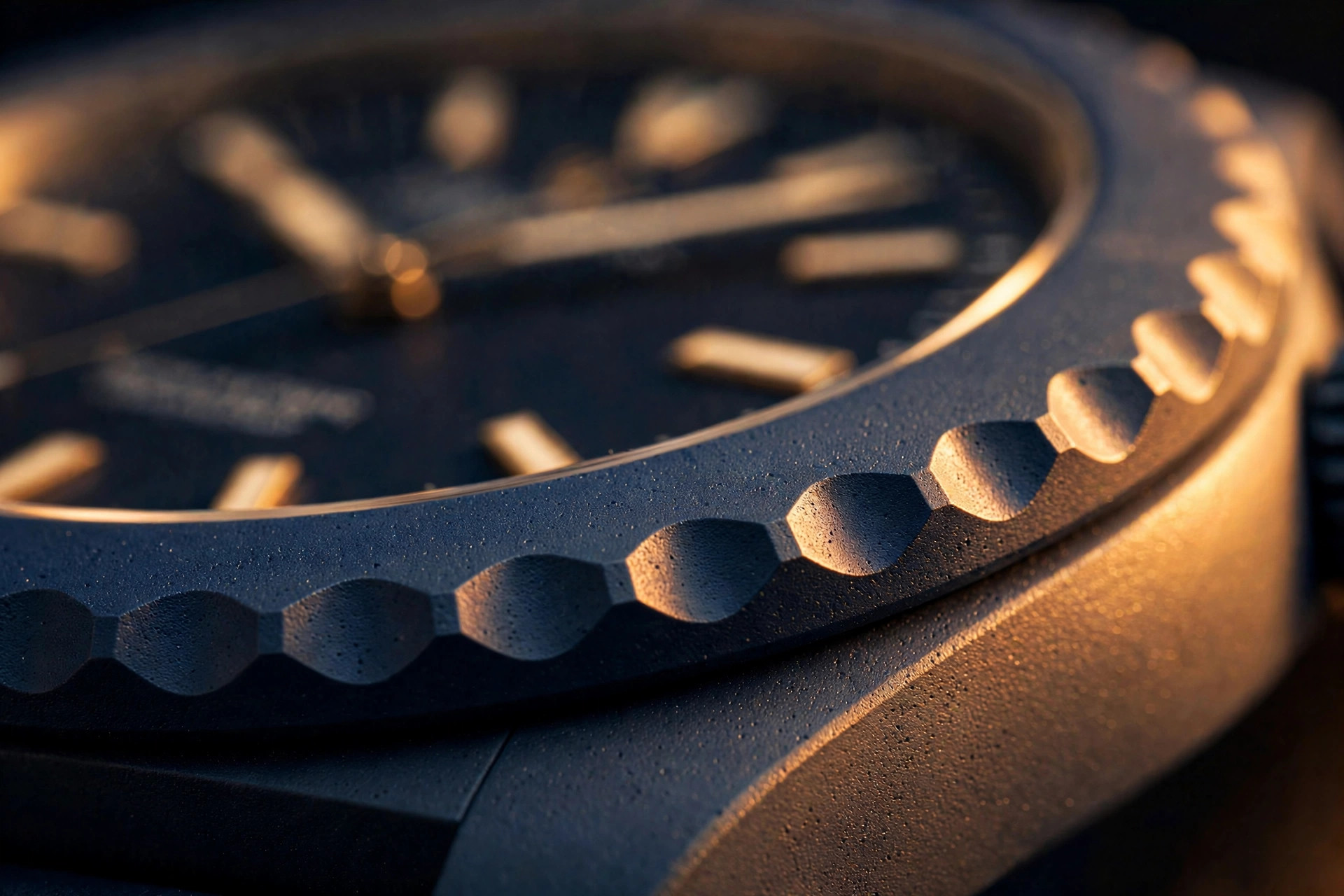
Machine steel wrong and you start over. Machine ceramic wrong and you throw it away. That is the entire engineering story behind Corum's first all-ceramic Admiral: a 39mm sports watch, 8.90mm thin, with an integrated bracelet, fired from a powder that shrinks by roughly a third in the kiln and cannot be reworked once it has sintered. Every case is a one-shot manufacturing run.
What Was Actually Announced
At Geneva Watch Days 2026, under embargo September 2, Corum unveiled the first all-ceramic execution of the redesigned Admiral: three references, all 39mm, all 8.90mm thick, all water resistant to 50 meters. Ceramic cases have appeared on the Admiral before, on 2019-era 42mm references paired with rubber straps and the ETA-based CO395; this is the first ceramic treatment of the new-generation case, and the collection's first fully ceramic integrated bracelet.
Admiral Ceramic Titanium Blue, ceramic paired with G5 titanium, 18,900 CHF. Admiral Ceramic Bicolour, ceramic enriched with 5N gold, 33,000 CHF. Admiral Ceramic Skeleton, anthracite ceramic around an openworked dial, 24,900 CHF.
These three build on the Admiral redesign Corum introduced in April 2026. That generation folded the collection's historic nautical pennants into trapezoidal hour markers, dropped conventional lugs in favor of a bracelet that flows directly from the case, and moved the movement supply to two calibres co-developed with Concepto. All-ceramic construction is the next step in the same renovation: the sportiest material on a watch born from the maritime world.
"Ceramic brings the Admiral all the performance of a contemporary material. It is an exacting material, unforgiving. These three new timepieces embody everything CORUM is in the process of becoming again: a precision manufacture, faithful to its heritage." — Haso Mehmedovic, Chairman and CEO of Corum
Why Ceramic Is the Hard Way to Build a Case
Watch ceramic is yttria-stabilized zirconia powder, mixed with organic binders and injection-molded into a "green" part that is oversized by design. That part goes into a kiln at roughly 1,400 degrees Celsius, the binders burn off, and the powder densifies into a solid that has shrunk by roughly 30 percent in every linear dimension.
That shrinkage number is the crux. A steel case blank can be milled, measured, and milled again until the dimensions converge. A ceramic green part must be molded exactly right the first time, because the shrinkage is large, nonlinear across geometry, and final: once the case is sintered, nothing but diamond tooling can touch it, and only to grind surfaces, never to add material. Tolerances measured in hundredths of a millimeter have to be predicted through a transformation that removes nearly a third of the part's size. Get the math wrong and the case is scrap, along with everything downstream of it.
Once the process is controlled, the payoff is substantial. Sintered zirconia lands around 1,200 to 1,500 Vickers against roughly 200 for 316L steel, which is why ceramic bezels still look new after years of desk diving. Density sits near 6 grams per cubic centimeter against steel's 7.9, so a 39mm sports case wears lighter than its dimensions suggest. And because the color is carried through the entire body of the material rather than applied as a coating, there is no plating to chip, no oxidation to darken it, and no UV fade to bleach it.
The Bracelet Is the Real Statement
Here is the part of the announcement that deserves more attention than it got: the integrated bracelet, in ceramic, from end-link to clasp. The Admiral's 2026 generation was the first in the model's history to offer an integrated bracelet at all, and this is the first time that bracelet has been built entirely in ceramic.
An integrated bracelet flows from the case with no lug structure in between. In steel, that is already a manufacturing exercise, because the first link has to match the case's end geometry exactly or the gap reads as a defect. In ceramic, every link is its own molded-and-sintered part, each subject to that same ~30 percent dimensional journey, and each one must line up with its neighbors across a curved wrist radius while preserving the five-link finishing pattern: satin-brushed center link, polished links flanking it, narrower satin-brushed outer links.
Steel gives you iteration. You can fit a link, see daylight at the junction, and recut the mold. Ceramic gives you one shot per firing. Across every link in the run, tolerances stack, and the finishing, alternating satin and polish across five links, has to be ground in after sintering with diamond wheels on a material that laughs at carbide tooling. That is the engineering content of this launch, hiding inside what reads as a design announcement.
The Movements Deserve Their Specs Stated
Inside sit two calibres co-developed with Concepto: the CO231 automatic (172 components, 29 jewels) and the skeletonized CO232 (181 components, 28 jewels). Both run at 28,800 vibrations per hour and both deliver a 72-hour power reserve, a full three days, in a case 8.90mm thick.
That combination matters. Sports watches tend to run thick because shock protection, water resistance seals, and long reserve barrels all compete for the same vertical millimeters. Holding 8.90mm while delivering a three-day automatic means the calibre was designed with the case envelope as a constraint, not an afterthought. The Admiral is competing in a category where 11mm is considered respectable; landing under 9mm in ceramic, with an integrated bracelet, is a genuine piece of packaging engineering.
Sixty-Six Years of Nautical DNA, Intact
For context: the Admiral was born in 1960 as Corum's maritime watch, got its signature dodecagonal bezel and pennant-shaped hour markers in 1983, and spent the decades since as the maison's recognizable sports icon. The 2026 redesign kept the pennant language but abstracted it into trapezoidal indices, a restrained move that reads modern without severing the lineage.
Going ceramic is, in a sense, the most honest material choice the Admiral has ever made. This is a watch whose entire visual identity is maritime. Salt spray, UV, and deck furniture are exactly the environments where steel needs attention and ceramic needs nothing. A material that cannot scratch, cannot corrode, and cannot fade is not a fashion choice for a sailing watch. It is the correct answer to the brief.
The Full Spec Sheet
| Detail | Specification |
|---|---|
| Collection | Corum Admiral Ceramic (three references) |
| Case material | Technical ceramic; Titanium Blue pairs with G5 titanium, Bicolour with 5N gold |
| Case dimensions | 39mm diameter, 8.90mm thick |
| Water resistance | 50 meters |
| Movement | Cal. CO231 automatic (172 components, 29 jewels) / Cal. CO232 skeleton (181 components, 28 jewels); co-developed with Concepto |
| Frequency / reserve | 28,800 vph (4 Hz); 72-hour power reserve |
| Bracelet | Integrated, five-link ceramic; satin-brushed center link framed by polished links |
| Dial | Trapezoidal indices derived from the Admiral's nautical pennants; skeletonized anthracite variant exposes CO232 |
| Prices | Titanium Blue 18,900 CHF; Skeleton 24,900 CHF; Bicolour 33,000 CHF |
| Unveiled | Geneva Watch Days 2026, September 2 |
One Shot, Every Time
Most material announcements in watchmaking are about feel or color. This one is about process control. Ceramic cases are not machined the way metal is; they are predicted, molded, fired, and only then finished, and the entire chain has exactly one acceptable outcome. Every integrated bracelet multiplies that difficulty across its links.
Corum's CEO chose the right adjective. Unforgiving is not a marketing word here. It is a manufacturing description. The Admiral has always been the house's sports watch; now it is built from a material that treats the sea the way the sea treats everything else, with total indifference, which is precisely the point.
Sources
- WatchTime, "Corum's Admiral Goes Ceramic for the First Time," September 2, 2026. Three references, 39mm x 8.90mm, 50m WR, integrated bracelet a first for the Admiral, April 2026 redesign context.
- WATCHESPEDIA, "Corum Admiral Ceramic Collection: Three Versions at Geneva Watch Days 2026." Prices (18,900 / 24,900 / 33,000 CHF), CO231 (172 components, 29 jewels) and CO232 (181 components, 28 jewels) calibres, 28,800 vph, 72h reserve, embargo date September 2.
- Instore Magazine, "Corum Debuts Three Ceramic Admiral Watches at Geneva Watch Days 2026" (press release). Ceramic rationale, Haso Mehmedovic quote, integrated bracelet first in model history.
- Southern Jewelry News, "New CORUM Admiral All-Ceramic Watches Unveiled." Material properties summary, price confirmation.
- WorldTempus, "Corum Admiral: A New Course in Ceramic." 39mm case, Concepto-developed movement, three-day reserve, skeleton CO232.
- Corum Press Room, "CORUM INTRODUCES CERAMICS TO ITS ADMIRAL COLLECTION," October 2023; thewatchpages.com, Admiral 42 Automatic Ceramic A395/04460. Prior ceramic Admiral references (42mm, rubber straps, ETA-based CO395), documenting that the 2026 launch is the first all-ceramic execution of the redesigned generation, not the first ceramic Admiral.