Eight Million Vibrations Per Second: How Citizen's AT-Cut Crystal Hunts the Perfect Second
A year has 31,536,000 seconds. Citizen's Caliber 0100 promises to miscount no more than one of them, using an oscillator frequency 256 times higher than standard quartz, gears fabricated by lithography, and a power source that never needs replacing.
Where Tuning Forks Run Out of Answers
Every quartz watch on earth keeps time by exploiting piezoelectricity. Run a current through a shaped quartz crystal and it vibrates at a fixed frequency. Count the vibrations and you can mark seconds. Since the late 1960s, virtually all quartz watches have used the same crystal geometry: a tiny tuning fork, oscillating at 32,768 Hz. At that frequency, a watch accurate to ±15 seconds per month is trivial to manufacture. Millions of such watches leave Asian factories every year, each one more precise than the finest mechanical chronometer.
But ±15 seconds per month is not ±1 second per year. Scaling quartz accuracy from "very good" to "nearly perfect" exposes problems that cheaper watches can ignore entirely. A tuning fork crystal has two prongs that vibrate in the air gap between them. Change the orientation of the watch on your wrist and gravitational acceleration pulls on those prongs asymmetrically, shifting the oscillation frequency by a tiny amount. Subject the watch to a sharp impact and the prongs deflect, briefly changing pitch like a struck dinner fork. Raise the temperature by five degrees Celsius and the crystal slows by roughly 0.1 seconds per day. Over a month, nobody notices. Over a year, it accumulates.
Citizen understood these limits because the company had spent decades pushing against them. Its Chronomaster line achieved ±5 seconds per year using conventionally shaped crystals with aggressive temperature compensation and meticulous crystal selection. Getting from five seconds to one required abandoning the tuning fork entirely.
Cutting at 35 Degrees
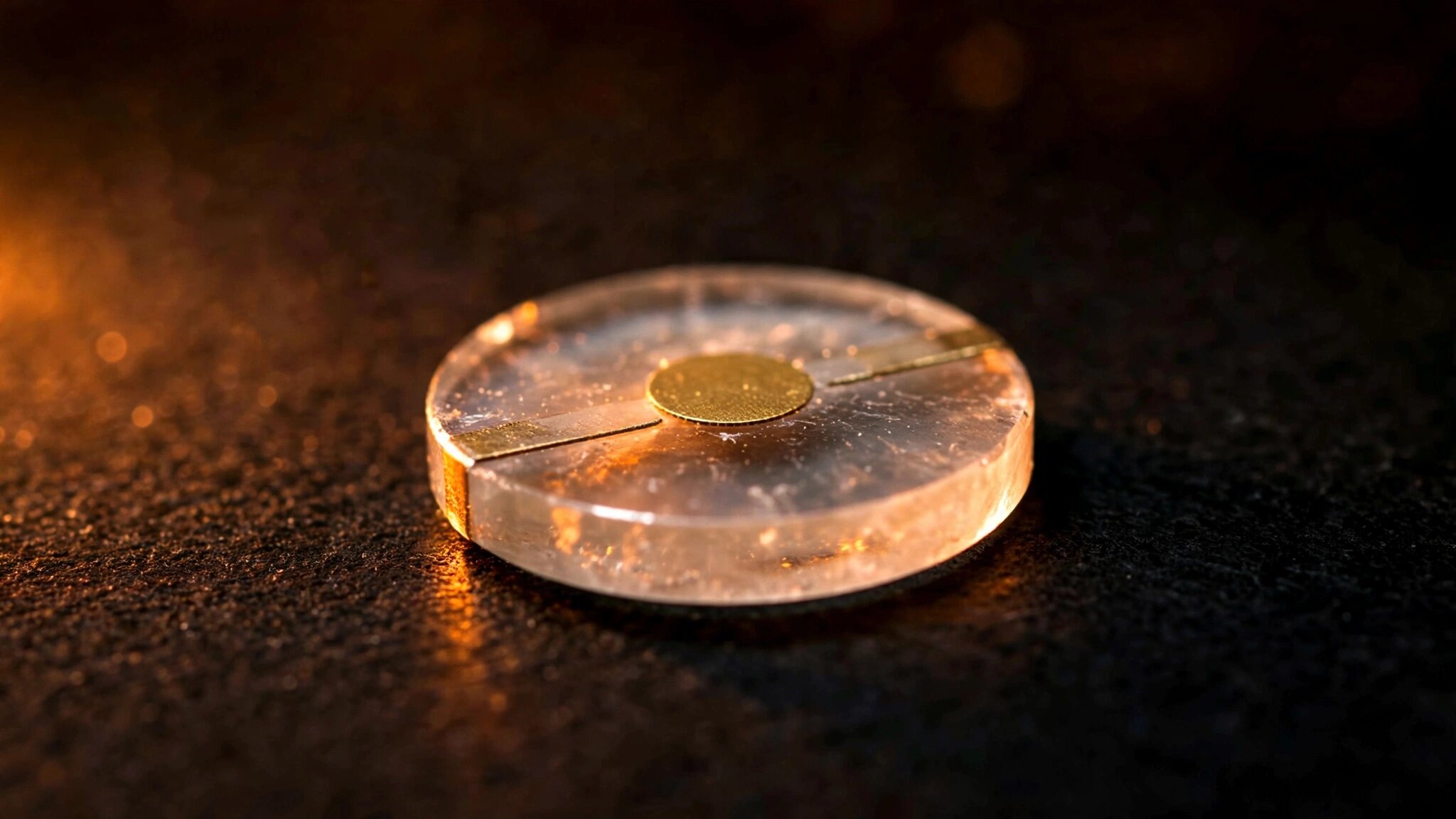
Quartz is silicon dioxide arranged in a hexagonal crystal lattice. Slice a crystal at different angles and you get oscillators with radically different physical properties. A tuning fork crystal is cut along what crystallographers call the X orientation, producing a shape that vibrates in a flexural mode: the prongs bend back and forth like the tines of a dinner fork, sweeping through relatively large amplitudes in open space. An AT-cut crystal is sliced at approximately 35 degrees and 15 minutes from the Z-axis of the source quartz. It vibrates in thickness-shear mode, a motion so small in amplitude that it is effectively invisible. One face of the disc shifts laterally relative to the other, thousands of times per second, with displacements measured in nanometres.
This distinction is not academic. Thickness-shear vibration occurs entirely within the solid body of the crystal. No prongs extend into free space. No air gap separates oscillating elements. Because the vibrating mass is constrained within the crystal itself, gravitational acceleration has almost no measurable effect on the oscillation frequency. Citizen claims that positional rate variation in an AT-cut oscillator is "basically zero." Hodinkee's Jack Forster, who spent a week testing the Caliber 0100, confirmed that the watch showed no detectable rate change when moved through different positions on the wrist.
Temperature stability follows from the same cut angle. Every crystal oscillator has a temperature-frequency curve that describes how its rate changes with temperature. For tuning fork crystals, this curve is parabolic: frequency peaks at a specific temperature and drops off on either side. For AT-cut crystals, the curve is cubic, with an inflection point that can be positioned near room temperature by precise control of the cut angle. In practical terms, an AT-cut crystal's frequency barely changes across the 5°C to 40°C range that covers nearly all wrist-wearing conditions. Where a tuning fork crystal drifts measurably with every five-degree swing, an AT-cut crystal absorbs the same swing with negligible effect.
Why 8,388,608 Hz
Higher oscillation frequency generally means higher precision in any timekeeping device. A clock counting 100 ticks per second can resolve time more finely than one counting 10. Standard quartz watches vibrate at 32,768 Hz, which is 215. Citizen's Caliber 0100 runs at 8,388,608 Hz, which is 223. Both are powers of two because binary frequency division circuits, the digital logic that converts oscillation counts into one-second pulses, work most efficiently when dividing by factors of two. Each doubling of frequency halves the timing resolution of each individual vibration, and the accumulated rounding errors shrink accordingly.
At 8,388,608 Hz, each oscillation lasts approximately 119 nanoseconds. At 32,768 Hz, each oscillation lasts about 30.5 microseconds. Citizen's crystal resolves time in increments 256 times finer than a conventional watch. Errors that would build across thousands of coarse ticks cancel across millions of fine ones. It is brute-force precision, and it works.
Citizen did not invent high-frequency AT-cut quartz for wristwatches. In 1975, the company released the Crystron Mega-Quartz, which ran at 4,194,304 Hz (222, or 4.19 MHz) and achieved ±3 seconds per year. It was a commercial failure. Running an AT-cut crystal at that frequency drained the battery in six months, and in the 1970s, there was no alternative power source compact enough for a wristwatch case. Omega's Marine Chronometer, released in 1974 with a 2.4 MHz crystal, faced the same problem. Both watches proved the physics but not the economics.
What changed between 1975 and 2019 was not crystal technology. It was power management. Citizen's Eco-Drive system, first introduced in 1976 and refined over four decades, converts ambient light into electrical energy through a photovoltaic cell beneath the dial. Modern Eco-Drive cells are efficient enough to power standard quartz movements indefinitely with minimal light exposure. Powering an 8.4 MHz AT-cut oscillator, which consumes substantially more current than a 32 kHz tuning fork, required Citizen to redesign the integrated circuit for drastically lower consumption. On a full charge, the Caliber 0100 runs for six months in complete darkness, eight months in power-saving mode. In any environment with occasional light, it runs indefinitely. No battery changes. No service intervals for the power source.
1,440 Corrections Per Day
An AT-cut crystal at 35 degrees has a nearly flat temperature-frequency response, but "nearly flat" is not flat. Over the course of a year, even small residual drift accumulates. A watch on a wrist in July in Phoenix and the same watch in January in Stockholm experience meaningfully different thermal environments. Without active compensation, those seasonal swings would erode the annual accuracy budget.
Citizen's solution is embedded in the integrated circuit. Once every minute, a temperature sensor inside the movement samples the ambient temperature and the circuit adjusts the crystal's effective frequency to compensate. Over 24 hours, that amounts to 1,440 independent corrections. Over a year, 525,600. Each correction references a lookup table unique to that specific crystal, generated during manufacturing.
No two quartz crystals have identical thermal behavior. Even crystals cut from the same source boule, at the same angle, by the same equipment, show subtle individual variations in their temperature-frequency curves. For mass-market quartz watches, this variation falls within acceptable tolerance. For a watch promising ±1 second per year, it does not. Citizen characterizes every AT-cut crystal individually, measuring its frequency response across a range of temperatures at double the number of test points used for standard production. Measurement precision is ten times higher than the company's conventional quartz line. Only crystals that meet the tightest stability criteria after repeated aging cycles are selected. Each crystal's individual thermal profile is programmed into the integrated circuit of the movement it will inhabit. No two Caliber 0100 movements carry the same correction data.
Gears Made by Light
Precision in the oscillator is meaningless if the gear train that connects it to the hands introduces its own errors. A conventional gear, stamped from sheet metal or cut on a hobbing machine, has microscopic imperfections: eccentricity in the bore, asymmetry in the tooth profile, burrs at the tooth tips. In a watch where ±15 seconds per month is acceptable, these imperfections are invisible. In a watch where the second hand must land precisely on the minute track sixty times per minute, 525,600 times per year, they are not.
Citizen manufactures critical gears and springs for the Caliber 0100 using LIGA, a microfabrication process borrowed from semiconductor manufacturing. LIGA stands for Lithographie, Galvanoformung, Abformung: lithography, electroforming, and molding. A UV light source projects the gear pattern through a photomask onto a photoresist-coated substrate. After development, the exposed pattern becomes a mold cavity. Nickel or nickel alloy is electrodeposited into the cavity, atom by atom, building the gear from the bottom up. When the resist is stripped away, the resulting component has tooth profiles defined by the optical resolution of the lithographic system, with geometry accurate to within a fraction of a micrometre.
LIGA gears have no eccentricity. Every tooth is identical to every other tooth. Bearing surfaces are smooth to a degree that pressing and machining cannot match at this scale. For the Caliber 0100, the benefit is cumulative: each perfect tooth engagement transfers torque with minimal friction and zero positional error, compounding across the entire gear train from the motor to the seconds hand.
Killing Backlash
Even LIGA-perfect gears have clearance between mating teeth. Without clearance, a gear train would bind. With it, the driven gear can rock slightly before engaging the next tooth of the driving gear. In watchmaking, this play is called backlash, and its most visible symptom is a seconds hand that twitches or overshoots when stepping to the next marker. On most quartz watches, the twitch is too small to notice. On a watch that bills itself as the purest expression of the individual second, it is intolerable.
Citizen developed a dedicated anti-backlash mechanism for the Caliber 0100, also fabricated by LIGA. A spring-loaded element in the gear train pushes constantly against the direction of rotation, preloading the teeth into contact and eliminating free play. When the stepper motor advances the gear train by one increment, the anti-backlash gear absorbs the transition, and the seconds hand steps cleanly to the next marker without oscillation or overshoot. It lands. It stops. It does this 31,536,000 times per year.
Citizen also engineered the system to rotate the seconds hand both forward and backward. When the watch wakes from power-saving mode, which halts the hands to conserve energy, the hand correction system can run the seconds hand in reverse to reach the correct position faster rather than advancing it through a full circuit. Forward and backward rotation through an anti-backlash gear train requires the preload mechanism to work symmetrically in both directions, a design constraint that LIGA fabrication makes achievable at tolerances that conventional manufacturing cannot.
A Heavier Hand, a Stronger Motor
Most quartz watches use aluminium seconds hands. Aluminium is light, reducing the torque required from the stepper motor and lowering energy consumption. It is also visually thin, which on a dress watch can look insubstantial. Citizen chose brass for the Caliber 0100's seconds hand. Brass is roughly three times denser than aluminium, but Citizen dimensioned the hand smaller than a typical aluminium seconds hand, resulting in approximately twice the unbalanced weight and twice the moment of inertia rather than three times. Even at that reduced size, the brass hand carries enough mass to arrive at each second marker with visible authority, settling firmly rather than fluttering.
Driving a brass hand at single-second intervals, hitting the markers with zero overshoot, demands a motor that can deliver higher torque and higher holding force than standard quartz motors. Citizen developed a dedicated high-holding-torque stepper motor for this caliber. After advancing one step, the motor locks the rotor in position with enough magnetic force to prevent the heavier hand from coasting past the marker. In Hodinkee's Week on the Wrist review, Jack Forster described the seconds hand hitting its marks with "bullseye accuracy" and likened the experience to watching a Zen archer split an arrow sixty times per minute.
Choosing brass over aluminium cost power. A heavier hand requires more energy per step, and the high-holding-torque motor draws more current than a standard stepper. Citizen absorbed this cost within the Eco-Drive energy budget by reducing consumption elsewhere in the circuit. Every component in the Caliber 0100 represents a balance between competing demands: the AT-cut crystal wants more power than a tuning fork, the temperature correction system runs continuously, the brass hand taxes the motor, and the anti-backlash gear adds friction. Light covers it all.
Three Lines of Defense
A watch that promises annual accuracy must survive daily abuse. Wrists collide with doorframes. Hands slam on desks. Phones held next to watches generate magnetic fields. Citizen built three protective systems into the Caliber 0100 to ensure that none of these events compromise the displayed time.
First, a shock counteraction function. An internal sensor detects sudden acceleration and instantly locks the motor rotor, freezing the hands in place. Without this lock, a sharp impact could jolt the seconds hand off its index, creating a visible error that would persist until the next correction cycle. Citizen's system locks and releases in approximately one millisecond, fast enough that the wearer never sees the hands move out of position.
Second, an automatic hand correction function. Periodically, the integrated circuit checks the position of the hands against the internal time reference and corrects any drift. If the shock counteraction system fails to prevent displacement, or if a sustained vibration gradually shifts a hand, the correction function catches it and resets. This is a software solution layered on top of the hardware protection, a safety net behind a safety net.
Third, antimagnetic shielding rated to 4,800 A/m. Magnetic fields interfere with the stepper motor, potentially causing it to skip steps or advance irregularly. At 4,800 A/m, the Caliber 0100 resists fields roughly equivalent to holding the watch against a moderately strong permanent magnet. ISO 764, the standard for antimagnetic watches, requires resistance to 4,800 A/m, and Citizen meets it exactly.
From the Crystron to 0100
Citizen's centennial was 2018. Naming the movement "Caliber 0100" was a deliberate marker: one hundred years of watchmaking, distilled into the most accurate timekeeper the company had ever produced. But the engineering lineage runs back further than the anniversary suggests. In 1975, Citizen's Crystron Mega-Quartz established that an AT-cut oscillator could work in a wristwatch, achieving ±3 seconds per year at 4.19 MHz. Omega's Marine Chronometer pushed AT-cut quartz from the Swiss side, running a lens-shaped crystal at 2.4 MHz with ±12 seconds per year accuracy. Neither watch survived commercially. Both proved that high-frequency AT-cut quartz was the correct path to extreme accuracy.
Citizen spent the intervening decades building the infrastructure that the Crystron lacked. Eco-Drive solved the power problem. Advances in integrated circuit design slashed current consumption. LIGA fabrication entered the company's manufacturing repertoire. Individual crystal characterization became feasible as testing equipment improved. By 2018, every enabling technology existed. What remained was the integration: fitting an 8.4 MHz AT-cut crystal, a LIGA-fabricated anti-backlash gear train, a custom high-torque motor, a per-minute temperature correction system, three protective functions, and a photovoltaic power source into a case that could pass for a conservative dress watch.
At retail, the Caliber 0100 starts at roughly $7,400 in Super Titanium with Duratect surface hardening. In 18-karat white gold, it reaches $16,800. For comparison, a Grand Seiko 9F quartz, rated to ±10 seconds per year with some of the finest case finishing in the industry, costs between $2,400 and $5,000 depending on variant. A Breitling SuperQuartz, using a thermocompensated movement rated to ±10 seconds per year, runs from $3,000 to $5,000. Nothing else on the market guarantees ±1 second per year from an autonomous, light-powered movement. Nothing else operates at 8.4 MHz. Citizen is competing with itself.
Whether ±1 second per year matters to anyone who carries a smartphone is a fair question with an obvious answer: it does not, practically. But the Caliber 0100 is not a practical proposition. It is an engineering statement about what becomes possible when a manufacturer controls the entire supply chain, from crystal growth to integrated circuit design to gear fabrication to final assembly, and decides to push every variable to its limit simultaneously. Citizen makes all its own components. It designs its own circuits. It grows its own crystals. It tests each one individually and programs each movement with that crystal's unique thermal fingerprint. In a world where "good enough" quartz costs twelve dollars and keeps time to within a few seconds per month, the Caliber 0100 exists because someone in Tokorozawa asked what would happen if nothing were allowed to be merely good enough.